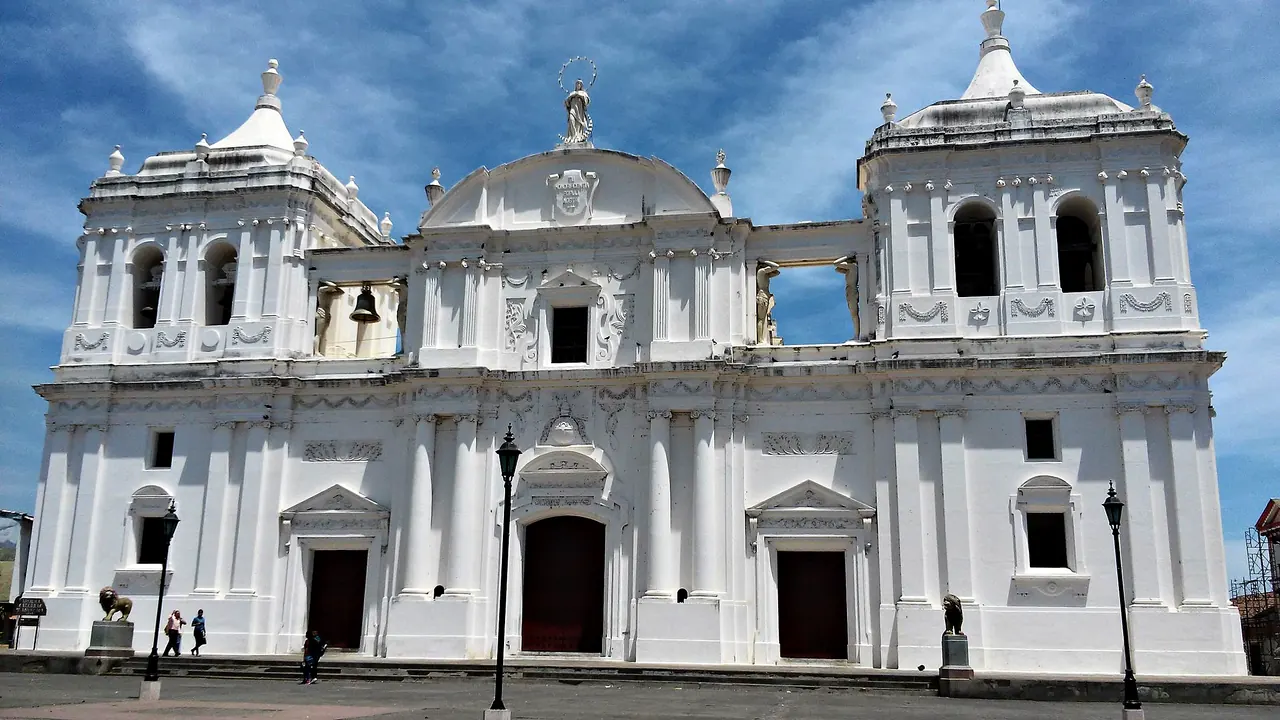
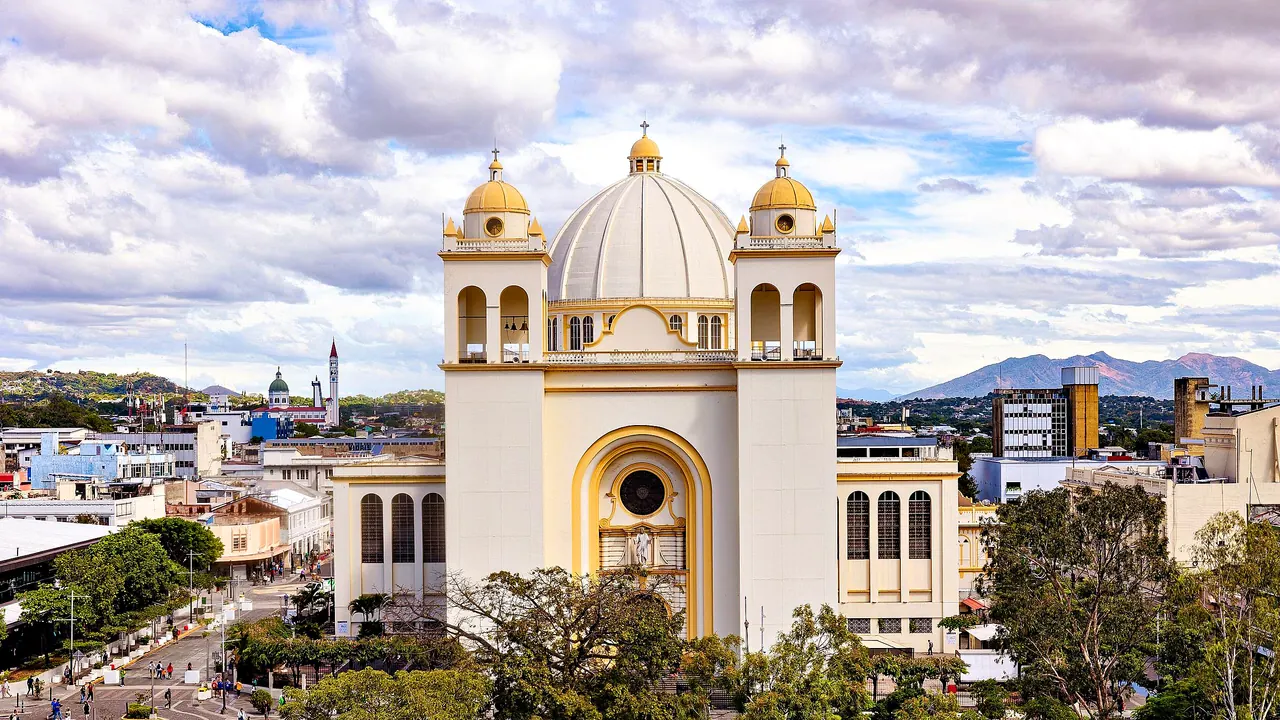
Photos: Leon, Nicaragua by Byralaal, CC BY-SA 4.0, cropped; San Salvador by Arne Müseler, CC BY-SA 3.0 DE, cropped.
Leon, Nicaragua or San Salvador?
Our verdict in twelve categories, each scored against the same fixed benchmark cities, and the climate month by month, so you can choose for your trip.
Choose Leon, Nicaragua for
- getting around
- culture and sights
- prices
León suits the traveller who wants a colonial city to walk around and a very small budget. The cathedral roof, a dozen churches and the Subtiava quarter all sit in a low grid you can cross on foot. Hostels, fritanga suppers and market buses cost almost nothing, and the Maribios volcanoes and the beach villages are close. It is a backpacker's base more than a family one.
Choose San Salvador for
- day trips
- shopping
- families
San Salvador makes more sense as a hub for seeing a whole country. Maya sites, Suchitoto and the Ruta de las Flores are all within a day's reach, and it has more for children, better coffee and proper malls and craft markets. The price is sprawl. You will need taxis or a driver, and the old town has far less heritage to show than León's.
Scoreboard
Twelve categories on one fixed scale from 0 to 100. The shaded stretch is the gap between the two.
Your match
Pick a travel style or drag the sliders, and both match scores follow your weighting.
Too close to call, 1 point apart
Wins on getting around and culture and sights with your weighting.
Wins on day trips and shopping with your weighting.
What matters to you?
Category by category
What the scores mean for a trip.
Beaches & swimming
The two coasts are much alike: dark volcanic sand, warm Pacific water and heavy surf with rip currents. Both suit surfers better than swimmers. The real difference is access. From León, Poneloya and Las Peñitas are a short bus ride across the plain, and the calmer water by the Juan Venado mangroves gives you somewhere to swim.
San Salvador is inland and up in the hills, so El Tunco and El Zonte are a proper road trip. In return you get a choice: the longer, gentler Costa del Sol further east is the better option for anyone who mainly wants to swim.
Food & drink
Both cities eat cheaply and simply, but San Salvador has a little more to offer. The pupusa, made at roadside griddles and in family dining rooms, is a dish worth travelling for. Good single-estate coffee is easy to find in San Benito and Escalón, and those districts and Santa Tecla add steakhouses and seafood.
León's food is the evening fritanga grill, a market lunch counter behind the cathedral and a quesillo or a nacatamal. It is good, honest eating, but there is less range, and beyond the backpacker cafés there is not much more.
Culture & sights
This is where León is far stronger. It is one of Central America's great colonial cities, and you can walk on the whitewashed roof of its UNESCO-listed cathedral, then wander between La Recolección, El Calvario and the old church in Subtiava. The Ortiz-Gurdián collection and the street murals give you two or three days of walking.
San Salvador lost most of its colonial buildings to earthquakes. Romero's tomb, the National Palace and the stained glass of El Rosario are worth a morning, and MUNA explains the Maya past well. Even so, the city's best heritage lies outside it.
Nightlife
Neither city is a reason to travel for nightlife, and both come alive only from Thursday to Saturday. The difference is the crowd. León's nights are students and backpackers drinking rum and beer at plastic tables and dancing to reggaeton, all within a few blocks of the cathedral.
San Salvador goes out more smartly, with cocktail bars and lounges in Zona Rosa and San Benito and terraces along Santa Tecla's Paseo El Carmen. These areas are spread out, so you go between them by taxi.
Nature & outdoors
Both cities sit among volcanoes, and both are excellent for getting outdoors. León's draw is more of an adventure: sandboarding down Cerro Negro, a night hike to Telica's glowing crater, hard dawn climbs on San Cristóbal and Momotombo, and kayaking through the Juan Venado mangroves.
San Salvador's landscape is greener and has more water. There is El Boquerón's crater on the city's edge, the huge caldera of Ilopango and the deep blue of Coatepeque. The Santa Ana climb to a turquoise crater lake is the classic hike, and the coffee highlands offer cool forest walks.
Day trips
San Salvador is the far better base for day trips, because so much of a small country is within reach. You can see Joya de Cerén's buried Maya village with San Andrés, then Tazumal, colonial Suchitoto above its lake and the mural villages of the Ruta de las Flores, each on a separate day.
From León, the León Viejo ruins on Lake Managua make an excellent outing, and the rum distillery near Chichigalpa is a good second. After those the options run thin, and Granada and Masaya are too far away to do comfortably in a day.
Good for families
Neither city is easy with young children, but San Salvador makes more of an effort. It has the Tin Marín museum, partly inside an old aircraft, plus a zoo, the playgrounds of Parque Cuscatlán and air-conditioned malls. Lake Coatepeque gives you calm water that the surf coast cannot.
León has nothing built for children, and the heat and rough beaches limit what you can do. Its one real appeal is for adventurous teenagers, who may well remember sliding down Cerro Negro long after the trip.
Getting around
León is much easier. Its cathedral, churches, museums and markets are all within about fifteen minutes' walk across a flat grid, and tricycle taxis cover the short hops. The only real problems are the midday heat and the broken pavements.
San Salvador spreads along busy avenues, and most visitors stay in the western districts, a ride away from the historic centre. Ride-hailing apps make this easy enough. City buses are confusing, and many of the best sights need a driver or a tour.
Shopping & style
San Salvador has more to buy. The national crafts market brings together painted wooden pieces from La Palma, ceramics from Ilobasco and indigo textiles, and the western malls cover anything practical.
In León, shopping means markets for everyday goods and a few shops near the cathedral selling hammocks, leather, coffee and rum. Nicaragua's main craft market is at Masaya, a long way off.
Affordability
León is one of the cheapest stops in the Americas, and even its boutique hotels in restored colonial houses are modest by international standards. Guided volcano trips are about the only thing that costs much.
San Salvador is cheap at street level, with pupusas, buses and ride-hailing all costing little. Things change once you move to comfortable hotels and sit-down restaurants in Escalón, which are priced like a business capital, and hiring a driver for day trips adds up quickly.
Live music & performing arts
Neither city has much of a stage scene, but what they do have differs. León's performance happens in the street. The Gigantona dances to drums with her big-headed dwarf, Subtiava lays sawdust carpets for Holy Week, and in early December the Purísima and Gritería bring singing and fireworks.
San Salvador has the more formal venues: the painted hall of the National Theatre, a symphony orchestra and ballet, and weekend cover bands in San Benito. Programmes are irregular, though, and nothing is guaranteed during a short stay.
Wellness & relaxation
León's quiet moments are ones you make yourself: an afternoon in a hammock in the shaded courtyard of a colonial guesthouse, ideally one with a pool, or a few slow days in the beach villages at Las Peñitas and Poneloya. Beyond a few simple massage rooms and the odd yoga class, nothing is organised, and the centre itself is hot and noisy with traffic.
San Salvador offers the more conventional kind of pampering, with hotel spas and day spas in the western districts. For proper rest, though, you leave town for the lodges on the rim of Lake Coatepeque or the coffee highlands, where the air is cooler and the pace slower. The volcanic hot springs near Ahuachapán are about two hours away, which makes them a long day out.
When should you go?
Pick your month. The climate figures are measured averages, not a forecast.
Leon, Nicaragua in July
San Salvador in July
Daytime high, °C
Rainfall in the month, mm
Where the figures come from
Leon, Nicaragua's temperatures are measured 84 km from the centre, at Managua A. C. Sandino.
Leon, Nicaragua has no rain gauge within 25 km of the centre, so its rainfall comes from a gridded climate dataset read at the destination rather than from a gauge further away.
Temperature and rainfall are climate normals, averaged over the years shown. Leon, Nicaragua: 1961-1990 (sunshine 1991-2020, rainfall 1991-2020) normals, Managua A. C. Sandino (83.6 km from centre). San Salvador: 1994-2020 (rainfall 1961-1990) normals, San Salvador / Ilopango (8.1 km from centre).
Both cities are hot all year and share the same rhythm of a dry season and a rainy one, so the best time is roughly December to April in either. León is the harsher of the two. Its dry months are almost rainless and very sunny, but the heat builds to about 35°C in April, so walking only works early and late in the day. Rain arrives in May and peaks in October at around 389mm, which is León's soggiest month.
San Salvador sits higher and stays a degree or two cooler. Its rains come a little later and hit hardest from June to September, then ease off sooner, so November is already a good month there. On both coasts the Pacific is around 28°C to 30°C all year, so the beach is warm enough in any month. The dry season is simply the more comfortable time to travel there.
Which traveller are you?
On a culture and arts trip, León is the clear choice. Its UNESCO cathedral with a walkable roof, the baroque churches, the Subtiava quarter, Darío's house and the revolutionary murals give you far more to see than San Salvador's quake-damaged centre.
For a trip on a tight budget, León again. Guesthouses, fritanga suppers and buses to the coast cost next to nothing. In San Salvador the comfortable western districts are priced like a business capital, and day trips often need a hired car or driver.
On a family trip with children, San Salvador has more to offer. There is the Tin Marín children's museum, the zoo and the big parks, plus calm Lake Coatepeque for swimming. León has little made for children beyond a hotel pool.
Before you go
| Measure | Leon, Nicaragua | San Salvador |
|---|---|---|
| Official language | Spanish | Spanish |
| Currency | Cordoba Oro (NIO) | US Dollar (USD) |
| Sockets | AB120 V, 60 Hz | AB115 V, 60 Hz |
| Driving side | Right | Right |
| Time zone | UTC-6 | UTC-6 |
| Emergency number | Police 118, ambulance 128, fire 115/120 | Police 911, ambulance 911, fire 911/913 |
| Elevation | 104 m | 670 m |
| Main airport | Augusto C. Sandino (Managua) International Airport (MGA)84 km from centre11 non-stop destinations | El Salvador International Airport Saint Óscar Arnulfo Romero y Galdámez (SAL)32 km from centre34 non-stop destinations |
| Public holidays this year | 12 days | 13 days |
By the numbers
| Measure | Leon, Nicaragua | San Salvador |
|---|---|---|
| Population | 174,051 | 330,543 |
| People per km² | 212 | 4,572 |
| Museums within 10 km | 3 | 9 |
| UNESCO World Heritage sites within 50 km | 2 | 1 |
| Swim season, months above 21 °C | 12 months | 12 months |
Where else could you go?
Every comparison below shares a destination with this one, so you can follow Leon, Nicaragua or San Salvador somewhere new.
- Granada, Nicaraguavs Leon, Nicaragua
- San Juan del Survs Leon, Nicaragua
- Antigua Guatemalavs San Salvador
- Tamarindovs Leon, Nicaragua
- Monteverdevs Leon, Nicaragua
- La Fortunavs Leon, Nicaragua