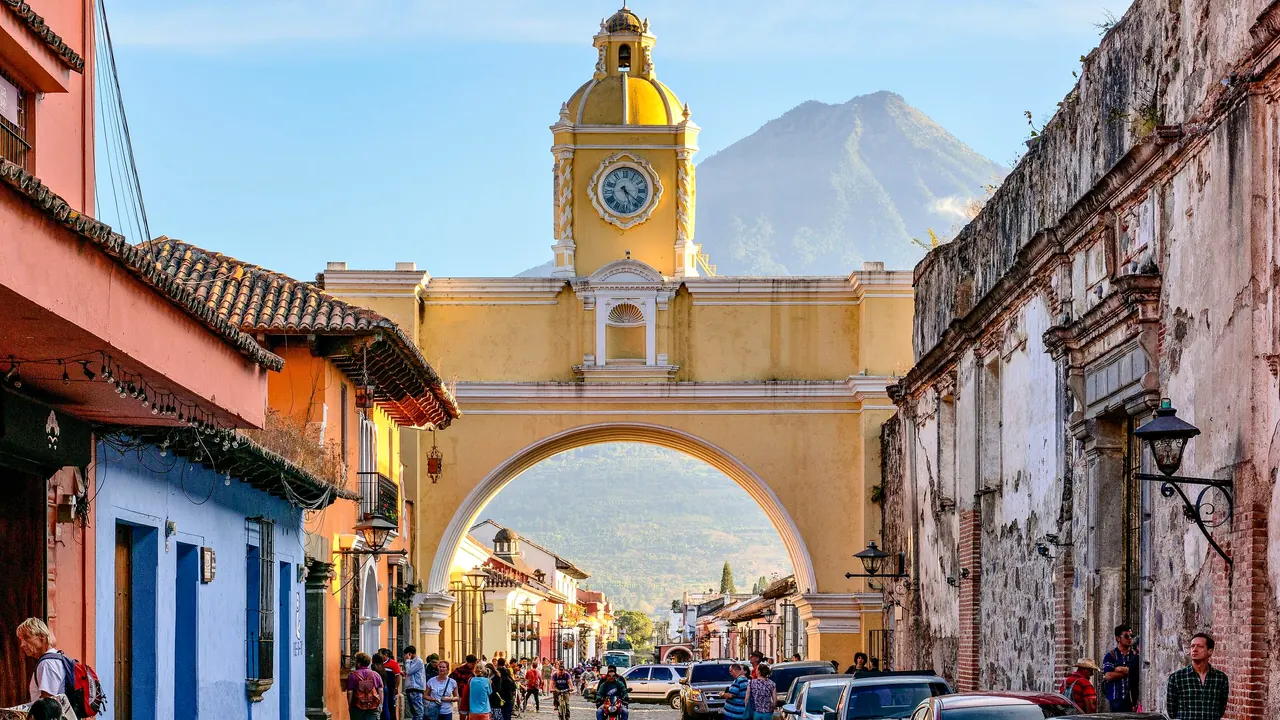
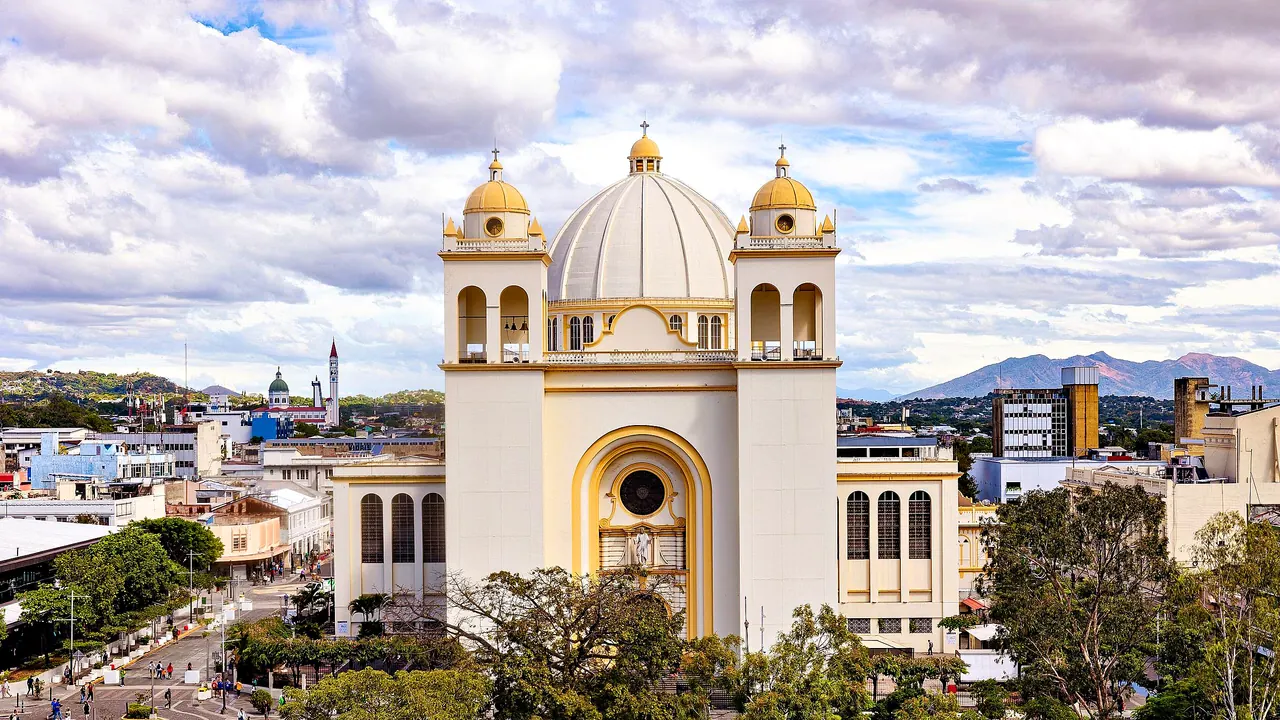
Photos: Antigua Guatemala by Chad Davis, CC BY-SA 2.0, cropped; San Salvador by Arne Müseler, CC BY-SA 3.0 DE, cropped.
Antigua Guatemala or San Salvador?
Our verdict in twelve categories, each scored against the same fixed benchmark cities, and the climate month by month, so you can choose for your trip.
Choose Antigua Guatemala for
- culture and sights
- getting around
- wellness
Antigua Guatemala suits a traveller who wants to walk and stay put. Its colonial grid of ruined churches and cobbled streets is easy to cross on foot, its courtyard hotels make it easy to slow down, and three volcanoes stand at the edge of town, with Acatenango's overnight climb as the big outing. Choose it for history, hiking and a calm few days, as long as you do not need the sea.
Choose San Salvador for
- beaches
- day trips
- live music and the arts
San Salvador works better as a base for exploring the country than as a destination in itself. The surf coast at La Libertad is under an hour away, and Joya de Cerén, Suchitoto and the Ruta de las Flores all fit into a day, with crater lakes close to the city. Go there for beaches, surfing and day trips, and expect to rely on taxis and a hired driver rather than walking.
Scoreboard
Twelve categories on one fixed scale from 0 to 100. The shaded stretch is the gap between the two.
Your match
Pick a travel style or drag the sliders, and both match scores follow your weighting.
Wins on culture and sights and getting around with your weighting.
Wins on beaches and day trips with your weighting.
What matters to you?
Category by category
What the scores mean for a trip.
Beaches & swimming
This is San Salvador's clearest win. The La Libertad coast, with El Tunco, El Sunzal and El Zonte, is under an hour's drive, and the longer, calmer beaches of the Costa del Sol are about an hour away, so a stay in the city can include real time by the sea.
Antigua has nothing close. Monterrico is about two hours off, and with its black sand and heavy surf it suits an overnight stay better than a swim. Both coasts are rough Pacific surf shores, but only San Salvador has one within easy reach. In Antigua, swimming means the hotel pool.
Food & drink
The two eat at a similar level, and both run short of variety after a few days, but the food is quite different. Antigua's eating centres on coffee from the volcano slopes, chocolate tastings and slow-cooked Guatemalan stews such as pepián and jocón, with comedor set lunches at the central market.
San Salvador's food is street food built around the pupusa, from roadside griddles to the rice versions at Olocuilta, plus single-estate coffee in Escalón and San Benito. Expect farm tours and tastings in Antigua and cheap, filling snacks in San Salvador.
Culture & sights
Antigua is a sight in itself. The whole colonial grid survives, and the ruined cloisters of Capuchinas and San Francisco, the Santa Catalina arch and La Merced are all within a few blocks. It suits slow wandering better than museum-going.
San Salvador lost most of its old buildings to earthquakes, and its sights are spread out: Romero's tomb in the cathedral, the National Theatre and Iglesia El Rosario downtown, then MUNA and MARTE in the west. Those museums explain the country's Maya past better than anything in Antigua, but as a place to walk through, Antigua is far ahead.
Nightlife
Neither is worth choosing for its nights, and the difference is in how they work. Antigua's evenings happen on foot within a few blocks of the central park: rooftop bars facing the volcanoes, mezcal bars behind colonial doorways and salsa with language students, mostly closing early.
San Salvador's scene is dressier and more local. It is spread across Zona Rosa, San Benito and Santa Tecla's Paseo El Carmen, with a few clubs and taxi rides between areas. For a looser party at weekends, its beach towns are the place.
Nature & outdoors
Both sit among volcanoes, but Antigua's are more dramatic and closer. On the overnight climb up Acatenango you watch Fuego throw out lava in the dark, Pacaya makes an easy half day, and Agua's cone rises over the streets.
San Salvador has crater lakes where Antigua has lava: El Boquerón's crater on the city's edge, Ilopango, the deep blue bowl of Coatepeque, and the guided climb to Santa Ana's turquoise crater lake an hour and a half away. It also has year-round surf, which Antigua cannot offer.
Day trips
San Salvador has the wider choice of day trips because El Salvador is so small. The buried Maya village of Joya de Cerén is about 40 minutes away, colonial Suchitoto about an hour, and the murals and food fairs of the Ruta de las Flores within two hours, though most need a car or driver.
Antigua's easy trips are the weaving and history villages in its own valley, plus the capital's museums. Its best-known outings, Lake Atitlán and the Chichicastenango market, make long days and usually become overnight stays.
Good for families
With children the two come out about even, but for opposite reasons. Antigua is easy to manage and harder to entertain in. A handful of walkable blocks and quiet evenings keep the days simple, but the town is built for adults who enjoy old stone and good coffee, so the fun has to be planned: a chocolate workshop, a morning on a coffee farm, an outing on horseback. The ruined cloisters give children room to run, and a hotel with a garden or pool makes a big difference, though pushing a buggy over those cobbles is hard work.\n\nSan Salvador is the other way round.
It has more made for children, including the Tin Marín museum with its old aircraft, the zoo and the playgrounds of Parque Cuscatlán, and Salvadorans make children welcome almost everywhere. Getting from one place to the next is what tires a family, since most outings need a taxi and the midday heat takes it out of children. For a day by the water, the calm shore of Lake Coatepeque suits small children better than the surf coast.
Getting around
Antigua is far easier to get around. Everything sits within a grid of about a dozen blocks, the volcanoes help you find your way, and tuk-tuks cover the short hops, so good shoes are all you really need.
San Salvador sprawls from the historic centre west to Escalón and Santa Tecla. With no metro and buses that are hard for visitors to follow, most journeys mean ride-hailing, and day trips mean a car or driver. The rides are cheap, but more of your stay is spent in traffic.
Shopping & style
Antigua is the better place to shop, because crafts are what it sells: highland huipiles, jade, ceramics and woven belts at the craft market and in courtyard boutiques near the arch, with bargaining expected.
San Salvador's shopping is mostly air-conditioned malls full of chains. Its national crafts market does have good finds, such as La Palma's painted wood, Ilobasco ceramics and indigo textiles, but it is a single stop rather than a whole town of craft shops. In both, local coffee is the easy thing to take home.
Affordability
Both are cheap day to day and expensive at the top end, so the difference is where the money goes. In Antigua, the boutique hotels in colonial houses and the restaurants around the central park are the costly part, while guesthouses, comedors and tuk-tuks stay cheap, and the extra spending comes from shuttles and guided hikes.
In San Salvador, street food and ride-hailing cost little, but business hotels in Escalón and San Benito charge what any capital does, and hiring a driver for day trips adds noticeably to the bill.
Live music & performing arts
Neither has much of a stage scene. San Salvador at least has a proper venue, the National Theatre with its painted ceiling, where the symphony and ballet perform, though programmes are irregular. At weekends, bar bands play rock and cumbia.
Antigua's music is more informal: marimba in the central park, salsa nights and the occasional concert in a ruined cloister. Its great spectacle, the Holy Week processions over sawdust carpets, belongs to faith rather than the theatre, but San Salvador has nothing like it.
Wellness & relaxation
Antigua is much the better place to unwind. The town is quiet in the evening, many hotels are built around courtyards with fountains and volcano views, and spas, yoga studios and temazcal sweat baths are within walking distance, though church bells and fireworks for saints' days can wake you early.
San Salvador is a working capital, and in the city rest means a hotel spa. For real calm, visitors head out to lodges on Lake Coatepeque or up into the cooler coffee highlands.
When should you go?
Pick your month. The climate figures are measured averages, not a forecast.
Antigua Guatemala in July
San Salvador in July
Daytime high, °C
Rainfall in the month, mm
Temperature and rainfall are climate normals, averaged over the years shown. Antigua Guatemala: 1998-2020 (rainfall 1981-2010) normals, Guatemala Aeropuertola Aurora (23.5 km from centre). San Salvador: 1994-2020 (rainfall 1961-1990) normals, San Salvador / Ilopango (8.1 km from centre).
Antigua's altitude keeps it mild all year, with daytime highs between 23°C and 27°C, so the streets are pleasant for walking in every month. The dry season from November to April is the time to go, when almost no rain falls and the volcanoes are at their clearest. From May the afternoon storms arrive, and June and September are the wettest months, with cloud often hiding the peaks.
San Salvador has the same dry and wet seasons but is much hotter, around 33°C from February to April, which makes midday sightseeing hard work. Its rains are heavier too, above 300mm a month from June to September. The sea is warm all year, so the coast works in any month, but December and January give the best balance of dry weather and slightly gentler heat.
Which traveller are you?
On a beach and sun trip, San Salvador is the clear choice. The warm Pacific at El Tunco and El Zonte is under an hour away, with surf all year and calmer sand on the Costa del Sol. Antigua's nearest shore is two hours away by shuttle.
For a culture and arts trip, Antigua is far ahead. The whole town is the sight: a 16th-century grid of colourful houses and roofless convents such as Capuchinas and Santa Clara. San Salvador has good museums, but earthquakes left it little colonial fabric.
On a relaxing and wellness trip, Antigua is the gentler place to be. Garden courtyards with fountains, yoga studios, spas using coffee and cacao, and the odd temazcal are all in town. San Salvador's visitors usually leave the capital and go to Coatepeque for rest.
Before you go
| Measure | Antigua Guatemala | San Salvador |
|---|---|---|
| Official language | Spanish | Spanish |
| Currency | Quetzal (GTQ) | US Dollar (USD) |
| Sockets | AB120 V, 60 Hz | AB115 V, 60 Hz |
| Driving side | Right | Right |
| Time zone | UTC-6 | UTC-6 |
| Emergency number | Police 110/120, ambulance 128, fire 123 | Police 911, ambulance 911, fire 911/913 |
| Elevation | 1,582 m | 670 m |
| Main airport | La Aurora International Airport (GUA)22 km from centre18 non-stop destinations | El Salvador International Airport Saint Óscar Arnulfo Romero y Galdámez (SAL)32 km from centre34 non-stop destinations |
| Public holidays this year | 13 days | 13 days |
By the numbers
| Measure | Antigua Guatemala | San Salvador |
|---|---|---|
| Population | 59,091 | 330,543 |
| People per km² | - | 4,572 |
| Museums within 10 km | 2 | 9 |
| UNESCO World Heritage sites within 50 km | 1 | 1 |
| Swim season, months above 21 °C | - | 12 months |
Where else could you go?
Every comparison below shares a destination with this one, so you can follow Antigua Guatemala or San Salvador somewhere new.
- Flores, Guatemalavs Antigua Guatemala
- Leon, Nicaraguavs San Salvador
- Flores, Guatemalavs San Salvador
- Granada, Nicaraguavs San Salvador
- San Juan del Survs San Salvador
- Leon, Nicaraguavs Antigua Guatemala