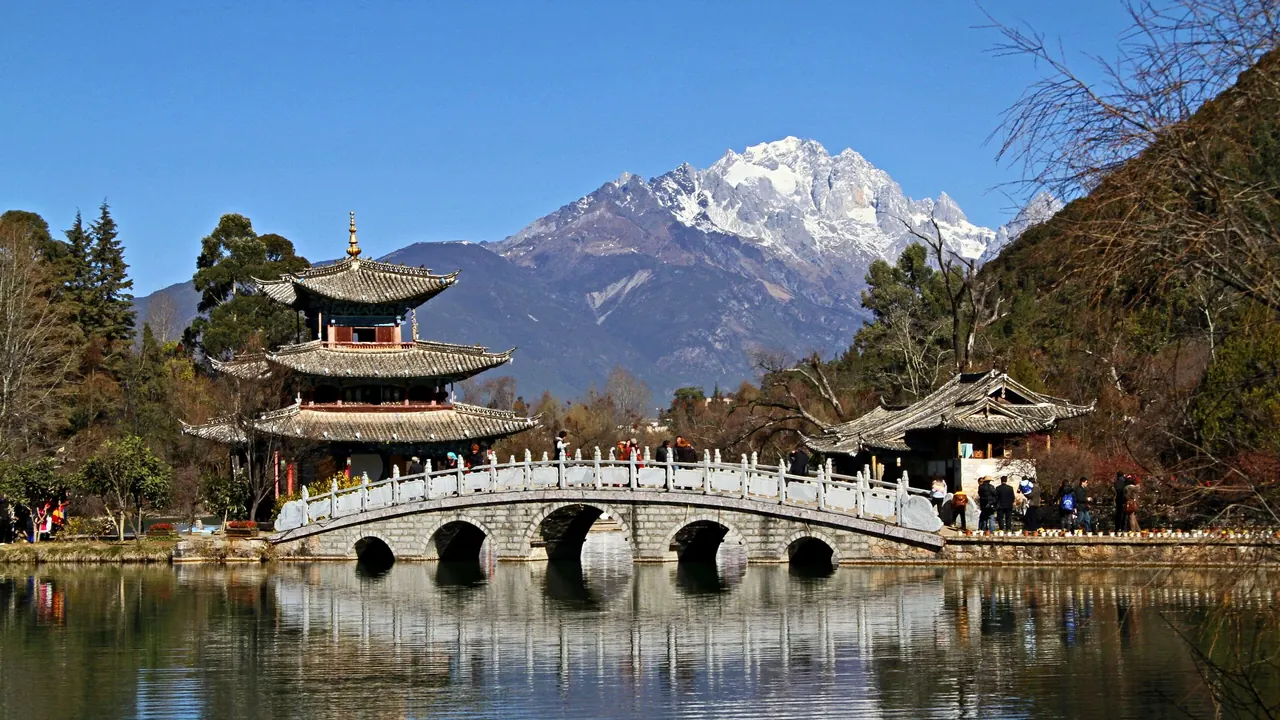

Photos: Lijiang by Miltos Gikas from Lutsa, Attiki, Greece, CC BY 2.0, cropped; Yangshuo by Rod Waddington from Kergunyah, Australia, CC BY-SA 2.0, cropped.
Lijiang or Yangshuo?
Our verdict in twelve categories, each scored against the same fixed benchmark cities, and the climate month by month, so you can choose for your trip.
Choose Lijiang for
- culture and sights
- day trips
- shopping
Lijiang is the better pick for a traveller who wants history and culture alongside big mountain scenery. The canal lanes of Dayan, the Naxi mansion and murals, and the Dongba script give it a past to explore. Glaciers on Jade Dragon Snow Mountain, the walk through Tiger Leaping Gorge and rail links to Dali and Shangri-La make it a strong base for a wider journey through northwest Yunnan. It suits couples and independent adults who don't mind altitude and a town centre that feels heavily restored.
Choose Yangshuo for
- families
- wellness
- beaches
Yangshuo is for people who want to spend their days outdoors and their evenings on a terrace. The karst peaks start at the edge of town, so rafting, cycling between villages, river swims and some of Asia's best rock climbing are all close by. It is also easier with older children, a little cheaper and calmer in the countryside. If you come here for sights or museums you will leave disappointed.
Scoreboard
Twelve categories on one fixed scale from 0 to 100. The shaded stretch is the gap between the two.
Your match
Pick a travel style or drag the sliders, and both match scores follow your weighting.
Wins on culture and sights and day trips with your weighting.
Wins on families and wellness with your weighting.
What matters to you?
Category by category
What the scores mean for a trip.
Beaches & swimming
Neither city is a beach destination, but Yangshuo at least lets you get in the water. In the hot months, people swim from the gravel banks of the Yulong and in calm stretches of the Li, often at the end of a cycling or rafting day. Lijiang's lakes sit high on the plateau and are too cold to swim in, so they are for boating and birdwatching only.
Food & drink
The two eat about equally well, and in both the main tourist streets serve the weakest meals. They differ in flavour. Lijiang offers Naxi and Yunnan cooking: baba flatbread, black-goat hotpot, yak and cured ham, wild mushrooms in the rainy season, and good Pu'er tea in courtyard cafés.
Yangshuo's cooking is built around the river. Beer fish is the dish everyone orders, alongside stuffed snails, tofu and bitter melon, with Guilin rice noodles for breakfast. The best versions come from the riverside villages rather than West Street.
Culture & sights
Lijiang is far ahead here. Dayan's grey-tiled lanes and canals, the Mu Family Mansion, Black Dragon Pool with its Dongba museum and the mixed Buddhist, Taoist and Tibetan murals at Baisha fill two or three good days. The catch is that much of the Old Town was rebuilt after the 1996 earthquake and is now given over to shops and inns.
Yangshuo has little to set against this. It has the Ming-era Dragon Bridge, the old brick villages along the Yulong and the Big Banyan Tree, but no museums worth the name. Most visitors there treat history as a side interest to the landscape.
Nightlife
Nights out are much alike in both places. Each has a single loud strip that stays packed past midnight with domestic tourists, with singers and drums by the Old Town canals in Lijiang and dancers and table games on West Street in Yangshuo. Neither has proper clubs. The quieter options differ: Lijiang has tucked-away courtyard bars and the calm of Shuhe, while Yangshuo has a few backpacker bars, riverside terraces and completely dark, silent villages.
Nature & outdoors
Both are outstanding for scenery, but the landscapes are very different. Lijiang's is high and alpine. Cable cars climb to the glaciers of Jade Dragon Snow Mountain at around 4,500m, and the classic two-day trail runs above Tiger Leaping Gorge. The mountain is crowded and tightly managed, and the thin air at the top is a real factor.
Yangshuo's karst peaks are lower and more intimate, and they begin right at the edge of town. You can raft the Yulong, walk the Li between Yangdi and Xingping or climb Laozhai Hill for the view without arranging a full-day excursion. Climbing, kayaking and caving give it an active edge as well.
Day trips
Lijiang has the better outings. Dali, with its walled town and Erhai Lake, and Shangri-La, with Songzanlin Monastery, are both a short train ride away, so you can see Bai and Tibetan culture without changing base. Shigu and the first bend of the Yangtze are within an hour's drive.
Yangshuo's excursions are pleasant but smaller in scale: the old streets of Xingping and Daxu, the fan workshops of Fuli, Ming and Qing Huangyao, and Guilin with Reed Flute Cave about an hour away.
Good for families
Yangshuo works better with children, especially older ones who like being outdoors. Rafting, mud-pool caves and village bike rides on a tandem or with a child seat keep them busy, and Chinese families visit in large numbers. Busy roads and hot summers still call for care.
In Lijiang, children enjoy following the streams through the Old Town, but there is little else for them. The altitude also rules out the snow-mountain trips for young children, and the uneven paving makes pushchairs hard work.
Getting around
Getting around is about equally awkward in both, and the reasons differ. Lijiang's car-free Old Town is easy on foot. Its sights, though, are spread across a wide valley and beyond, so most visitors rely on taxis or a hired driver. In Yangshuo, the countryside itself is what you come to see, and hiring a bicycle or electric scooter to ride the lanes along the Yulong is part of the pleasure. In both, the train station lies outside town, and Chinese-only signs make life harder for independent travellers.
Shopping & style
Neither city is worth visiting for shopping, though Lijiang gives you more to browse. Its Old Town houses sell silver, Dongba-painted woodcarvings and Pu'er tea cakes, and a few workshops still work silver in view. Yangshuo's West Street stalls are mostly mass-produced, and its one genuine craft is the hand-painted fans from Fuli.
Affordability
Both are inexpensive day to day, and Yangshuo comes out slightly cheaper. In both places, the extra costs come from tickets. In Lijiang that means the fee to enter the Old Town and the snow mountain with its cable cars, one of the dearest outings in the region. In Yangshuo it means Li River cruises, rafts, caves and the night show. A visitor in Yangshuo who mostly cycles and walks can avoid nearly all of those costs, and that is much harder to do around Lijiang.
Live music & performing arts
Lijiang has the one tradition genuinely worth seeking out. Older Naxi musicians perform its ancient Taoist ritual music in evening concerts in the Old Town, and that offers something more authentic than the tour-group song-and-dance spectacles held below the snow mountain.
Yangshuo's best-known performance is a single event, the large outdoor night show on the Li River with floodlit karst peaks behind it. It is impressive to look at, but it is a spectacle rather than music or drama.
Wellness & relaxation
Yangshuo is the more restful choice, as long as you stay out in the Yulong valley or the villages towards Xingping. There, days slow to cycling, swimming in the river and evenings looking over the rice fields, with tai chi classes, massage and a warm mud pool in one of the caves.
Lijiang has fewer of these extras. Its quiet comes from tea in a sunny courtyard inn and early morning walks through Shuhe and Baisha before the crowds arrive.
When should you go?
Pick your month. The climate figures are measured averages, not a forecast.
Lijiang in July
Yangshuo in July
Daytime high, °C
Rainfall in the month, mm
Where the figures come from
Yangshuo's temperatures are measured 64 km from the centre, at Guilin.
Yangshuo has no rain gauge within 25 km of the centre, so its rainfall comes from a gridded climate dataset read at the city rather than from a gauge further away.
Temperature and rainfall are climate normals, averaged over the years shown. Lijiang: 1991-2020 normals, Lijing (23.5 km from centre). Yangshuo: 1991-2020 normals, Guilin (64.4 km from centre).
Both cities get most of their rain in summer, so the real differences are temperature and winter. Lijiang's altitude keeps summers mild, with highs around 24°C. The monsoon from June to September brings heavy rain, though, peaking near 245mm in July, and cloud often hides the snow mountain. Its winters are almost completely dry, cool by day and fine for walking. March to early May and October to November are the best times to go.
Yangshuo is lower and much hotter. Highs reach 33°C in July and August, which makes cycling and climbing heavy work, although this is when river swimming feels best. The rains start earlier than in Lijiang. April is already fairly wet, and rainfall peaks at about 326mm in June. Winter is cooler and greyer and never as dry as in Lijiang. October is the best month, with highs near 26°C and little rain for walking and climbing. November is a cooler second choice.
Which traveller are you?
On a culture and arts trip, Lijiang is the clear choice. Naxi heritage is still part of the town: a pictographic script that is still used and a ritual music tradition kept alive by older musicians. Yangshuo is about landscape, with little history to fill a day.
On a family trip with children, Yangshuo is the easier choice. Its outdoor days are gentle and at low altitude, children are welcome everywhere because Chinese families come in large numbers, and costs stay low. Lijiang has little made for children beyond its Old Town.
Rock climbers should go to Yangshuo without hesitation. Hundreds of bolted limestone routes sit among the karst peaks just outside town, and the cafés and guesthouses are set up for climbers. Lijiang's mountains are for cable cars and trekking, not sport climbing.
Before you go
| Measure | Lijiang | Yangshuo |
|---|---|---|
| Official language | Putonghua | Putonghua |
| Currency | Yuan Renminbi (CNY) | Yuan Renminbi (CNY) |
| Sockets | ACI220 V, 50 Hz | ACI220 V, 50 Hz |
| Driving side | Right | Right |
| Time zone | UTC+8 | UTC+8 |
| Emergency number | Police 110, ambulance 120, fire 119 | Police 110, ambulance 120, fire 119 |
| Elevation | 2,400 m | 118 m |
| Main airport | Lijiang Sanyi International Airport (LJG)22 km from centre60 non-stop destinations | Guilin Liangjiang International Airport (KWL)67 km from centre43 non-stop destinations |
| Public holidays this year | 6 days | 6 days |
By the numbers
| Measure | Lijiang | Yangshuo |
|---|---|---|
| City population | 1,253,878 | 273,124 |
| People per km² | - | 190 |
| Museums within 10 km | 2 | 0 |
| UNESCO World Heritage sites within 50 km | 1 | 1 |
Where else could you go?
Every comparison below shares a destination with this one, so you can follow Lijiang or Yangshuo somewhere new.
- Guilinvs Yangshuo
- Guangzhouvs Yangshuo
- Macauvs Yangshuo
- Shenzhenvs Yangshuo
- Hong Kongvs Yangshuo
- Zhangjiajievs Yangshuo