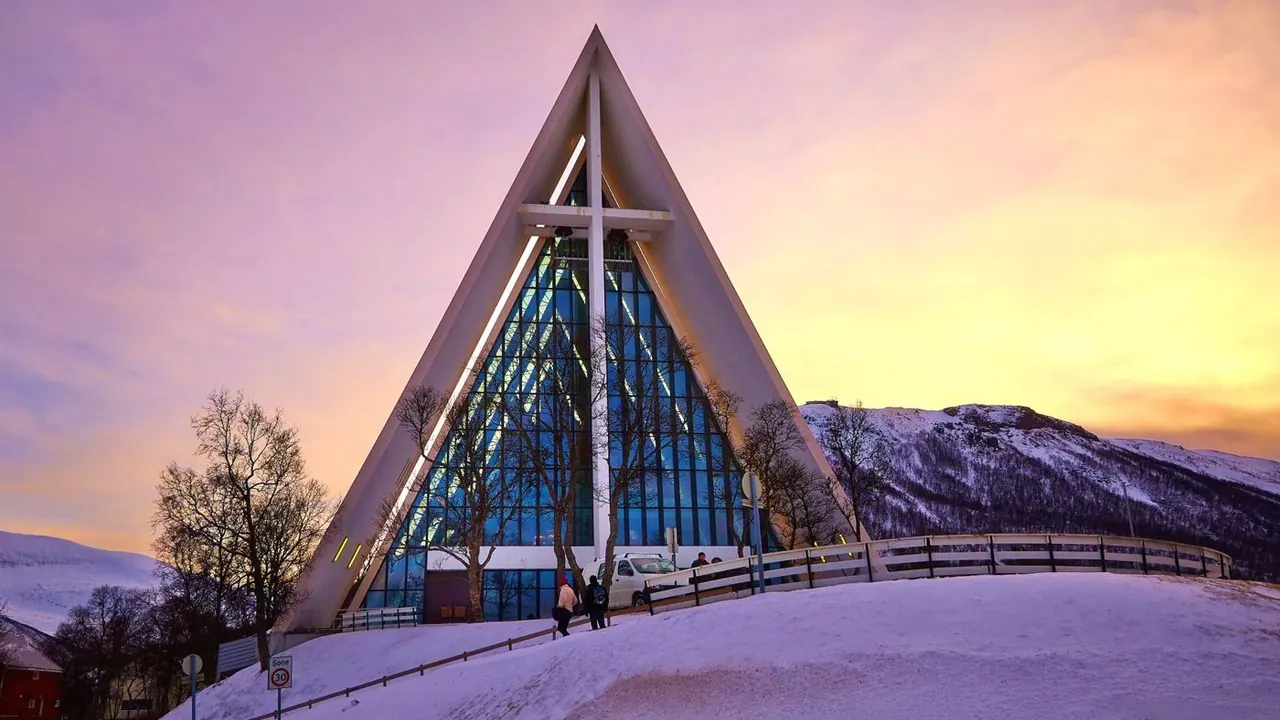
Photos: Tromso by Moyan Brenn, CC BY 2.0, cropped.
Lofoten or Tromso?
Our verdict in twelve categories, each scored against the same fixed benchmark cities, and the climate month by month, so you can choose for your trip.
Choose Lofoten for
- beaches
- day trips
- culture and sights
Lofoten suits travellers who want to live inside the landscape for a week or more: a hire car, a cabin over a harbour, a different peak or white bay each day, and fishing villages like Nusfjord and Å along the way. You give up evenings out and easy logistics, and in return you get a whole island chain of granite and sea to move through at your own pace.
Choose Tromso for
- nightlife
- getting around
- live music and the arts
Choose Tromso for a fixed base with some town life around it. From your room you can walk to the harbour restaurants, the Polar Museum and a late bar on Storgata, ride the cable car above the fjords, and let organised tours take you to whales, huskies and the northern lights. It is the easier choice without a car or with only a few days.
Scoreboard
Twelve categories on one fixed scale from 0 to 100. The shaded stretch is the gap between the two.
Your match
Pick a travel style or drag the sliders, and both match scores follow your weighting.
Wins on beaches and day trips with your weighting.
Wins on nightlife and getting around with your weighting.
What matters to you?
Category by category
What the scores mean for a trip.
Beaches & swimming
Neither is a swimming destination, but in Lofoten the beaches are a real part of the trip. Haukland, Uttakleiv, Ramberg and Skagsanden have pale sand under the peaks, and the walk over to Kvalvika makes a day of it. The late-summer sea is a few degrees warmer than Tromso's, enough for a bracing dip after a sauna.
Tromso has little to match this. Telegrafbukta is a small strip on the island that only fills on rare warm afternoons, and the better sand is out at Sommaroy, about an hour's drive away.
Food & drink
Both cook from the same Arctic larder, with skrei cod in late winter, stockfish and fish soup, and in neither is the food a reason to come. The difference is in the setting. Lofoten's places to eat are scattered through the fishing villages, with the most choice in Svolvær and Henningsvær, and many visitors buy fish off the quay to cook in their cabin.
Tromso keeps its better tables together on the old harbour quays and adds king crab, reindeer and a few more ambitious kitchens. A nineteenth-century brewery sits at the heart of its drinking life, so eating out night after night is easier to arrange.
Culture & sights
Lofoten has more heritage to see, because its fishing history is all around you. There are rorbuer on stilts in every harbour, the preserved trading post at Nusfjord and the fishery and stockfish museums at Å. The reconstructed chieftain's longhouse at Borg is the most substantial sight in the islands.
Tromso's sights are fewer and fit into a day or two: the Arctic Cathedral across the bridge, the Polar Museum on Amundsen and Nansen, and Tromso Museum on Sami culture. Beyond these the centre is mostly modern, with only a few streets of painted wooden houses.
Nightlife
This is one of the clearest differences between the two. In Lofoten an evening out is a beer at a harbour pub in Svolvær or a drink on a quay in Henningsvær, and there are no clubs at all.
Tromso has a university and a proper weekend scene along Storgata and the harbour, with cocktail bars and a couple of dance floors that stay open late. It is still small, and quiet midweek.
Nature & outdoors
Lofoten's scenery is right beside the road. A wall of granite peaks rises straight out of the sea, with white bays at their feet, and short, steep climbs such as Reinebringen above Reine and Ryten above Kvalvika give huge views for a few hours' effort. Summer adds climbing on the Svolvær granite, sea kayaking among the skerries and cold-water surfing at Unstad, and in late winter ski touring runs down to the shore.
Tromso is the better base for guided winter trips into the wild. Aurora tours drive inland to find clear skies, orcas and humpbacks feed in the fjords, and there is dog and reindeer sledding, with the Lyngen Alps about two hours away. Closer in, the Fjellheisen cable car lifts you to a ridge above the town, and in summer Tromsdalstinden makes a fine hike under the midnight sun.
Day trips
Neither offers much beyond its own landscape, but Lofoten has more places to go, because driving the island chain is the outing. You can visit Henningsvær on its skerries, Svolvær and Kabelvåg, or Reine and Hamnøy, and ferries run to the seabird islands of Værøy and Røst. The villages do start to look alike after two or three.
From Tromso the realistic outings are fewer: Sommaroy about an hour away, the old trading post at Hillesoy, and the coastal hamlets of Kvaloya and Senja. Most visitors book another fjord or aurora trip instead.
Good for families
Both are safe and calm places to bring children, and in both it is the outdoors that children remember. Tromso is the easier base, with the Polaria aquarium, a science centre, a walkable centre, and husky rides and reindeer feeding. Midwinter there brings hard cold and aurora tours that run late into the night.
Lofoten suits an active family moving slowly along the islands, with rock pools at Ramberg and Haukland, fishing off the quays and the Viking longhouse at Borg. The price is long hours in the car, and the famous hikes are too steep and exposed for small children.
Getting around
Tromso is far easier without a car. You can cross the centre on foot in a quarter of an hour, buses run to the airport and the mainland, and tours pick you up for the fjords and aurora spots. The catch is icy, steep streets in winter.
Lofoten more or less requires a hire car. The E10 takes about two hours from Svolvær to Å, buses are sparse, and in summer the single-lane bridges and full trailhead car parks slow you down. Even reaching the islands takes planning, whether by small airport, the ferry from Bodø or a coastal ship.
Shopping & style
Neither is a place to go shopping, and what differs is what you bring home. In Lofoten it is art and craft: paintings and photographs from the galleries in Henningsvær and Svolvær, and glass and ceramics from the villages. Tromso's Storgata is more practical, good for thermal layers and outdoor gear alongside knitwear and Sami crafts.
Affordability
Both charge full Norwegian prices, and neither suits a tight budget. The costs fall in different places. In Lofoten it is car hire, fuel and scarce cabins, though the landscape is free and most rooms have a kitchen.
In Tromso the paid excursions add up quickly: whale safaris, dog sledding and aurora tours. Self-catering and hunting for the lights yourself in the hills above town both help keep costs down.
Live music & performing arts
Tromso has a real cultural season, if a small one. The Arctic Philharmonic and the Halogaland Theatre perform through the year, the Northern Lights Festival brings music in midwinter, a film festival fills the cinemas each January, and there are midnight concerts in the Arctic Cathedral in summer.
Lofoten has nothing comparable. Its live music comes in summer, with small festivals and concerts in churches and old fish-processing buildings, and for most of the year there is little to go to.
Wellness & relaxation
Both relax the Norwegian way, with saunas, some of them floating in the harbour, followed by a plunge into cold water, and neither has thermal baths. Lofoten's calm is more complete, a rorbu cabin over the water and nothing to hurry for. Tromso adds a large swimming hall with warm pools for dark afternoons, but a stay there tends to fill up with early excursions and late aurora trips.
When should you go?
Pick your month. The climate figures are measured averages, not a forecast.
Lofoten in July
Tromso in July
Daytime high, °C
Rainfall in the month, mm
Where the figures come from
Lofoten has no rain gauge within 25 km of the centre, so its rainfall comes from a gridded climate dataset read at the destination rather than from a gauge further away.
Temperature and rainfall are climate normals, averaged over the years shown. Lofoten: 2011-2025 (rainfall 1991-2020) normals, Svolvaer Airport (4.4 km from centre). Tromso: 1991-2020 normals, Tromso (0.9 km from centre).
For walking and hiking, both are at their best in summer, with June to August the mildest stretch. Neither is ever warm enough for a normal beach day. Lofoten is a little milder, reaching about 17°C in July, and its sea is near 13°C in August, so a quick dip there is slightly less of a shock than in Tromso. In both places the rain builds from September and is heaviest in October. Tromso is the wetter of the two then, at about 128mm.
The bigger difference is in winter. Lofoten's coast stays just above freezing through January, while Tromso is below zero from December to February and gets no sunshine at all in December, the depth of the polar night. Tromso's sunniest months are May to July. Lofoten's milder spring and autumn are kinder for walking outside the summer. In Tromso's frozen, dark midwinter you spend your days on sledding and aurora trips rather than in the streets.
Which traveller are you?
On a beach and sun trip, Lofoten is the better of two cold-water options. Haukland, Uttakleiv and Kvalvika are real white-sand bays with peaks behind them, good for picnics under the midnight sun. Tromso's beaches are small, and the better ones are an hour away.
For a food and nightlife trip, Tromso wins. The Arctic menus are much the same in both places, but Tromso keeps its restaurants together along the harbour and has a weekend bar scene with dance floors that run late. In Lofoten the evening ends at a harbour pub.
For a short city break, Tromso is the obvious pick. You can fly straight in, walk everywhere from the harbour, see the Arctic Cathedral and the Polar Museum, and join a tour into the fjords. Lofoten needs a car and several days before it makes sense.
Before you go
| Measure | Lofoten | Tromso |
|---|---|---|
| Official language | Norwegian, Nynorsk, Bokmål, Sámi | Norwegian, Nynorsk, Bokmål, Sámi |
| Currency | Norwegian Krone (NOK) | Norwegian Krone (NOK) |
| Sockets | CF230 V, 50 Hz | CF230 V, 50 Hz |
| Driving side | Right | Right |
| Time zone | UTC+1, UTC+2 in summer | UTC+1, UTC+2 in summer |
| Emergency number | Police 112, ambulance 113, fire 110 | Police 112, ambulance 113, fire 110 |
| Elevation | - | 20 m |
| Main airport | Svolvær Airport, Helle (SVJ)3 non-stop destinations | Tromsø Airport (TOS)4 km from centre49 non-stop destinations |
| Public holidays this year | 13 days | 13 days |
By the numbers
| Measure | Lofoten | Tromso |
|---|---|---|
| Population | - | 79,943 |
| People per km² | - | 32 |
| Museums within 10 km | - | 8 |
| UNESCO World Heritage sites within 50 km | - | 0 |
| Swim season, months above 21 °C | None | None |
Where else could you go?
Every comparison below shares a destination with this one, so you can follow Lofoten or Tromso somewhere new.
- Rovaniemivs Tromso
- Flåmvs Tromso
- Oslovs Tromso
- Stavangervs Tromso
- Isle of Skyevs Lofoten
- Reykjavikvs Tromso