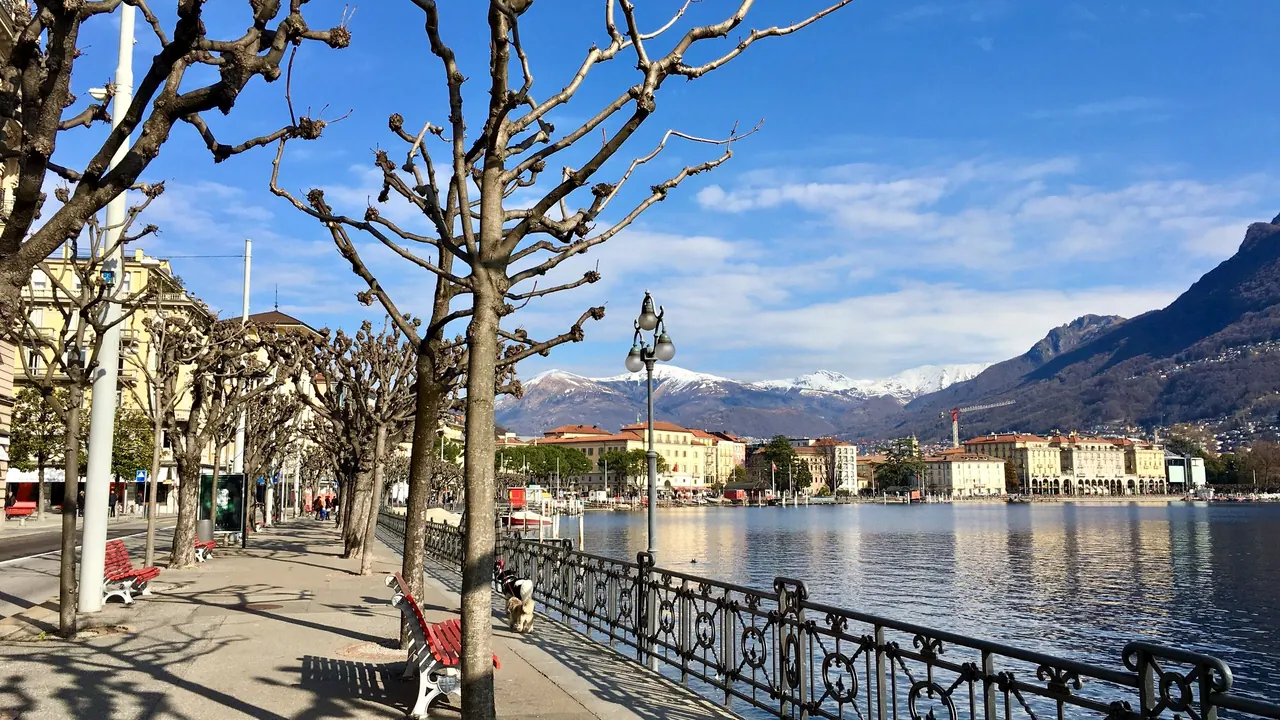
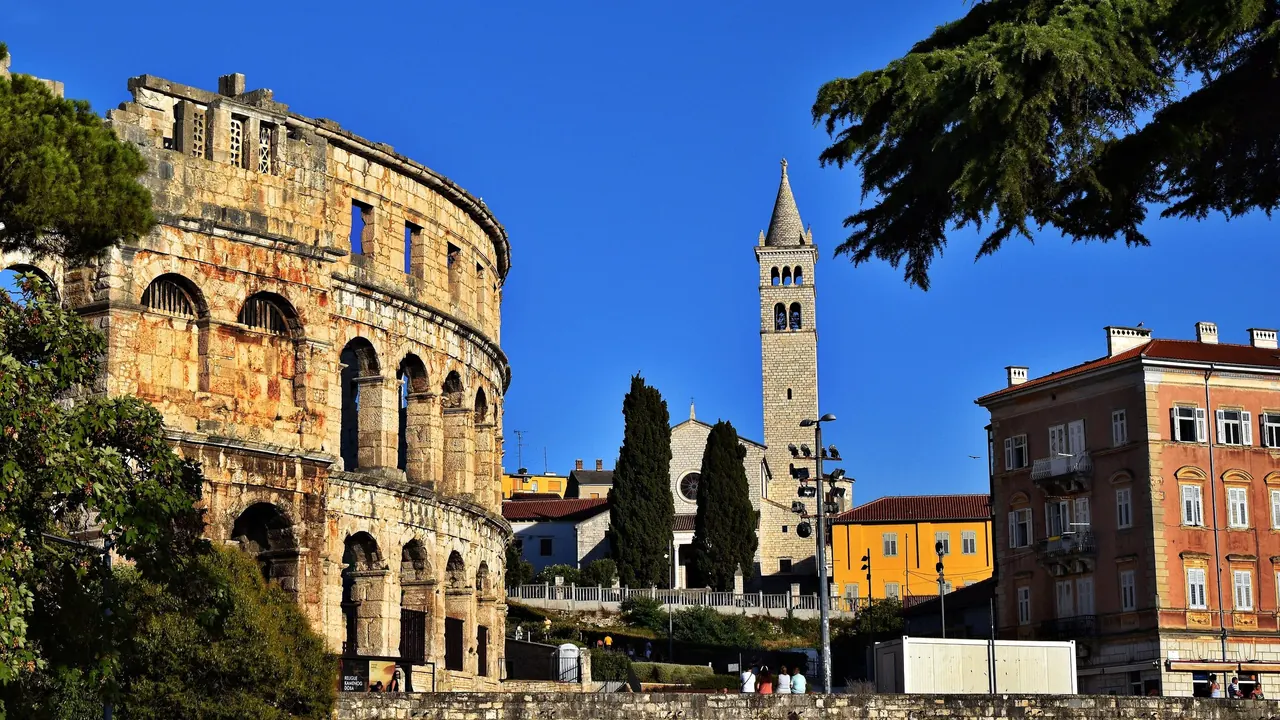
Photos: Lugano by Thomas Woodtli from Zürich, Switzerland, CC BY-SA 2.0, cropped; Pula by Miroslav.vajdic, CC BY-SA 4.0, cropped.
Lugano or Pula?
Our verdict in twelve categories, each scored against the same fixed benchmark cities, and the climate month by month, so you can choose for your trip.
Choose Lugano for
- getting around
- nature and the outdoors
- shopping
Lugano is the choice for travellers who want mountains and easy trains. Funiculars climb from the edge of town to Monte Brè and San Salvatore, ridge walks and green Alpine valleys are close by, and Milan, Como and Bellinzona are all a short rail journey away. It suits a calm, scenic stay with lake swimming on the side, for people willing to pay Swiss prices for it.
Choose Pula for
- prices
- beaches
- culture and sights
If the sea, Roman stones and a lighter bill matter more, Pula wins. It has one of the best-preserved amphitheatres anywhere and clear Adriatic coves running down to Cape Kamenjak, and Istrian truffle and seafood cooking is close at hand. It costs far less than Lugano, though you will want a car to make the most of the coast and the hill towns.
Scoreboard
Twelve categories on one fixed scale from 0 to 100. The shaded stretch is the gap between the two.
Your match
Pick a travel style or drag the sliders, and both match scores follow your weighting.
Too close to call, 2 points apart
Wins on getting around and nature and the outdoors with your weighting.
Wins on prices and beaches with your weighting.
What matters to you?
Category by category
What the scores mean for a trip.
Beaches & swimming
Pula is the stronger swimming destination. The water off the Verudela and Stoja peninsulas is very clear, pines grow almost to the waterline, and Cape Kamenjak has dozens of wild coves and cliff ledges to explore. The shore is rock and pebble, not sand, so pack water shoes.
Lugano has no coastline at all. Swimming there means a lido: lawns, decks and ladders into the lake at the mouth of the Cassarate or along the shore towards Paradiso. It is lovely on a hot afternoon, but the lake is cooler than the sea and the season is shorter.
Food & drink
Pula has the edge, mostly because it is the gateway to Istrian cooking: fuži pasta with truffle, scampi buzara, pršut, and Malvazija or Teran from estates nearby. The tables around the Arena are touristy, though, and the best meals are in village konobas inland.
Lugano's food tradition is the grotto, where you eat polenta, braised meats and local cheeses at granite tables with a glass of Ticino Merlot. It is satisfying but narrow and expensive, and many visitors cross into Italy for their bigger meals.
Culture & sights
Pula has the more substantial sights, all of them Roman. The three-storey Arena still stands complete above the harbour, the Temple of Augustus survives intact on the Forum, and you enter the old streets through the Arch of the Sergii. The Venetian fortress and the Habsburg naval forts add later layers of history.
Lugano's attractions are quieter and fewer. They include Luini's Passion fresco in Santa Maria degli Angioli, the cathedral of San Lorenzo above the arcaded old town, the art collection at LAC and the Hermann Hesse museum in Montagnola. One unhurried day is enough to see them all.
Nightlife
Neither city is a place for big nights out, but Pula offers a little more in summer. Terraces around the Forum lead on to beach bars on Verudela and around Medulin, and a few small clubs fill up at weekends. Out of season it goes quiet.
An evening in Lugano means an aperitivo under the arcades or by the lake, followed by a long dinner. There are a handful of polished bars, the crowd is well-dressed, and most nights are over before midnight.
Nature & outdoors
Lugano's landscape is in a different league. The steep wooded mountains around the lake are easy to reach by funicular and rack railway, there are walks down through chestnut woods to Gandria, and the green rivers of the Verzasca and Maggia valleys are about an hour away.
Pula's outdoors is low and coastal: macchia, olive groves and the car-free headland of Kamenjak, which is good for cycling and has dinosaur footprints along the shore. It is better for being on the water, with sea kayaking, windsurfing and wreck diving. The nearest real hiking is in the Učka range, an hour and a half away.
Day trips
Lugano offers more, and it is easier to get to. Trains take you to Milan's cathedral and The Last Supper in just over an hour, to Como in about half an hour, and to the castles of Bellinzona in less. Boats carry you to Morcote, and Lake Maggiore and the Borromean Islands are within reach too.
Pula has excellent destinations of its own: Venetian Rovinj, the Byzantine mosaics of Poreč, the hilltop towns of Motovun and Hum, and the Brijuni islands. Buses are sparse, though, so most of these trips depend on hiring a car.
Good for families
The two are about equally good for children, but in different ways. Pula is a seaside trip, with shallow, sheltered bays at Medulin, an aquarium inside an old fort, an Arena to clamber around, and a dinosaur park and water park within an hour.
Lugano revolves around boats, funiculars and the miniature Swiss landmarks at Melide, which suits younger children on outdoor days. Its steep streets are tiring with a pushchair, while Pula asks you to cope with summer heat and lots of driving.
Getting around
Lugano is much easier without a car. The centre is walkable once you have taken the short funicular down from the station, lake boats serve the villages, and Swiss trains run to Bellinzona, Locarno, Como and Milan. Hotel stays usually include regional transport.
Pula's centre is flat and compact, and city buses reach Verudela. Beyond that, the slow trains and infrequent regional buses mean that Kamenjak, the coast and the hill towns are really only practical with a car or a scooter.
Shopping & style
Lugano has more to offer shoppers. Via Nassa is lined with Swiss watchmakers, jewellers and Italian fashion under its arcades, and there is a big designer outlet near Mendrisio. Even so, it is a narrow, upmarket offer, and serious shoppers head for Milan.
In Pula the best buys are things to eat and drink: Istrian olive oil, truffle products, honey, rakija and wine from the market hall or straight from the producers. Apart from that, it is high-street chains and souvenirs.
Affordability
Lugano is by far the dearer of the two. A boat to Morcote, a bottle of Ticino Merlot or a ride up Monte Brè all cost well above what they would just over the border. Two things lighten the bill. A hotel stay usually comes with free use of regional public transport, and Como and the other Italian lake towns are close enough to make lunch across the border a real saving.
Pula costs much less from day to day. City buses and entry to the Arena and the other Roman sites are cheap, and the town undercuts the best-known resorts further down the Croatian coast. The extras are what add up: hiring a car, which most of the region needs, boat trips to Brijuni, and the tourist-priced menus around the Arena and the harbour.
Live music & performing arts
Lugano has the steadier programme, centred on LAC. Its concert hall is home to the Orchestra della Svizzera italiana, and drama and dance run through the season. In summer, Estival Jazz brings free open-air concerts to Piazza della Riforma.
Pula has a more dramatic setting. On summer nights the Roman Arena hosts touring pop and rock acts, classical galas and the Pula Film Festival. Outside those months there is little beyond Croatian-language theatre at the Istrian National Theatre.
Wellness & relaxation
Lugano is the better place for slowing down. A lakeside bench in Parco Ciani, a long lunch in a grotto and the palm-lined shore set the pace. There is also a large indoor pool and sauna complex near Rivera, as well as the spas of the grand lakeside hotels.
Pula's spa options are limited to resort hotels on Verudela and in Medulin. Its calm comes from the coastal paths under the pines and the countryside, and it is best outside the busy summer months.
When should you go?
Pick your month. The climate figures are measured averages, not a forecast.
Lugano in July
Pula in July
Daytime high, °C
Rainfall in the month, mm
Where the figures come from
Pula's temperatures are measured 87 km from the centre, at Trieste.
Pula has no rain gauge within 25 km of the centre, so its rainfall comes from a gridded climate dataset read at the city rather than from a gauge further away.
Temperature and rainfall are climate normals, averaged over the years shown. Lugano: 1991-2020 normals, Lugano (1.2 km from centre). Pula: 1991-2020 normals, Trieste (87 km from centre).
Lugano is warmest in July and August, with highs around 27°C, and the lake is good for swimming from June to early September. Those months are also wet. Rain is heavy from April right through November and peaks at 178mm in May, so summer days often break into thunderstorms. Spring and autumn are the best times for hiking, between the showers. Winter is cold for walking the streets, but it is the driest part of the year and gets more sunshine than Pula does in the same months.
Pula is a little hotter, at about 29°C in July and August, and it is much drier and sunnier through the summer. The sea is warm enough to swim in from June to September and reaches 25°C in August. In May it is still too cool for most swimmers, but May and late September are pleasant for walking around the Roman sites without the midday heat. The rain comes in autumn and peaks at 107mm in November. Pula's winters are a few degrees milder than Lugano's, but they are greyer, with fewer hours of sun.
Which traveller are you?
For a beach and sun trip, Pula is the clear pick. It has clear sea in rocky, pine-shaded coves, the wild inlets of Kamenjak, a swimming season that runs to late September, and much more summer sunshine than Lugano, which can only offer lake lidos.
For an outdoors trip, choose Lugano. Funiculars and a rack railway lift you onto mountain summits, the Lema to Tamaro ridge is a classic day hike, and the Verzasca valley is an hour away. Pula's outdoors is gentler: coastal cycling, kayaking and wreck diving.
On a trip with a tight budget, Pula makes far more sense. Private apartments, simple konobas and cheap sights keep costs reasonable, especially outside July and August. In Lugano, hotels, meals and mountain railways all carry Swiss prices, and there is no cheap way to stay.
Before you go
| Measure | Lugano | Pula |
|---|---|---|
| Official language | French, German, Italian, Romansh | Croatian |
| Currency | Swiss Franc (CHF) | Euro (EUR) |
| Sockets | CJ230 V, 50 Hz | CF230 V, 50 Hz |
| Driving side | Right | Right |
| Time zone | UTC+1, UTC+2 in summer | UTC+1, UTC+2 in summer |
| Emergency number | 112 | 112 |
| Elevation | 283 m | 5 m |
| Main airport | Milan Malpensa International Airport (MXP)46 km from centre208 non-stop destinations | Pula Airport (PUY)7 km from centre34 non-stop destinations |
| Public holidays this year | 15 days | 14 days |
By the numbers
| Measure | Lugano | Pula |
|---|---|---|
| City population | 63,495 | 52,220 |
| People per km² | 837 | 971 |
| Museums within 10 km | 17 | 4 |
| UNESCO World Heritage sites within 50 km | 5 | 1 |
| Swim season, months above 21 °C | - | 4 months |
Where else could you go?
Every comparison below shares a destination with this one, so you can follow Lugano or Pula somewhere new.