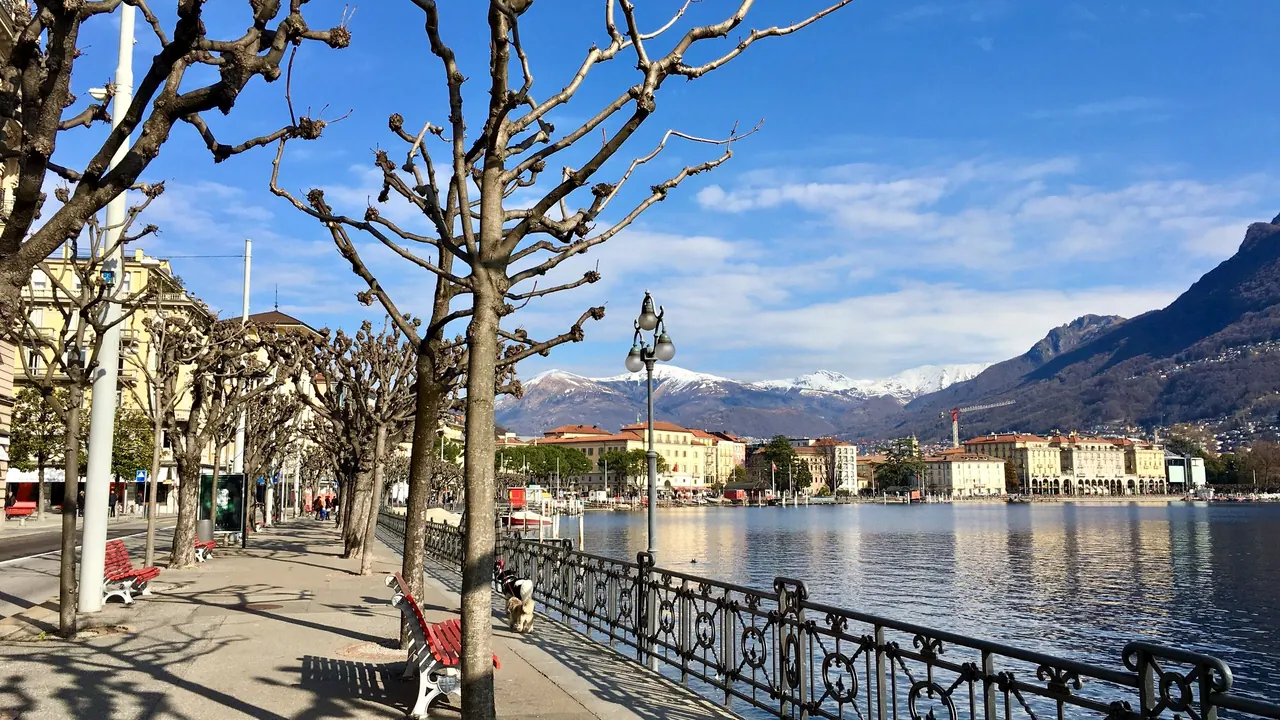
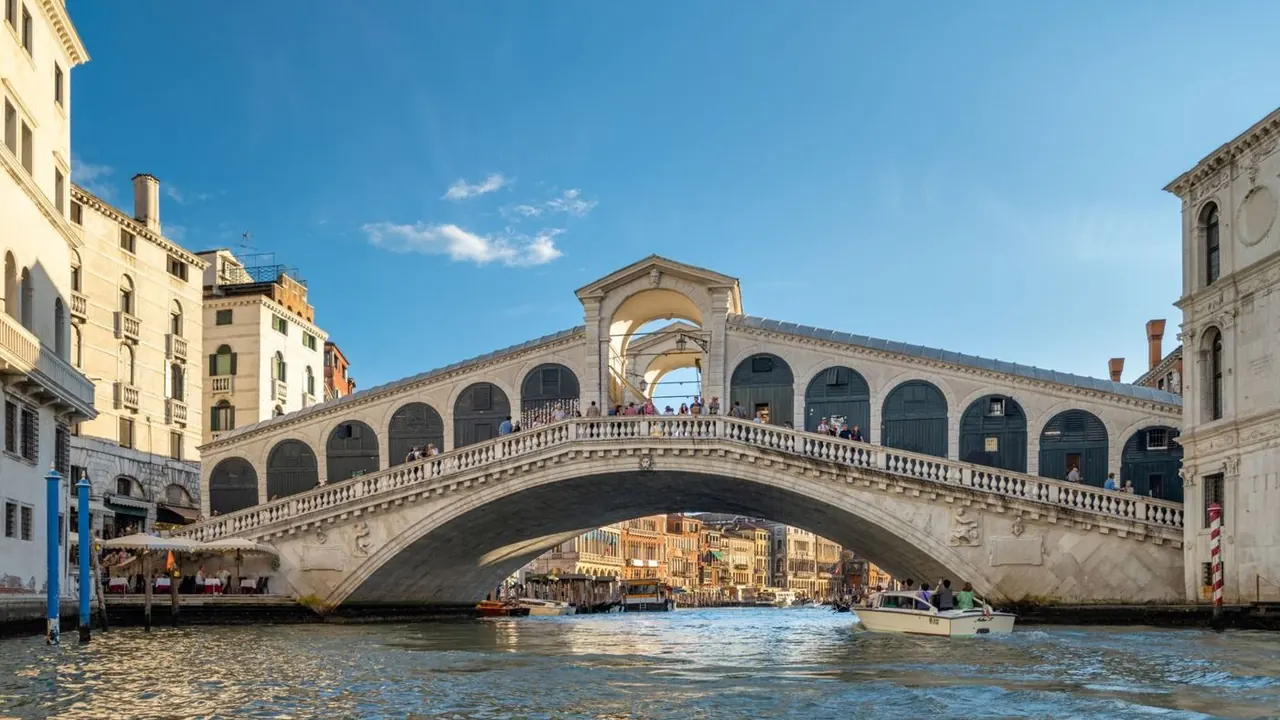
Photos: Lugano by Thomas Woodtli from Zürich, Switzerland, CC BY-SA 2.0, cropped; Venice by David Vives, Pexels License.
Lugano or Venice?
Our verdict in twelve categories, each scored against the same fixed benchmark cities, and the climate month by month, so you can choose for your trip.
Choose Lugano for
- nature and the outdoors
- families
- getting around
Lugano suits travellers who want the landscape to do the work. Steep wooded mountains rise straight from the lake, with funiculars, ridge walks, lidos and boat rides to stone villages all close to town. It is also the easier base: a small, walkable centre, Swiss trains to Milan, Como and Lake Maggiore, and a calm pace that works for families with young children and for couples who want to slow down.
Choose Venice for
- culture and sights
- live music and the arts
- food and drink
Venice is the choice for anyone who travels for art, architecture and atmosphere. A whole city of palaces and churches stands on water, with Titian, Tintoretto and the Biennale inside, opera at La Fenice and cicchetti at the bacari counters. Expect stepped bridges, crowds on the main routes and a lot of walking, but no other place gives you a week of looking like this.
Scoreboard
Twelve categories on one fixed scale from 0 to 100. The shaded stretch is the gap between the two.
Your match
Pick a travel style or drag the sliders, and both match scores follow your weighting.
Wins on nature and the outdoors and families with your weighting.
Wins on culture and sights and live music and the arts with your weighting.
What matters to you?
Category by category
What the scores mean for a trip.
Beaches & swimming
Venice has the only actual beach of the two. The Lido is a long strip of fine sand on the open Adriatic, a short vaporetto ride from San Marco, with shallow, gentle water that suits waders, and Pellestrina is quieter further along. The water is greenish rather than clear, and most visitors give it no more than an afternoon.
Lugano swims in a lake instead. You get lawns, wooden decks and ladders into the water at the lido by the Cassarate mouth and smaller bathing spots towards Castagnola and Paradiso. It is lovely on a hot day but has no sand at all.
Food & drink
Venice eats better, as long as you avoid the picture-menu places on the main routes. The bacari of the Rialto, Cannaregio and Castello serve cicchetti such as creamed salt cod and sarde in saor with a spritz, and the Rialto market supplies a real lagoon cuisine: cuttlefish in black ink, moeche and canocchie.
Lugano's strength is narrower: the grotto, with polenta, braised meats and local cheeses at granite tables under chestnut trees, washed down with Ticino Merlot. Beyond that the choice is thin and every meal comes at Swiss prices. Neither city offers much cooking from outside its own region.
Culture & sights
This is where Venice pulls furthest ahead. The whole city is the sight: the gold mosaics of San Marco, the Doge's Palace and the Grand Canal palazzi, then Titian at the Frari, Tintoretto at San Rocco, the Accademia and modern art at the Guggenheim and Punta della Dogana. A week barely scratches the surface.
Lugano offers a pleasant Lombard-style old town around Piazza della Riforma, San Lorenzo cathedral, Luini's Passion fresco in Santa Maria degli Angioli and the art museum split between LAC and Palazzo Reali. Add the Hesse museum in Montagnola and you have seen the town in a day or so.
Nightlife
Both towns are quiet by midnight, so neither suits a big night out. What differs is the crowd. In Lugano the evening is a smart, mostly local aperitivo on the lakefront or under the arcades, with a few lounge bars by the water and one or two clubs, and young locals head to Milan.
Venice packs into the bacari along the Fondamenta della Misericordia at aperitivo time, and students keep a few bars in Campo Santa Margherita going later. Apart from a handful of late bars there is no club district, and in summer the dancing moves to the beach clubs of Jesolo.
Nature & outdoors
Lugano is far stronger for the outdoors. Wooded mountains rise straight from the lake, and funiculars climb Monte Brè and San Salvatore, with paths leading down through chestnut woods. The shore path to Gandria, the rack railway up Monte Generoso and the green water of the Verzasca and Maggia valleys are all close.
Venice's nature is the lagoon: salt marshes around Torcello and Sant'Erasmo with herons, egrets and flamingos, best seen by kayak or on a rowing lesson. Everything else is flat, apart from cycling on the sea walls of the Lido and Pellestrina, and the Dolomites are more than two hours away.
Day trips
Both are superb bases. Lugano's trips cross a border and take in lakes as well as cities: Milan's Last Supper in just over an hour, Como in half an hour, Bellinzona's castles, Lake Maggiore and the Borromean Islands, and Morcote by boat.
Venice's trips are a run of art cities on one fast line, with Giotto in Padua, Palladio in Vicenza and the arena in Verona. Closer still, the lagoon islands of Murano, Burano and Torcello make a full day without a train.
Good for families
Lugano is the easier family destination, mainly thanks to the lake. Children get lido slides, boat trips to villages, funicular and rack railway rides and Parco Ciani's playgrounds, and the miniature Swiss landmarks at Melide are close by. The steep streets are hard work with a pushchair, and there are no big attractions for teenagers.
Venice wins children over with the idea of boats instead of buses, glass-blowing on Murano and the dinosaurs at the natural history museum. In practice, though, stepped bridges, heat and packed main routes make it best for short stays with older children.
Getting around
Lugano is simpler to get around. The centre is compact, a short funicular links the station to the old town, buses and lake boats cover the rest, and Swiss trains reach Bellinzona, Como and Milan with ease. The main effort is the slope.
Venice has no cars, so everything is on foot or by water. The twisting alleys get almost everyone lost, the main vaporetto lines are slow and crowded, and hundreds of stepped bridges make luggage and wheelchairs a real struggle. It has its charm, but you work for it.
Shopping & style
Venice gives shoppers more to look for, mostly crafts made in the city: Murano glass, Burano lace, papier-mâché masks, marbled paper and furlane slippers from workshops in Dorsoduro and Castello. The big fashion names are on Calle Larga XXII Marzo, but the cheap imitation glass on the main routes means you need to choose carefully.
Lugano's offer is luxury rather than craft. Via Nassa has Swiss watchmakers, jewellers and Italian fashion houses under the arcades, there are delicatessens in the lanes and a designer outlet out at Mendrisio. Serious shoppers go on to Milan.
Affordability
Both are costly, but Venice gives you more ways to cut back. You can eat cicchetti standing at the counter, sleep in Mestre or a quieter sestiere, and come in late autumn or winter outside the festivals.
Lugano has Swiss prices for everything, from hotels and wine to boat trips and mountain railways, and there is no cheap way to stay. Grotti, set lunches and the free regional transport that comes with hotel stays help a little, as does eating across the Italian border.
Live music & performing arts
Venice has the deeper stage. La Fenice, where Verdi and Rossini held premieres, runs full opera, ballet and symphonic seasons, the Goldoni stages drama, and the Biennale adds contemporary music, theatre and dance. On most evenings there are Vivaldi concerts in churches and scuole grandi, some excellent and many routine.
Lugano's music is centred on LAC, a fine concert hall that is home to the Orchestra della Svizzera italiana. In summer, Estival Jazz brings free open-air concerts to Piazza della Riforma, but opera lovers head to La Scala in Milan.
Wellness & relaxation
Neither city has a bathing tradition of its own, and both are restful in their own way. Lugano relaxes you through its pace: lido afternoons, the palm-lined shore of Parco Ciani and grotto lunches that last into the evening, plus a big pool and sauna complex near Rivera.
Venice's calm comes from having no traffic. Early mornings and the residential lanes of Castello, Cannaregio and Giudecca are deeply quiet, though San Marco by day is not. It also has proper thermal waters within an hour at Abano and Montegrotto Terme.
When should you go?
Pick your month. The climate figures are measured averages, not a forecast.
Lugano in July
Venice in July
Daytime high, °C
Rainfall in the month, mm
Temperature and rainfall are climate normals, averaged over the years shown. Lugano: 1991-2020 normals, Lugano (1.2 km from centre). Venice: 1991-2020 (sunshine 1971-2000, rainfall 1981-2010) normals, Venezia / Tessera (6.7 km from centre).
Winters are cold in both, with daytime highs around 7°C in January, and both warm up at much the same pace through spring. The real difference is rain. From April to November Lugano is a wet place, with May the wettest month at about 178mm, while Venice stays far drier all year and rarely gets much past 90mm in a month. Lugano does have the sunnier winters, though, so a bright, cold January day by the lake is more likely than in the grey lagoon.
For swimming, Venice's Adriatic reaches about 26°C in August, so the Lido is pleasant from late June to mid-September. Lugano's lidos keep to a similar summer season. Venice gets slightly hotter in high summer, around 29°C in July, which makes long days of walking over bridges tiring. For sightseeing it is at its best in April, May, September and October. In Lugano, late spring and September are the times to hike, as long as you allow for showers.
Which traveller are you?
On an outdoors trip, Lugano lets you start the day on a mountain path and end it in the lake, and you never need a car. Go in spring or autumn and pack for showers. Venice offers flat lagoon water and little more.
For a culture and arts trip, Lugano fills a day at most, while Venice rewards a full week. In Venice, book the big galleries and an evening performance ahead, go out early before the crowds and leave time for small churches.
On a family trip with young children, Lugano makes the days easier: a short outing by boat or mountain train, an afternoon swim and a calm, safe town to return to. Venice enchants children for a day or two, but leave the pushchair at home.
Before you go
| Measure | Lugano | Venice |
|---|---|---|
| Official language | French, German, Italian, Romansh | Italian |
| Currency | Swiss Franc (CHF) | Euro (EUR) |
| Sockets | CJ230 V, 50 Hz | CFL230 V, 50 Hz |
| Driving side | Right | Right |
| Time zone | UTC+1, UTC+2 in summer | UTC+1, UTC+2 in summer |
| Emergency number | 112 | 112 |
| Elevation | 283 m | 2 m |
| Main airport | Milan Malpensa International Airport (MXP)46 km from centre208 non-stop destinations | Venice Marco Polo Airport (VCE)7 km from centre103 non-stop destinations |
| Public holidays this year | 15 days | 13 days |
By the numbers
| Measure | Lugano | Venice |
|---|---|---|
| City population | 63,495 | 250,369 |
| People per km² | 837 | 602 |
| Museums within 10 km | 17 | 52 |
| UNESCO World Heritage sites within 50 km | 5 | 5 |
| Swim season, months above 21 °C | - | 4 months |
Where else could you go?
Every comparison below shares a destination with this one, so you can follow Lugano or Venice somewhere new.