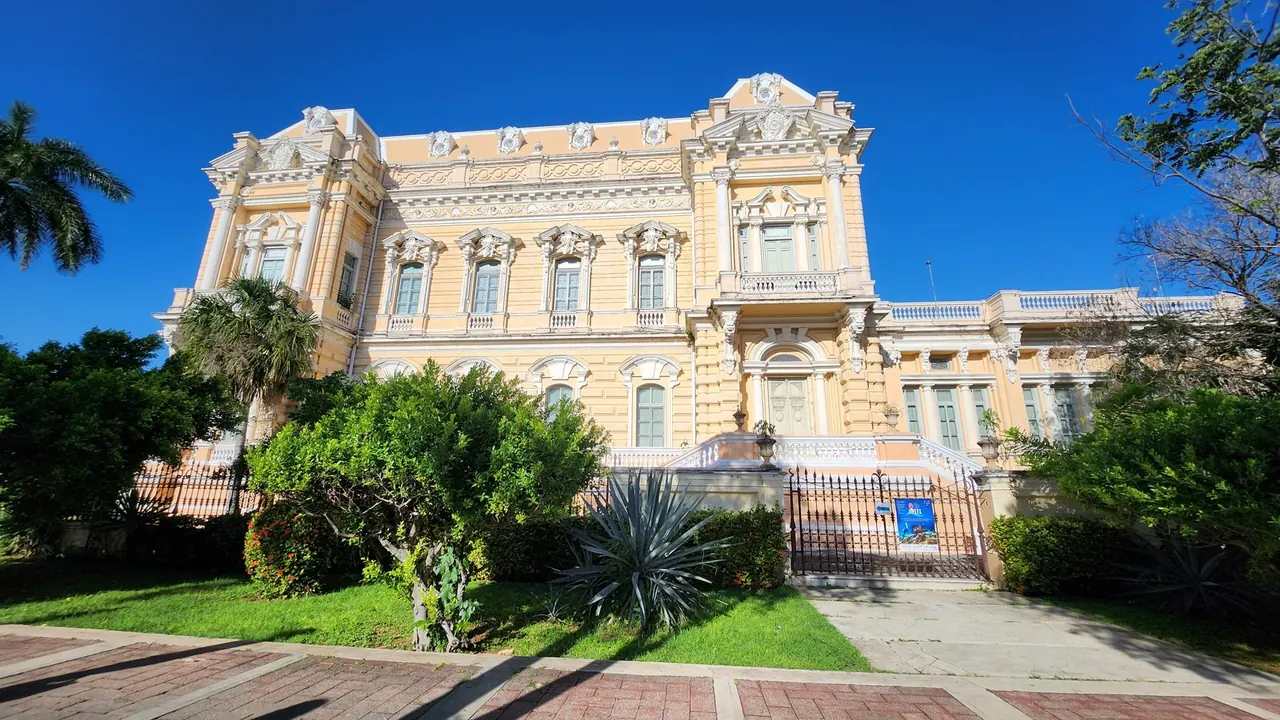
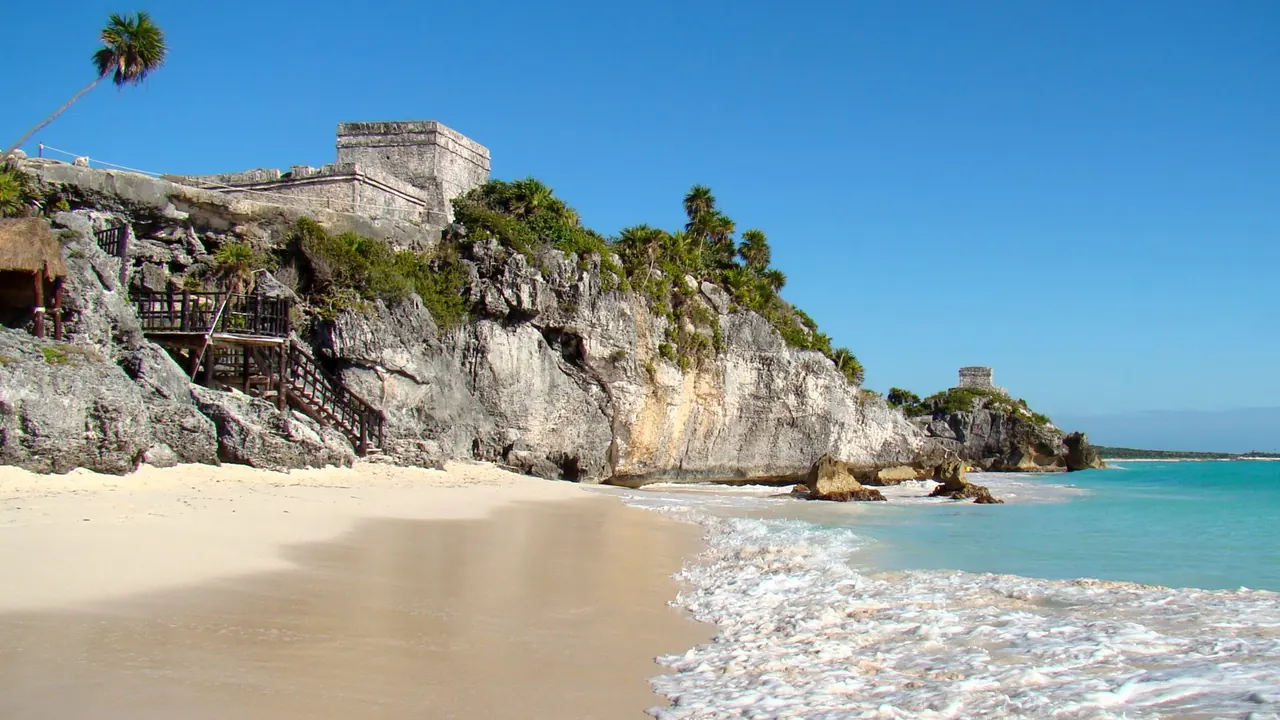
Photos: Merida by Mariposa2723, CC BY 4.0, cropped; Tulum by Bjørn Christian Tørrissen, CC BY-SA 3.0, cropped.
Merida or Tulum?
Our verdict in twelve categories, each scored against the same fixed benchmark cities, and the climate month by month, so you can choose for your trip.
Choose Merida for
- prices
- live music and the arts
- culture and sights
Merida suits a trip built around Maya history and Yucatecan life. It has a colonial centre with its cathedral and the mansions of Paseo de Montejo, the region's best cooking at market stalls, and free music and dance in the squares, with Uxmal and the Ruta Puuc close by. It costs far less than Tulum and rewards travellers who will give up a beach for culture and day trips.
Choose Tulum for
- wellness
- beaches
- nature and the outdoors
Travellers who want white sand, turquoise water and slow days should choose Tulum. Its coast runs south towards Sian Ka'an, its cenotes are among the finest anywhere, and yoga shalas, temazcal sessions and DJ nights set the tone. Expect to pay much more, and to rely on a bicycle or a car to get about.
Scoreboard
Twelve categories on one fixed scale from 0 to 100. The shaded stretch is the gap between the two.
Your match
Pick a travel style or drag the sliders, and both match scores follow your weighting.
Wins on prices and live music and the arts with your weighting.
Wins on wellness and beaches with your weighting.
What matters to you?
Category by category
What the scores mean for a trip.
Beaches & swimming
These are very different beach trips. Merida is inland, and its nearest sea at Progreso is warm, calm and shallow but greenish, along a flat, plain shore that fills with local families at weekends. Most visitors do their real swimming in the cenotes.
Tulum is built around its coast: long pale sand under palms, turquoise water and the ruins on the cliff above. Sargassum can spoil the sand in the warmer months and the town is a few kilometres from the shore, but for days in the sea it is in another league.
Food & drink
Merida is where Yucatecan cooking is at home. Cochinita pibil comes in breakfast tortas at the Lucas de Galvez and Santiago markets, relleno negro and papadzules fill the family loncherias, and marquesita carts work the squares at night.
Tulum serves some of the same dishes, mostly at taco stands in town. Its reputation, though, rests on candlelit fire-cooking along the beach road, where the setting often outshines the plate and menus repeat the same ceviche-and-smoothie-bowl formula.
Culture & sights
Merida gives you a whole colonial city to explore. There is the cathedral of San Ildefonso, built from Maya temple stones, the carved conquest facade of the Casa de Montejo, the henequen-era mansions of Paseo de Montejo, and the Gran Museo del Mundo Maya, which makes sense of the ruins before you visit them.
In Tulum, culture comes down to the walled Maya port, with El Castillo above the sea, and it takes a couple of hours to see. The town itself is a low, modern grid with no museums of note.
Nightlife
The two go out in quite different ways. Merida's evenings are relaxed and local: mezcal bars on Calle 60, rooftops over the old town and cantinas serving free botanas, with a few clubs going late at weekends.
Tulum is better known for nights out, with DJ sets in jungle clearings, beach clubs that run into the night and full-moon parties, all at their peak in winter and around New Year. Away from those events the town is fairly quiet, and the big nights are expensive.
Nature & outdoors
Both cities sit on the same flat limestone plain with cenotes beneath it, but Tulum has the better of it. Gran Cenote and Dos Ojos are among the world's great places for cavern snorkelling and cave diving, and Sian Ka'an adds lagoons, mangroves and reef, with dolphins and turtles.
From Merida you reach the cenotes around Cuzama and Homun by bicycle or horse-drawn rail cart, and Celestun's flamingos are a drive of about an hour and a half west. Neither city has hills or real hiking.
Day trips
Both make good bases for the Maya world, but more of it is within reach of Merida. Uxmal and the Ruta Puuc sites are about an hour south, Dzibilchaltun is barely half an hour out, and the yellow town of Izamal and the old henequen haciendas are close in every direction.
From Tulum, Coba is under an hour inland and Chichen Itza about two hours away, the same as from Merida. Tulum's advantage is the coast: Playa del Carmen, the ferry to Cozumel and the lagoon at Bacalar.
Good for families
Tulum gives children more to do, mostly in the water: warm sea, turtles in the shallows at Akumal, calm cenote pools and the big eco-parks at Xel-Ha and Xcaret. The drawback is that much of the beach strip is aimed at couples and late parties, so families do best with a pool rental and a car.
Merida is calmer, with a free zoo at the Parque del Centenario, Animaya on the edge of town and easy evenings in the squares. However, the heat, the uneven pavements and the ruins in full sun make it harder going, and nothing there is built specially for children.
Getting around
Merida is the easier of the two to get around. Its centre is a compact numbered grid, and most sights are a walk from the Plaza Grande, although the midday heat and narrow pavements make that walk hard work. Taxis and ride-hailing cover anything further out.
Tulum's small centre is walkable, but the town, the beach and the hotel strip lie kilometres apart along a highway. Most days start on a bicycle or in a taxi that costs a lot for the distance. The two do have one thing in common: from either base, the cenotes and outlying ruins are much easier with a hire car or a tour.
Shopping & style
Merida is the better place to buy Yucatecan crafts. Hammocks are its speciality, and it also sells guayabera shirts, Panama hats from Becal and embroidered huipiles, in the chaotic streets around the Lucas de Galvez market or in galleries in the restored houses. For brands there are the malls in the north of the city.
Tulum's shopping is narrower and more expensive: a single boho look of linen, macramé and woven bags in the beach-road boutiques, with cheaper crafts on the main avenue.
Affordability
Merida is much the cheaper stay. Market meals cost little, cantina snacks come free with drinks, and many cultural evenings are free. Even the boutique hotels in courtyard townhouses are fair for what they offer, and the main extra costs are a hire car and the entrance fees at the ruins.
Tulum is one of the most expensive places to stay in Mexico, with resort pricing at beach-road hotels and restaurants, beach clubs and taxis, and every cenote charges its own entry. A budget trip there means staying in town and cycling to the sea.
Live music & performing arts
Merida has a real programme, much of it free. Jarana dancers perform the vaqueria, trova trios sing at the Santa Lucia serenade and the Maya ballgame is re-enacted in front of the cathedral, while the Teatro Jose Peon Contreras hosts the Yucatan Symphony Orchestra and ballet.
Tulum has no theatre or concert hall at all. Live music means bar bands on the main avenue and saxophone over DJ sets, and traditional dance appears mostly as a show at the eco-parks.
Wellness & relaxation
Wellness is central to Tulum. The jungle strip has yoga shalas, retreat hotels and open-air spas, and many places run temazcal sweat-lodge ceremonies. For a quiet stay, pick somewhere well away from the clubs.
Merida offers less, and nothing like a retreat scene: hacienda spas outside town, courtyard plunge pools, hammocks and shuttered afternoons. The centre is loud with traffic, and the spring heat tires you out rather than restoring you.
When should you go?
Pick your month. The climate figures are measured averages, not a forecast.
Merida in July
Tulum in July
Daytime high, °C
Rainfall in the month, mm
Where the figures come from
Tulum has no weather station within reach, so its figures come from a gridded climate model rather than a measured record, and read a broad area rather than the city itself.
Temperature and rainfall are climate normals, averaged over the years shown. Merida: 1991-2020 normals, Merida / lic Manuel Crecencio (5.1 km from centre). Tulum: 2001-2020 normals, NASA POWER reanalysis grid, no weather station within 90 km.
Merida is at its best from November to February, when the days are hot but still bearable for walking the old grid and visiting ruins, and the skies are dry and sunny. By April and May highs reach 37°C, which leaves only early mornings for being out and about. The rains arrive in June with 206mm and stay heavy until October. Progreso's sea is warmest from late summer into autumn.
Tulum's heat is gentler and steadier, with highs around 27°C in winter and only a few degrees more in late spring, and the sea is warm enough for swimming all year, never dropping below 27°C. Its dry season runs from December to April. Rain builds from May and peaks later than in Merida, with 208mm in October.
Which traveller are you?
On a beach and sun trip, Tulum is the clear choice: pale sand under palms, turquoise water, turtles in the shallows at Akumal and a quieter shore heading south to Sian Ka'an. Merida's nearest sea, at Progreso, is shallow and plain.
For a culture and arts trip, Merida is far richer, with its 16th-century cathedral, the Palacio de Gobierno murals, the Gran Museo del Mundo Maya, jarana and trova in the squares and an orchestra at the Peon Contreras. Tulum has one cliff-top ruin.
On a trip on a tight budget, Merida makes money go much further, with cheap market breakfasts, free botanas with drinks, free evening performances and low taxi fares. In Tulum a cheap stay only works from the town centre, cycling out to the sea.
Before you go
| Measure | Merida | Tulum |
|---|---|---|
| Official language | Spanish, Nahuatl, Yucatec Maya | Spanish, Nahuatl, Yucatec Maya |
| Currency | Mexican Peso (MXN) | Mexican Peso (MXN) |
| Sockets | AB127 V, 60 Hz | AB127 V, 60 Hz |
| Driving side | Right | Right |
| Time zone | UTC-6 | UTC-5 |
| Emergency number | 911 | 911 |
| Elevation | 12 m | 5 m |
| Main airport | Manuel Crescencio Rejón International Airport (MID)5 km from centre22 non-stop destinations | Felipe Carrillo Puerto International Airport Tulum (TQO)21 km from centre11 non-stop destinations |
| Public holidays this year | 9 days | 9 days |
By the numbers
| Measure | Merida | Tulum |
|---|---|---|
| City population | 892,363 | 33,374 |
| People per km² | 1,010 | - |
| Museums within 10 km | 5 | 0 |
| UNESCO World Heritage sites within 50 km | 0 | 0 |
| Swim season, months above 21 °C | 12 months | 12 months |
Where else could you go?
Every comparison below shares a destination with this one, so you can follow Merida or Tulum somewhere new.