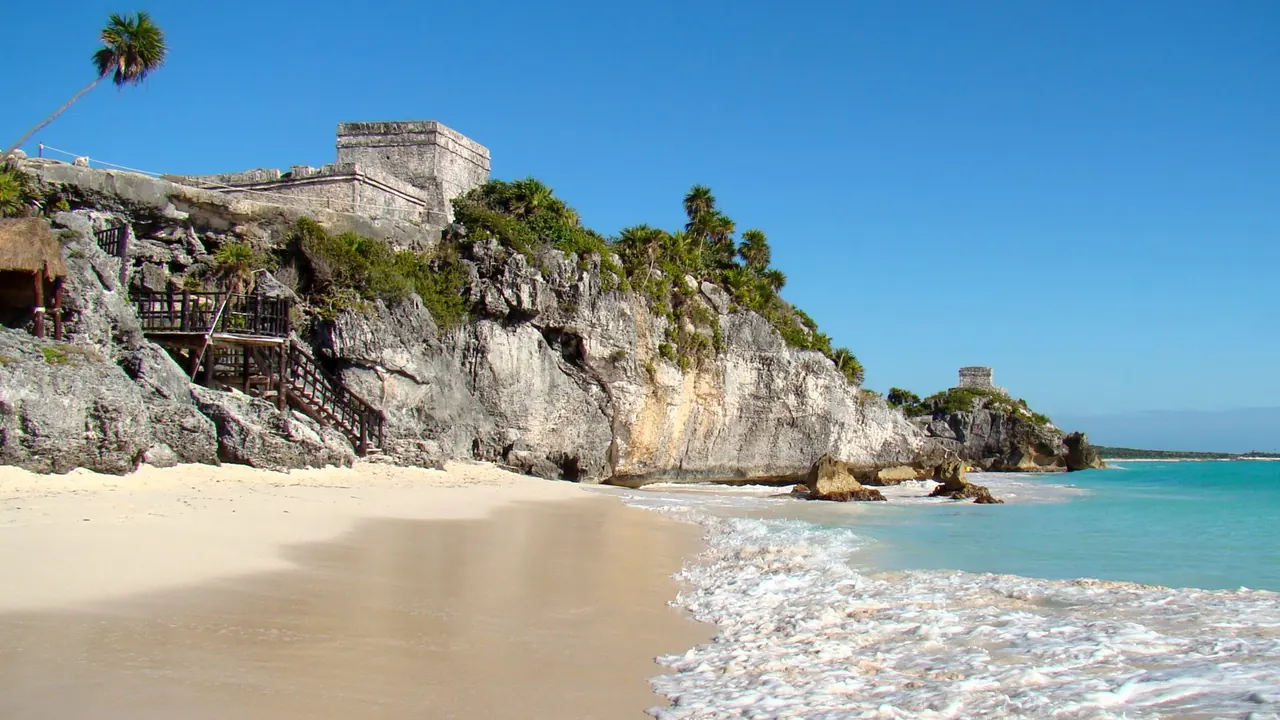
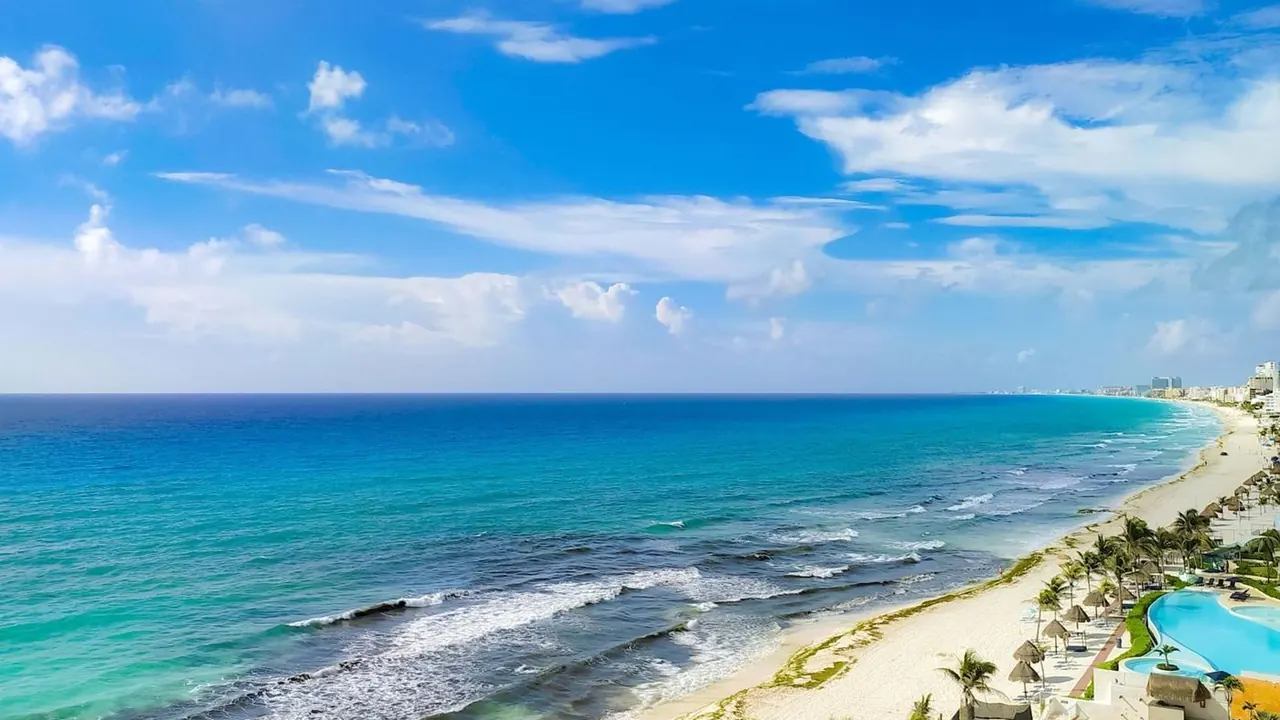
Photos: Tulum by Bjørn Christian Tørrissen, CC BY-SA 3.0, cropped; Cancun by Tellez Erik, Pexels License.
Tulum or Cancun?
Our verdict in twelve categories, each scored against the same fixed benchmark cities, and the climate month by month, so you can choose for your trip.
Choose Tulum for
- wellness
- culture and sights
- nature and the outdoors
Tulum is the better pick for a slower, more restorative stay built around yoga, spas and the water inland. Cenotes and the Sian Ka'an reserve are close at hand, the walled Maya city stands on the cliff above the sand, and the candlelit jungle restaurants give evenings more atmosphere. You pay noticeably more for all of this, and the town is set up for couples rather than children.
Choose Cancun for
- families
- prices
- beaches
Cancun suits travellers who want the beach to carry the trip. It has the longer and finer run of sand, calm bay water on the northern arm for small swimmers, large resorts with kids' clubs, and the loudest late nights on this coast. It is also the cheaper of the two, because downtown's taco stands, markets and small hotels are a short bus ride from the Hotel Zone.
Scoreboard
Twelve categories on one fixed scale from 0 to 100. The shaded stretch is the gap between the two.
Your match
Pick a travel style or drag the sliders, and both match scores follow your weighting.
Too close to call, level with your weighting
Wins on wellness and culture and sights with your weighting.
Wins on families and prices with your weighting.
What matters to you?
Category by category
What the scores mean for a trip.
Beaches & swimming
Both coasts are excellent, but Cancun's is the stronger beach. Its 22km of cool, powdery sand runs along both arms of the Hotel Zone, so you can choose between sheltered bay water on the north side and Caribbean surf on the east. When sargassum washes up, the bay side is an easy fallback.
Tulum's shore is wilder and more beautiful in places, with palms, low dunes and the ruins above the sand, but it is a few kilometres from town and has no sheltered side of its own. The closest calm water is the turtle bay at Akumal.
Food & drink
Tulum eats a little better. The open-fire restaurants on its jungle strip are more ambitious than Cancun's resort buffets and steakhouses, even if the setting sometimes matters more than the plate, and the taco stands and fondas in town are close by. In Cancun, the good food is downtown, at Mercado 28 and the stalls around Parque de las Palapas, and you have to make a point of going there. Both serve the same Yucatecan dishes, so cochinita pibil and sopa de lima are easy to find in either.
Culture & sights
Neither is a culture destination, but Tulum has the more memorable sight. Its walled Maya port stands on the cliff above the sea and fills a fine early morning. Cancun was built as a resort from the 1970s, and its best sight is indoors: the Maya Museum, with the small San Miguelito ruins in its grounds. Visitors serious about the Maya use either place as a base for the great inland sites.
Nightlife
Cancun goes harder and later. The huge clubs in the Party Center put on acrobats, confetti drops and open-bar nights that run until dawn for much of the year, though almost every venue aims at the same crowd. For a cheaper local drink, residents go to the bars around Avenida Tulum downtown.
Tulum's night scene is smaller and more particular. It is built around electronic music, with DJ sets in jungle clearings, beach clubs that run into the night and full-moon parties, and it is busiest in winter. Away from those big events it comes down to a few mezcal bars on the main avenue.
Nature & outdoors
Tulum has more of the outdoors on its doorstep. Gran Cenote, Dos Ojos and many smaller pools are a short ride away, and they are among the world's best places for cavern snorkelling and cave diving. Just to the south, Sian Ka'an's lagoons and Maya-built channels hold dolphins, turtles and wading birds, and the flat roads make it easy to cycle to most of it.
Cancun's outdoors is mostly on the water. You can snorkel the reef off Isla Mujeres and Puerto Morelos, swim over the underwater sculptures of MUSA and take a whale shark trip between June and September. Kayaks and paddleboards explore the mangrove channels of the Nichupte lagoon, and kitesurfers use the windier shore. Its cenotes, though, mean a trip inland rather than a short ride down the road.
Day trips
Both make good bases for day trips, but in different directions. From Tulum the Maya interior is closer. Coba's forest pyramid is under an hour away, Muyil is just down the road, and Chichen Itza with Valladolid is a manageable day. Bacalar's lagoon is within reach for a long day.
Cancun is the better base for islands. Isla Mujeres is a short ferry ride across the bay, and Holbox is close enough for an overnight. The big ruins mean longer drives from here, with Chichen Itza about two and a half hours away.
Good for families
Cancun asks less of parents. Its big hotels are designed with children in mind from the moment you check in, the bay side gives small swimmers gentle water, and the aquarium is an easy way to spend an afternoon out of the sun. The main things to watch are the currents along the eastern shore.
Tulum's attractions for children are at least as good, and some are closer: turtles at Akumal, cenotes with wooden steps into calm pools, and Xel-Ha and Xcaret just up the coast. The difficulty is where you stay. Most of the town's accommodation is aimed at couples and retreat guests, and mosquitoes and the seaweed season need some thought before you book.
Getting around
Getting around is equally awkward in both, but in different ways. Cancun is laid out along one boulevard with frequent buses to downtown, and ADO coaches run down the coast, although walking any distance in the heat is tiring. Tulum has a compact centre where bicycles do most of the work, but beyond the town there are only colectivo vans, costly taxis and a Tren Maya station outside the centre. In both, a hire car or tours are the realistic way to reach the ruins and cenotes.
Shopping & style
Cancun's shopping means malls and a souvenir market, and Tulum's means a strip of linen-and-macramé boutiques. Cancun's air-conditioned centres along the Hotel Zone carry international fashion, luxury labels and duty-free goods. Downtown, Mercado 28 is where to haggle for hammocks, silver and huipiles, though one stall's stock looks much like the next.
Tulum has no malls and no proper market. Its shaded beach-road boutiques sell woven bags, palm baskets and natural-dyed homewares in one upmarket style, small and pricey, while the shops on the main avenue in town sell embroidered huipiles, hammocks and silver for less.
Affordability
Cancun is easier on the wallet. The Hotel Zone is expensive, but downtown is a different world of cheap tacos, local buses and small hotels, and an all-inclusive package fixes the cost of a stay in advance.
Tulum is among the priciest places in Mexico. Beach-road hotels, beach clubs, taxis and party tickets all cost more, and every cenote charges its own entry. A budget stay is possible only from a guesthouse in town with a hired bicycle for the ride to the sea.
Live music & performing arts
Neither has a stage worth planning around, and the difference is only in what fills the evenings. Cancun leans towards staged entertainment, with folkloric dinner shows, mariachi, resort entertainment and occasional music in the downtown squares. In Tulum, live music means bar bands and acoustic sets on the main avenue, or the sax and drums that play over DJ nights.
Wellness & relaxation
Here Tulum is far ahead. Yoga shalas, retreat hotels, open-air spas, sound baths and breathwork are part of daily life along the jungle strip, and the southern beach road is slow and barefoot, provided you stay well away from the party venues.
Cancun's version is resort-based but polished, with hydrotherapy circuits and ocean-view treatment rooms in the big hotels. Both offer the temazcal sweat lodge. For real quiet near Cancun, people head to the far south of the strip, to Puerto Morelos or to Isla Mujeres.
When should you go?
Pick your month. The climate figures are measured averages, not a forecast.
Tulum in July
Cancun in July
Daytime high, °C
Rainfall in the month, mm
Where the figures come from
Tulum has no weather station within reach, so its figures come from a gridded climate model rather than a measured record, and read a broad area rather than one spot.
Cancun has no weather station within reach, so its figures come from a gridded climate model rather than a measured record, and read a broad area rather than one spot.
Temperature and rainfall are climate normals, averaged over the years shown. Tulum: 2001-2020 normals, NASA POWER reanalysis grid, no weather station within 90 km. Cancun: 2001-2020 normals, NASA POWER reanalysis grid, no weather station within 90 km.
The two share one climate, so the same months suit both. The sea is warm enough to swim in all year and never drops below about 26°C. The driest and most comfortable stretch is February to April, when days are warm rather than heavy and there is little rain, which makes it the best time for walking ruins and cycling. From May the heat builds to around 30°C with thick humidity, and the rains arrive in June.
Late summer and autumn are the wettest part of the year in both places, peaking in October at a little over 200mm. Tulum is a touch warmer in spring, reaching 31°C in May, and Cancun is slightly cooler in January. In practice that makes almost no difference. Plan either trip for the dry months if you can, and expect short heavy downpours if you travel between June and November.
Which traveller are you?
On a family trip with young children, Cancun needs less organising. One Hotel Zone resort with a kids' club can be the whole base, and buses and booked tours cover the eco-parks, so nobody has to drive. In Tulum, almost every outing with children starts in a car.
For a relaxing and wellness trip, choose Tulum. Stay at the quiet southern end of the beach road, where retreats run daily yoga, massage and temazcal sessions. Check the winter party calendar first, because the big DJ nights carry a long way.
On a tight budget, Cancun goes further. Downtown hotels, taco stands and local buses cost little, and ADO coaches to Valladolid take the place of paid tours. Tulum can be done cheaply from a town guesthouse with a hired bicycle, but cenote fees and taxis soon add up.
Before you go
| Measure | Tulum | Cancun |
|---|---|---|
| Official language | Spanish, Nahuatl, Yucatec Maya | Spanish, Nahuatl, Yucatec Maya |
| Currency | Mexican Peso (MXN) | Mexican Peso (MXN) |
| Sockets | AB127 V, 60 Hz | AB127 V, 60 Hz |
| Driving side | Right | Right |
| Time zone | UTC-5 | UTC-5 |
| Emergency number | 911 | 911 |
| Elevation | 5 m | 5 m |
| Main airport | Felipe Carrillo Puerto International Airport Tulum (TQO)21 km from centre9 non-stop destinations | Cancún International Airport (CUN)14 km from centre136 non-stop destinations |
| Public holidays this year | 9 days | 9 days |
By the numbers
| Measure | Tulum | Cancun |
|---|---|---|
| Population | 33,374 | 888,797 |
| Museums within 10 km | 0 | 1 |
| UNESCO World Heritage sites within 50 km | 0 | 0 |
| Swim season, months above 21 °C | 12 months | 12 months |
Where else could you go?
Every comparison below shares a destination with this one, so you can follow Tulum or Cancun somewhere new.
- Isla Mujeresvs Cancun
- Akumalvs Tulum
- Playa del Carmenvs Tulum
- Cozumelvs Tulum
- Playa del Carmenvs Cancun
- Riviera Mayavs Cancun