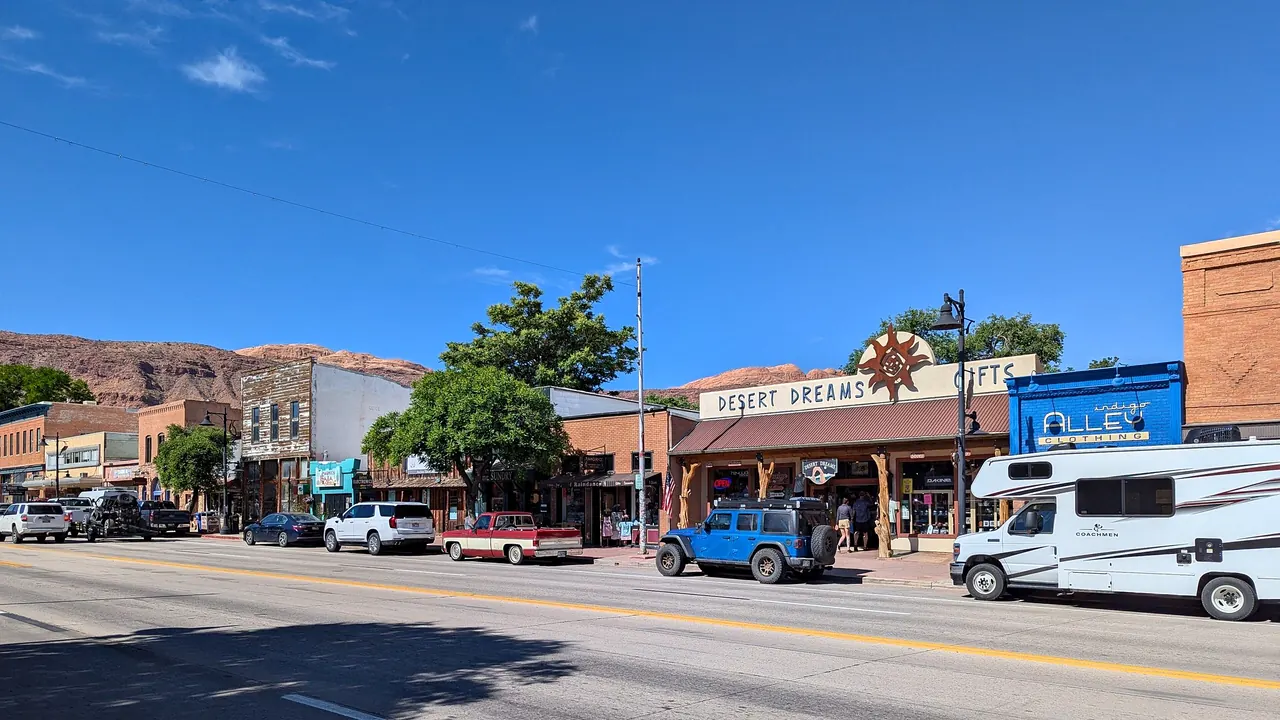
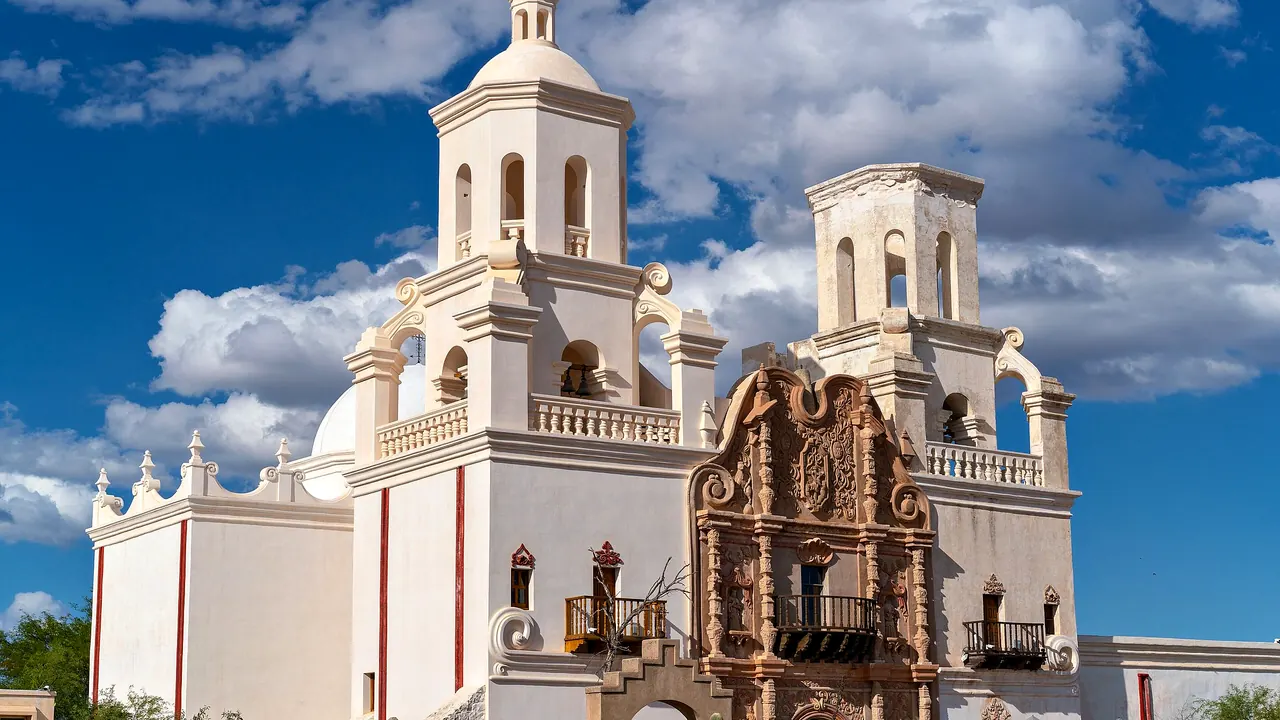
Photos: Moab by G. Edward Johnson, CC BY 4.0, cropped; Tucson by Steve and Kimberly Rader, CC BY-SA 4.0, cropped.
Moab or Tucson?
Our verdict in twelve categories, each scored against the same fixed benchmark cities, and the climate month by month, so you can choose for your trip.
Choose Moab for
- nature and the outdoors
- beaches
Moab is for the traveller whose whole trip is the landscape. Arches begins at the edge of town, Canyonlands and Dead Horse Point are close behind, and the slickrock bike trails, river trips and canyoneering make it a base you leave at dawn and return to tired. Evenings, dining and sightseeing in town are thin, and that suits people who only want a shower, a burger and a dark sky.
Choose Tucson for
- day trips
- wellness
- food and drink
Tucson suits a broader, slower trip. It still has desert trails, giant saguaro and a mountain to climb, but it adds Sonoran Mexican cooking, a colonial mission, a modest bar scene, resort spas and day trips to old frontier towns. Choose it for a winter escape where the outdoors is one part of the week rather than all of it.
Scoreboard
Twelve categories on one fixed scale from 0 to 100. The shaded stretch is the gap between the two.
Your match
Pick a travel style or drag the sliders, and both match scores follow your weighting.
Wins on nature and the outdoors and beaches with your weighting.
Wins on day trips and wellness with your weighting.
What matters to you?
Category by category
What the scores mean for a trip.
Beaches & swimming
Neither city has a beach, and both are a long way from the sea. Moab at least has river sandbars, Ken's Lake and the shallow pools of Mill Creek for a cold summer dip, though the Colorado's current needs care. Tucson's swimming happens almost entirely in hotel and resort pools, with Sabino Canyon's pools appearing only after rain and the Gulf of California four hours away in Mexico.
Food & drink
Tucson has a cuisine of its own and Moab does not. Sonoran Mexican cooking, from paper-thin flour tortillas to menudo and cheese crisps, is worth seeking out along South 12th Avenue and in the older barrios, and desert ingredients such as tepary beans and prickly pear give menus a local character.
Moab's Main Street is about refuelling: burgers, tacos, pizza, a couple of breweries and a few more ambitious Southwestern dinners. It is relaxed and filling, but choice shrinks in winter and the queues build on busy spring and autumn evenings.
Culture & sights
Tucson has the far deeper set of sights. Mission San Xavier del Bac, with its gilded painted interior, the adobe streets of Barrio Viejo and El Presidio, the Arizona State Museum's Native American collections and the huge aircraft collection at Pima Air & Space fill two or three days.
Moab's town offers a morning at most, with the small Museum of Moab and some uranium-boom buildings. Its real heritage is out on the cliffs: Ancestral Puebloan and Fremont petroglyphs along Potash Road and Kane Creek, and dinosaur trackways nearby.
Nightlife
Tucson offers a real night out, if a modest one: student dive bars and patios on Fourth Avenue, cocktail bars and a few dance floors on Congress Street, all walkable between the two. In Moab, a couple of brewpubs fill with bikers and rafters and the town goes quiet by eleven, so the best thing to do after dark is look up at the stars.
Nature & outdoors
Both are superb desert bases, but Moab is in a class of its own. Arches is minutes from town, the canyon maze of Canyonlands and Dead Horse Point is under an hour away, and the mountain biking, river running, canyoneering and jeep trails draw people from around the world.
Tucson answers with saguaro forests on both sides of the city, trails in Sabino Canyon and Catalina State Park, and the drive up Mount Lemmon from cactus into pine. It is strong on road cycling and birdwatching in the sky island ranges, and its outdoor season runs through winter, when Moab's trails are cold.
Day trips
Tucson has proper places to visit within a day. Bisbee's Victorian mining streets, Wild West Tombstone, the artists' village of Tubac with the Tumacácori mission ruins, the Sonoita wineries and Biosphere 2 give real variety, even if none is a major destination.
From Moab, the outings are mostly more landscape. The towns nearby are small, and the most rewarding cultural trip, south to Edge of the Cedars in Blanding and the towers of Hovenweep, takes up a long day of driving.
Good for families
Tucson gives families more to work with, especially between October and April. The Arizona-Sonora Desert Museum, Reid Park Zoo, the Children's Museum, the planetarium and the old western film set with stunt shows cover the days when small children need a break from hiking.
Moab suits active school-age children who love scrambling over rock, with short walks to Sand Dune Arch, dinosaur tracks, gentle river floats and Junior Ranger programmes. The unfenced drops, summer heat and lack of anything built for children make it harder with toddlers.
Getting around
Plan on a car in both. Tucson at least has the Sun Link streetcar linking downtown, Fourth Avenue and the university, plus slow buses and easy parking, though its main sights sit on the city's edges. Moab has a walkable Main Street and a bike path to the Arches entrance, but beyond that there is no public transport, and without a vehicle you rely on outfitters' shuttles; a high-clearance car opens up the backcountry.
Shopping & style
Tucson is the better place to buy something to take home: Native American jewellery, Tohono O'odham baskets and Mexican folk art in old-town galleries, vintage shops on Fourth Avenue, and the winter gem and mineral show that fills the city with dealers. Moab's Main Street is practical, with good bike and climbing shops, rock shops selling geodes and fossils, and a few galleries with Navajo weavings.
Affordability
Tucson is the easier city on the budget. Mid-range hotels are reasonable for the Southwest, taquerías and hot dog stands keep meals cheap, and summer brings easy bargains, though the gem show and the winter season push rates up.
Moab's limited rooms charge resort rates in spring and autumn, and rafting, jeep tours and car hire add up quickly. It saves money mainly for campers, with cheap public campgrounds, free dispersed camping and free hikes, and in winter, when prices drop.
Live music & performing arts
Tucson has a regular season, chiefly from autumn to spring: the Tucson Symphony Orchestra, Arizona Opera, the Arizona Theatre Company, touring shows at Centennial Hall, concerts at the restored Fox Theatre and a deep mariachi tradition. Moab has no theatre or concert hall, but its late-summer chamber music festival, with concerts in canyon grottoes reached by boat, is a memorable one-off.
Wellness & relaxation
Tucson is a natural choice for rest, with long-established destination spas in the Catalina foothills and towards Oracle offering massage, meditation and desert walks, and resort pools facing the mountains. There are no public baths, so wellness here means a resort stay.
Moab is built for exertion, with only a few small massage studios for tired riders. Its calm comes from the desert itself, red cliffs at sunset and very dark skies, and those wanting real quiet head for a ranch or a cabin in the La Sals.
When should you go?
Pick your month. The climate figures are measured averages, not a forecast.
Moab in July
Tucson in July
Daytime high, °C
Rainfall in the month, mm
Where the figures come from
Moab's temperatures are measured 27 km from the centre, at Moab / Crescent Junction.
Moab's station stands 162 m above the city centre, so the centre is likely a little warmer than the figures say.
Moab has no rain gauge within 25 km of the centre, so its rainfall comes from a gridded climate dataset read at the city rather than from a gauge further away.
Temperature and rainfall are climate normals, averaged over the years shown. Moab: 2006-2020 (rainfall 1991-2020) normals, Moab / Crescent Junction (27 km from centre). Tucson: 1991-2020 (sunshine 1981-2010) normals, Tucson International Airport (10.1 km from centre).
Moab is a spring and autumn destination. April, May, September and October bring comfortable hiking and biking weather, while June to August climbs to around 35°C and pushes any exertion to early morning. Winter is properly cold, with January highs near 2°C, quiet trails and snow on the La Sals. Rain is light all year, so heat and cold decide the timing.
Tucson runs on a different calendar. From October to April it is warm and sunny, with even December and January reaching about 19°C, which makes winter its best season and the time Moab is at its least comfortable. Spring is the driest and among the sunniest stretches. By June the heat reaches 39°C, and July and August bring the monsoon, with storms pushing rainfall to around 56mm a month. Walking the streets is then best saved for dawn or for Mount Lemmon.
Which traveller are you?
On an outdoors trip, Moab is the clear pick. Two national parks within an hour, world-famous mountain biking on Slickrock and the Whole Enchilada, rafting on the Colorado and climbing at Wall Street pack more into each day than Tucson's trails can.
For a food and nightlife trip, Tucson wins easily. Mesquite-grilled carne asada, Sonoran hot dogs from south-side stands and family-run barrio kitchens are followed by patio bars on Fourth Avenue and cocktails on Congress Street, while Moab is asleep by eleven.
On a relaxing and wellness trip, choose Tucson. Its foothills destination spas and resort pools facing the mountains are built for slow, sunny winter days, whereas Moab means early starts, long hot hikes and only a few massage studios for sore legs.
Before you go
| Measure | Moab | Tucson |
|---|---|---|
| Currency | US Dollar (USD) | US Dollar (USD) |
| Sockets | AB120 V, 60 Hz | AB120 V, 60 Hz |
| Driving side | Right | Right |
| Time zone | UTC-7, UTC-6 in summer | UTC-7 |
| Emergency number | 911 | 911 |
| Elevation | 1,227 m | 728 m |
| Main airport | Canyonlands Regional Airport (CNY)27 km from centre2 non-stop destinations | Tucson International Airport (TUS)12 km from centre18 non-stop destinations |
| Public holidays this year | 12 days | 12 days |
By the numbers
| Measure | Moab | Tucson |
|---|---|---|
| City population | 5,366 | 542,629 |
| People per km² | 501 | 923 |
| Museums within 10 km | 1 | 10 |
| UNESCO World Heritage sites within 50 km | 0 | 0 |
Where else could you go?
Every comparison below shares a destination with this one, so you can follow Moab or Tucson somewhere new.