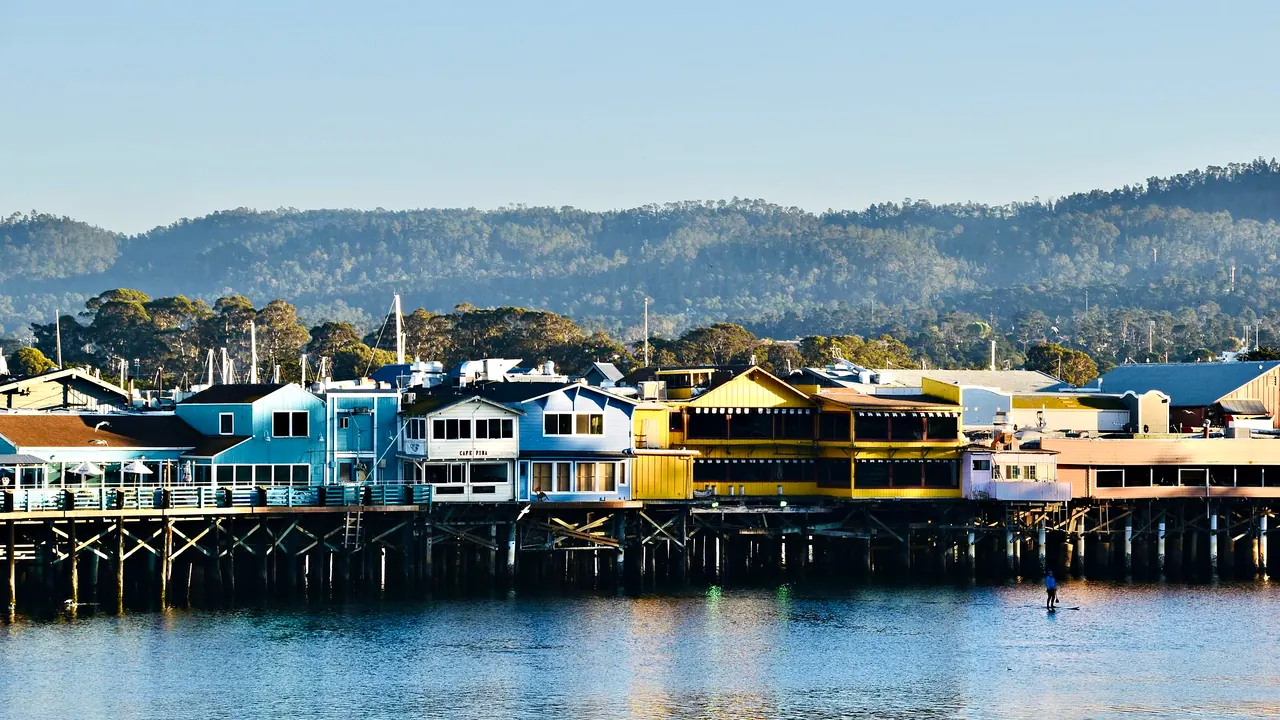
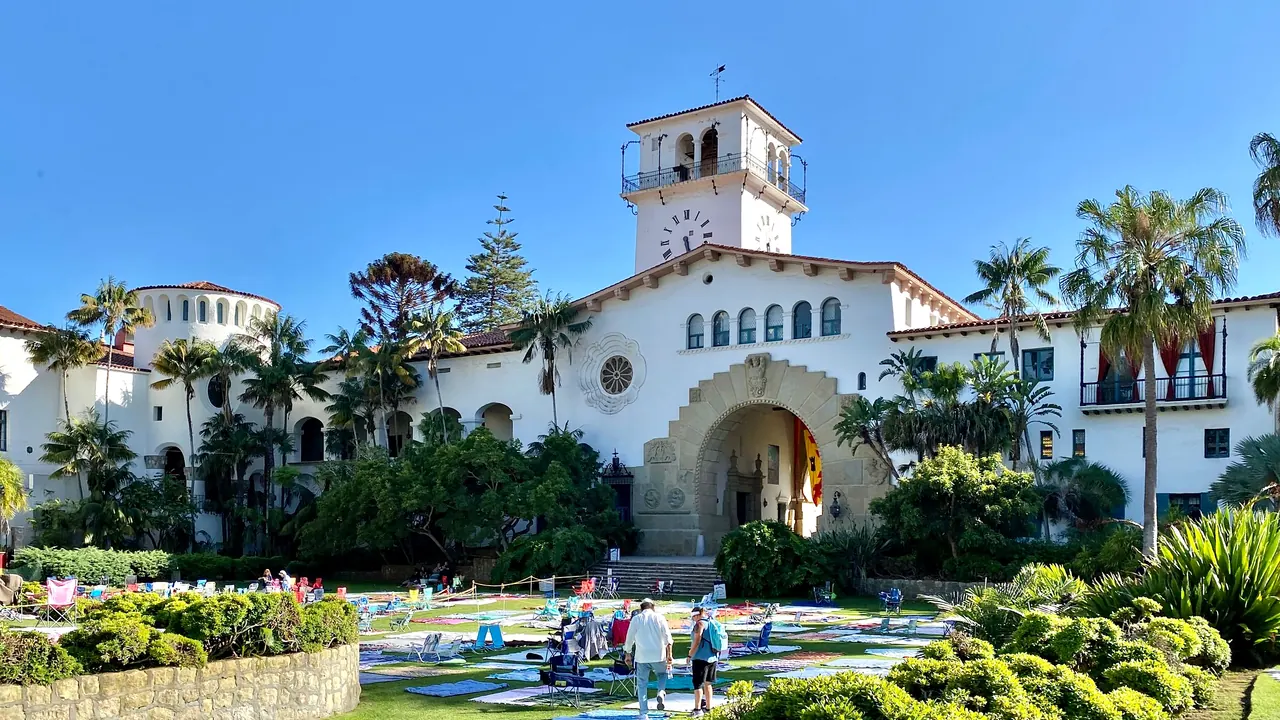
Photos: Monterey by Lesli Whitecotton, Pexels License; Santa Barbara by Warren LeMay, CC BY-SA 2.0, cropped.
Monterey or Santa Barbara?
Our verdict in twelve categories, each scored against the same fixed benchmark cities, and the climate month by month, so you can choose for your trip.
Choose Monterey for
- prices
- nature and the outdoors
- day trips
Monterey is the pick for travellers who come for the wild coast and the animals in it. Sea otters in the kelp, whales over the submarine canyon, the tide pools of Point Lobos and the long drive into Big Sur are the trip, and the world-class aquarium makes it an easy sell to children. Expect quiet evenings, colder water and a smaller choice of restaurants, and come for the landscape rather than the town.
Choose Santa Barbara for
- beaches
- food and drink
- live music and the arts
Santa Barbara gives more to people who want a rounded seaside town as well as the outdoors. The water is gentler and warmer, the Spanish Colonial Revival centre is a pleasure to wander, and the wine, farmers' markets and taquerias make for better eating. It also has real stages, from the Granada to the Bowl. The mountains rise straight behind the streets, so a morning hike and an afternoon on the sand fit into the same day.
Scoreboard
Twelve categories on one fixed scale from 0 to 100. The shaded stretch is the gap between the two.
Your match
Pick a travel style or drag the sliders, and both match scores follow your weighting.
Wins on prices and nature and the outdoors with your weighting.
Wins on beaches and food and drink with your weighting.
What matters to you?
Category by category
What the scores mean for a trip.
Beaches & swimming
Monterey's beaches are for looking at rather than swimming in. Del Monte Beach, Carmel's white sand and the Asilomar dunes are lovely to walk, but the bay stays cold all year and rip currents are common, so the water belongs to wetsuited kayakers and divers.
Santa Barbara is far better for a day by the sea. Its coast faces south behind the Channel Islands, which keeps the surf gentle, East and West Beach are right in town, and Carpinteria is shallow enough for toddlers. Swims are still short, but in late summer they are a real pleasure rather than a dare.
Food & drink
Monterey has superb raw materials and too few kitchens that do them justice. Dungeness crab, squid and sand dabs come off the boats and artichokes come in from the Salinas Valley, yet the wharf and Cannery Row lean on bread-bowl chowder for day visitors. Good cooking means seeking out Old Monterey's side streets, Pacific Grove or Carmel.
Santa Barbara eats better and with less effort. Spot prawns and sea urchin land at the harbour, the farmers' markets are among California's best, and Funk Zone tasting rooms pouring Santa Rita Hills pinot sit a short walk from one another. The long-established taquerias and Mexican bakeries of the Eastside add a cheap, everyday side that Monterey lacks.
Culture & sights
Monterey's history matters more on paper, but Santa Barbara's is more enjoyable to walk through. As the capital of Spanish and Mexican Alta California, Monterey keeps the Custom House and Colton Hall among a compact cluster of adobes, with the Carmel Mission ten minutes south and Steinbeck's old canneries on Cannery Row. A day covers most of it.
In Santa Barbara the whole centre is the sight. Rebuilt after the 1925 earthquake in white stucco and red tile, it is crowned by the County Courthouse tower, with the Old Mission on the slope above. The art and natural history museums fill the afternoons, so the town is worth two or three unhurried days.
Nightlife
Neither is a place for clubbing, but Santa Barbara has more going on after dinner. Funk Zone breweries and wine bars fill up early in the evening, and lower State Street has student bars and a few small dance floors at weekends.
Monterey usually winds down well before midnight. A drink on Alvarado Street or in a Cannery Row hotel bar is about the extent of it, and anyone wanting more would drive to Santa Cruz.
Nature & outdoors
Both are superb outdoor bases, but they look in different directions. Monterey looks out to sea. The submarine canyon brings whales and orcas close, otters float beside the recreation trail, Point Lobos has some of California's best coastal walking, and Big Sur's redwood canyons and cliff trails begin just beyond it.
Santa Barbara looks up to the mountains. Trails such as Rattlesnake Canyon and Seven Falls start at the ends of suburban streets and climb to ridges above the channel, Los Padres National Forest lies beyond, and Rincon's point break and the Channel Islands add surfing and island kayaking. Monterey suits wildlife and coastal scenery, and Santa Barbara suits hiking.
Day trips
Both have a short list of good outings and a long drive to the nearest big city. Monterey's best trips are very close: Carmel-by-the-Sea in fifteen minutes, Pacific Grove next door, Steinbeck's Salinas, and Santa Cruz's boardwalk within the hour.
Santa Barbara's standout day goes over the mountains to the Santa Ynez Valley wineries and Danish-built Solvang, with La Purisima Mission and Ojai's arts town as runners-up. Each town has San Francisco or Los Angeles about two hours away, and both cities are better saved for a separate stay.
Good for families
Monterey has one outstanding attraction for children, and it is enough to plan a trip around. The aquarium's kelp forest, otters and jellyfish galleries anchor the visit. Tide pools at Pacific Grove, whale-watching boats and Dennis the Menace Park fill the rest, though the cold sea keeps beach days to sandcastles.
Santa Barbara spreads its appeal across smaller places: the hilltop zoo, the touch tanks at the Sea Center on Stearns Wharf, the MOXI science museum and a planetarium. Its gentler, shallower beaches give it the edge for toddlers who want to paddle, and the downtown sights sit close enough together for short legs.
Getting around
Santa Barbara is the easier town to manage without a car. The coastal train stops near the beach, and a downtown shuttle and local buses cover the core. Flat State Street then runs straight from the Mission district to the waterfront.
Monterey's waterfront trail is a joy on foot or by bike, linking the wharf, Cannery Row, the aquarium and Pacific Grove, but buses are sparse and most visitors arrive by road. In both towns the wine country and the best of the outdoors need a car.
Shopping & style
Santa Barbara offers more browsing on its own streets. Chains and independents line State Street, galleries and boutiques hide in tiled paseos such as La Arcada, Montecito has upmarket fashion and the Funk Zone has design shops.
In Monterey itself it is mostly taffy and sea-otter souvenirs. The worthwhile shopping is a short drive away, in Carmel's galleries and boutiques and Pacific Grove's antique shops.
Affordability
Neither town is kind to a tight budget. Both price their rooms and restaurants for well-off Californian weekenders, with Montecito and the Carmel waterfront the dearest corners and Monterey's rates jumping during the Pebble Beach classic-car week in August.
The ways to save are similar but not identical. In Monterey, the chain motels along the highway and in Seaside or Marina cut costs, and the free wildlife on the shore fills the days. In Santa Barbara, taquerias and farmers' markets keep meals cheap, and Goleta or Ventura are cheaper places to sleep.
Live music & performing arts
Santa Barbara has a year-round stage life that Monterey cannot match. The restored Granada hosts symphony, opera and ballet, the historic Lobero has chamber music and jazz, and the Santa Barbara Bowl draws major touring bands into its canyon from spring to autumn.
Monterey's fame rests on its festivals: the long-running September Jazz Festival on the fairgrounds where the 1967 Pop Festival was held, and Carmel's summer Bach Festival. Outside those weeks there is little beyond the symphony and the Golden State Theatre, so time your trip around them.
Wellness & relaxation
Monterey's calm is foggy and coastal: mist lifting off the bay in the morning, evening walks along the Pacific Grove shore, quiet days in Carmel. Its spas lie out of town, at the Pebble Beach golf resorts and among the oaks and vineyards of Carmel Valley, and summer weekends bring traffic to the waterfront.
Santa Barbara makes pampering easier, with polished spas at the Montecito and beachfront resorts and plenty of yoga studios and day spas in town. For a deeper retreat, the Ojai Valley's long tradition of spa resorts is an hour's drive away. Neither town has public baths, so in both the slow pace does most of the work.
When should you go?
Pick your month. The climate figures are measured averages, not a forecast.
Monterey in July
Santa Barbara in July
Daytime high, °C
Rainfall in the month, mm
Temperature and rainfall are climate normals, averaged over the years shown. Monterey: 1991-2020 normals, Monterey / Pacific Grove Acres (5 km from centre). Santa Barbara: 1991-2020 normals, Santa Barbara / La Patera (11.7 km from centre).
Both towns have the same Californian rhythm: wet winters from December to March, then months of almost no rain from May to September. Santa Barbara's wettest month brings about 99mm. Neither gets too hot to walk in, and the warmest stretch in both runs from late summer into October, after the early-summer fog and marine layer clear. Monterey peaks at about 23°C in September and October, and that is its best season for being outdoors on the coast.
Santa Barbara is a degree or two warmer through most of the year, reaching about 24°C from July to September. The real difference is the sea. Monterey Bay stays near 15°C at best, so it is cold all year, while Santa Barbara's water warms to about 18°C from July to October, which is the only spell when either town is good for a proper beach day.
Which traveller are you?
On a beach and sun trip, Santa Barbara is the clear choice. Its south-facing shore is sheltered by the Channel Islands, Carpinteria's shallow beach suits small swimmers, and the water warms enough in late summer for short swims, which Monterey Bay never does.
For a food and nightlife trip, Santa Barbara again comes out ahead. There are spot prawns and sea urchin off the harbour boats, Funk Zone tasting rooms within walking distance of each other and Eastside taquerias, and State Street keeps going later than Monterey's short run of pubs on Alvarado Street.
For divers and wildlife watchers, Monterey is the place. The submarine canyon brings humpbacks, grey whales and orcas close to shore, the kelp forests are dived straight from town, and otters and sea lions can be seen from the waterfront path for free.
Before you go
| Measure | Monterey | Santa Barbara |
|---|---|---|
| Currency | US Dollar (USD) | US Dollar (USD) |
| Sockets | AB120 V, 60 Hz | AB120 V, 60 Hz |
| Driving side | Right | Right |
| Time zone | UTC-8, UTC-7 in summer | UTC-8, UTC-7 in summer |
| Emergency number | 911 | 911 |
| Elevation | 8 m | 15 m |
| Main airport | Mineta San Jose International Airport (SJC)85 km from centre38 non-stop destinations | Santa Barbara Municipal Airport (SBA)12 km from centre13 non-stop destinations |
| Public holidays this year | 13 days | 13 days |
By the numbers
| Measure | Monterey | Santa Barbara |
|---|---|---|
| City population | 30,218 | 88,665 |
| People per km² | 991 | 816 |
| Museums within 10 km | 5 | 10 |
| UNESCO World Heritage sites within 50 km | 0 | 0 |
| Swim season, months above 21 °C | None | None |
Where else could you go?
Every comparison below shares a destination with this one, so you can follow Monterey or Santa Barbara somewhere new.
- San Josevs Monterey
- Santa Monicavs Santa Barbara
- San Franciscovs Monterey
- Los Angelesvs Santa Barbara
- Huntington Beachvs Santa Barbara
- Newport Beachvs Santa Barbara