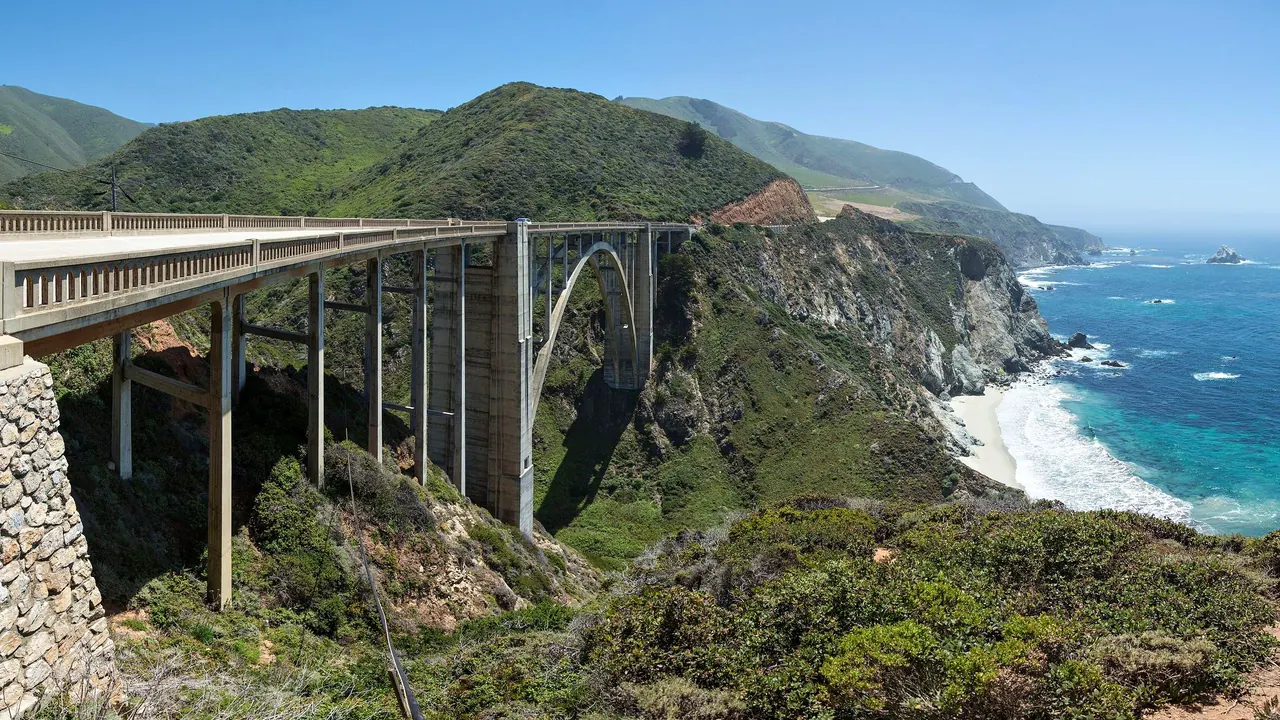
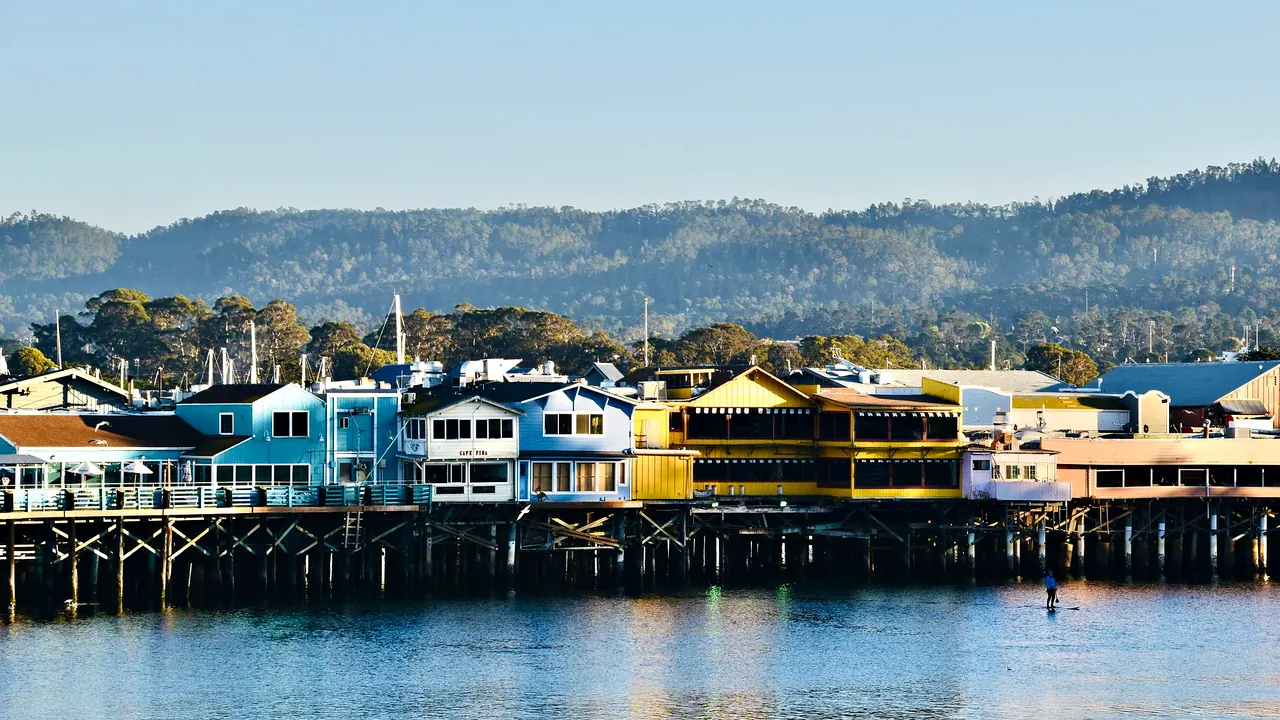
Photos: Big Sur by Diliff, CC BY-SA 3.0, cropped; Monterey by Lesli Whitecotton, Pexels License.
Big Sur or Monterey?
Our verdict in twelve categories, each scored against the same fixed benchmark cities, and the climate month by month, so you can choose for your trip.
Choose Big Sur for
- wellness
- nature and the outdoors
Big Sur is for travellers who come for the coast itself: the Santa Lucia Mountains dropping straight into the Pacific, redwood canyons, trails climbing into the Ventana Wilderness and nights dark enough for real stargazing. It suits couples and walkers who want a slow, restorative stay at a cliff-top spa, a retreat at Esalen or a redwood campsite. In return they accept a car, one winding road, very few places to eat and some of the highest room rates in the country.
Choose Monterey for
- families
- shopping
- getting around
Choose Monterey if you want that same coastline within reach but a proper town to come back to each evening. Families have the aquarium and the tide pools, history lovers have the adobes of California's old capital, and dinner and a drink on Alvarado Street are a short walk away. The waterfront can be covered on foot, and Big Sur makes an easy long day out from here.
Scoreboard
Twelve categories on one fixed scale from 0 to 100. The shaded stretch is the gap between the two.
Your match
Pick a travel style or drag the sliders, and both match scores follow your weighting.
Wins on wellness and nature and the outdoors with your weighting.
Wins on families and shopping with your weighting.
What matters to you?
Category by category
What the scores mean for a trip.
Beaches & swimming
Big Sur's beaches are wilder and better for photographs than for spending the day. Pfeiffer Beach, with its purple sand and rock arch, and the coves at Garrapata are worth an hour's walk, but heavy surf and sneaker waves keep people out of the water, and some of the most famous coves cannot be reached at all.
Monterey's shore is cold too, but you can use more of it. Del Monte Beach and the Asilomar dunes are close to town and Carmel Beach is a short drive away. On warm autumn days children paddle in the calmer shallows by the wharf while kayakers and divers head out into the bay.
Food & drink
Eating in Big Sur means a scattering of lodge dining rooms, cliff-top terraces, one well-regarded bakery and a few roadhouse cafés, with long drives between them. Treat it as a place for one memorable lunch with the ocean below, not for a week of dinners.
Monterey has more choice and makes better use of the region's produce: squid, Dungeness crab and sand dabs from the bay, vegetables from the Salinas Valley and Pinot Noir from the Carmel Valley. Walk past the bread-bowl chowder on the wharf and eat in Old Monterey's side streets or Pacific Grove, which is where many Big Sur visitors drive for their serious meals anyway.
Culture & sights
Big Sur's heritage is mostly stories and a few landmarks. You can stop at the 1932 arch of Bixby Bridge, take a guided walk to the Point Sur Lightstation and visit the Henry Miller library under the redwoods, which keeps alive the coast's past as a refuge for writers and Beat poets. Beyond that there are homesteaders' cabins and the landscape.
Monterey has real history you can walk through. The adobes of Monterey State Historic Park include the Custom House and Colton Hall, where California's first constitution was written. The Royal Presidio Chapel, Steinbeck's Cannery Row and the Carmel Mission ten minutes south add more. None of it is a great museum, but it fills a couple of good days.
Nightlife
In Big Sur the evening ends with dinner. A few lodge bars and a roadside tavern pour drinks, then the coast goes dark, and nobody wants the hairpins after a glass of wine. Monterey is quiet too, with no clubs, but Alvarado Street's pubs, wine bars and brewpubs and a few weekend spots on Cannery Row give you somewhere to walk to after dinner.
Nature & outdoors
Both sit on one of California's finest coastlines, and Big Sur has more of it. For about 140km the mountains fall straight into the sea, with redwood canyons, waterfalls, state parks from Garrapata to Julia Pfeiffer Burns, and roadless wilderness trails such as Pine Ridge. Condors over the ridges and elephant seals near Piedras Blancas round it out.
Monterey's strength is wildlife on the water close to town. The deep submarine canyon offshore brings whales near enough for boat trips from the harbour, and you can kayak, dive the kelp forest or cycle to Lovers Point straight from town. Point Lobos and the start of Big Sur are a short drive south, though deep hiking means driving further.
Day trips
Both have a good choice of outings, but they are laid out differently. Big Sur's sit at its two ends: Carmel and Monterey to the north, Hearst Castle and Cambria to the south. From the middle of the coast either end is a slow drive, and a landslide can split the coast in two, so most people visit only the outings nearest their base.
Monterey's outings are a tight cluster of short hops: Pacific Grove next door, Carmel fifteen minutes away, the Carmel Valley wineries, Steinbeck's Salinas and the mission at San Juan Bautista. Santa Cruz's boardwalk is under an hour north. You won't find a set piece like Hearst Castle, but getting to each place is much easier.
Good for families
Big Sur suits families who camp. The redwood campgrounds by the Big Sur River have a creek to paddle in and flat forest trails, and the short walk to McWay Falls is easy for small legs. Against that are unfenced cliffs, a sea too rough for play, no attractions made for children and a road known for car sickness.
Monterey is far easier with children. The aquarium's kelp forest and jellyfish galleries can fill a day, and the tide pools, sea lions on the wharf, whale-watching boats and Dennis the Menace Park fill several more, all in a small, safe town.
Getting around
Big Sur means Highway 1 and nothing else: a narrow road of hairpins and drops, slowed by summer traffic and photo stops. Petrol stations are few, phone signal comes and goes, and after a wet winter, landslides can force long inland detours. Nothing is within walking distance of anything else.
In Monterey you can leave the car parked for the core of a visit. The flat coastal trail links the wharf, downtown, Cannery Row, the aquarium and Pacific Grove on foot or by hired bike. You still need to drive for Point Lobos, the Carmel Valley or the 17-Mile Drive.
Shopping & style
Big Sur has only roadside gift and craft shops, a couple of galleries and general stores for supplies. Monterey's own streets offer mostly taffy and sea-otter souvenirs. Still, Carmel's galleries and boutiques and Pacific Grove's antique shops are minutes away, so you can easily spend a good afternoon browsing.
Affordability
Neither is cheap, but Big Sur is in a class of its own. Rooms are few and lodges charge luxury rates, and even simple cabins cost as much as a good city hotel. Food and petrol carry a premium because everything comes in along one road. Camping is the one real saving, and summer pitches go months ahead.
Monterey gives you more ways to cut costs: chain motels along the highway, beds in Seaside or Marina, and midweek or winter stays. The coastal trail, tide pools and wildlife from the shore cost nothing. That is why many Big Sur visitors sleep here and drive south for the day.
Live music & performing arts
Big Sur's cultural evenings are few and small: outdoor concerts, readings and film screenings at the Henry Miller library in the warmer months, and the occasional musician at a lodge.
Monterey has a real place in music history. The Monterey Jazz Festival has run every September since 1958, and the 1967 Monterey Pop Festival was held on the same fairgrounds. Summer adds the Carmel Bach Festival and plays at the Forest Theater. Outside festival time it is quieter, but there is still the symphony's season and touring acts at the Golden State Theatre.
Wellness & relaxation
The real difference is between a trip built around rest and a trip with rest fitted in. In Big Sur, rest takes commitment. You reach Esalen through a booked workshop or residential stay, not a casual visit. The cliff-top resorts, with their massage rooms, yoga and soaking tubs facing the ocean, are made for several unhurried nights. Little here can be done on a whim, and none of it is cheap, but once you arrive there is almost nothing to pull you away.
Monterey's calm is easier to fit in between other plans. A morning walk on the Pacific Grove shore or a slow afternoon in Carmel needs no booking. For spa time, the golf resorts at Pebble Beach have their own. The resort spas of the sunnier Carmel Valley sit inland among vineyards and oaks, away from the bay. Neither place has a public bathhouse to drop into. If rest is the whole point of the trip, Big Sur is the one to plan around.
When should you go?
Pick your month. The climate figures are measured averages, not a forecast.
Big Sur in July
Monterey in July
Daytime high, °C
Rainfall in the month, mm
Where the figures come from
Big Sur's temperatures are measured 42 km from the centre, at Monterey / Pacific Grove Acres.
Big Sur has no rain gauge within 25 km of the centre, so its rainfall comes from a gridded climate dataset read at the destination rather than from a gauge further away.
Temperature and rainfall are climate normals, averaged over the years shown. Big Sur: 1991-2020 normals, Monterey / Pacific Grove Acres (41.9 km from centre). Monterey: 1991-2020 normals, Monterey / Pacific Grove Acres (5 km from centre).
The two share the same mild, even temperatures, so neither is ever too hot or too cold for walking. Daytime highs sit around 17°C in winter and reach 23°C from August to October. The sea stays at about 15°C at best off both, so no month is a swimming month. Late summer and autumn suit both best: the early-summer fog on the coast tends to give way to clearer days, and the rain has not yet arrived.
Winter rain is where they differ. Both are almost dry from May to September, but Big Sur's mountain coast gets far more from November to March, around 205mm in December against Monterey's 69mm. This affects more than your walks: wet winters set off landslides that can close Highway 1 for long periods. A winter or early spring trip to Big Sur needs a check on road access, while Monterey stays easy to reach all year.
Which traveller are you?
On a relaxing and wellness trip, Big Sur is the stronger choice. Esalen's hot spring baths above the surf, spas facing the ocean, patchy phone signal and silent, dark nights make it almost impossible not to slow down. In Monterey, calm depends on avoiding busy summer weekends.
On a family trip with children, Monterey wins clearly. The aquarium, the tide pools at Pacific Grove, sea lions on the wharf and a flat waterfront path keep children busy. Big Sur gives them unfenced cliffs, a twisting road and little beyond camping.
For a culture and arts trip, Monterey has far more to offer: the adobes and Custom House of California's old capital, the Carmel Mission nearby, and the jazz and Bach festivals. Big Sur has Bixby Bridge, a lighthouse and the Henry Miller library, and not much more.
Before you go
| Measure | Big Sur | Monterey |
|---|---|---|
| Currency | US Dollar (USD) | US Dollar (USD) |
| Sockets | AB120 V, 60 Hz | AB120 V, 60 Hz |
| Driving side | Right | Right |
| Time zone | UTC-8, UTC-7 in summer | UTC-8, UTC-7 in summer |
| Emergency number | 911 | 911 |
| Elevation | - | 8 m |
| Main airport | Monterey Regional Airport (MRY)11 non-stop destinations | Mineta San Jose International Airport (SJC)85 km from centre39 non-stop destinations |
| Public holidays this year | 13 days | 13 days |
By the numbers
| Measure | Big Sur | Monterey |
|---|---|---|
| Population | - | 30,218 |
| People per km² | - | 991 |
| Museums within 10 km | - | 5 |
| UNESCO World Heritage sites within 50 km | - | 0 |
| Swim season, months above 21 °C | None | None |
Where else could you go?
Every comparison below shares a destination with this one, so you can follow Big Sur or Monterey somewhere new.
- Carmel-by-the-Seavs Monterey
- Carmel-by-the-Seavs Big Sur
- San Josevs Monterey
- San Franciscovs Monterey
- Napavs Monterey
- Sonomavs Monterey