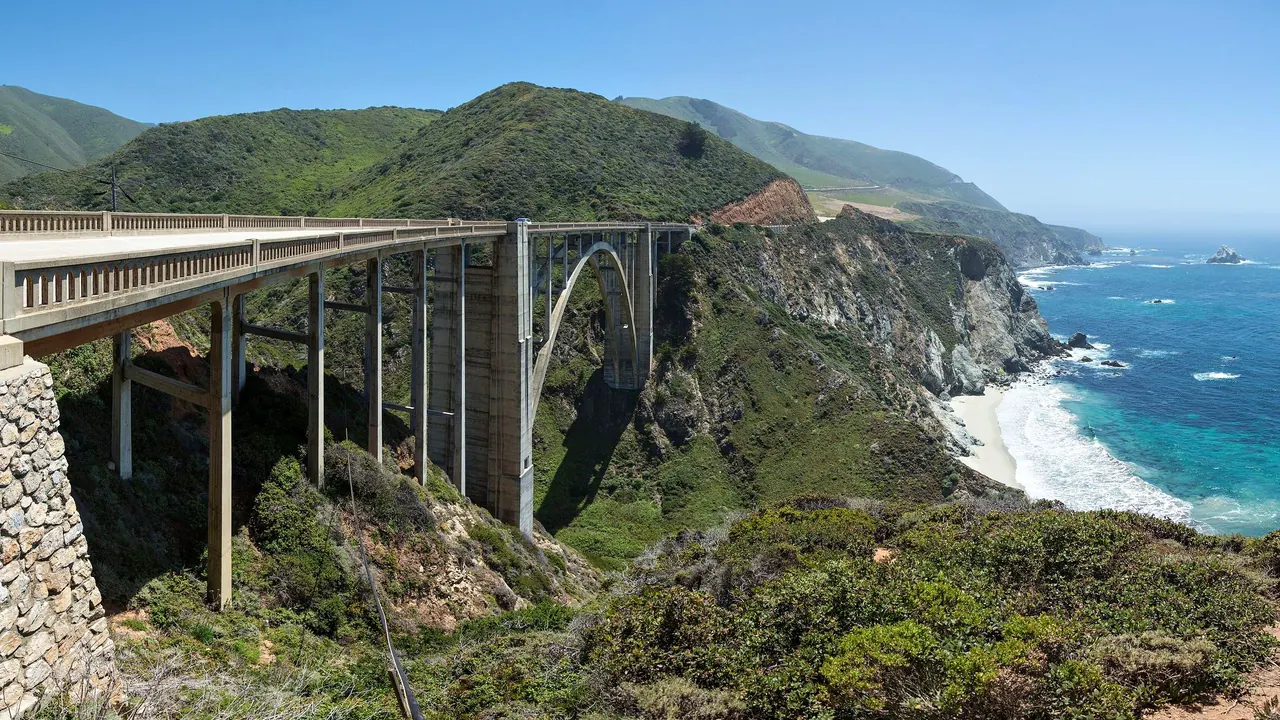
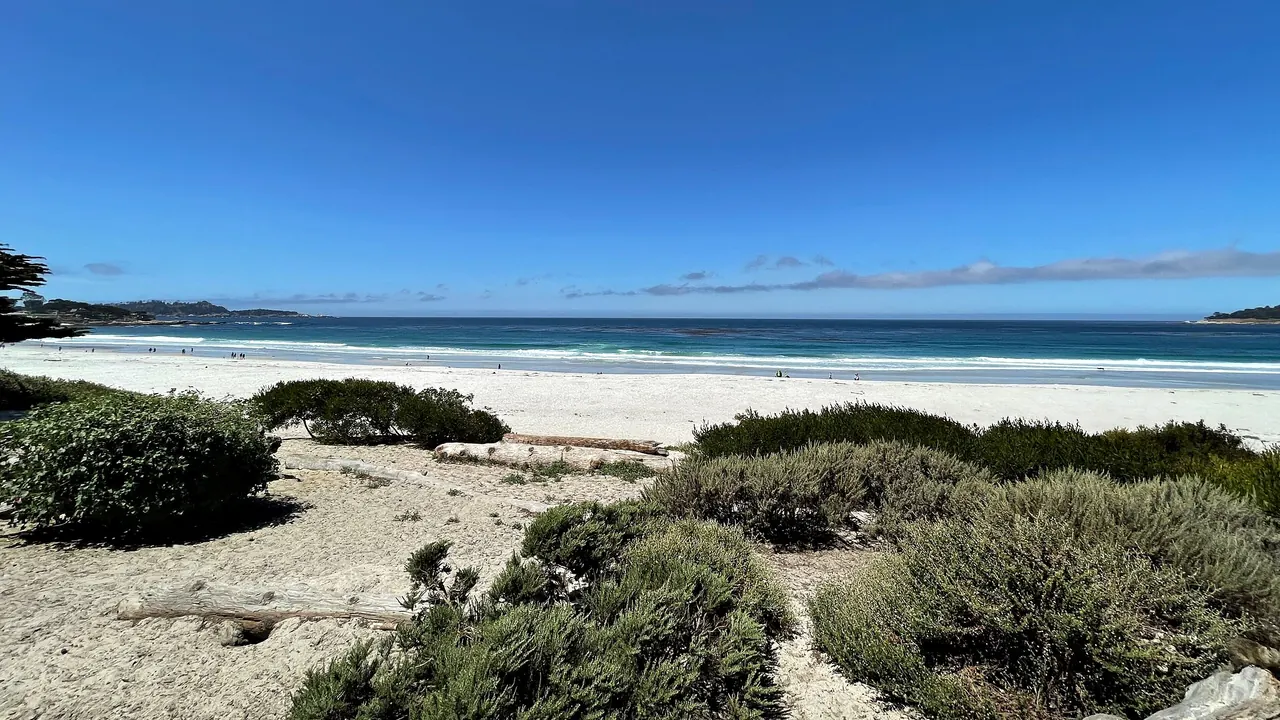
Photos: Big Sur by Diliff, CC BY-SA 3.0, cropped; Carmel-by-the-Sea by Gregory Ford Henderson, CC BY-SA 4.0, cropped.
Big Sur or Carmel-by-the-Sea?
Our verdict in twelve categories, each scored against the same fixed benchmark cities, and the climate month by month, so you can choose for your trip.
Choose Big Sur for
- wellness
- nature and the outdoors
Big Sur is for travellers who want to be inside the landscape rather than visiting it. You wake among redwoods or on a cliff above the surf and walk into the Ventana Wilderness. In the evenings there is a spa, a hot spring or simply a dark sky. It suits hikers, campers and couples on a retreat who accept that meals are few, the road is slow and everything costs a great deal.
Choose Carmel-by-the-Sea for
- shopping
- families
- live music and the arts
Choose Carmel-by-the-Sea for a comfortable base with the coast on its doorstep. Point Lobos is five minutes away and the northern Big Sur parks are within an hour, but you come back to a walkable village with good dinners, the Carmel Mission, galleries, summer concerts and the Monterey Bay Aquarium nearby for the children. You give up some of the wildness and gain far more to do once the walk is over.
Scoreboard
Twelve categories on one fixed scale from 0 to 100. The shaded stretch is the gap between the two.
Your match
Pick a travel style or drag the sliders, and both match scores follow your weighting.
Wins on wellness and nature and the outdoors with your weighting.
Wins on shopping and families with your weighting.
What matters to you?
Category by category
What the scores mean for a trip.
Beaches & swimming
Neither is a place to swim, but Carmel comes out ahead because its beach is part of daily life. A long curve of white sand lies at the bottom of Ocean Avenue, within walking distance of most rooms, and people use it for sunrise dog walks, sunset blankets and children digging.
Big Sur's shores are more dramatic and harder to use. Pfeiffer Beach's rock arch and purple sand and the coves at Garrapata are reached by car and visited for an hour. Others, such as the cove below McWay Falls, can only be seen from above. In both places a hotel pool is where any swimming happens.
Food & drink
Carmel is the clear winner for eating. Within its small grid are candlelit French and Italian dining rooms, wine tasting rooms pouring Santa Lucia Highlands Pinot, and local cooking built on Dungeness crab, sand dabs and Castroville artichokes. Its weakness is that almost nothing is cheap or casual.
Big Sur has a respected bakery, a couple of serious dinner rooms and some roadhouse cafés, all spread along the highway with long drives between them. The view often matters more than the cooking. Many people staying on the Big Sur coast drive up to Carmel for their best dinner.
Culture & sights
Carmel has more to see. Its centrepiece is the Carmel Mission, where Junípero Serra is buried, and around it are the storybook cottages of the 1920s, the timber houses of the old artists' colony and Robinson Jeffers' hand-built Tor House. Even so, it fills a morning or two rather than a whole stay.
Big Sur's culture is mostly a matter of stories. You stop at Bixby Bridge, take a guided walk to the Point Sur Lightstation and spend an hour at the Henry Miller Memorial Library under the redwoods. There is no town to wander, and the history of writers and Beat-era settlers lives more in the landscape than in buildings.
Nightlife
Both are quiet after dark, but in different ways. In Carmel, an evening means a wine bar, a long dinner and a stroll home through quiet unlit lanes by ten. In Big Sur, there is a drink at a lodge bar, then a campfire or stargazing, because no one wants to drive the winding road after a glass of wine. For bars, both send you to Monterey.
Nature & outdoors
Big Sur puts you inside the landscape, with the Santa Lucia Mountains dropping straight into the Pacific for some 140km. Trails such as Pine Ridge climb into the roadless Ventana Wilderness, redwood canyons and waterfalls line the coast, condors circle the ridges and elephant seals gather near Piedras Blancas at the southern end.
Carmel sits at the northern gate of that same coast. Point Lobos is five minutes away, and Garrapata and Bixby Bridge are about half an hour south. Carmel also adds variety the wilder coast lacks: oak-covered trails in sunny Carmel Valley, kayaking among otters and kelp-forest diving in Monterey Bay, and the 17-Mile Drive. The remote southern stretch of Big Sur, however, is a long day's drive away.
Day trips
On the Big Sur coast, where you sleep decides your outings. From the northern end, Carmel, Monterey and the Carmel Valley wineries are within an hour. From the southern end, Hearst Castle above San Simeon and the village of Cambria are closest. The middle of the coast is a slow drive from either end, and landslides sometimes cut the road, so few people manage both.
Carmel avoids that split with short trips north and inland. Monterey's Cannery Row and adobe quarter and the lighthouse at Pacific Grove are minutes away. Salinas has the Steinbeck country, San Juan Bautista has its mission and plaza, and Santa Cruz has its boardwalk about an hour north. San Francisco works as a long day out.
Good for families
Carmel is much easier with children. The Monterey Bay Aquarium is fifteen minutes away and can fill a whole day, and there are tide pools at Point Lobos and Pacific Grove, a gentle town beach for digging and a well-known playground in Monterey. School-age children who like wildlife do best here.
Big Sur works mainly for families who camp. The redwood campgrounds along the Big Sur River have a creek to paddle in and flat forest trails. Beyond that, parents face unfenced cliff viewpoints, carsickness on the bends and nothing designed for children.
Getting around
You need a car in both, but Carmel is much easier. The village is a walkable square mile from the Ocean Avenue shops down to the beach, and thin bus services link it to Monterey. The car is only needed for outings.
In Big Sur, Highway 1 is the only route: narrow, full of hairpins, busy in summer, with few petrol stations and patchy phone signal. After wet winters, landslides can close sections and turn a short trip into a detour of several hours inland. Nothing is within walking distance of anything else.
Shopping & style
Carmel offers an afternoon of proper browsing. There are plein-air galleries around Ocean Avenue and Dolores Street, cashmere and jewellery boutiques tucked into courtyards, and two small open-air centres with upmarket chains. Big Sur has only roadside gift shops, a couple of galleries and general stores for supplies, so for Big Sur visitors Carmel is also the place to shop.
Affordability
Both are among the most expensive places to stay in California, but the ways to save differ. In Big Sur, the few rooms are luxury lodges or costly motels, and petrol and food are expensive because everything comes in by one road. Camping is the main saving, provided you book months ahead.
In Carmel, the boutique inns and dinners are just as costly, but the beach, the village streets and most coastal walks are free. Both are cheaper if you sleep in Monterey or Seaside and drive in.
Live music & performing arts
Carmel has a real arts season. The Bach Festival has filled the summer with Baroque concerts since 1935, the Sunset Center hosts touring performers, and the Forest Theater stages plays outdoors among the pines. The Monterey Jazz Festival is nearby each September.
Big Sur has outdoor concerts, films and readings at the Henry Miller Memorial Library in the warmer months, plus the occasional musician in a lodge. For anything more, Big Sur visitors drive up to Carmel.
Wellness & relaxation
For a real retreat, Big Sur is the better choice. Esalen's stone baths, fed by hot springs on a ledge above the surf, are open to people booked on its workshops and stays. The cliff-top resorts have spas and soaking tubs facing the ocean, and the lack of phone signal and town lights slows everyone down.
Carmel has no thermal water. Its version of wellness is a spa day at a Pebble Beach or Carmel Valley resort, a treatment in your inn and a room with a fire, which suits a slow weekend for a couple rather than a dedicated retreat.
When should you go?
Pick your month. The climate figures are measured averages, not a forecast.
Big Sur in July
Carmel-by-the-Sea in July
Daytime high, °C
Rainfall in the month, mm
Where the figures come from
Big Sur's temperatures are measured 42 km from the centre, at Monterey / Pacific Grove Acres.
Big Sur has no rain gauge within 25 km of the centre, so its rainfall comes from a gridded climate dataset read at the destination rather than from a gauge further away.
Temperature and rainfall are climate normals, averaged over the years shown. Big Sur: 1991-2020 normals, Monterey / Pacific Grove Acres (41.9 km from centre). Carmel-by-the-Sea: 1991-2020 normals, Monterey / Pacific Grove Acres (8.7 km from centre).
Daytime temperatures are almost identical in the two places. Highs run from about 17°C in winter to 23°C from August to October, which makes the whole year mild enough for walking and never hot. The sea stays cold all year, peaking around 15°C in early autumn, so it is never beach weather in the swimming sense. Late summer and autumn bring the warmest days in both places.
Rain is where they part. Both are almost dry from May to September. In winter, though, the Big Sur coast gets far more: around 205mm in December, against about 69mm in Carmel. Those wet months are when landslides close Highway 1, so Big Sur is best from late spring, when the rain stops and the waterfalls still run, through to October. Carmel is easier in winter too, because a wet day in the village still leaves dinner, galleries and the Mission.
Which traveller are you?
On a relaxing and wellness trip, Big Sur is the stronger choice. Esalen's hot-spring baths, cliff-top spas facing the ocean, poor phone signal and nights of real darkness make it a true retreat. Carmel offers a pleasant spa weekend rather than a retreat.
On a family trip with children, Carmel works much better. The Monterey Bay Aquarium is fifteen minutes away, and children can explore tide pools or dig on a safe town beach. In Big Sur, families get unfenced cliffs, a road that makes children carsick and little made for them beyond camping.
For a culture and arts trip, Carmel has more to offer. It has the Carmel Mission and Tor House, galleries along Ocean Avenue, the summer Bach Festival and plays at the Forest Theater. Big Sur's culture is mainly the Henry Miller Library and the stories of the coast.
Before you go
| Measure | Big Sur | Carmel-by-the-Sea |
|---|---|---|
| Currency | US Dollar (USD) | US Dollar (USD) |
| Sockets | AB120 V, 60 Hz | AB120 V, 60 Hz |
| Driving side | Right | Right |
| Time zone | UTC-8, UTC-7 in summer | UTC-8, UTC-7 in summer |
| Emergency number | 911 | 911 |
| Elevation | - | 68 m |
| Main airport | Monterey Regional Airport (MRY)11 non-stop destinations | Monterey Regional Airport (MRY)8 km from centre11 non-stop destinations |
| Public holidays this year | 13 days | 13 days |
By the numbers
| Measure | Big Sur | Carmel-by-the-Sea |
|---|---|---|
| Population | - | 3,220 |
| People per km² | - | 1,150 |
| Museums within 10 km | - | 5 |
| UNESCO World Heritage sites within 50 km | - | 0 |
| Swim season, months above 21 °C | None | None |
Where else could you go?
Every comparison below shares a destination with this one, so you can follow Big Sur or Carmel-by-the-Sea somewhere new.
- Montereyvs Carmel-by-the-Sea
- Montereyvs Big Sur
- San Josevs Carmel-by-the-Sea
- San Franciscovs Carmel-by-the-Sea
- Napavs Carmel-by-the-Sea
- Sonomavs Carmel-by-the-Sea