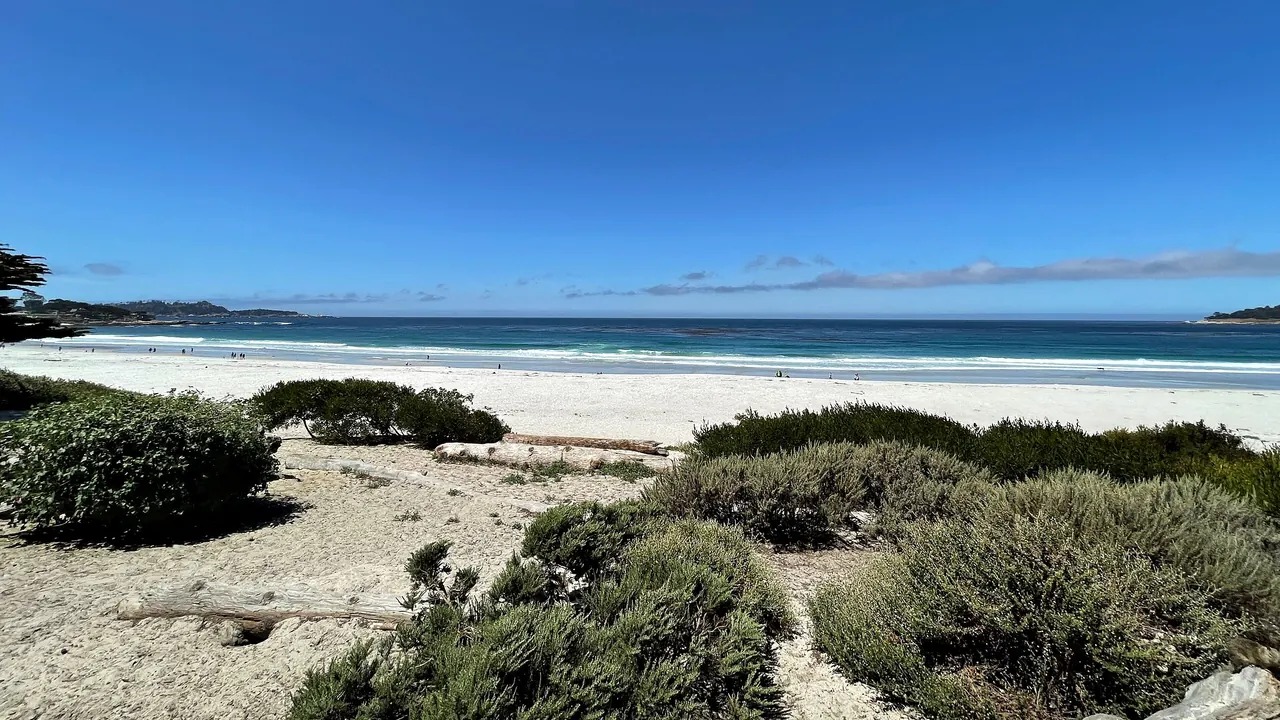
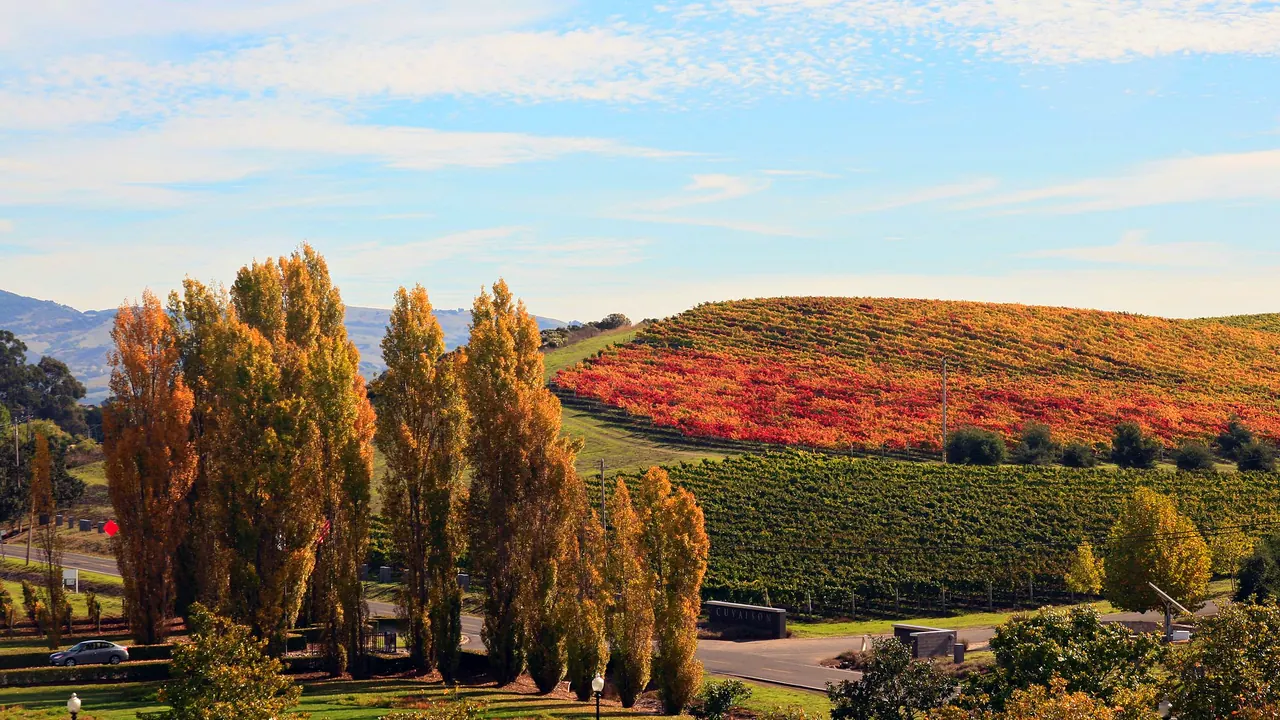
Photos: Carmel-by-the-Sea by Gregory Ford Henderson, CC BY-SA 4.0, cropped; Napa by Brocken Inaglory, CC BY-SA 3.0, cropped.
Carmel-by-the-Sea or Napa?
Our verdict in twelve categories, each scored against the same fixed benchmark cities, and the climate month by month, so you can choose for your trip.
Choose Carmel-by-the-Sea for
- nature and the outdoors
- families
- beaches
Carmel-by-the-Sea suits travellers who want the wild coast close at hand: early walks among the cypress and otters of Point Lobos, a drive down Big Sur, and sunset on the white sand at the foot of the village, followed by a quiet dinner in a cottage bistro. It is also the easier pick with school-age children, thanks to the Monterey Bay Aquarium nearby, and its mission and storybook streets give a little more to look at.
Choose Napa for
- food and drink
- day trips
- wellness
Napa is the place for people who travel to eat and drink. The tasting rooms of Highway 29 and the Silverado Trail, the celebrated kitchens of Yountville and St Helena and the mud baths of Calistoga make a slow, indulgent stay for adults. Sonoma, the Marin towns and San Francisco are all within easy reach for days out. Expect hot summers, and plan on a car or a driver for almost everything.
Scoreboard
Twelve categories on one fixed scale from 0 to 100. The shaded stretch is the gap between the two.
Your match
Pick a travel style or drag the sliders, and both match scores follow your weighting.
Too close to call, level with your weighting
Wins on nature and the outdoors and families with your weighting.
Wins on food and drink and day trips with your weighting.
What matters to you?
Category by category
What the scores mean for a trip.
Beaches & swimming
Neither town is for swimming, but only Carmel has a beach at all. Carmel Beach is a long curve of white sand below the cypress trees at the foot of the village, good for walks, sunset picnics and children digging, even though the cold water and strong surf keep almost everyone out of the sea.
Napa has no shore of its own. The coast at Bodega Bay is more than an hour away and just as cold, so swimming in summer means a resort pool or a drive out to Lake Berryessa in the eastern hills.
Food & drink
Both eat well for their size, but in Napa food is the whole point of the trip. Its Cabernet estates, the Pinot Noir and sparkling wine of Carneros and the famous restaurants of Yountville and St Helena draw people from across the country, and the Oxbow Public Market in town adds oyster counters, cheese and bakeries.
Carmel offers a smaller, more intimate version: candlelit French and Italian dining rooms in cottages, Dungeness crab and sand dabs from Monterey Bay, and Santa Lucia Highlands Pinot poured in the village tasting rooms. Neither does cheap food well, though Napa's taquerias at least give you somewhere casual to eat.
Culture & sights
Carmel has the stronger single sight in the Carmel Mission, the stone basilica where Junípero Serra is buried. Its 1920s storybook cottages, the timber houses of the artists' colony and Robinson Jeffers' Tor House make the village itself worth a slow walk.
Napa's sights are smaller and more spread out: the Victorian fronts along First Street, the di Rosa art estate in Carneros and the old stone wineries up the valley. Neither has a major museum, and a morning in one or a day in the other covers it.
Nightlife
An evening in Carmel is a glass in a tasting room before it shuts, a long dinner and perhaps a nightcap in a hotel lounge. By ten the village streets are silent, and the nearest bars are on Monterey's Alvarado Street, which are fairly modest too.
Napa's evenings run a little longer. After dinner there are wine bars downtown and a few cocktail bars and pubs along the riverfront and First Street, which fill up on summer weekends. There are no clubs, but San Francisco is about an hour away for a real night out.
Nature & outdoors
This is where Carmel pulls clearly ahead. Point Lobos, five minutes away, has granite headlands, seals and sea otters in the coves, and grey whales offshore in winter and spring. Beyond it the Big Sur coast unfolds towards Bixby Bridge and the redwood canyons of Pfeiffer Big Sur, and Monterey Bay adds kayaking and kelp-forest diving.
Napa's landscape is gentler and farmed: a floor of vines between the Mayacamas and Vaca ranges, balloon flights at dawn, a cycling trail along the valley, and walks in Skyline Wilderness Park, among the redwoods of Bothe-Napa and up Mount St Helena. It is lovely, but it is a vineyard valley rather than a wild coast.
Day trips
Napa is much better placed for days out. Sonoma's plaza and mission are about half an hour over the hills, Healdsburg and the Russian River valleys about an hour, and San Francisco is about an hour away by car or by ferry from Vallejo, with Sausalito and Berkeley on the way. Sacramento's state capitol and old town are another option.
Carmel's best outings are close by: Cannery Row and the adobes of old Monterey, the Victorian houses and lighthouse of Pacific Grove, and the tasting rooms of Carmel Valley. Salinas and San Juan Bautista are worth the drive, but San Francisco is two and a half hours away, which makes it a long day.
Good for families
Carmel works better with children, mostly because of what lies nearby. The Monterey Bay Aquarium, with its otters and kelp forest tank, can fill a day, and the tide pools at Point Lobos and Pacific Grove keep school-age children busy, even if the sea is too rough for paddling.
Napa is built around tastings and long dinners, which bore most children. The theme and animal park in Vallejo, the geyser and petting farm near Calistoga and the hotel pools help, but long drives and summer heat make it hard going with small children.
Getting around
Carmel's square-mile grid is easy to cover on foot, from the shops of Ocean Avenue down the steep hill to the beach, and Point Lobos is only minutes away by car. The lanes have no street lights and few pavements, though, so walking back after dinner is dark. You still need a car for Big Sur and the aquarium.
Napa's downtown is just as compact, but the wineries and valley towns are spread along some 50km of road. Since tasting and driving do not mix, many visitors pay for a driver or a tour, and the main road slows to a crawl on summer weekends.
Shopping & style
Neither is a real shopping destination, and the difference is in what you come home with. Carmel is for browsing: an unusually dense run of galleries of plein-air painting, photography and sculpture around Ocean Avenue and Dolores Street, with cashmere and jewellery boutiques tucked into the courtyards.
Napa is for buying wine, often whole cases shipped home from the cellars you visited. Add food gifts and olive oil from the Oxbow Public Market, cookware along St Helena's main street and an outlet mall for familiar brands.
Affordability
Both are expensive, and on cost there is little to choose between them. In Carmel the money goes on boutique inns, cottages and refined dinners, but the best of the place is free: the beach, the village streets and the coastal walks. Staying in Monterey or Seaside cuts the cost of a bed.
Napa adds costs of its own, from tastings at the well-known estates to a driver for the day, and its famous restaurants are special-occasion meals. Chain hotels further south, the taquerias and the market hall make it cheaper, but less of what people come for is free.
Live music & performing arts
Carmel's stage leans classical, with an artists' colony tradition behind it. The Bach Festival has filled its summers with Baroque concerts since 1935, the Sunset Center hosts recitals and speakers, and the open-air Forest Theater stages plays among the pines. Each September the Monterey Jazz Festival takes place next door. Out of season, expect an occasional concert, some community theatre or a guitarist in a wine bar.
Napa leans towards touring bands, singers and comedy, at the 1880 Opera House and a restored Art Deco theatre. A summer classical festival plays in winery venues, and a large rock and pop festival fills the fairgrounds in late spring. Outside those seasons the programme is thin, but San Francisco is close enough for an evening of opera or an orchestra.
Wellness & relaxation
Napa has a bathing tradition that Carmel lacks. The volcanic mud baths and mineral pools of Calistoga have drawn visitors since the nineteenth century, and the resorts in Carneros and the hills have large spas, so a soak after a day of tastings is part of the trip.
In Carmel the calm comes from the setting: misty mornings, dark and quiet evenings, and the spas of the Pebble Beach and Carmel Valley resorts, with no hot springs. It suits a slow weekend by the fire better than a stay built around spa treatments.
When should you go?
Pick your month. The climate figures are measured averages, not a forecast.
Carmel-by-the-Sea in July
Napa in July
Daytime high, °C
Rainfall in the month, mm
Where the figures come from
Napa has no rain gauge within 25 km of the centre, so its rainfall comes from a gridded climate dataset read at the city rather than from a gauge further away.
Napa's sunshine is measured 73 km from the centre, at Sacramento Executive Airport.
Temperature and rainfall are climate normals, averaged over the years shown. Carmel-by-the-Sea: 1991-2020 normals, Monterey / Pacific Grove Acres (8.7 km from centre). Napa: 1991-2020 (sunshine 1981-2010) normals, Napa / Middleton (9.8 km from centre).
Carmel hardly changes through the year. It never really gets hot, and the warmest weather comes late, with highs of about 23°C from August to October. Early autumn is its best season, dry and clear after the foggy summer mornings. The rain arrives in December and lasts until March, though even then it is mild enough for walking. The sea stays at around 14°C all year, so the beach is for walking, not swimming.
Napa swings much more. From June to September it is dry, sunny and hot at about 26°C, so walks and cycling are best done early and afternoons belong to the pool. Winters are cooler and wetter than in Carmel, with more than 130mm of rain a month from December to February. Spring, when the valley turns green, and the warm, dry weeks of October are the most comfortable times to be out among the vines.
Which traveller are you?
For an outdoors trip, Carmel-by-the-Sea is the clear choice. Point Lobos is five minutes away, the Big Sur trails and redwoods are within an hour, and Monterey Bay has kayaking among sea otters. Napa offers gentler vineyard cycling and hill walks.
On a food and nightlife trip, choose Napa. The tasting rooms along Highway 29, the celebrated restaurants of Yountville and St Helena and the wine bars downtown turn every evening into an occasion, though anyone wanting a late night still drives into San Francisco.
On a family trip with children, Carmel-by-the-Sea works better. The Monterey Bay Aquarium is fifteen minutes away, and tide pools and digging on the beach fill the rest of the day. In Napa, tasting rooms, long drives and summer heat leave children with little to do.
Before you go
| Measure | Carmel-by-the-Sea | Napa |
|---|---|---|
| Currency | US Dollar (USD) | US Dollar (USD) |
| Sockets | AB120 V, 60 Hz | AB120 V, 60 Hz |
| Driving side | Right | Right |
| Time zone | UTC-8, UTC-7 in summer | UTC-8, UTC-7 in summer |
| Emergency number | 911 | 911 |
| Elevation | 68 m | 6 m |
| Main airport | Monterey Regional Airport (MRY)8 km from centre11 non-stop destinations | San Francisco International Airport (SFO)76 km from centre143 non-stop destinations |
| Public holidays this year | 13 days | 13 days |
By the numbers
| Measure | Carmel-by-the-Sea | Napa |
|---|---|---|
| City population | 3,220 | 79,246 |
| People per km² | 1,150 | 1,686 |
| Museums within 10 km | 5 | 3 |
| UNESCO World Heritage sites within 50 km | 0 | 0 |
| Swim season, months above 21 °C | None | None |
Where else could you go?
Every comparison below shares a destination with this one, so you can follow Carmel-by-the-Sea or Napa somewhere new.
- Montereyvs Carmel-by-the-Sea
- Sonomavs Napa
- San Franciscovs Napa
- San Josevs Carmel-by-the-Sea
- San Josevs Napa
- San Franciscovs Carmel-by-the-Sea