
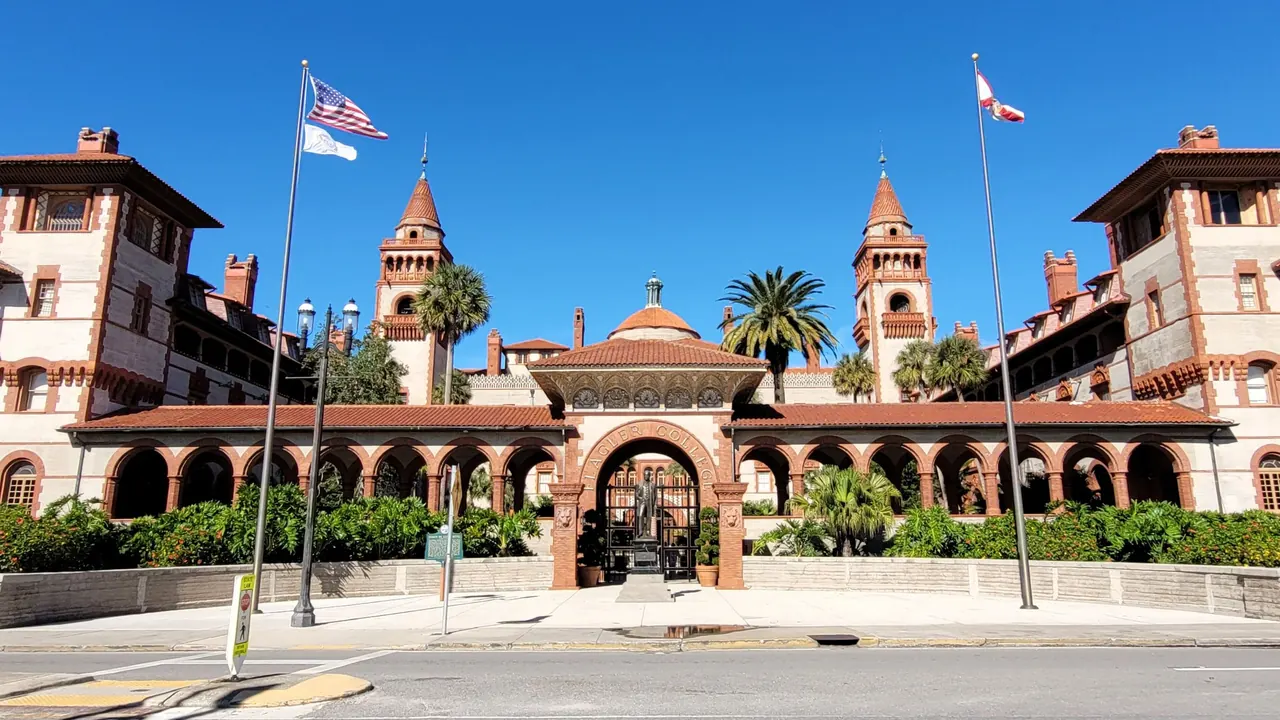
Photos: New Orleans by Bernard Spragg, CC0; St. Augustine by Farragutful, CC BY-SA 4.0, cropped.
New Orleans or St. Augustine?
Our verdict in twelve categories, each scored against the same fixed benchmark cities, and the climate month by month, so you can choose for your trip.
Choose New Orleans for
- nightlife
- live music and the arts
- food and drink
New Orleans is the choice for travellers who plan their days around meals and their nights around music. Creole and Cajun cooking, jazz and brass bands on Frenchmen Street and a bar culture with no closing time give it a depth that St. Augustine can't match. The French Quarter and the Garden District are easy to explore on foot and by streetcar. Just don't expect a beach, because here swimming means a hotel pool.
Choose St. Augustine for
- beaches
- nature and the outdoors
- families
Families, and anyone who wants sand close to old streets, will be happier in St. Augustine. The Spanish colonial town around the Castillo de San Marcos is a short drive from the wide beaches of Anastasia Island, so you can spend the morning on the ramparts and the afternoon in the surf. Evenings are quieter and the food is simpler. That suits a slower trip with children, or a couple who want rest more than late nights.
Scoreboard
Twelve categories on one fixed scale from 0 to 100. The shaded stretch is the gap between the two.
Your match
Pick a travel style or drag the sliders, and both match scores follow your weighting.
Wins on nightlife and live music and the arts with your weighting.
Wins on beaches and nature and the outdoors with your weighting.
What matters to you?
Category by category
What the scores mean for a trip.
Beaches & swimming
This is where the two cities differ most clearly. New Orleans has a lake and a working river but nowhere to swim. The nearest sand is on the Mississippi Gulf Coast around Bay St. Louis, more than an hour's drive away, and the water there is shallow and brownish.
St. Augustine has a real beach on its doorstep. Anastasia Island runs from the dunes of the state park down to quieter Crescent Beach, with Vilano Beach to the north, and the gently shelving Atlantic suits most swimmers from late spring to autumn. The water is greenish rather than clear, but an afternoon on the sand fits easily after a morning in the old town.
Food & drink
New Orleans is one of the great American cities for eating, with a cuisine entirely its own. There are Creole dining rooms in the French Quarter that have served the same dishes for more than a century, Cajun cooking from the bayous, po'boy shops in Mid-City and beignets by Jackson Square. Cocktails such as the Sazerac were invented here. The food is rich and heavy, and it rarely strays from its own tradition.
St. Augustine eats simply and well, mostly seafood. Local shrimp and oysters are served by the water, and the fiery Minorcan datil pepper is the town's own flavour. Apart from a few chef-driven places near San Marco, it is small-town eating, and the restaurants on St. George Street rely on passing tourists.
Culture & sights
Both are old colonial towns with Spanish roots, and for sightseeing they are closely matched. New Orleans is larger and has more layers: the Creole townhouses of the French Quarter and the Cabildo, the mansions of the Garden District, the above-ground tombs and the large National WWII Museum. Creole, African American and Caribbean heritage runs through all of it.
St. Augustine is older and more concentrated. You can see the coquina-stone Castillo de San Marcos, the narrow Spanish lanes and the Gilded Age splendour of Flagler College and the Lightner Museum in two or three days, though some of the colonial houses are reconstructions.
Nightlife
The nights are the heart of a New Orleans trip. There is no closing time and you can carry drinks in the street, so an evening moves from Frenchmen Street to the corner bars of the Bywater and often lasts until dawn. Bourbon Street supplies the neon and the crowds, and the pickpockets too.
St. Augustine offers a pleasant drink on a courtyard patio off St. George Street or at a beach bar on Anastasia Island, and most places close well before the small hours. It suits a drink after dinner, not a big night out.
Nature & outdoors
Both landscapes are flat and wet, but St. Augustine's is easier to reach. Salt marsh, barrier-island dunes and the Matanzas River are minutes from town. You can paddleboard on the lagoon in Anastasia State Park, kayak among dolphins or take long birding walks in the Guana Tolomato Matanzas reserve, and the beach adds a stretch of open coast.
New Orleans has swamps instead. The Barataria Preserve, within an hour, has alligators, herons and Spanish moss, and City Park in town has old live oaks and lagoons. But the wild country takes a tour or a drive to reach, and in both places the summer heat pushes outdoor plans to spring and autumn.
Day trips
Neither city has a long list of day trips, and from both you mostly need a car. From New Orleans the outings are about history and Louisiana itself: the River Road plantations, where the Whitney tells the story of the enslaved people who worked there, the capitol at Baton Rouge, and the Cajun dance-hall towns around Lafayette.
St. Augustine's options lean towards Florida's big attractions. Kennedy Space Center and the Orlando theme parks are each about two hours away, and Jacksonville's museums and the Victorian port of Fernandina Beach are closer.
Good for families
St. Augustine is the easier place to bring children. The Alligator Farm, the cannon demonstrations at the Castillo and the lighthouse climb make history and wildlife hands-on. The island beaches have gentle surf, and the old town is compact and safe.
New Orleans has good family days too: Audubon Zoo, the Aquarium of the Americas, the children's attractions in City Park, and the Mardi Gras parades along St. Charles Avenue. But parents have to plan around Bourbon Street and choose their streets carefully after dark.
Getting around
New Orleans is the easier city to manage without a car. The French Quarter, the Marigny and the Warehouse District are walkable. The historic streetcars are slow but reach the Garden District, Uptown and City Park, and ride-hailing covers the rest.
St. Augustine's old town is smaller still and very easy on foot, but the easy part stops there. The buses are of little use, and the beaches, the lighthouse and anywhere further out mean driving, cycling or taking a taxi.
Shopping & style
New Orleans gives shoppers far more to do. The antique dealers and galleries of Royal Street and the miles of independent boutiques and vintage shops along Magazine Street make a full day of browsing. Mardi Gras masks and costumes are the city's own speciality.
In St. Augustine the shopping is mostly fudge, hot sauce and pirate souvenirs on St. George Street. Aviles Street has a better mix of galleries and antiques, and there is an outlet mall by the interstate for mainstream brands.
Affordability
Neither city is cheap, and in both the room is the biggest cost, rising steeply on peak weekends. New Orleans combines big-city hotel rates and high taxes with cheap everyday pleasures: po'boys, neighbourhood bars, the streetcar and free music in the street. In St. Augustine you save by staying in a highway motel or coming midweek, and walking the old streets and using the public beaches costs nothing.
Live music & performing arts
Live music is one of the main reasons to choose New Orleans. Jazz, brass bands, blues, Cajun and zydeco play every night of the year on Frenchmen Street and in Tremé. Second-line parades move through the neighbourhoods on Sundays, and Jazz Fest is the big event of the spring. The formal arts are modest, but the music in the streets and clubs is the real attraction.
In St. Augustine the main stage is the open-air amphitheatre in the woods on Anastasia Island, which hosts touring rock, country and folk acts. In the old town, cover bands play on bar patios. For opera or serious theatre you would have to go to Jacksonville.
Wellness & relaxation
Neither is a spa destination, and both offer little more than hotel treatment rooms and a few day spas. Where they differ is in the kind of calm. St. Augustine is gentler overall, with B&B verandas and the bayfront seawall in the evening, and it is especially quiet midweek. In New Orleans you have to find rest in a courtyard guesthouse or on a slow streetcar ride, away from the French Quarter at night.
When should you go?
Pick your month. The climate figures are measured averages, not a forecast.
New Orleans in July
St. Augustine in July
Daytime high, °C
Rainfall in the month, mm
Where the figures come from
St. Augustine has no rain gauge within 25 km of the centre, so its rainfall comes from a gridded climate dataset read at the city rather than from a gauge further away.
St. Augustine's sunshine is measured 73 km from the centre, at Jacksonville International.
Temperature and rainfall are climate normals, averaged over the years shown. New Orleans: 1991-2020 (sunshine 1981-2010) normals, New Orleans Airport (2.7 km from centre). St. Augustine: 2006-2020 (sunshine 1991-2020, rainfall 1991-2020) normals, St Augustine / Kingsley Mobile Home Park (7.6 km from centre).
The two cities follow a similar pattern through the year. Both are warm from April to October and hot and stormy in midsummer, when New Orleans reaches about 33°C and long walks become hard work. New Orleans is also wetter for most of the year, with its heaviest rain in June. Its mild winters are fine for walking the Quarter, though January can feel cool. Spring and late October to November are the best times to be out in its streets.
St. Augustine is drier and sunnier, especially from March to May, which is its best season, with warm days, little rain and long hours of sun. The Atlantic is warm enough to swim from late May to October, reaching 28°C, and the rain peaks in September. The Gulf water nearest New Orleans is even warmer in summer, around 30°C, but it is more than an hour's drive away. In winter the sea at both is too cool for most swimmers.
Which traveller are you?
For a food and nightlife trip, New Orleans is the clear pick. Gumbo, po'boys, oysters and crawfish boils fill the days. At night you walk from the jazz clubs of Frenchmen Street to the dive bars of the Bywater, with no closing time to end the evening.
On a beach and sun trip, St. Augustine wins easily. The pale sand of Anastasia Island and Crescent Beach is ten to fifteen minutes from the old town, and the surf is gentle. Spring there also brings much more sunshine than New Orleans gets.
On a family trip with children, St. Augustine is the easier choice. The Alligator Farm, the cannon firings at the Castillo, the lighthouse climb and the gentle surf keep children busy. The compact, safe old town also spares parents the night-time care New Orleans needs.
Before you go
| Measure | New Orleans | St. Augustine |
|---|---|---|
| Currency | US Dollar (USD) | US Dollar (USD) |
| Sockets | AB120 V, 60 Hz | AB120 V, 60 Hz |
| Driving side | Right | Right |
| Time zone | UTC-6, UTC-5 in summer | UTC-5, UTC-4 in summer |
| Emergency number | 911 | 911 |
| Elevation | -2 m | 152 m |
| Main airport | Louis Armstrong New Orleans International Airport (MSY)18 km from centre51 non-stop destinations | Jacksonville International Airport (JAX)76 km from centre48 non-stop destinations |
| Public holidays this year | 14 days | 11 days |
By the numbers
| Measure | New Orleans | St. Augustine |
|---|---|---|
| City population | 383,997 | 14,329 |
| People per km² | 423 | 433 |
| Museums within 10 km | 16 | 12 |
| UNESCO World Heritage sites within 50 km | 0 | 0 |
| Swim season, months above 21 °C | 7 months | 8 months |
Where else could you go?
Every comparison below shares a destination with this one, so you can follow New Orleans or St. Augustine somewhere new.
- Daytona Beachvs St. Augustine
- Orlandovs St. Augustine
- Cocoa Beachvs St. Augustine
- Gulf Shoresvs New Orleans
- Savannahvs St. Augustine
- Tampavs St. Augustine