
Photos: Savannah by Chris M Morris, CC BY 2.0, cropped; St. Augustine by Farragutful, CC BY-SA 4.0, cropped.
Savannah or St. Augustine?
Our verdict in twelve categories, each scored against the same fixed benchmark cities, and the climate month by month, so you can choose for your trip.
Choose Savannah for
- nightlife
- getting around
- food and drink
Savannah suits travellers who want the town itself to be the trip. Its garden squares, Lowcountry cooking and easy-going evenings fill a long weekend on foot, and Charleston, Beaufort and the Georgia islands make good days out. It is the better pick for couples and friends who care more about dinner, a drink in the street and an old-house tour than a swim.
Choose St. Augustine for
- beaches
- families
- nature and the outdoors
St. Augustine is the stronger choice when the sea matters. The beaches of Anastasia Island are a short drive from the Spanish fort, so mornings of history and afternoons on the sand sit comfortably in the same day, and children are well looked after with the Alligator Farm, cannon demonstrations and the lighthouse climb. Choose it for a family trip or a mixed beach-and-sightseeing week, and expect quieter nights and simpler food.
Scoreboard
Twelve categories on one fixed scale from 0 to 100. The shaded stretch is the gap between the two.
Your match
Pick a travel style or drag the sliders, and both match scores follow your weighting.
Wins on nightlife and getting around with your weighting.
Wins on beaches and families with your weighting.
What matters to you?
Category by category
What the scores mean for a trip.
Beaches & swimming
St. Augustine is the beach town of the two. Anastasia Island's long pale sand runs from the dunes of the state park down to quieter Crescent Beach, with Vilano Beach north of the inlet, and all of it is ten to fifteen minutes from the old town, so swimming can fill any afternoon.
Savannah, set on a river, has to drive about half an hour to Tybee Island, a low-key beach town with wide flat sand that most visitors treat as a single day out. Both seas warm to around 28°C in high summer and both are greenish rather than clear, so the difference is access and choice rather than water quality.
Food & drink
Savannah eats better. Its Lowcountry repertoire runs from she-crab soup and Lowcountry boil to fire-roasted oysters in the cooler months, the family-style dining rooms with platters passed along long tables are an experience in themselves, and a handful of serious kitchens sit in restored townhouses south of Forsyth Park.
St. Augustine's table is narrower and mostly casual waterfront seafood, though its Minorcan heritage gives it one thing Savannah lacks: the fiery datil pepper, in hot sauces, pilau and a spicy clam chowder. Beyond that and a few chef-driven places around San Marco, depth means a trip to Jacksonville.
Culture & sights
Savannah offers the fuller townscape. Oglethorpe's 1733 grid of garden squares under live oaks survives almost whole, so the walk itself is the sight, and the Telfair Museums, the Owens-Thomas House with its account of enslaved lives, and Bonaventure Cemetery add depth.
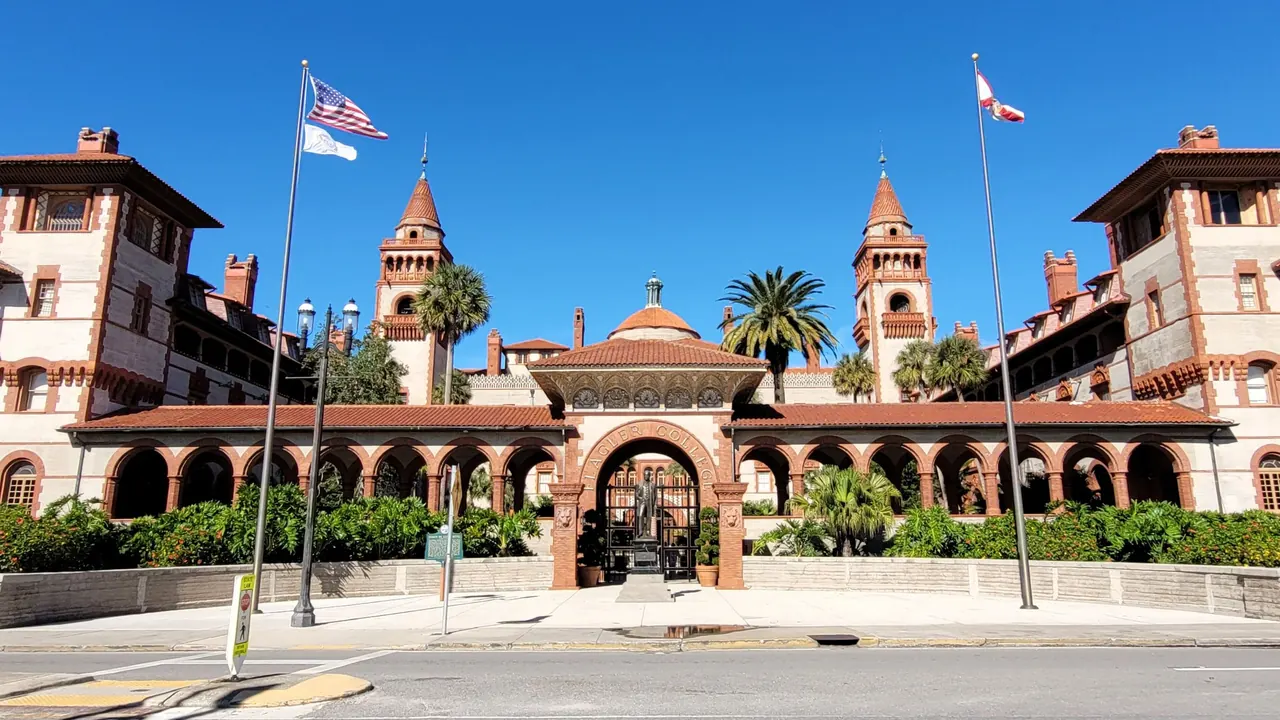
St. Augustine is older and more monumental in a few places, the 1565 Spanish town anchored by the coquina Castillo de San Marcos and, later, Flagler's extravagant hotel that is now Flagler College, with the Lightner Museum opposite. Its Spanish quarter is partly reconstruction, so it reads as a cluster of landmarks rather than an intact city.
Nightlife
Savannah has the livelier evenings. Open-container rules in the historic district let a night wander from River Street's cobbled bars to the taverns of City Market and on to cocktail rooms in old townhouses, and art students keep a few dive bars and dance nights busy. St Patrick's Day turns the whole city into a street party.
St. Augustine is gentler: courtyard pubs and cocktail bars around St. George and Hypolita streets, a small beach-bar scene on the island and almost no clubs. It suits a drink after dinner rather than a late night.
Nature & outdoors
Both sit in flat, watery coastal country of salt marsh and tidal creek, and there is little to choose between them. The difference is in setting: Savannah's outdoors leans to the marsh itself, with kayaking at high tide, dolphin boat trips and the oak avenue at Wormsloe, while St. Augustine adds open-coast dunes, the lagoon at Anastasia State Park and long marsh walks in the Guana Tolomato Matanzas reserve.
St. Augustine's milder winter also stretches the comfortable season from late autumn into spring.
Day trips
Savannah has the richer list. Charleston is about two hours north, and the historic town of Beaufort, Hilton Head, Fort Pulaski and the Georgia islands of Jekyll and St Simons are all an easy drive, mostly old towns and coast that extend the same Southern character.
St. Augustine's outings lean towards big-ticket attractions instead: Kennedy Space Center and the Orlando theme parks are long two-hour days, Daytona's speedway is closer, and Victorian Fernandina Beach and Jacksonville's museums make quieter choices. A car is needed from either town.
Good for families
St. Augustine is easier with children. The Alligator Farm, with every species of crocodilian and a zipline course, the cannon demonstrations at the Castillo and the lighthouse climb are ready-made treats, and a gentle beach is minutes away.
Savannah manages with shady squares, Forsyth Park, the free river ferry, ghost walks for older children and the Girl Scouts founder's birthplace, but it has no zoo, aquarium or theme park, and Tybee's beach and turtle centre need a drive.
Getting around
Savannah is the better town to be without a car for a few days. Its historic district is larger but laid out on a flat grid of shaded squares, with a free downtown shuttle and a river ferry filling the gaps, so most of a stay happens on foot.
St. Augustine's walkable core is smaller, a few minutes from fort to Flagler College, and sightseeing trolleys loop the sights, but the beaches and lighthouse need a car, bike or taxi and old-town parking gets tight. In both, anything beyond the centre means driving.
Shopping & style
Neither is a shopping destination, but Savannah gives the better browse. Broughton Street's restored storefronts hold clothing and home-goods boutiques, and shops selling work by art-school students and graduates add something distinctive.
St. Augustine's St. George Street is mostly fudge, T-shirts and pirate souvenirs; the galleries and antique dealers on Aviles Street are the better find, and an outlet mall by the interstate covers mainstream brands.
Affordability
Costs are much the same in both: historic inns are in demand, weekend and peak rates climb, and eating out carries American tourist-town prices with tip on top. Highway motels and midweek stays help in each, at the cost of needing a car.
What differs is the free entertainment. In Savannah it is the squares, Forsyth Park and Bonaventure Cemetery; in St. Augustine it is the old streets and the public beaches close by, which makes a cheap day out easier there.
Live music & performing arts
Neither town has a deep year-round stage, and the two are roughly matched; they differ in what they put on. Savannah's highlight is its spring Music Festival of chamber music, jazz, blues and Americana in historic theatres and churches, backed by a local philharmonic and an autumn jazz festival in Forsyth Park, so timing matters.
St. Augustine's real venue is the open-air Amphitheatre in the woods on Anastasia Island, booking touring rock, country and folk through much of the year, with cover bands on bar patios most nights.
Wellness & relaxation
Savannah is clearly the more restful of the two. Its twenty-odd squares put a shaded bench under the oaks on almost every walk, and a quiet inn on one of the southern squares, visited midweek in spring or autumn, stays well away from the weekend noise on River Street. Spas are few in both towns, and neither has a bathing tradition.
St. Augustine's calm is more confined: B&B verandas, courtyard gardens and an unhurried evening along the bayfront seawall, all in a small centre that fills up on long weekends.
When should you go?
Pick your month. The climate figures are measured averages, not a forecast.
Savannah in July
St. Augustine in July
Daytime high, °C
Rainfall in the month, mm
Where the figures come from
St. Augustine has no rain gauge within 25 km of the centre, so its rainfall comes from a gridded climate dataset read at the city rather than from a gauge further away.
St. Augustine's sunshine is measured 73 km from the centre, at Jacksonville International.
Temperature and rainfall are climate normals, averaged over the years shown. Savannah: 1991-2020 (sunshine 1981-2010) normals, Savannah Airport (9.9 km from centre). St. Augustine: 2006-2020 (sunshine 1991-2020, rainfall 1991-2020) normals, St Augustine / Kingsley Mobile Home Park (7.6 km from centre).
Both towns are at their best in spring and again in October, when days are warm enough for walking and the sea is still swimmable into autumn. Summer is hot and sticky in each, though Savannah runs hotter, reaching about 34°C in July. The wet season peaks at different times: Savannah's heaviest rain comes early in summer, around 169mm in June, while St. Augustine's builds later and tops out at about 173mm in September, so late summer is the stormier stretch on the Florida coast.
Winter separates them more clearly. St. Augustine stays a little milder and its sea holds at about 19°C in January, against 15°C off Tybee, so a winter beach walk feels gentler there, though swimming is out in both. St. Augustine also gets noticeably more sunshine from late spring through August, while Savannah's cooler, quieter winter months still suit an unhurried stroll through the squares.
Which traveller are you?
For a beach and sun trip, St. Augustine is the better base. From Savannah the sea means a half-hour drive and usually a single day of the stay, while St. Augustine's sand lies just across the bridge, so a swim can follow every morning's sightseeing.
On a food and nightlife trip, Savannah is the stronger choice. Its Southern cooking has more range and a few ambitious kitchens, and its evenings run later across more of the town, while St. Augustine offers mostly casual seafood and a quiet drink after dinner.
On a family trip with children, St. Augustine makes life easier. Savannah keeps children content with open space and short treats but has nothing big built for them, and its beach needs a drive. St. Augustine has more aimed at young visitors, and the sand is close.
Before you go
| Measure | Savannah | St. Augustine |
|---|---|---|
| Currency | US Dollar (USD) | US Dollar (USD) |
| Sockets | AB120 V, 60 Hz | AB120 V, 60 Hz |
| Driving side | Right | Right |
| Time zone | UTC-5, UTC-4 in summer | UTC-5, UTC-4 in summer |
| Emergency number | 911 | 911 |
| Elevation | 15 m | 152 m |
| Main airport | Savannah Hilton Head International Airport (SAV)12 km from centre39 non-stop destinations | Jacksonville International Airport (JAX)76 km from centre48 non-stop destinations |
| Public holidays this year | 12 days | 11 days |
By the numbers
| Measure | Savannah | St. Augustine |
|---|---|---|
| City population | 147,780 | 14,329 |
| People per km² | 524 | 433 |
| Museums within 10 km | 19 | 12 |
| UNESCO World Heritage sites within 50 km | 0 | 0 |
| Swim season, months above 21 °C | 6 months | 8 months |
Where else could you go?
Every comparison below shares a destination with this one, so you can follow Savannah or St. Augustine somewhere new.
- Daytona Beachvs St. Augustine
- Charlestonvs Savannah
- Orlandovs St. Augustine
- Cocoa Beachvs St. Augustine
- Tampavs St. Augustine
- Clearwatervs St. Augustine