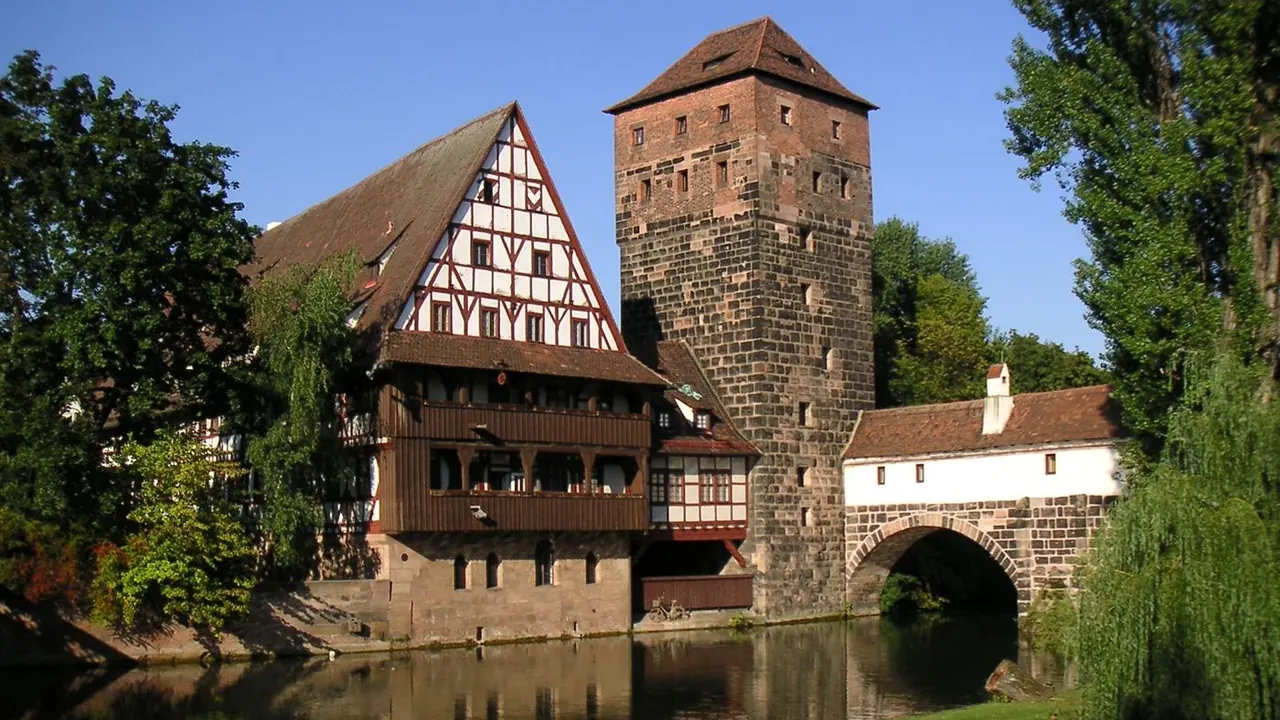
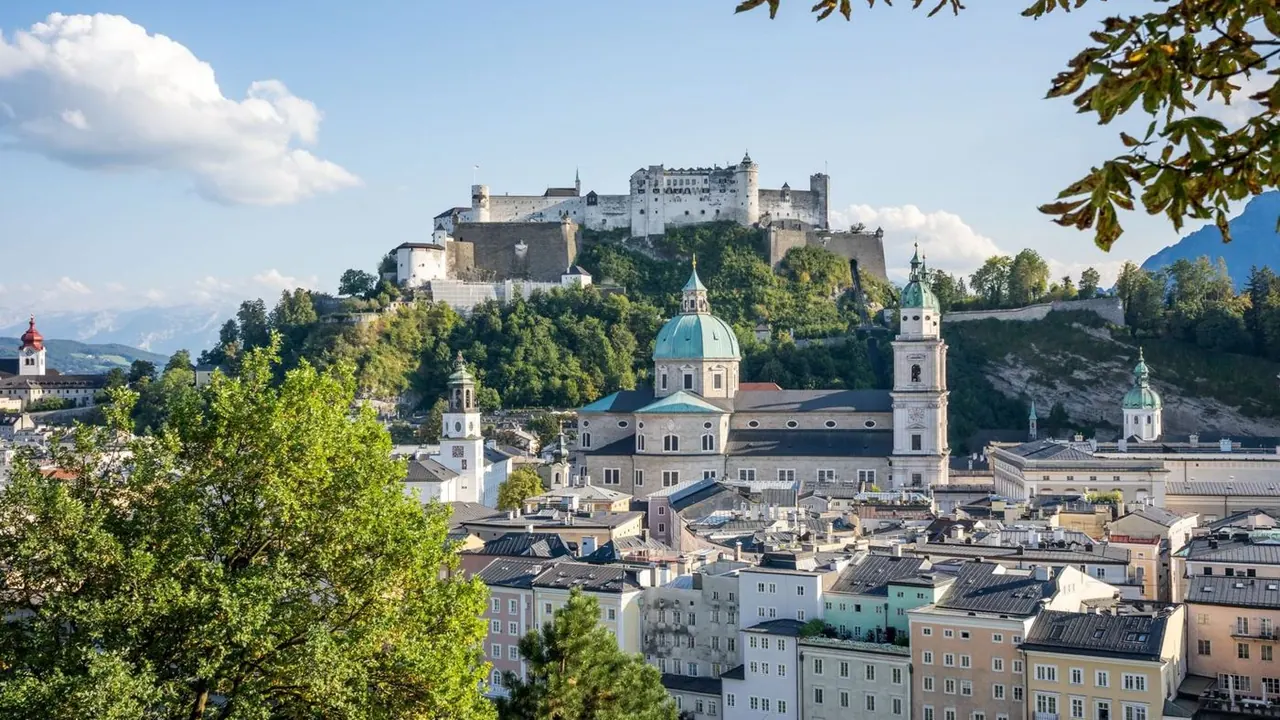
Photos: Nuremberg by Horst Gutmann, CC BY 2.0, cropped; Salzburg by Leonhard Niederwimmer, Pexels License.
Nuremberg or Salzburg?
Our verdict in twelve categories, each scored against the same fixed benchmark cities, and the climate month by month, so you can choose for your trip.
Choose Nuremberg for
- prices
- nightlife
- food and drink
Nuremberg suits travellers who want a walled city they can cover on foot and a lot to think about, from the Kaiserburg and the Germanisches Nationalmuseum to the Rally Grounds and Courtroom 600. Evenings are spent in taverns and beer gardens. It is the cheaper base of the two, its bars in Gostenhof stay livelier, and trains put Bamberg, Regensburg and Würzburg within easy reach without a car.
Choose Salzburg for
- nature and the outdoors
- live music and the arts
- beaches
Pick Salzburg if music and mountains matter more than the bill. Its festival halls, the Mozarteum and the nightly palace concerts give it a classical calendar Nuremberg cannot approach. The Alps begin at the edge of town, with the Untersberg, the Salzkammergut lakes and Berchtesgaden all close by. Expect to pay more and to be in bed earlier.
Scoreboard
Twelve categories on one fixed scale from 0 to 100. The shaded stretch is the gap between the two.
Your match
Pick a travel style or drag the sliders, and both match scores follow your weighting.
Wins on prices and nightlife with your weighting.
Wins on nature and the outdoors and live music and the arts with your weighting.
What matters to you?
Category by category
What the scores mean for a trip.
Beaches & swimming
Neither city is a place for swimming, but Salzburg has better lakes within reach. Fuschlsee, Wolfgangsee and Mondsee are half an hour to forty-five minutes away, with clear green water below steep hills, and you get in from jetties, lawns and small pebble shores.
Nuremberg's nearest swimming is the Franconian Lake District, around an hour south. These are reservoirs such as the Brombachsee, flatter and plainer, though the strips of sand may suit small children better than pebbles. At both, a swim is something extra for a hot afternoon.
Food & drink
Nuremberg eats better, mainly because of its beer. Franconia has a huge number of small breweries, so the old-town taverns and riverside beer gardens pour local lagers and smoky Kellerbier. With them come beechwood-grilled finger-sized bratwurst, Schäufele on a Sunday and Lebkuchen all year.
Salzburg's Austrian cooking is just as hearty, with schnitzel, Kasnocken and the peaked Salzburger Nockerl, and its coffee houses are the best part of the scene. The weak spot is the old town, where many restaurants serve the same menus to tour groups. Better meals are found in the inns of the outer districts and on the hills.
Culture & sights
Both have a historic core you can walk, with a fortress on the hill above, but they come from different centuries. Salzburg is one Baroque ensemble built by the prince-archbishops: cathedral, Residenz, Mirabell, the Mozart houses and the St Peter catacombs, all close together and done in two or three unhurried days.
Nuremberg is Gothic and medieval, ringed by its walls and visibly rebuilt after the war. It adds two things Salzburg has no match for. One is the Germanisches Nationalmuseum, which takes a full day on its own. The other is the sobering twentieth-century history of the Rally Grounds and Courtroom 600.
Nightlife
Nuremberg gives the better night out, though neither is a clubbing city. Gostenhof's small bars and alternative venues, students on the squares and riverbanks in summer, and the weekend crowd from Erlangen keep things going later.
In Salzburg an evening usually means a concert and then a litre mug in a beer hall, and the old town is quiet by midnight. Anyone wanting a proper night out takes the train to Munich.
Nature & outdoors
Here Salzburg is in a different league. Wooded ridges rise right in the centre, a cable car lifts you to limestone ridge walks on the Untersberg at about 1,800m, and the Gaisberg draws hikers and paragliders. Berchtesgaden National Park, the Königssee and the Salzkammergut lakes are all close.
Nuremberg's outdoors is gentler. There is the Reichswald pine forest at the edge of town and riverside cycling along the Pegnitz, and Franconian Switzerland, about an hour away, has wooded valleys, caves and well-known climbing crags. It is good country for walkers and cyclists, but there are no mountains.
Day trips
Both make excellent bases, but the outings are of different kinds. Nuremberg's are historic towns, nearly all easy by train: Bamberg's cathedral hill and smoked-beer taverns in under an hour, Regensburg on the Danube and baroque Würzburg in about an hour, and Munich about an hour by fast train. Rothenburg ob der Tauber and Dinkelsbühl, two of the best-preserved walled towns on the Romantic Road, take a little longer.
Salzburg's trips are lakes, salt and mountains. Hallstatt is about an hour and a half away, St Wolfgang, St Gilgen and the old imperial spa town of Bad Ischl are closer, and the salt mines at Hallein and Berchtesgaden and the clifftop fortress at Werfen are also within easy reach. Munich and Linz work by rail, but the lake villages are where a car saves the most time.
Good for families
Nuremberg wins children over with its centuries of toy-making. There is the Toy Museum, the railway museum with its full-size locomotives, a zoo in wooded old quarries with a dolphin and manatee house, and a play park with water play in Zirndorf. In Advent, a children's market adds carousels and a small steam train.
Salzburg's best family outings either get children wet or take them underground. The trick fountains at Hellbrunn soak unsuspecting visitors, Haus der Natur is hands-on, and the marionettes are popular too. Nearby, the salt mines have wooden miners' slides and boat rides on underground lakes. In both cities the cobbled climb to the castle above town is hard work with a pushchair.
Getting around
Both centres can be walked, but beyond them Nuremberg is a little easier. Its U-Bahn, trams and S-Bahn run on one ticket out to the zoo, the Rally Grounds and Fürth, and regional trains reach every day trip.
Salzburg's core is even more compact and largely free of cars, and trolleybuses cover the city. There is no metro or tram, though, and the buses to the lakes are slow enough that many visitors hire a car.
Shopping & style
Neither is a shopping destination, and what you take home differs. Nuremberg means Lebkuchen in decorated tins, wooden toys, tin figures and crafts from the Handwerkerhof, with chain stores along Königstraße.
Salzburg's speciality is Tracht: dirndls and loden jackets, often made to measure, in shops around Getreidegasse, along with Mozartkugeln and regional cheese from the farmers' market. Both have well-known Advent markets, and Nuremberg's Christkindlesmarkt is the more famous of the two.
Affordability
Nuremberg is clearly the cheaper stay. Tavern meals, local beer and transport cost little, and hotels are fairly priced apart from trade-fair weeks and Advent.
In Salzburg, hotels in and near the old town are expensive all year and restaurants in the centre charge well above the Austrian average, with the summer festival and Advent dearer still. Staying across the river, eating in outer-district beer halls and buying the city card all help.
Live music & performing arts
For music, Salzburg is far ahead. The summer festival fills the Grosses Festspielhaus and the Felsenreitschule with leading performers, and Jedermann is played in front of the cathedral. Mozart Week and the Easter Festival add two more seasons, and the Mozarteum, the Landestheater and the Marionette Theatre fill the rest of the year.
Nuremberg has a respectable regional programme: opera and ballet in the Art Nouveau Staatstheater, two orchestras, the free Bardentreffen folk weekend and a large rock festival by the Zeppelinfeld. For rock rather than Mozart, Nuremberg is the better choice.
Wellness & relaxation
Salzburg is the more restful of the two. It slows down once the day-trippers leave, the Paracelsus Bad in the city park has saunas, and proper spa country is close: the brine baths of Bad Reichenhall about twenty minutes away and the radon springs of the Gastein valley.
Nuremberg relies on a large thermal spa in Fürth, saunas at the edge of town (expect them to be nude and mixed) and the saline pools of Bad Windsheim an hour west. Here the local way to unwind is a slow afternoon in a beer garden.
When should you go?
Pick your month. The climate figures are measured averages, not a forecast.
Nuremberg in July
Salzburg in July
Daytime high, °C
Rainfall in the month, mm
Temperature and rainfall are climate normals, averaged over the years shown. Nuremberg: 1991-2020 normals, Nuernberg (5.5 km from centre). Salzburg: 1991-2020 normals, Salzburg (3.4 km from centre).
The two cities have almost the same temperatures. Winters are cold, with highs around 4°C, and July and August reach about 25°C. That makes May to September the time for walking the streets, and June to early September the only window for lake swimming. The real difference is rain. Salzburg sits against the Alps and gets heavy summer rainfall, up to 168mm in June. Nuremberg's wettest month, July, has only 77mm and is also its sunniest.
In winter it is the other way round. From November to February Salzburg gets noticeably more sunshine than grey Nuremberg, and snow often reaches the town. For a dry summer of beer gardens and riverside afternoons, Nuremberg is the safer bet. A summer trip to Salzburg means planning around showers.
Which traveller are you?
For an outdoors trip, Salzburg is the clear choice. Mountain walking starts at the city limits, with the Untersberg cable car and the Gaisberg trails, and the Salzkammergut lakes for paddling and Berchtesgaden National Park are both about half an hour away.
On a trip on a tight budget, your money goes much further in Nuremberg. Tavern food and local beer are cheap, one ticket covers all the transport, and hotels are fairly priced outside the fair weeks. Salzburg's centre stays expensive all year.
For a food and nightlife trip, Nuremberg has the edge again. Franconia's small breweries, its bratwurst and its beer gardens beat Salzburg's tour-group menus, and the bars in Gostenhof keep going long after Salzburg's old town has gone quiet at midnight.
Before you go
| Measure | Nuremberg | Salzburg |
|---|---|---|
| Official language | German | German, Austrian Sign Language |
| Currency | Euro (EUR) | Euro (EUR) |
| Sockets | CF230 V, 50 Hz | CF230 V, 50 Hz |
| Driving side | Right | Right |
| Time zone | UTC+1, UTC+2 in summer | UTC+1, UTC+2 in summer |
| Emergency number | 112 | 112 |
| Elevation | 209 m | 424 m |
| Main airport | Nuremberg Airport (NUE)5 km from centre56 non-stop destinations | Salzburg Airport (SZG)3 km from centre64 non-stop destinations |
| Public holidays this year | 12 days | 16 days |
By the numbers
| Measure | Nuremberg | Salzburg |
|---|---|---|
| City population | 531,159 | 155,021 |
| People per km² | 2,848 | 2,360 |
| Museums within 10 km | 50 | 38 |
| UNESCO World Heritage sites within 50 km | 1 | 3 |
Where else could you go?
Every comparison below shares a destination with this one, so you can follow Nuremberg or Salzburg somewhere new.