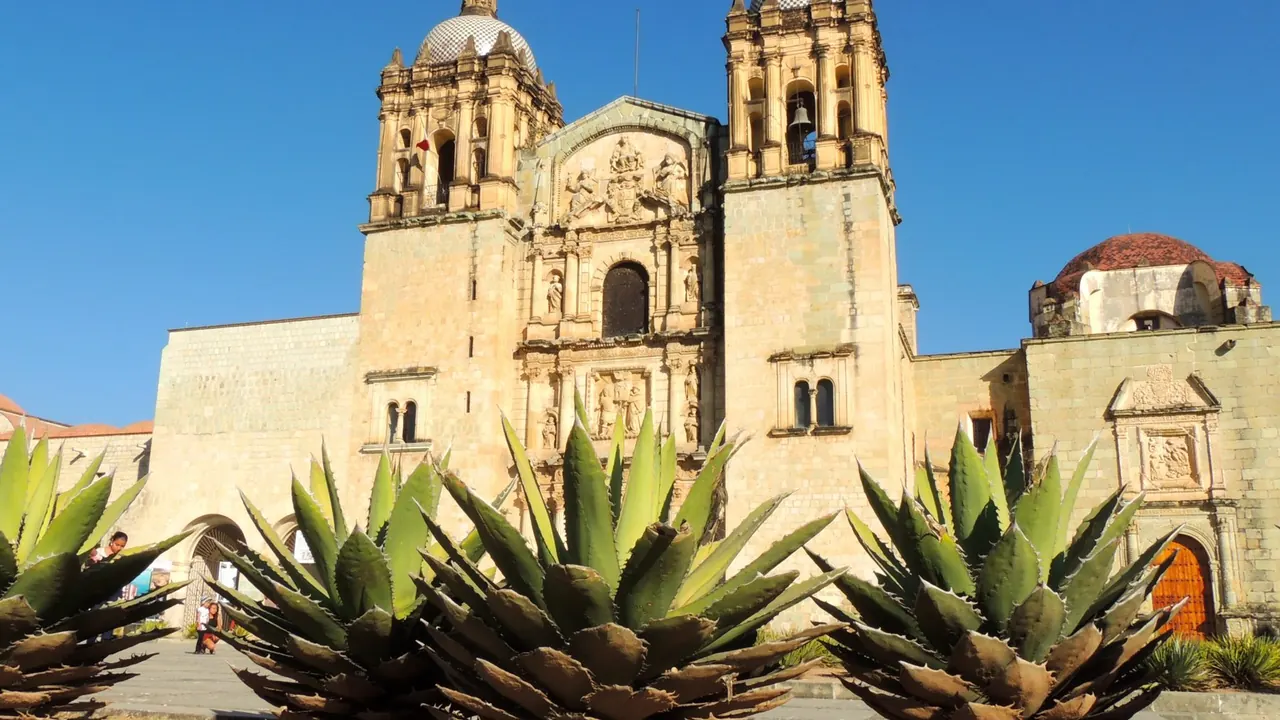
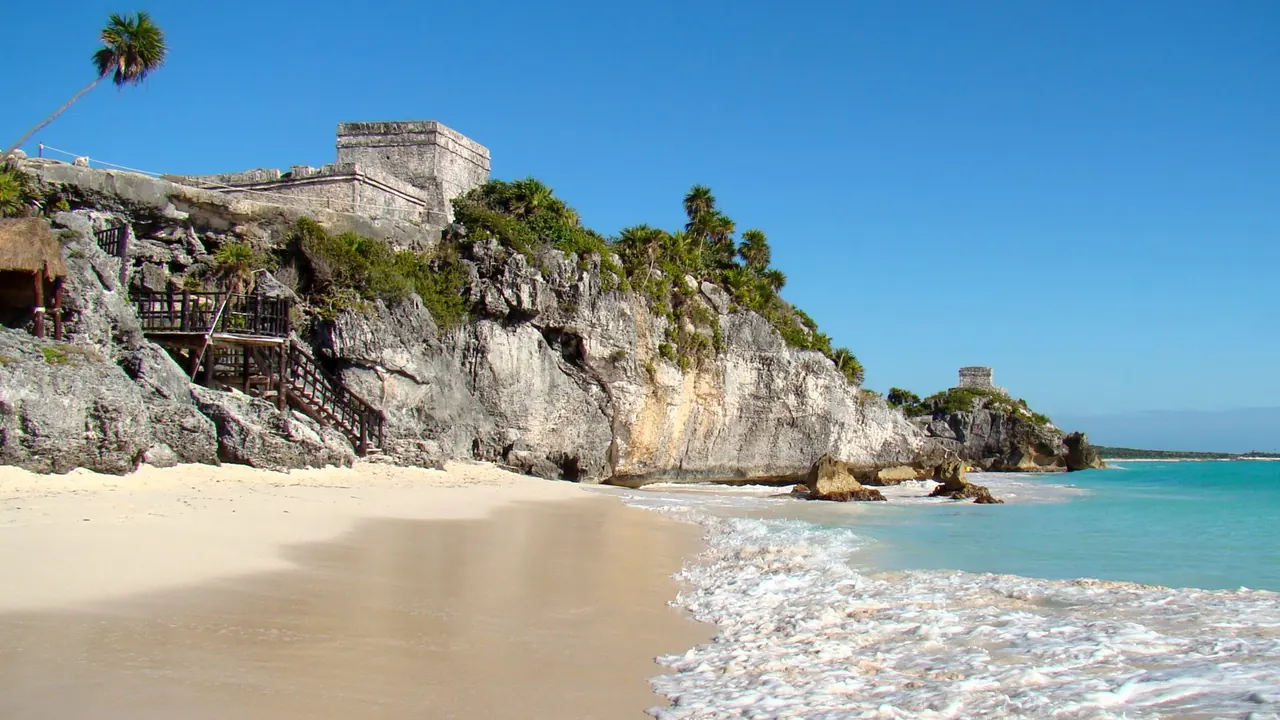
Photos: Oaxaca by Öskr Rck, CC BY-SA 3.0, cropped; Tulum by Bjørn Christian Tørrissen, CC BY-SA 3.0, cropped.
Oaxaca or Tulum?
Our verdict in twelve categories, each scored against the same fixed benchmark cities, and the climate month by month, so you can choose for your trip.
Choose Oaxaca for
- prices
- culture and sights
- food and drink
Oaxaca suits travellers who want a city to walk and eat in. It has a UNESCO-listed colonial centre of pale green stone, Monte Albán on its flattened mountaintop, markets full of mole and tlayudas, and valley villages where rugs, pottery and mezcal are made. It costs far less, and evenings run on mezcal and long dinners rather than parties. There is no beach, so anyone who wants sand has to add the Pacific coast as a separate leg.
Choose Tulum for
- beaches
- wellness
- nightlife
Pick Tulum when the trip is built around water and slowing down. Pale Caribbean sand, cenotes for snorkelling, the lagoons of Sian Ka'an and a dense spread of yoga shalas and spas give it an easy, barefoot rhythm, and its jungle DJ nights draw a party crowd in winter. In return you pay a great deal more, need a car or tours to get about, and find little history beyond the cliff-top ruins and the Maya sites inland.
Scoreboard
Twelve categories on one fixed scale from 0 to 100. The shaded stretch is the gap between the two.
Your match
Pick a travel style or drag the sliders, and both match scores follow your weighting.
Too close to call, 2 points apart
Wins on prices and culture and sights with your weighting.
Wins on beaches and wellness with your weighting.
What matters to you?
Category by category
What the scores mean for a trip.
Beaches & swimming
This is where the two differ most. Oaxaca lies in a highland valley with mountain ranges between it and the Pacific, so swimming in the city means a hotel pool. Puerto Escondido or Huatulco is a separate trip of several hours.
Tulum is a beach destination first. Long pale sand runs south from the cliff-top ruins, the water is warm and turquoise, and turtles graze in the bay at Akumal. The one thing to check before booking is sargassum, which can pile up in the warmer months.
Food & drink
Oaxaca is by far the stronger place to eat. The moles, tlayudas, quesillo and chapulines, the smoky grill aisle of the 20 de Noviembre market and mezcal from village distilleries make food a reason to come in its own right. Serious chefs also build tasting menus on local maize.
Tulum has good Yucatecan cooking, such as sopa de lima, fish grilled with achiote and cochinita pibil from the town's taco stands. But the candlelit restaurants on the beach road often sell the setting more than the plate, and in a small town the choice is narrow.
Culture & sights
Oaxaca offers days of sightseeing: the gilded interior of Santo Domingo, the Tomb 7 gold in the Museo de las Culturas, the Tamayo and textile museums, and Monte Albán twenty minutes away. Tulum has one sight of real weight, the walled Maya port on the cliff, which takes a couple of hours, and its modern town grid has no museums of note. Culture-minded visitors staying in Tulum end up spending their time at Coba or Chichen Itza instead.
Nightlife
Tulum has the bigger nights. Its jungle DJ sets, beach clubs that run from late afternoon into the dark and full-moon parties are known well beyond Mexico, and they peak in winter. Big events are expensive, though, and there is no bar district to wander on the quieter nights.
Oaxaca's evenings are smaller and more local. Expect mezcal tasting bars in the centre and Jalatlaco, rooftop terraces over the domes of Santo Domingo, and a few salsa nights at weekends, but almost no clubbing.
Nature & outdoors
Tulum's outdoors is mostly about water. Cenotes such as Gran Cenote and Dos Ojos offer cavern snorkelling and cave diving, there is reef offshore, and boats float through the mangroves and Maya channels of Sian Ka'an. That gives it the edge for most visitors, though the land is flat and has no hiking to speak of.
Oaxaca is the opposite, mountains rather than water. It has village-to-village walks through the pine-oak and cloud forest of the Sierra Norte, guided mountain biking among agave fields, and the mineral cliffs of Hierve el Agua.
Day trips
Both make good bases, but for different kinds of outing. From Oaxaca the trips are short and close together: Mitla's stone fretwork, the weavers of Teotitlán and the earth-pit distilleries of Matatlán are all within an hour, and colectivos make two or three stops in a day easy.
Tulum's outings are bigger names spread further apart. Coba is under an hour away, Chichen Itza with Valladolid is about two hours, and Cozumel is a ferry ride from Playa del Carmen. Most need a car, a tour or the Tren Maya.
Good for families
Tulum works better with children, mainly because of the water: warm sea, turtles at Akumal, calm cenote pools and the eco-parks at Xel-Ha and Xcaret. Families still need a pool, a hire car and a plan for heat and mosquitoes.
Oaxaca welcomes children in its zócalo and pedestrian streets, and older ones enjoy painting alebrijes. But it has no zoo or theme park, the ruins have little shade, and the cobbles are hard work with a pushchair.
Getting around
Oaxaca is the easier of the two to get around. Almost everything lies within a twenty-minute walk of the zócalo, and cheap taxis and colectivos cover the valley. Tulum is strung out along a highway, with the beach a few kilometres from town and the hotel strip running far to the south, so days depend on bicycles, costly taxis or a hire car.
Shopping & style
Oaxaca is one of Mexico's great places to buy crafts. You can shop in the cooperative galleries along the Macedonio Alcalá or go to the villages where things are made: rugs in Teotitlán, black pottery in San Bartolo Coyotepec, carvings in Arrazola, and the weekly market at Tlacolula. Tulum's shopping has one look, linen, macramé and palm baskets in pricey beach-road boutiques, with better-value hammocks and silver on the town's main avenue.
Affordability
Oaxaca is much the cheaper of the two, and the gap is clearest in a comfortable mid-range stay. A pleasant room a few streets from the zócalo, a good dinner and a round of village mezcal afterwards cost far less than the same evening in Tulum. Oaxaca's dearest options, its colonial boutique hotels and chef-led menus, are closer to what Tulum charges for an ordinary room on the beach road than to anything exceptional.
In Tulum you pay mainly for location rather than comfort, and every step closer to the sand raises the price. Going out costs more too: the big DJ nights are priced well above anything in Oaxaca's mezcal bars. Days out add up differently as well. Oaxaca's ruins and craft villages are close and simple to reach, while Tulum's cenotes, Sian Ka'an and the inland Maya sites usually mean paying for a hire car or a tour as well as the entry. The way to save there is to stay in the town grid and ride out to the beach.
Live music & performing arts
Neither city is somewhere to plan a trip around shows, but Oaxaca has far more. The Guelaguetza takes over in July, the Day of the Dead brings processions, the state band and marimbas play in the zócalo, and the ornate Teatro Macedonio Alcalá hosts concerts and dance. Tulum has no theatre or concert hall, and live music means bar bands and the musicians who play alongside DJ nights.
Wellness & relaxation
Tulum is built around wellness. Yoga shalas, retreat hotels and open-air spas line the beach road and the jungle, with sound baths and breathwork every day. The southern strip has a slow, barefoot pace, as long as you stay well away from the clubs.
Oaxaca shares the temazcal sweat lodge, often led by a traditional healer in the valley villages. Beyond that, its calm comes from the city's easy pace, shaded courtyards and slow mornings over hot chocolate rather than from a spa scene.
When should you go?
Pick your month. The climate figures are measured averages, not a forecast.
Oaxaca in July
Tulum in July
Daytime high, °C
Rainfall in the month, mm
Where the figures come from
Tulum has no weather station within reach, so its figures come from a gridded climate model rather than a measured record, and read a broad area rather than the city itself.
Temperature and rainfall are climate normals, averaged over the years shown. Oaxaca: 1961-1990 normals, Oaxaca, Oax. (1.1 km from centre). Tulum: 2001-2020 normals, NASA POWER reanalysis grid, no weather station within 90 km.
Oaxaca is most comfortable from November to January. The valley is almost dry and sunny nearly every day, and highs of around 28°C make walking the centre and climbing Monte Albán easy. It warms through February and March, and by April and May highs reach 33°C, so midday sightseeing becomes tiring. The rains arrive in June and last into September, turning the hills green but muddying the mountain trails.
Tulum is warm enough for the beach in every month, and the sea never drops below 27°C. February to April is its driest stretch, and rain builds from May to a peak in September and October, when a month can bring over 200mm. Month by month the two follow a similar pattern, drier in winter and wet in summer, but Oaxaca's dry season is far drier. In October Oaxaca is already drying out, while Tulum is having its wettest month.
Which traveller are you?
On a beach and sun trip, Tulum is the only real choice. It has long pale sand, sea warm enough to swim in all year and turtles to snorkel with at Akumal. Oaxaca sits in the mountains, several hours from the Pacific.
For a culture and arts trip, Oaxaca wins clearly. The colonial centre, gilded Santo Domingo, museums of Zapotec gold and regional weaving, printmaking workshops and Monte Albán fill several days. The Guelaguetza adds dance and music in July.
On a trip on a tight budget, Oaxaca goes much further. Market tlayudas, family-run fondas, cheap colectivos and simple guesthouses keep costs low. In Tulum, hotels, taxis, beach clubs and separate cenote entries all cost far more.
Before you go
| Measure | Oaxaca | Tulum |
|---|---|---|
| Official language | Spanish, Nahuatl, Yucatec Maya | Spanish, Nahuatl, Yucatec Maya |
| Currency | Mexican Peso (MXN) | Mexican Peso (MXN) |
| Sockets | AB127 V, 60 Hz | AB127 V, 60 Hz |
| Driving side | Right | Right |
| Time zone | UTC-6 | UTC-5 |
| Emergency number | 911 | 911 |
| Elevation | 1,555 m | 5 m |
| Main airport | Xoxocotlán International Airport (OAX)7 km from centre14 non-stop destinations | Felipe Carrillo Puerto International Airport Tulum (TQO)21 km from centre11 non-stop destinations |
| Public holidays this year | 9 days | 9 days |
By the numbers
| Measure | Oaxaca | Tulum |
|---|---|---|
| City population | 258,913 | 33,374 |
| People per km² | 3,028 | - |
| Museums within 10 km | 10 | 0 |
| UNESCO World Heritage sites within 50 km | 2 | 0 |
| Swim season, months above 21 °C | - | 12 months |
Where else could you go?
Every comparison below shares a destination with this one, so you can follow Oaxaca or Tulum somewhere new.