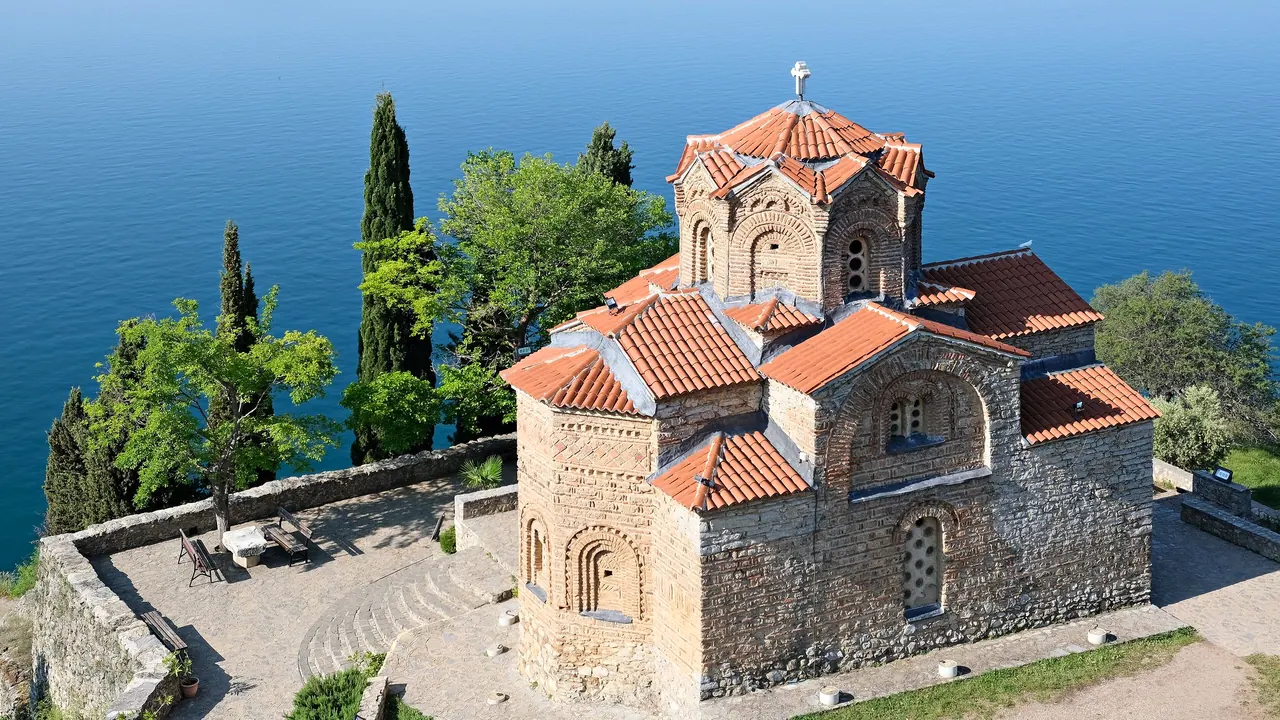
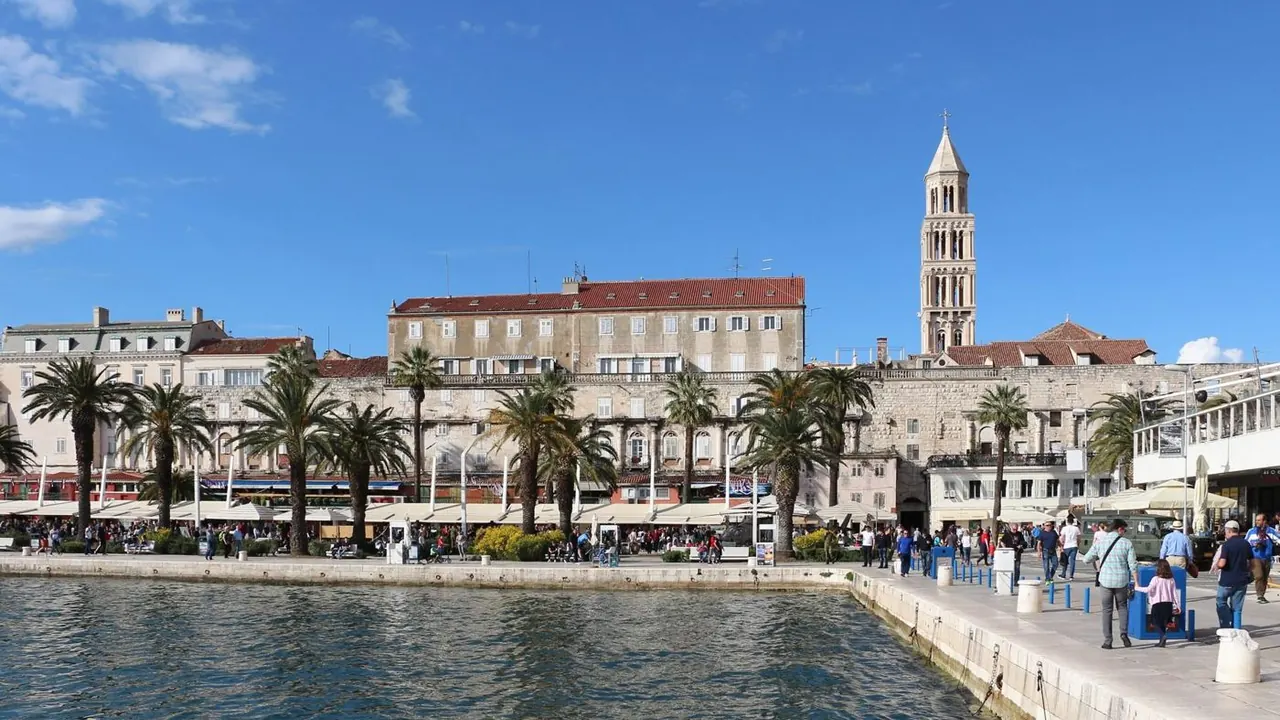
Photos: Ohrid by kallerna, CC BY-SA 4.0, cropped; Split by Bernard Gagnon, CC BY-SA 4.0, cropped.
Ohrid or Split?
Our verdict in twelve categories, each scored against the same fixed benchmark cities, and the climate month by month, so you can choose for your trip.
Choose Ohrid for
- prices
Ohrid suits a slower, cheaper trip built around one place: a hillside old town of medieval churches and frescoes, a clear freshwater lake to swim in, and the mountains of Galičica rising behind it. It costs far less than Split, especially outside high summer. It is the better pick if you are happy with simple Macedonian cooking, quiet evenings and a car or driver for the wider region.
Choose Split for
- day trips
- beaches
- food and drink
Choose Split if you want the sea and plenty of variety. You can swim from the old town, eat Dalmatian seafood, and spend evenings in the stone alleys of a Roman palace. Ferries and buses from the harbour put islands, Trogir and Krka within easy reach. You will pay more for it, but there is much more to fill a week.
Scoreboard
Twelve categories on one fixed scale from 0 to 100. The shaded stretch is the gap between the two.
Your match
Pick a travel style or drag the sliders, and both match scores follow your weighting.
Wins on prices with your weighting.
Wins on day trips and beaches with your weighting.
What matters to you?
Category by category
What the scores mean for a trip.
Beaches & swimming
Split is the stronger swimming base because it has the sea, warm and clear, a short walk from the palace. There is the shallow sandy bay at Bačvice, quieter pine-shaded coves around Marjan, and ferries to Brač, Šolta and Hvar for longer beaches. The water stays pleasant into October.
Ohrid offers something different: fresh, very clear, calm lake water, reached from jetties, concrete platforms and short pebble strips at Kaneo, Potpeš and further south at Lagadin and Gradište. The beaches are smaller and the season runs only from about late June to mid-September.
Food & drink
Split eats better and more widely. Its Dalmatian table runs from grilled squid and black risotto to pašticada and octopus slow-cooked under the peka bell. The fish market and the Pazar green market show what is in season, and Plavac Mali and Pošip wines go with all of it.
Ohrid's cooking is honest Macedonian home food, such as tavče gravče, stuffed peppers and belvica from the lake, but the same menus repeat along the waterfront. In both places the best meals are in family-run spots away from the main promenade, and neither has much fine dining.
Culture & sights
The two are evenly matched, but in very different ways. Ohrid is a whole hillside of Orthodox churches: the medieval frescoes of St Sophia, St John at Kaneo on its rock above the lake, the Plaošnik site linked to Cyrillic learning, and Samuel's Fortress at the top.
Split's draw is a single Roman monument that people still live in. Diocletian's Palace holds the cathedral that was once the emperor's mausoleum, and the vaulted halls beneath it show the original plan. The Meštrović Gallery adds sculpture. Either city can be seen properly in about two days.
Nightlife
Split has the livelier evenings. In summer, the crowd moves from the Riva into small bars tucked into the palace stairways, then on to beach bars and a few late clubs around Bačvice.
Ohrid's summer nights centre on the stroll along the lake, with café-bars by the old bazaar and some beach clubs on the southern shore, and there is no real club scene. In both towns, going out shrinks to a glass of wine with locals once autumn comes.
Nature & outdoors
Both have fine settings, but Split gives you more kinds of outdoors from one base. Marjan's pine woods and cliffs start at the edge of the old town, and Mosor, Kozjak and Biokovo offer proper ridge hikes. You can raft or go canyoning on the Cetina at Omiš, see the waterfalls at Krka, and sail or kayak among the islands.
Ohrid's outdoors centre on its lake. Galičica rises steeply above it, with trails to summits above 2,000m, a viewpoint over both Ohrid and Prespa, and paragliders launching from the same ridge. Kayaks and the lakeshore path south of town cover the gentler side.
Day trips
Split is much the easier base for outings. Trogir is about half an hour away and Šibenik's cathedral about an hour, and Salona and Klis Fortress are on the edge of the city. In summer the harbour ferries make Hvar, Brač and Vis simple to reach.
From Ohrid the choice is good but harder to reach: St Naum by summer boat, Bitola and the mosaics of Heraclea, and cross-border days to Pogradec and Korçë in Albania. Roads are slow and buses are sparse, so you will need a car or a driver.
Good for families
Split works a little better with children. Bačvice is shallow enough for paddling, Marjan has shade and room to run, and a ferry ride to an island is often the highlight. The catch is the heat and crowds of July and August.
Ohrid is calmer and very safe. Children can spend whole days in the lake, and the prehistoric pile village at the Bay of Bones is a good outing. Its steep, cobbled lanes are hard work with a pushchair, and neither city has zoos or theme parks.
Getting around
Split is simpler to manage without a car. Its car-free centre puts the palace, the markets, Varoš and Bačvice within about fifteen minutes' walk, and the ferry port, bus station and railway station sit together at the harbour.
Ohrid's centre is just as easy on foot, and taxis are plentiful for short hops. Once you leave town, though, the buses and boats to the southern beaches and St Naum are infrequent, so many visitors hire a car. Both old towns mean stone steps.
Shopping & style
Neither is a shopping destination, and they are broadly level, but they sell different things. Ohrid's speciality is a craft: the Ohrid pearl, best bought from an old family workshop in the bazaar, along with filigree silver, carved wood and icons.
Split's best buys are edible, such as figs, honey, brandies, olive oil and wine from the Pazar market. Marmontova street also has the mainstream fashion chains that Ohrid lacks.
Affordability
Ohrid is far cheaper. Guesthouses, meals with wine, taxis and church entry fees all cost little, and only lakefront rooms on summer weekends rise noticeably.
Split is mid-priced for most of the year but expensive in July and August. Old town rooms then cost Western European big-city rates, fish is priced by weight on the waterfront, and island ferries add up for a family. In both places, late spring and early autumn give the best mix of price and weather.
Live music & performing arts
Split offers more to see over the year. The 19th-century Croatian National Theatre stages opera and ballet through its season, the Split Summer Festival uses the Peristyle as an open-air stage, and klapa singers often perform in the palace's domed vestibule.
Ohrid's offer is mostly its summer festival, held since the early 1960s, with concerts and opera in St Sophia and the ancient theatre. These are memorable settings, but there is little else outside the season.
Wellness & relaxation
Neither has a bathing tradition. Split has a little more for relaxing, with resort spas along the coast east of the centre, the Dalmatian habit of fjaka over long coffees on the Riva, and quiet islands close by when the old town gets loud.
Ohrid has only a few hotel spas, and its nearest thermal springs are a long drive away near Debar. Its strength is the stillness of the lake in May, June and September, when slow mornings by the water are the main way to unwind.
When should you go?
Pick your month. The climate figures are measured averages, not a forecast.
Ohrid in July
Split in July
Daytime high, °C
Rainfall in the month, mm
Where the figures come from
Ohrid has no rain gauge within 25 km of the centre, so its rainfall comes from a gridded climate dataset read at the city rather than from a gauge further away.
Temperature and rainfall are climate normals, averaged over the years shown. Ohrid: 1999-2017 (rainfall 1991-2020) normals, Ohrid (0.2 km from centre). Split: 1991-2020 (sunshine 1971-2000, rainfall 1981-2010) normals, Split / Marjan (0.9 km from centre).
Both cities are at their best from late May to late September, but Split's season is longer and hotter. Ohrid peaks at about 29°C in August, and the lake is warm enough for swimming from late June to mid-September. Split reaches 31°C in July and August, which is hot for walking the streets at midday. Its sea is warmest in August at 25°C and still pleasant through September into early October. Split is also much sunnier, with long, bright days in July.
Ohrid is cold and grey in winter, with highs of 6°C or 7°C in January and December, and from October onwards the rain picks up. Split stays milder in winter, but October and November are its wettest months. Even so, a winter weekend there is still comfortable for sightseeing in a way that Ohrid is not. For walking and hiking in either place, May, June and September are the most comfortable months.
Which traveller are you?
On a trip on a tight budget, Ohrid is the clear choice. Guesthouse rooms, lakeside meals with local wine, taxis and church entry fees all cost little. In Split, high-summer rooms near the palace cost about what you would pay in a big Western city.
For a beach and sun trip, Split wins. It has warm, clear Adriatic water a walk from the old town, the sandy shallows of Bačvice and ferries to the coves of Brač and Hvar. It also gets more sunshine, and its swimming season is longer than Ohrid's lake summer.
On a food and nightlife trip, Split gives you more. You get grilled fish, peka and black risotto in Varoš konobas, then bars spilling out of the palace alleys and clubs near Bačvice. Ohrid's menus repeat along the waterfront, and the evenings mostly end at dinner.
Before you go
| Measure | Ohrid | Split |
|---|---|---|
| Official language | Albanian, Macedonian | Croatian |
| Currency | Denar (MKD) | Euro (EUR) |
| Sockets | CF230 V, 50 Hz | CF230 V, 50 Hz |
| Driving side | Right | Right |
| Time zone | UTC+1, UTC+2 in summer | UTC+1, UTC+2 in summer |
| Emergency number | 112 | 112 |
| Elevation | 695 m | 0 m |
| Main airport | Ohrid St. Paul the Apostle Airport (OHD)9 km from centre14 non-stop destinations | Split Saint Jerome Airport (SPU)12 km from centre69 non-stop destinations |
| Public holidays this year | 12 days | 14 days |
By the numbers
| Measure | Ohrid | Split |
|---|---|---|
| City population | 38,818 | 160,577 |
| People per km² | 100 | - |
| Museums within 10 km | 11 | 11 |
| UNESCO World Heritage sites within 50 km | 2 | 4 |
| Swim season, months above 21 °C | - | 4 months |
Where else could you go?
Every comparison below shares a destination with this one, so you can follow Ohrid or Split somewhere new.