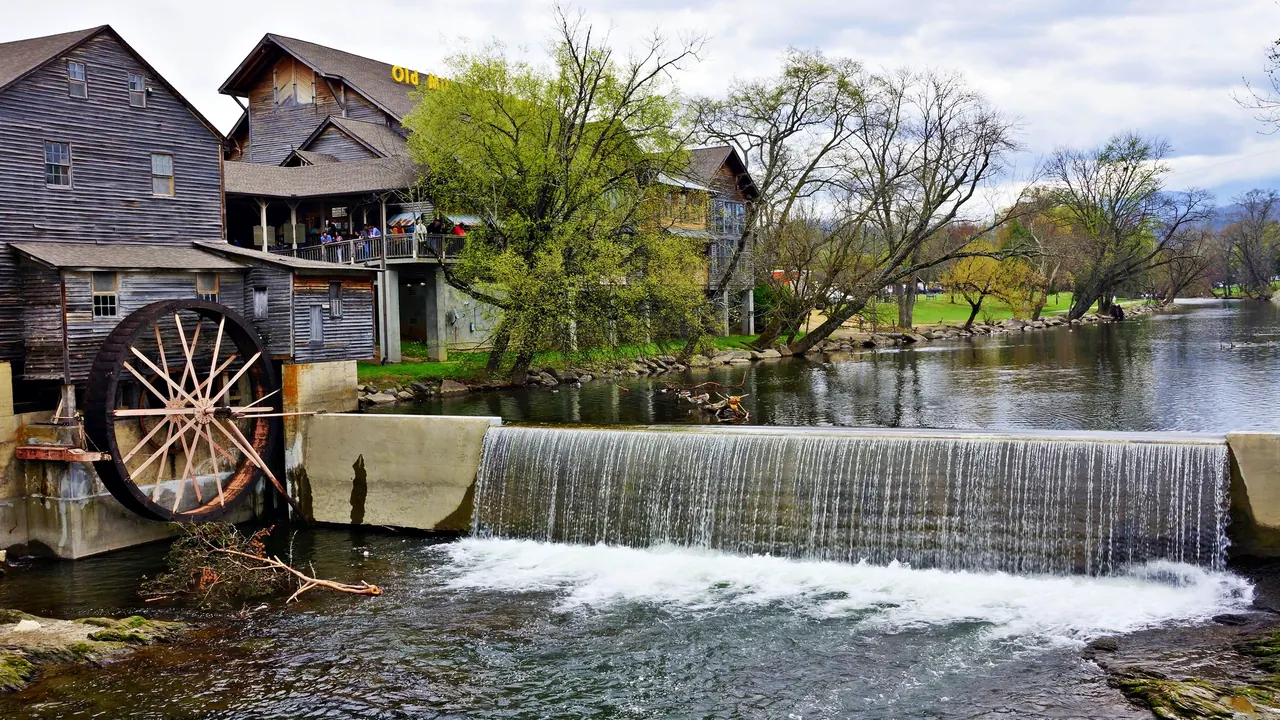

Photos: Pigeon Forge by NealVickers, CC BY-SA 4.0, cropped; St. Louis by Holly Cheng, CC BY 2.0, cropped.
Pigeon Forge or St. Louis?
Our verdict in twelve categories, each scored against the same fixed benchmark cities, and the climate month by month, so you can choose for your trip.
Choose Pigeon Forge for
- nature and the outdoors
- families
- wellness
Pigeon Forge suits a family or a group of friends who want the Great Smoky Mountains on the doorstep and Dollywood for the days off the trail. You stay in a hillside cabin, drive out to waterfall walks and the bears of Cades Cove, and spend evenings at dinner shows. It is a vacation of mountains, rides and hot tubs, not of streets and museums.
Choose St. Louis for
- culture and sights
- food and drink
- nightlife
Travellers who want a real city should pick St. Louis. You get the Gateway Arch, free museums in Forest Park, a renowned symphony, musicals at the Muny and blues bars in Soulard. Its food has a character of its own, from toasted ravioli on the Hill to the Bosnian grills of South Grand, and Cahokia Mounds is a day trip with real historical weight. The trade-off is that the countryside around it is gentler and further away.
Scoreboard
Twelve categories on one fixed scale from 0 to 100. The shaded stretch is the gap between the two.
Your match
Pick a travel style or drag the sliders, and both match scores follow your weighting.
Wins on nature and the outdoors and families with your weighting.
Wins on culture and sights and food and drink with your weighting.
What matters to you?
Category by category
What the scores mean for a trip.
Beaches & swimming
Neither place has a beach, and both are far inland. The difference is that Pigeon Forge has natural places to swim in summer: the shores of Douglas Lake, the wading pools among the boulders in the national park's streams, and the water park beside Dollywood.
In St. Louis, the Mississippi and Missouri are fast-flowing working rivers and are not for swimming. Cooling off there means a pool or a long drive to an Ozark lake.
Food & drink
St. Louis eats far better, and with more personality. It has dishes of its own, such as toasted ravioli, thin-crust pizza topped with Provel cheese and gooey butter cake. Around them are the Italian trattorias of the Hill, the Bosnian bakeries of Bevo Mill, the Saturday Soulard Market and a long brewing history.
Pigeon Forge feeds you generously rather than interestingly: pancake houses, Southern buffets, barbecue and chains along the Parkway, with moonshine tastings and the Old Mill's cornmeal treats as the local touch. For a meal to remember, you drive to Knoxville or Asheville.
Culture & sights
This is where the two differ most. St. Louis has the Gateway Arch and its museum of westward expansion, the Old Courthouse where the Dred Scott case began, free art and history museums in Forest Park, and whole Victorian streets in Lafayette Square and Soulard. That is enough for two or three full days.
Pigeon Forge is a resort strip, and its sights are built to entertain, like the half-scale Titanic and the illusion museums. The 1830 Old Mill and Dollywood's craft workshops are its only real heritage, so anyone interested in history heads into the national park for its log cabins and churches.
Nightlife
St. Louis has a proper night out, though it is spread across separate areas. Soulard has blues bars and old taverns, Washington Avenue has the dance bars, the Grove is the place for LGBTQ+ venues and late nights, and students fill the Delmar Loop. You will need taxis between them, and weeknights can be quiet.
Pigeon Forge winds down around ten, after the dinner shows and go-karts, and adults have only sports bars, brewpubs and moonshine tasting rooms. Most either drive over to Gatlinburg or settle into the cabin hot tub.
Nature & outdoors
Pigeon Forge wins this outright, because the Great Smoky Mountains National Park is half an hour up the road. Its forested ridges rise above 2,000m, and the trails run from the short Laurel Falls walk to the steep climb up Mount LeConte. Black bears are easy to spot in Cades Cove, and spring wildflowers and October colour are the high points of the year.
St. Louis has gentler country. There is the large Forest Park in town, then river bluffs and caves at Castlewood and Meramec within an hour, the Katy Trail for cyclists, and bald eagles near Alton in winter. It is pleasant, rolling country, not mountains.
Day trips
St. Louis has the edge, mainly because of Cahokia Mounds, the UNESCO-listed remains of a pre-Columbian city twenty minutes across the river. Add French colonial Ste. Genevieve, the German wine towns of Hermann and Augusta, Mark Twain's Hannibal and Lincoln's Springfield, and you find history in every direction.
From Pigeon Forge, most day trips are to the towns around the mountains: the craft loop at Gatlinburg, Knoxville's Market Square, and Cherokee over Newfound Gap. Asheville and the Biltmore Estate make the big day out. Both places need a car for these trips.
Good for families
Both are good with children, but Pigeon Forge is built around them. Dollywood, with its rides, crafts and seasonal festivals, is the centre of it. Around it are a water park, go-karts, mountain coasters and cabins big enough for several families. The catch is slow traffic on the Parkway and the summer heat.
St. Louis comes close with a different kind of day out: the climbable City Museum, the free zoo and Science Center in Forest Park, the Magic House and the tram pods up the Arch. It suits families who like to mix play with learning, with a ball game at Busch Stadium in the evening.
Getting around
Neither works well without a car, but St. Louis is the easier of the two. MetroLink links the airport, the Central West End, Forest Park, downtown and the stadium, and several districts are walkable on their own. The roads are uncongested and parking is simple.
Pigeon Forge is one long multi-lane strip. The trolley along the Parkway is slow and does not reach the hillside cabins, and you can only get to the trailheads by car. In summer, in October and over the Christmas weeks, the traffic crawls.
Shopping & style
In both places shopping is a side activity, but the shopping is quite different. Pigeon Forge has outlet malls with American mid-market brands, plus quilts, pottery and stone-ground cornmeal at the Old Mill and handmade brooms and baskets in the craft studios above Gatlinburg.
St. Louis is for browsing: vintage, records and antiques on Cherokee Street, independent shops on the Delmar Loop and boutiques in the Central West End. For big-name brands you go out to the suburban malls.
Affordability
The overall cost of a stay comes out much the same, but the money goes in different places. In Pigeon Forge lodging is cheap, especially a large cabin shared between families, while theme park tickets and dinner shows push up the bill.
In St. Louis, hotels cost less than in the coastal cities, and the zoo and the Forest Park museums are free. A hire car or taxis add to the cost, and in both places you tip on every restaurant bill.
Live music & performing arts
St. Louis has more on its stages. There is the Saint Louis Symphony at Powell Hall, touring Broadway shows at the Fabulous Fox, open-air musicals at the Muny and an opera festival every early summer. Alongside them runs a blues heritage that stretches from Chuck Berry to the National Blues Museum and the bars of Soulard.
Pigeon Forge has dozens of theatres, but they all do the same kind of show: country and gospel revues, comedy, magic and big dinner spectacles, with bluegrass on Dollywood's stages. For anything classical, you go to Knoxville.
Wellness & relaxation
Neither is a spa destination, but Pigeon Forge is the easier place to unwind. It has thousands of wooded cabins with porches, fireplaces and private hot tubs looking out over the ridges. If you book one high above the neon of the Parkway, your evenings will be quiet.
St. Louis has day spas and yoga studios in Clayton and the Central West End, and the city moves at an unhurried pace. Its most restful spot is the Japanese garden at the Missouri Botanical Garden.
When should you go?
Pick your month. The climate figures are measured averages, not a forecast.
Pigeon Forge in July
St. Louis in July
Daytime high, °C
Rainfall in the month, mm
Where the figures come from
Pigeon Forge's temperatures are measured 38 km from the centre, at McGhee Tyson Airport.
Pigeon Forge has no rain gauge within 25 km of the centre, so its rainfall comes from a gridded climate dataset read at the city rather than from a gauge further away.
Temperature and rainfall are climate normals, averaged over the years shown. Pigeon Forge: 1991-2020 (sunshine 1981-2010) normals, McGhee Tyson Airport (37.9 km from centre). St. Louis: 2006-2020 (sunshine 1981-2010, rainfall 1991-2020) normals, Cahokia / Maplewood Park (7.2 km from centre).
The two places follow much the same pattern through the year. Summers are hot and humid, with July highs around 31°C in both. From June to August that heat makes it pleasant to swim in Douglas Lake, the national park's streams or a pool, but it is heavy going on the Parkway and on city pavements alike. Winters are cool. St. Louis is the colder of the two, with January days near 5°C, while the Tennessee valley stays a few degrees milder.
Spring and autumn are the best seasons for walking in both. In Pigeon Forge rain falls fairly evenly all year, and October is the driest month at 64mm. With its mild, sunny days, October is the best month for the trails. In St. Louis the wettest stretch runs from April to June, with more than 110mm in each of those months. September and October are drier and still pleasantly warm, so they are the most reliable months for walking between neighbourhoods and around Forest Park.
Which traveller are you?
On an outdoors trip, Pigeon Forge is the clear pick. The Great Smoky Mountains begin half an hour away, with the climb up Alum Cave to Mount LeConte, bears in Cades Cove and the Appalachian Trail along the crest. St. Louis offers rolling Ozark state parks and the Katy Trail.
For a culture and arts trip, St. Louis wins easily. The Gateway Arch, the free Saint Louis Art Museum, the Cathedral Basilica mosaics, a symphony founded in 1880 and an early-summer opera festival fill several days. Pigeon Forge has the Old Mill and its revue theatres.
On a food and nightlife trip, St. Louis gives far more: toasted ravioli on the Hill, serious ribs and Bosnian grills on South Grand, followed by blues bars in Soulard or late nights in the Grove. In Pigeon Forge evenings end around ten, after the buffets and moonshine tastings.
Before you go
| Measure | Pigeon Forge | St. Louis |
|---|---|---|
| Currency | US Dollar (USD) | US Dollar (USD) |
| Sockets | AB120 V, 60 Hz | AB120 V, 60 Hz |
| Driving side | Right | Right |
| Time zone | UTC-5, UTC-4 in summer | UTC-6, UTC-5 in summer |
| Emergency number | 911 | 911 |
| Elevation | 305 m | 149 m |
| Main airport | McGhee Tyson Airport (TYS)39 km from centre34 non-stop destinations | St. Louis Lambert International Airport (STL)20 km from centre64 non-stop destinations |
| Public holidays this year | 13 days | 14 days |
By the numbers
| Measure | Pigeon Forge | St. Louis |
|---|---|---|
| City population | 6,343 | 301,578 |
| People per km² | 185 | 1,764 |
| Museums within 10 km | 7 | 18 |
| UNESCO World Heritage sites within 50 km | 1 | 1 |
Where else could you go?
Every comparison below shares a destination with this one, so you can follow Pigeon Forge or St. Louis somewhere new.
- Gatlinburgvs Pigeon Forge
- Ashevillevs Pigeon Forge
- Chattanoogavs Pigeon Forge
- Atlantavs Pigeon Forge
- Nashvillevs Pigeon Forge
- Louisvillevs Pigeon Forge