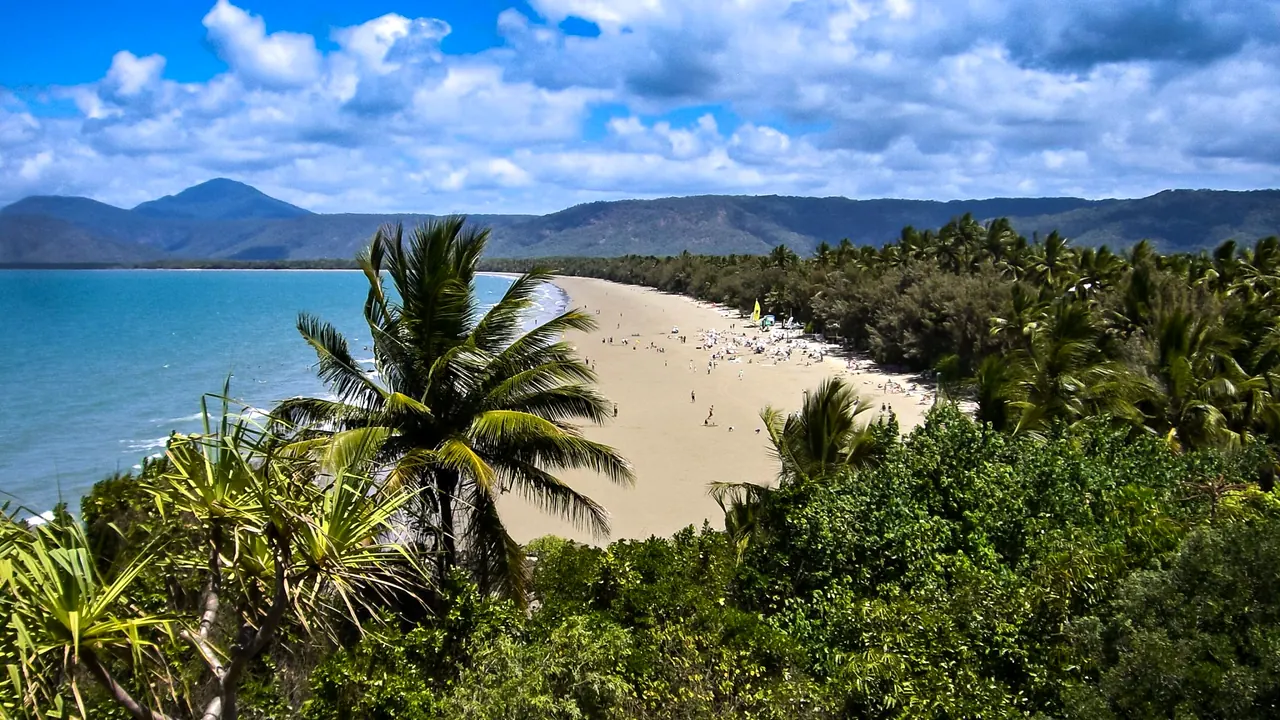
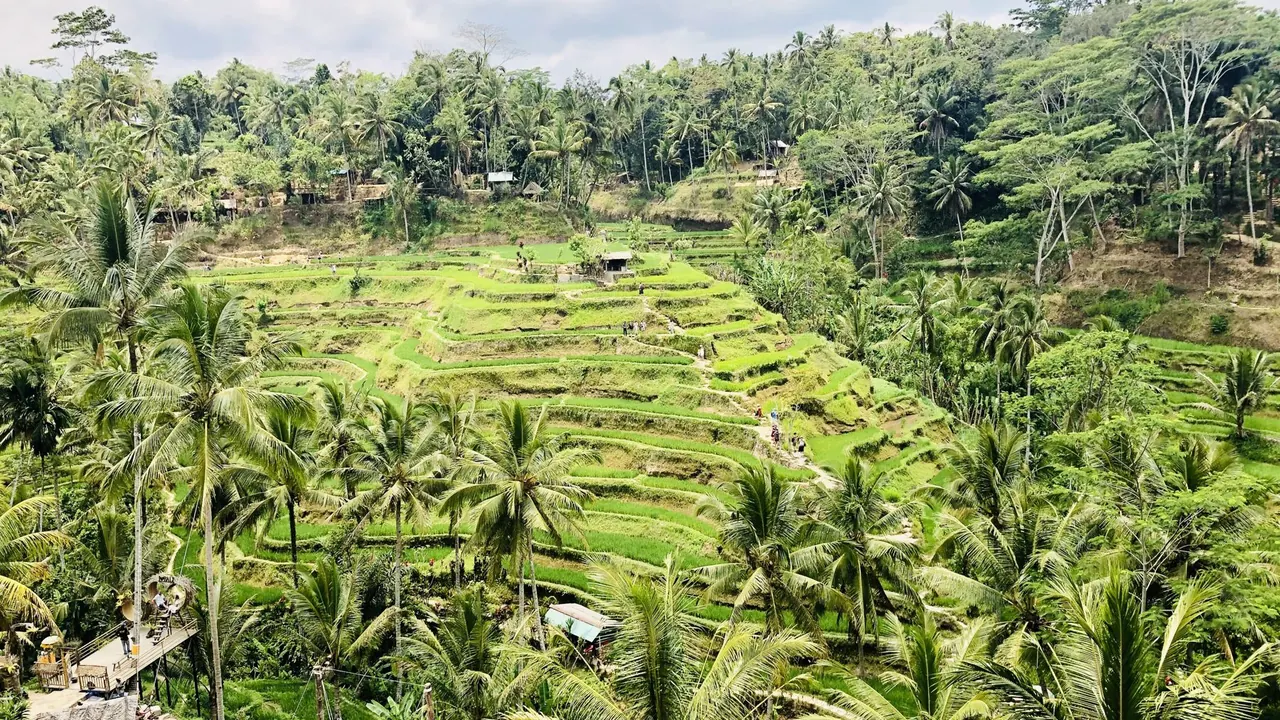
Photos: Port Douglas by dronepicr, CC BY 2.0, cropped; Ubud by Pinterpandai, CC BY-SA 3.0, cropped.
Port Douglas or Ubud?
Our verdict in twelve categories, each scored against the same fixed benchmark cities, and the climate month by month, so you can choose for your trip.
Choose Port Douglas for
- getting around
- beaches
- nature and the outdoors
Port Douglas is for travellers who want the sea and the reef at the heart of the trip. Four Mile Beach starts at the edge of town, boats leave the marina for the outer Great Barrier Reef, and the Daintree rainforest lies just beyond. The small, flat town is easy with children, but it is expensive, quiet after dark and has almost nothing in the way of sights.
Choose Ubud for
- prices
- culture and sights
- day trips
Ubud rewards a slower and more inward kind of trip: yoga at dawn, a massage most afternoons, walks along the rice terraces and Balinese dance in a temple courtyard at night. Everyday costs are far lower, the living culture runs much deeper, and the island's great temples are within a day's drive. The price is that there is no beach in town and nearly every outing beyond the centre means hiring a driver.
Scoreboard
Twelve categories on one fixed scale from 0 to 100. The shaded stretch is the gap between the two.
Your match
Pick a travel style or drag the sliders, and both match scores follow your weighting.
Wins on getting around and beaches with your weighting.
Wins on prices and culture and sights with your weighting.
What matters to you?
Category by category
What the scores mean for a trip.
Beaches & swimming
Port Douglas has a real beach on the doorstep. Four Mile Beach curves south from town, palm-backed and firm underfoot, and from June to October it is an easy place to swim. From November to May you swim inside the netted enclosure or in a stinger suit. The water is often milky rather than clear, and crocodiles rule out the creeks.
Ubud is inland, so a beach day means the best part of an hour in a car to Sanur's calm, reef-sheltered water or to the black sand of Keramas and Saba, which is better for watching surfers. Most people swim in a villa pool looking out over the paddies instead.
Food & drink
Ubud gives you more to discover at the table. Its best food is Balinese: babi guling at lunchtime counters, bebek betutu slow-cooked in spice paste, and nasi campur in family warungs a lane or two away from the main street. On top of that come raw-food cafés, Kintamani coffee and a few tasting menus built on island produce.
Port Douglas does a long outdoor seafood dinner well, with reef fish, prawns and mud crab around Macrossan Street and the marina, and good tropical fruit for breakfast. The choice narrows after a week, though, and nothing on the menu is particular to the place.
Culture & sights
In Ubud you see culture every day. Offerings sit on doorsteps, processions pass on feast days, and the old royal palace of Puri Saren stands beside the lotus pond of Pura Taman Saraswati. Puri Lukisan, Neka and ARMA trace Balinese painting since the 1930s, and the eleventh-century Elephant Cave, Goa Gajah, is on the edge of town.
Port Douglas has two small buildings worth a look, the old Court House and the timber chapel of St Mary's by the Sea, and both take minutes. Its most rewarding cultural experience is a Kuku Yalanji-guided walk at Mossman Gorge.
Nightlife
Both towns are early to bed, and neither has clubs. Port Douglas evenings are Australian pub evenings, with a cover band on a Macrossan Street terrace and a cheerful crowd, and Cairns is an hour away for anything later. Ubud's evenings are quieter still, with garden bars and a couple of music bars, and a much longer drive to Seminyak or Canggu to go out properly.
Nature & outdoors
Port Douglas has the bigger natural setting. Boats run daily to the outer ribbon reefs for coral walls, turtles and reef sharks, with dwarf minke whales passing in midwinter, and Low Isles makes a gentler reef day. On land, Mossman Gorge and the Daintree reach Cape Tribulation, where the rainforest comes down to the sea.
Ubud's nature is on land and mostly on foot: the Campuhan Ridge path, the terraces of Tegallalang, rafting on the Ayung, jungle waterfalls, and a climb of Mount Batur in the dark for sunrise. It is gentler and closer to hand, but it has nothing like the reef.
Day trips
Ubud is much the better base for day trips. Tirta Empul's holy spring and the cliff-cut tombs of Gunung Kawi are close, and Besakih, Klungkung's painted pavilions, Tanah Lot, Pura Ulun Danu Bratan and the Jatiluwih terraces are each a day out with a driver. The slow roads decide how many fit into one day.
From Port Douglas, most outings go to reef and rainforest rather than to other towns. Cairns is an hour down the coast, Kuranda is reached by the old mountain railway and cable car, and the crater lakes of the Atherton Tablelands fill a day. After those, the list runs short.
Good for families
Port Douglas is the easier choice with young children. The town is small and safe, the Wildlife Habitat puts koalas and cassowaries within reach, Low Isles offers snorkelling straight from the sand, and glass-bottom boats show coral to children who cannot swim yet. The limits are the summer stinger nets, crocodile warnings and long boat rides out to the outer reef.
Ubud welcomes children warmly, and villa pools, dance shows and gentle rafting go down well. Even so, missing pavements, scooter traffic and bag-grabbing macaques make it better suited to older, outdoorsy children than to toddlers.
Getting around
Port Douglas is simpler to get around. Macrossan Street, the marina and the north end of the beach are a flat walk from each other, bicycles cover the resort strip, and tours collect you from your hotel. You only need a car for the Daintree or the Tablelands, and the airport transfer from Cairns takes about an hour.
Ubud is hard work on foot. Pavements are broken, the main streets fill with scooters, and the roads climb steeply in and out of the river valleys, with no public transport to fall back on. Days are planned around a driver or ride-hailing, so stay central if you want to walk to dinner.
Shopping & style
Shopping in Port Douglas is an evening stroll along Macrossan Street and the marina, past resort-wear boutiques, South Sea pearl jewellery and a few galleries of Aboriginal art. On Sundays there is also the market in Anzac Park under the trees. The selection is small, and for anything more you go to Cairns.
In Ubud, things made by hand give you far more to take home. Haggling is expected at the Art Market opposite the palace. Each craft village on the road from the south has its own trade: woodcarving in Mas, silver in Celuk and painting in Batuan. Jalan Hanoman adds linen clothes and natural cosmetics, though you won't find fashion or luxury shopping.
Affordability
Ubud costs far less. Garden rooms in family homestays, warung meals, massages and a driver for the day all come cheap. Spending there is a choice, since the jungle resorts and tasting menus charge close to European prices.
In Port Douglas, high costs are hard to avoid. Most beds are in upmarket resorts and apartments, and the reef and rainforest trips that bring you there are all paid excursions. Self-catering, takeaway seafood on the beach and wet-season rates help a little.
Live music & performing arts
Ubud has a performance most evenings: Legong, the Barong drama or the chanting circle of the Kecak, danced to live gamelan in the palace courtyard or on the lotus-pond stage at Saraswati by village troupes with long traditions. A temple festival, if you chance on one, shows the same dances in their own setting.
Port Douglas has no stage at all. Live music means an acoustic set or cover band at a pub, plus the outdoor music and parades of its yearly autumn carnival.
Wellness & relaxation
Ubud is built around wellness. Yoga runs from dawn to dusk in open pavilions, retreats last from a weekend to several weeks, and Balinese massage, flower baths and traditional healers are part of local life, with riverside spas above the Ayung and Petanu gorges and quiet paddies a few steps from the main road.
Port Douglas relaxes you through its pace and its setting: lagoon pools under palms, resort day spas using native botanicals and a few yoga classes. It is restful, but it has no healing or bathing tradition of its own.
When should you go?
Pick your month. The climate figures are measured averages, not a forecast.
Port Douglas in July
Ubud in July
Daytime high, °C
Rainfall in the month, mm
Where the figures come from
Ubud's temperatures are measured 29 km from the centre, at Denpasar / Ngurah-Rai.
Ubud's station stands 209 m below the city centre, so the centre is likely a little cooler than the figures say.
Ubud has no rain gauge within 25 km of the centre, so its rainfall comes from a gridded climate dataset read at the city rather than from a gauge further away.
Temperature and rainfall are climate normals, averaged over the years shown. Port Douglas: 1991-2020 normals, Low Isles (17.1 km from centre). Ubud: 1991-2020 normals, Denpasar / Ngurah-Rai (29 km from centre).
Port Douglas has two clear seasons. From June to October the days are warm rather than heavy, with highs around 25°C in midwinter, very little rain, calmer seas and no stingers, so this is the time for beach days and reef trips. The sea cools a little then but stays pleasant to swim in. From December to March the heat turns humid and January to March each bring over 400mm of rain, enough to cancel boat trips and send swimmers to the resort pool.
Ubud stays hot all year, at about 30°C, with no cool season for walking. Rain peaks from December to February, with close to 300mm in January, which makes the trails muddy but the terraces their greenest. May to September is drier, and August is the pick, with only 36mm of rain and the most sunshine of the year. The sea on the nearby coast stays warm in every month. The two dry seasons overlap, so June to September suits both.
Which traveller are you?
For a beach and sun trip, Port Douglas is the clear choice. Four Mile Beach is a long stretch of firm sand you can walk to from town, and in the dry months the swimming is easy. In Ubud the nearest calm swim is about an hour away.
On a relaxing and wellness trip, Ubud is hard to beat. Yoga pavilions, retreats, Balinese massage and flower baths are part of ordinary life there. Port Douglas offers resort day spas and lagoon pools, but it has no healing tradition of its own.
On a trip with a tight budget, Ubud makes far more sense. Homestays, warung meals, massages and day drivers all cost little. In Port Douglas, resort prices and the paid reef and rainforest tours you came for add up every day.
Before you go
| Measure | Port Douglas | Ubud |
|---|---|---|
| Official language | English | Indonesian |
| Currency | Australian Dollar (AUD) | Rupiah (IDR) |
| Sockets | I230 V, 50 Hz | CF50 Hz |
| Driving side | Left | Left |
| Time zone | UTC+10 | UTC+8 |
| Emergency number | 000 | 112 |
| Elevation | 24 m | 210 m |
| Main airport | Cairns International Airport (CNS)53 km from centre32 non-stop destinations | Denpasar I Gusti Ngurah Rai International Airport (DPS)29 km from centre63 non-stop destinations |
| Public holidays this year | 11 days | - |
By the numbers
| Measure | Port Douglas | Ubud |
|---|---|---|
| City population | 3,650 | - |
| Museums within 10 km | 2 | 14 |
| UNESCO World Heritage sites within 50 km | 1 | 1 |
| Swim season, months above 21 °C | 12 months | 12 months |
Where else could you go?
Every comparison below shares a destination with this one, so you can follow Port Douglas or Ubud somewhere new.
- Cairnsvs Port Douglas
- Yogyakartavs Ubud
- Jakartavs Ubud
- Noosavs Port Douglas
- Gold Coastvs Port Douglas
- Byron Bayvs Port Douglas