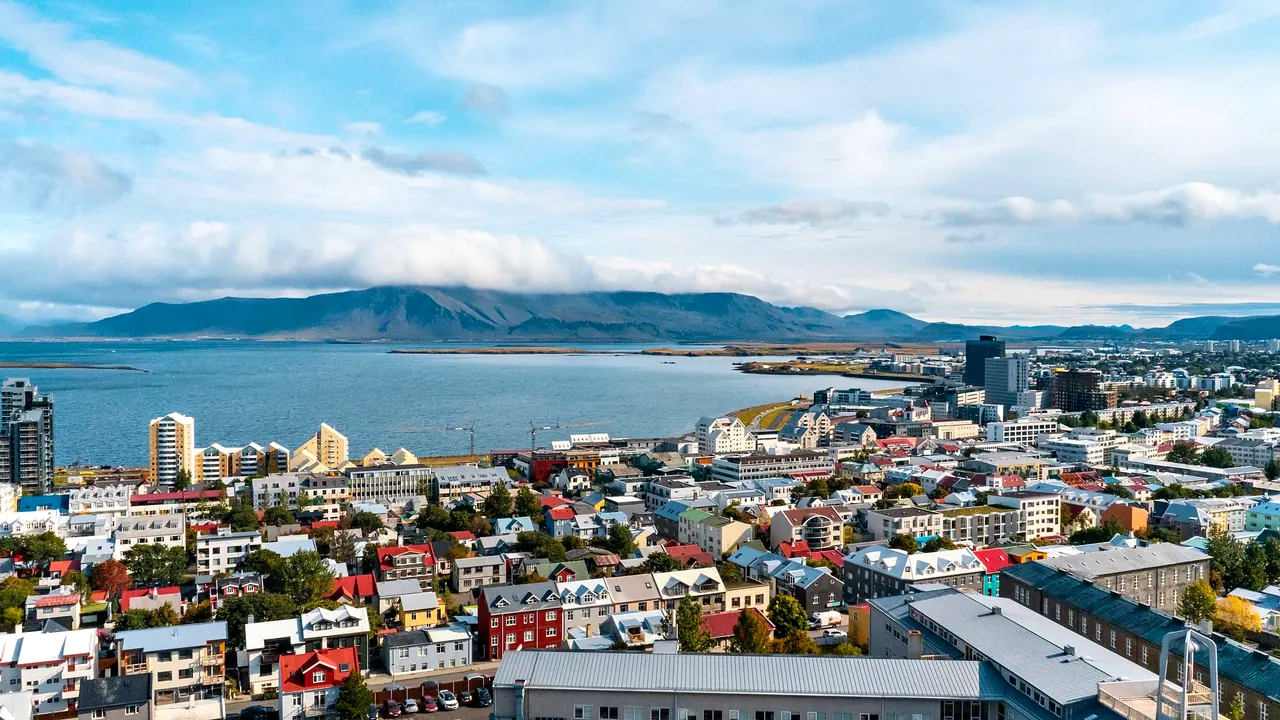
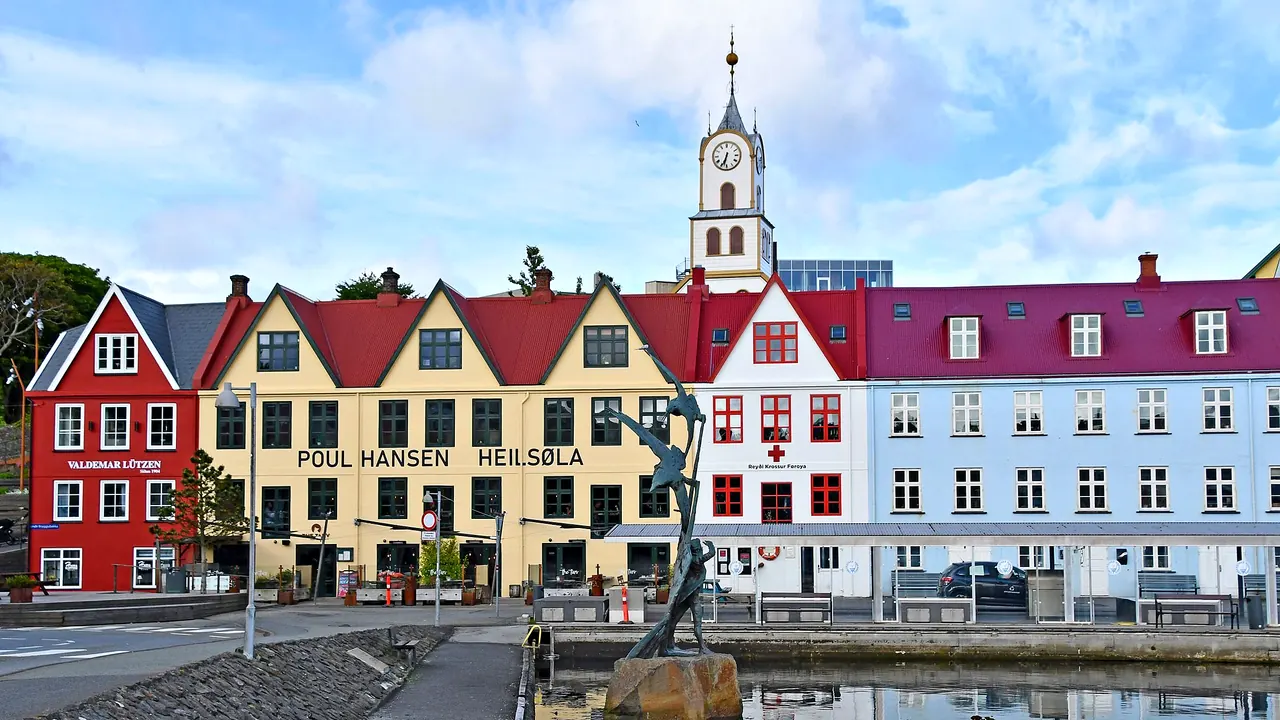
Photos: Reykjavik by Atlantic Ambience, Pexels License; Tórshavn by Pasztilla aka Attila Terbócs, CC BY-SA 4.0, cropped.
Reykjavik or Tórshavn?
Our verdict in twelve categories, each scored against the same fixed benchmark cities, and the climate month by month, so you can choose for your trip.
Choose Reykjavik for
- wellness
- nightlife
- families
Reykjavik suits travellers who want wild North Atlantic landscape with a proper small capital around it. Between glacier walks and geyser trips there are geothermal pools in every neighbourhood, a weekend bar crawl that runs until daylight, concerts at Harpa and enough to keep children busy, so the days off the road are still full.
Choose Tórshavn for
- prices
- culture and sights
Tórshavn is for those who want the scenery with very little else in the way. It is a quiet harbour town of turf roofs and tarred houses, with green basalt islands, bird cliffs and fjords a short drive or ferry away. Evenings and rainy days are thin, but a small town on a scattered group of islands far out in the ocean feels more remote than a capital, however small. A farmhouse meal of wind-dried Faroese food also stays with you.
Scoreboard
Twelve categories on one fixed scale from 0 to 100. The shaded stretch is the gap between the two.
Your match
Pick a travel style or drag the sliders, and both match scores follow your weighting.
Wins on wellness and nightlife with your weighting.
Wins on prices and culture and sights with your weighting.
What matters to you?
Category by category
What the scores mean for a trip.
Beaches & swimming
You won't come to either place for a beach, but Reykjavik has the one spot where a dip is actually pleasant: Nauthólsvík, a golden-sand cove with a geothermally warmed lagoon and a hot tub to retreat to. Its heated outdoor pools cover the swimming that the sea can't.
Tórshavn's shoreline is rock and cliff, and the black-sand bays at Tjørnuvík and Sandur are for walking in a waterproof jacket. Swimming means a bracing plunge off the harbour rocks with the locals, or the indoor pool.
Food & drink
The two kitchens are broadly level, but they feel quite different. Reykjavik cooks its fish, lamb, skyr and greenhouse vegetables in a polished New Nordic style. It also has a wider spread of cafés, bakeries and bistros around Laugavegur and the Old Harbour, plus lamb soup and harbour hot dogs for cheap lunches.
Tórshavn is narrower but more distinctive. Wind-dried and fermented ræst flavours run through Faroese food, and booking heimablídni, dinner in a family home or farmhouse, is something Reykjavik has no real equivalent for.
Culture & sights
Both can be seen properly in a day or two, so the difference is one of character. Reykjavik's landmarks are mostly modern: the basalt-like tower of Hallgrímskirkja and the glass of Harpa. Its past is shown in museums, especially the Settlement Exhibition built around a Viking-age longhouse.
In Tórshavn the history is still standing in the streets. The turf-roofed government buildings on Tinganes, where the assembly met in the Viking age, the tarred lanes of Reyn and the ramparts of Skansin make the old town itself the main sight.
Nightlife
Reykjavik is the place for a night out. On Fridays and Saturdays the runtur moves through the bars around Laugavegur and Austurvöllur, which turn into dance floors after midnight. In midsummer you walk home in daylight.
Tórshavn has a few pubs near the harbour that get busy at weekends when people come in from the villages. They are good for conversation, but there are no clubs, and weeknights are over early.
Nature & outdoors
Both are first-rate for landscape, but the landscape is different. Around Reykjavik it is raw geology: the rift valley at Þingvellir, the Strokkur geyser, Gullfoss, glacier walks at Sólheimajökull and the steaming lava fields of Reykjanes. In winter there are ice caves and northern lights trips too.
From Tórshavn the scenery is greener and steeper, and closer to the sea. You get waterfalls dropping into the Atlantic at Gásadalur, the lake above the cliffs at Sørvágsvatn, puffins on Mykines and sea kayaking in the fjords. Walks start at the edge of town, and fog can close them within the hour.
Day trips
Neither has much in the way of towns to visit, so outings are really drives through the landscape with a historic stop or two. From Reykjavik the stops carry more weight: Þingvellir, where the open-air parliament met from 930, the old bishopric at Skálholt and Snorri Sturluson's home at Reykholt.
From Tórshavn the highlight is Kirkjubøur, with its roofless medieval cathedral and centuries-old farmhouse. Beyond that come the fishing town of Klaksvík and turf-roofed villages such as Saksun and Gjógv.
Good for families
Reykjavik is the easier place to keep children happy. The outdoor pools with slides and warm shallow water are a daily treat in any weather. Laugardalur adds farm animals and rides, and Perlan's indoor ice cave fills a wet afternoon.
Tórshavn is just as safe and relaxed, but there is little made for children beyond a small aquarium, playgrounds and the indoor pool. Children who love boats, sheep and puffins will enjoy it, but a run of rainy days can drag.
Getting around
Reykjavik is the more straightforward of the two. Its centre is a compact half-hour walk from end to end, buses reach the pools and Perlan, and a coach runs from Keflavík. The Golden Circle and south coast are also well served by organised tours if you don't want to drive.
Tórshavn's centre is small but hilly. Intercity buses and ferries do reach the islands, but they are too sparse for a sightseeing day, so in practice you need a hire car to cope with the single-lane tunnels and sheep on the road. Fog and wind can also hold up ferries and flights.
Shopping & style
Shopping is a minor part of a trip to either, and in both places the thing to buy is a wool sweater: the round-yoked lopapeysa in Reykjavik, patterned Faroese knitwear in undyed island wool in Tórshavn.
Reykjavik gives you a bit more to browse along Laugavegur and Skólavörðustígur, with design pieces in lava stone and fish leather, record shops and the weekend harbour flea market. Tórshavn has a few shops around the old centre and a modest shopping centre.
Affordability
Both are among the costliest places in Europe to travel. Reykjavik is the harder on the wallet: guesthouses, plain meals, taxed alcohol, guided tours and car hire all cost a lot. Its cheap, excellent public pools are the one real bargain.
Tórshavn comes out somewhat lighter, though hotels are few and dear in summer and you will almost certainly need a car. Self-catering and the free walking straight from town keep a stay manageable.
Live music & performing arts
Reykjavik has much more to choose from. Harpa is home to the Iceland Symphony Orchestra and also stages opera, and small venues in the centre host local alternative and electronic bands most weekends. Iceland Airwaves fills the town each late autumn.
Tórshavn's music runs deep but surfaces less often. The ballads of the chain dance are sung at Ólavsøka each summer, and the Nordic House holds concerts and theatre, but on a random night there may be nothing on.
Wellness & relaxation
This is where the two differ most. In Reykjavik, soaking in hot water is part of daily life: neighbourhood pools such as Laugardalslaug and Vesturbæjarlaug have rows of hot tubs and steam rooms, and the Blue Lagoon and Golden Circle hot springs lie beyond the city.
Tórshavn has no bathing culture to match, only a hotel spa, the indoor pool and the odd sauna with a cold dip. What it does offer is calm: quiet streets, a slow harbour and long summer evenings for anyone who unwinds by walking.
When should you go?
Pick your month. The climate figures are measured averages, not a forecast.
Reykjavik in July
Tórshavn in July
Daytime high, °C
Rainfall in the month, mm
Temperature and rainfall are climate normals, averaged over the years shown. Reykjavik: 1991-2020 normals, Reykjavik (2.3 km from centre). Tórshavn: 1991-2020 normals, Thorshavn (0.8 km from centre).
Neither place is ever warm, and the sea never gets near swimming temperature, so summer is about long light and walking weather rather than beaches. Reykjavik has the bigger swing through the year. July highs reach about 15°C, early summer is the driest stretch at around 41mm in June, and May and June bring the most sunshine. Winter is cold and dark, with highs of about 3°C and barely 13 hours of sunshine in all of December. Those months are for northern lights trips and hot pools, not long walks through the streets.
Tórshavn stays milder in winter and cooler in summer, peaking at about 13°C. Above all it is wetter, with roughly 163mm of rain in January and a long wet season from September to March. May to August is the only window where hiking and ferry trips are reasonably dependable. Even then, expect fog and wind.
Which traveller are you?
On a relaxing and wellness trip, Reykjavik is the clear choice. Every district has a geothermal outdoor pool with hot tubs and a cold plunge, and the Blue Lagoon lies on the airport road. Tórshavn offers quiet and sea views but little in the way of bathing.
For a food and nightlife trip, Reykjavik gives more to do after dark. The weekend runtur along Laugavegur turns small bars into dance floors until the early hours, and the centre has more bistros and craft-beer bars. Tórshavn's evenings end in a handful of harbour pubs.
On a trip on a tight budget, Tórshavn is slightly less punishing, though neither is cheap. With self-catering, supermarket food and free walks straight into the hills, it can be done for a little less than Reykjavik. There, restaurants, tours and car hire add up very quickly.
Before you go
| Measure | Reykjavik | Tórshavn |
|---|---|---|
| Official language | Icelandic | Danish, Faroese |
| Currency | Iceland Krona (ISK) | Danish Krone (DKK) |
| Sockets | CF230 V, 50 Hz | CEFK230 V, 50 Hz |
| Driving side | Right | Right |
| Time zone | UTC | UTC, UTC+1 in summer |
| Emergency number | 112 | 112 |
| Elevation | 8 m | 24 m |
| Main airport | Keflavik International Airport (KEF)37 km from centre89 non-stop destinations | Vágar Airport (FAE)27 km from centre11 non-stop destinations |
| Public holidays this year | 16 days | 17 days |
By the numbers
| Measure | Reykjavik | Tórshavn |
|---|---|---|
| Population | 138,772 | 14,038 |
| People per km² | 569 | 120 |
| Museums within 10 km | 23 | 3 |
| UNESCO World Heritage sites within 50 km | 1 | 0 |
| Swim season, months above 21 °C | None | None |
Where else could you go?
Every comparison below shares a destination with this one, so you can follow Reykjavik or Tórshavn somewhere new.
- Bergenvs Tórshavn
- Lofotenvs Tórshavn
- Tromsovs Tórshavn
- Bergenvs Reykjavik
- Oslovs Reykjavik
- Tromsovs Reykjavik