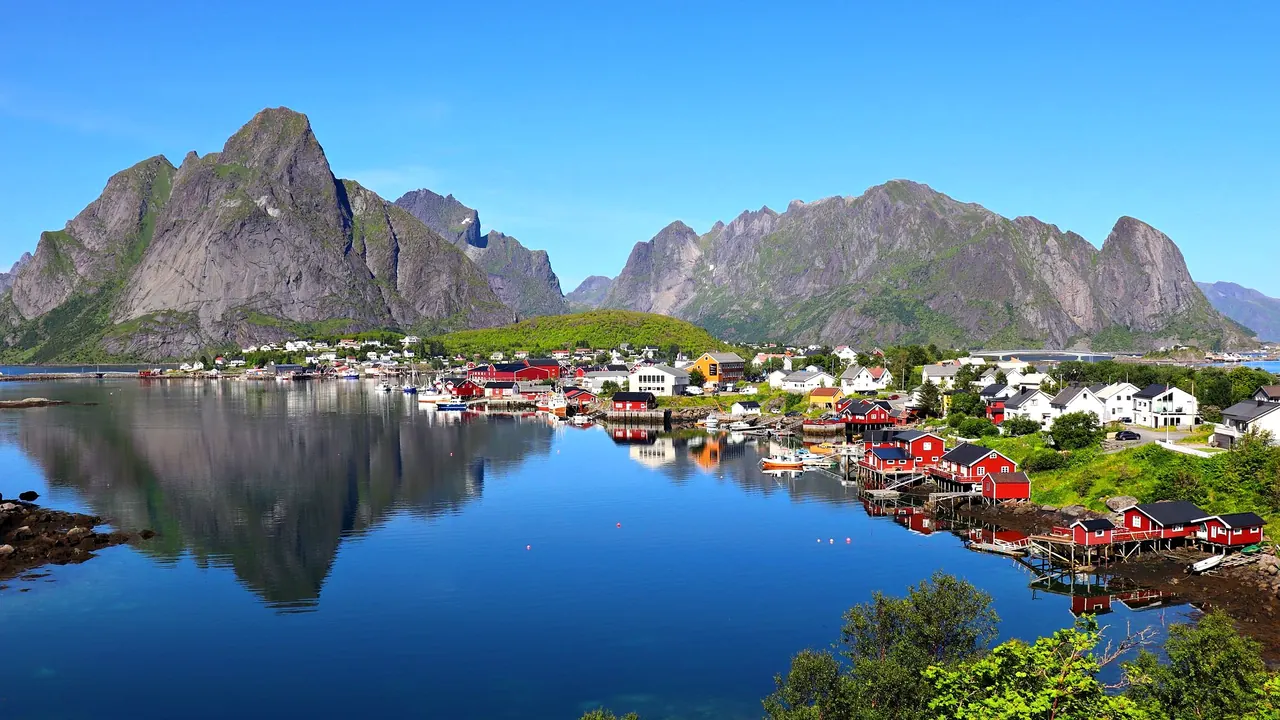
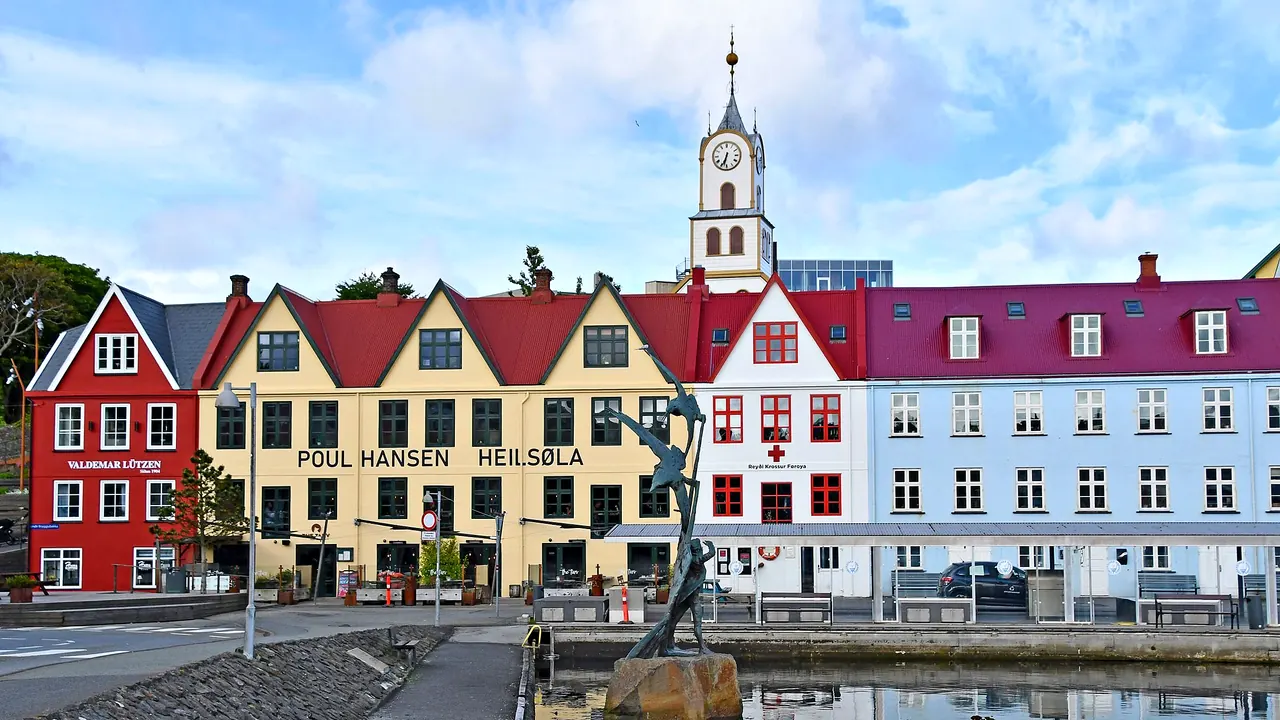
Photos: Lofoten by Mario Vogt, Pexels License; Tórshavn by Pasztilla aka Attila Terbócs, CC BY-SA 4.0, cropped.
Lofoten or Tórshavn?
Our verdict in twelve categories, each scored against the same fixed benchmark cities, and the climate month by month, so you can choose for your trip.
Choose Lofoten for
- beaches
- culture and sights
- nature and the outdoors
Lofoten is the choice for a trip built around landscape. Granite peaks rise straight from the sea, short hikes above Reine and Henningsvær give enormous views, and you get white-sand bays plus either the midnight sun or the northern lights. A rorbu cabin with a sauna by the water also makes it the calmer retreat. Expect to drive the E10 between villages and to cook a good share of your own meals.
Choose Tórshavn for
- live music and the arts
- getting around
- nightlife
Tórshavn suits travellers who want a small capital as their base. It has a walkable old centre at Tinganes and Reyn, pubs that fill at weekends, concerts at the Nordic House and farmhouse dinners of Faroese lamb and fish. The cliffs, waterfalls and puffin colonies are a drive or a ferry away. Compared with Lofoten you give up a little scenic drama, and in return you get town life and easier connections.
Scoreboard
Twelve categories on one fixed scale from 0 to 100. The shaded stretch is the gap between the two.
Your match
Pick a travel style or drag the sliders, and both match scores follow your weighting.
Too close to call, 1 point apart
Wins on beaches and culture and sights with your weighting.
Wins on live music and the arts and getting around with your weighting.
What matters to you?
Category by category
What the scores mean for a trip.
Beaches & swimming
Neither is a place for swimming, but Lofoten at least has proper beaches. Haukland and Uttakleiv have pale sand and turquoise water, Ramberg has a wide bay, and Kvalvika can only be reached on foot. They are good for picnics and a cold dip followed by a sauna.
Tórshavn's coast is mostly rock and cliff. The black sand at Tjørnuvík and the beach at Sandur are best seen in a waterproof jacket. Cold dips off the harbour rocks and the indoor pool are as close as it gets to a swim.
Food & drink
Both kitchens are built on the sea and on dried fish, but they lean different ways. Lofoten is all about cod: stockfish, klippfisk, cod tongues and the late-winter skrei. Many visitors buy fish straight off the quay to cook in their cabin.
Tórshavn's food is stranger and more distinctive, with wind-dried lamb, seabirds and the sharp, fermented ræst, and heimablídni lets you eat in a family home. Its few ambitious kitchens are all in one town. In Lofoten the restaurants are scattered along the island chain, and many close out of season.
Culture & sights
Lofoten has a little more to see, though it is spread along the islands. The Viking longhouse at Borg, the preserved trading post at Nusfjord and the fishing museums at Å tell the story of the cod fishery, and Vågan Church at Kabelvåg is worth a stop.
Tórshavn has fewer sights, but they sit close together: the turf-roofed government buildings on Tinganes, the tarred lanes of Reyn, Skansin fort and the National Museum. You can see them all on foot in a day or two.
Nightlife
Both are quiet, and Tórshavn is the livelier of the two. Its harbourside pubs and bars fill on Friday and Saturday, when young people come in from the villages, and those nights can run late.
In Lofoten an evening out means a beer in Svolvær or a drink on a quay in Henningsvær, and nothing stays open late. There, the after-dark activity is a midnight hike or a wait for the aurora.
Nature & outdoors
Lofoten's mountains are jagged granite rising straight out of the sea, with white bays and fishing harbours at their feet, and they are the more dramatic sight. Reinebringen above Reine and Ryten above Kvalvika are short, steep climbs with huge views. The two seasons also differ sharply: hiking at midnight in early summer, and the northern lights over the peaks from September.
The Faroes are green basalt instead: cliffs and stacks, the waterfall at Gásadalur dropping into the Atlantic and Sørvágsvatn, a lake that seems to hang above the sea. Slættaratindur is a manageable summit, and Mykines and the Vestmanna cliffs are for seabirds. Some walks start at the edge of Tórshavn, but fog and wind can close a route within the hour.
Day trips
Lofoten offers a string of fishing villages along one road. Henningsvær on its skerries, Svolvær and Kabelvåg, and Reine and Hamnøy in the west each make a pleasant afternoon, but after two or three they look much alike. Ferries to Værøy and Røst are more about seabirds than villages.
Tórshavn has one outing with real history: Kirkjubøur, a short drive south, with its roofless medieval cathedral, the small church of St Olav and a timber farmhouse kept by one family for centuries. Beyond that there is the fishing harbour at Klaksvík through a subsea tunnel, and the turf-roofed churches at Saksun and Gjógv.
Good for families
Lofoten keeps an active family busier. Children have sand and rock pools at Ramberg and Haukland, fishing from the quays and boat trips, and the Viking longhouse at Borg, with costumes and boats, is the highlight. The price is long hours in the car and steep hikes that are too exposed for small legs.
Tórshavn is simpler to manage, because everything is close together. Its small aquarium, playgrounds and indoor pool are within easy reach, and the pool helps through a run of wet days. Puffins and sheep are a short trip out, but children who need attractions may soon get restless.
Getting around
Tórshavn is the easier of the two to manage. The centre is compact enough to walk, if hilly, and red town buses serve the outskirts. Buses, ferries and subsea tunnels reach most islands, though a car makes sightseeing days simpler.
Lofoten is a road trip. One narrow road, the E10, runs about two hours from Svolvær to Å, buses are sparse, and summer brings slow campervans and full trailhead car parks. Getting there also takes more planning: you arrive by small airport, by car ferry from Bodø or by coastal ship.
Shopping & style
Tórshavn has the better shopping, mostly because it is all in one small old centre. Faroese knitwear is the thing to buy, from patterned sweaters in undyed island wool to contemporary designs, and the same streets have prints and ceramics.
In Lofoten you collect your souvenirs on the way: small galleries of painting and photography in Henningsvær and Svolvær, and glassblowers and ceramicists in the villages. Wool sweaters, outdoor clothing and a pack of stockfish are the usual things to take home.
Affordability
Both are very expensive, with Nordic prices for meals, drinks and car hire, and the gap between them will barely show in a budget. Lofoten's added pressure is that rooms sell out early in summer and in the northern lights season, while Tórshavn simply has few hotel rooms. In both, a kitchen, the supermarket and the free landscape are what save money.
Live music & performing arts
Tórshavn has a real cultural calendar for a town its size. The Nordic House hosts concerts, theatre and the Faroese symphony orchestra, and there is a jazz festival. At Ólavsøka each summer the Faroese chain dance is performed, with the dancers singing its long ballads themselves.
Lofoten has small summer music festivals and concerts in churches and old fish-processing buildings, but no regular season outside them.
Wellness & relaxation
Lofoten's wood-fired saunas by the water give it a ritual of its own. Some of them float in the harbour, and you move from the heat to a plunge in the cold sea and back. Add a quiet rorbu cabin over the water, the long light of summer or the still dark of winter, and the islands make a calm retreat.
Tórshavn has less to offer: a hotel spa, the indoor pool and the odd sauna with a cold dip. Its calm comes from the slow pace of the harbour, light traffic and very few crowds, which suits someone who unwinds by walking rather than with treatments.
When should you go?
Pick your month. The climate figures are measured averages, not a forecast.
Lofoten in July
Tórshavn in July
Daytime high, °C
Rainfall in the month, mm
Where the figures come from
Lofoten has no rain gauge within 25 km of the centre, so its rainfall comes from a gridded climate dataset read at the destination rather than from a gauge further away.
Temperature and rainfall are climate normals, averaged over the years shown. Lofoten: 2011-2025 (rainfall 1991-2020) normals, Svolvaer Airport (4.4 km from centre). Tórshavn: 1991-2020 normals, Thorshavn (0.8 km from centre).
Lofoten has the warmer summer and the much colder winter. In July and August daytime highs reach about 17°C, May to August are the driest months, and from late May to mid July the sun never sets. That makes early to high summer the time for hiking and a bracing sea dip. Rain builds from September, and winter highs near 1°C suit the northern lights and ski touring more than long walks.
Tórshavn's year is flatter and wetter. Summer barely gets past 13°C and the sea stays cool all year. Winter is milder, with highs around 6°C, but it is very wet: from October to January monthly rainfall reaches up to 163mm. May to July is the drier window and the clear choice for walking the cliffs.
Which traveller are you?
For an outdoors trip, Lofoten has the edge. It has steep short hikes over the sea and long ridge routes, climbing on Svolvær granite, kayaking among the skerries, surfing at Unstad and ski touring to the shore in late winter. That is more range than the Faroese cliffs, fine as they are.
For a short city break, Tórshavn is the natural pick because it is an actual town. Tinganes, Reyn, Skansin fort and the National Museum are all within walking distance, and buses cover the outskirts. Lofoten is a chain of villages that needs a car and several days.
On a food and nightlife trip, Tórshavn gives you more to do after dark. Weekend nights in the harbour pubs run late, and heimablídni home dinners and fermented ræst make for a memorable table. Lofoten's cod is excellent, but its evenings end early.
Before you go
| Measure | Lofoten | Tórshavn |
|---|---|---|
| Official language | Norwegian, Nynorsk, Bokmål, Sámi | Danish, Faroese |
| Currency | Norwegian Krone (NOK) | Danish Krone (DKK) |
| Sockets | CF230 V, 50 Hz | CEFK230 V, 50 Hz |
| Driving side | Right | Right |
| Time zone | UTC+1, UTC+2 in summer | UTC, UTC+1 in summer |
| Emergency number | Police 112, ambulance 113, fire 110 | 112 |
| Elevation | - | 24 m |
| Main airport | Svolvær Airport, Helle (SVJ)3 non-stop destinations | Vágar Airport (FAE)27 km from centre11 non-stop destinations |
| Public holidays this year | 13 days | 17 days |
By the numbers
| Measure | Lofoten | Tórshavn |
|---|---|---|
| Population | - | 14,038 |
| People per km² | - | 120 |
| Museums within 10 km | - | 3 |
| UNESCO World Heritage sites within 50 km | - | 0 |
| Swim season, months above 21 °C | None | None |
Where else could you go?
Every comparison below shares a destination with this one, so you can follow Lofoten or Tórshavn somewhere new.
- Tromsovs Lofoten
- Kirunavs Lofoten
- Laplandvs Lofoten
- Bergenvs Tórshavn
- Reykjavikvs Tórshavn
- Norwegian Fjordsvs Lofoten