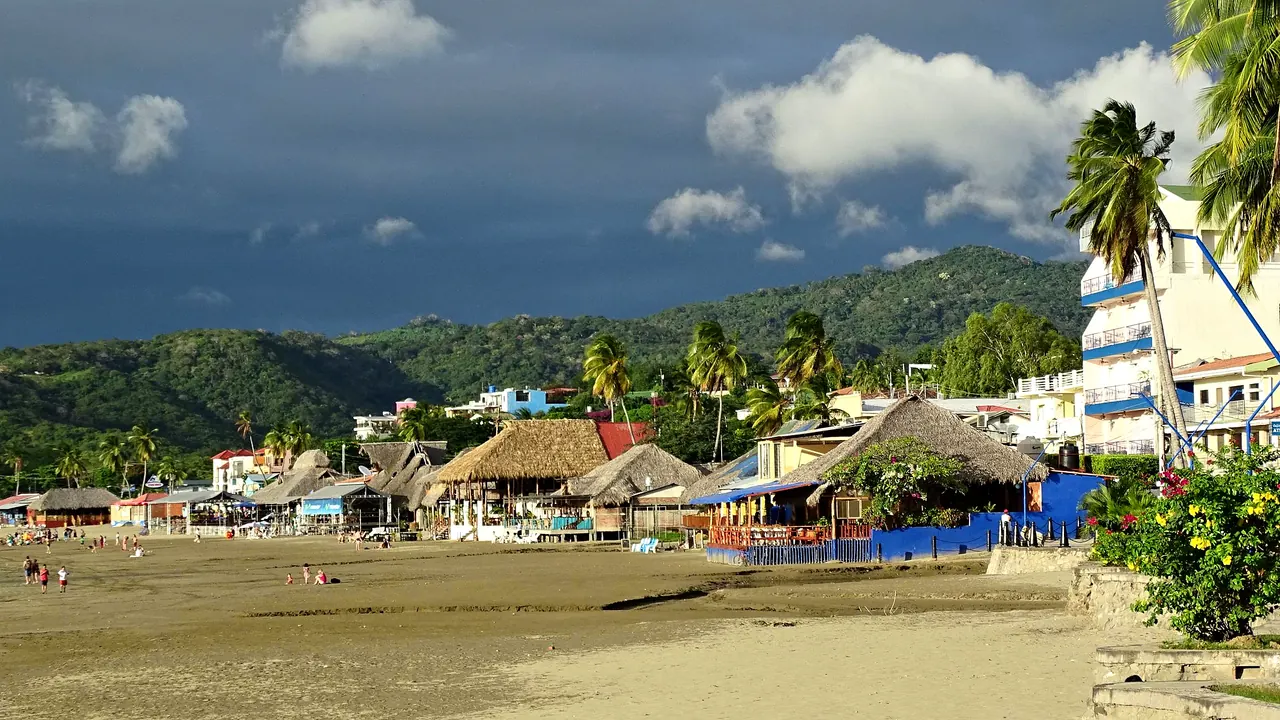
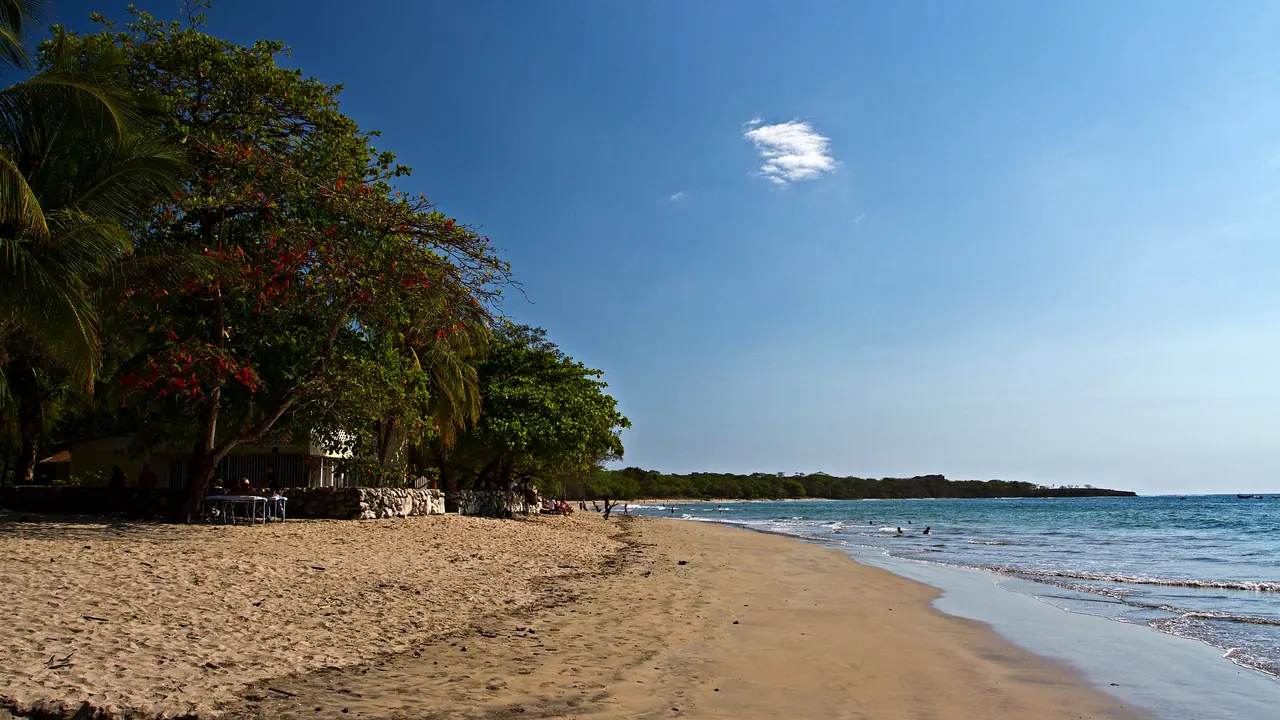
Photos: San Juan del Sur by Adam Jones from Kelowna, BC, Canada, CC BY-SA 2.0, cropped; Tamarindo by Jarle Naustvik, CC BY 2.0, cropped.
San Juan del Sur or Tamarindo?
Our verdict in twelve categories, each scored against the same fixed benchmark cities, and the climate month by month, so you can choose for your trip.
Choose San Juan del Sur for
- prices
- day trips
- culture and sights
San Juan del Sur suits travellers watching their money who want a surf base with somewhere real to go on a free day. Meals, beer and hostel beds cost little in Nicaragua, and Granada's colonial streets and the volcano island of Ometepe are within reach, which the Costa Rican coast cannot match. In return you arrange a ride to every good beach and share the town with a young party crowd.
Choose Tamarindo for
- families
- beaches
- nature and the outdoors
Pick Tamarindo for an easier beach vacation, especially with children. Its long sandy bay is right in front of town, with gentle surf for learning and warm water all year, and the mangrove trips, turtle nights at Playa Grande and quieter Langosta make the days simple to fill. It costs far more, close to North American home prices, and away from the coast and its parks there is little to visit.
Scoreboard
Twelve categories on one fixed scale from 0 to 100. The shaded stretch is the gap between the two.
Your match
Pick a travel style or drag the sliders, and both match scores follow your weighting.
Too close to call, 2 points apart
Wins on prices and day trips with your weighting.
Wins on families and beaches with your weighting.
What matters to you?
Category by category
What the scores mean for a trip.
Beaches & swimming
Tamarindo has the stronger beach life because its sand is right in front of town: a long golden bay with gentle waves made for learning to surf, calmer Langosta a short hop south and wild Playa Grande across the estuary. Conchal's crushed-shell sand and clear snorkelling water are half an hour north. Just keep away from the crocodiles at the river mouth.
San Juan del Sur's own bay is calm but shared with fishing boats and not always clean, so the best swimming is at Marsella and Majagual to the north, with Maderas, Remanso and Hermosa for surf. All of them are reached on dirt tracks, have little more than a beach bar, and the water is cooler in the windy dry months.
Food & drink
The two eat at about the same level, simple and fish-led, with no great depth in either. San Juan del Sur keeps more of a local table: whole fried snapper on the beachfront, then gallo pinto, fresh cheese and big fruit juices from market stalls a few streets back, with Flor de Caña rum to finish.
Tamarindo is more polished for an evening out, with fish taco stands, poke, Argentine grills and a few ambitious dinner places. Its local layer is the soda serving casados, since it has no real market culture.
Culture & sights
Neither town is a reason to come for sights. San Juan del Sur at least has a small grid of wooden houses with verandas, a parish church on a little park and the Christ of Mercy statue on the headland, which is worth the climb for the view over the bay. Tamarindo is a strip of hotels and surf shops with no historic fabric at all, so anyone curious about the past has to drive inland to the Nicoya Peninsula towns.
Nightlife
Both are party towns on a small scale, and they party in different ways. San Juan del Sur's nights are built around backpackers, above all the Sunday hostel pool-party crawl, and the crowd is young and mostly foreign. Outside the dry season it goes quiet early.
Tamarindo's evenings begin with sunset drinks on the sand and move along the main road to a few dance clubs that take turns hosting the big night. That means something is on most evenings, and young Costa Ricans join in at weekends.
Nature & outdoors
Tamarindo offers more on and around the water. You can dive or snorkel at the Catalinas Islands, kayak the estuary mangroves past crocodiles and herons, and watch leatherbacks nest at Las Baulas, just across the river. The volcanic fumaroles and waterfalls of Rincon de la Vieja are about two hours inland.
San Juan del Sur is a fine surf coast with year-round breaks, howler monkeys above the northern beaches and headland trails. Its highlight is La Flor, forty minutes south, where olive ridley turtles come ashore in large numbers in the second half of the year.
Day trips
This is where San Juan del Sur pulls clearly ahead. Granada's colonial churches and lake islets are about two hours away, Masaya's craft market is as close, and a ferry from San Jorge reaches Ometepe's twin volcanoes, though that island is better kept for an overnight stay.
From Tamarindo the outings are mostly into nature. The town-based choices are smaller: the potters of Guaitil, Nicoya's old colonial church, the folk traditions of Santa Cruz and a change of beach at Playas del Coco or Nosara, on roads that slow down in the rains.
Good for families
Tamarindo is the better bet with children. The town waves suit children's surf lessons, Langosta has calm water at low tide, and mangrove trips, turtle nights, zip-lines and horse rides are easy to book. Families can sleep at Langosta or Playa Grande, away from the noise of the strip.
San Juan del Sur works mainly for older children who like the water and can enjoy the calm town bay and the surf schools. The rough tracks, the rip currents on open beaches, a weekend beachfront ruled by partygoers and the drive to Rivas for medical care all make it harder.
Getting around
Both towns are easy on foot and awkward beyond it, and much of a stay goes into arranging transport. In San Juan del Sur the local buses only link to Rivas and the highway, so the beaches mean shuttles, taxis, quads or a four-wheel drive on tracks that turn to mud in the rains. Tamarindo has a walkable strip and sand to stroll to Langosta, golf carts for short hops, and Liberia's airport a little over an hour away, though a rental car is still the usual answer for the southern beaches.
Shopping & style
Neither place is worth a shopping trip, and Tamarindo only edges ahead with its linen and swimwear boutiques alongside the surf shops, plus some Guaitil pottery for sale. San Juan del Sur sells boards, beachwear, hammocks and souvenirs, but its real crafts are found in Masaya and Granada, just as Tamarindo's are best bought in Guaitil itself.
Affordability
San Juan del Sur is by far the cheaper stay, even though it is the priciest place in Nicaragua. Local eateries, market food, beer and buses cost very little, and costs only climb at the outer-beach surf lodges and with daily shuttles.
Tamarindo sits in Costa Rica's costliest resort belt, where rooms, meals and tours approach North American prices and every ride adds up. Hostels, surf camps and sodas help, but a careful budget still stretches noticeably further across the border.
Live music & performing arts
Neither town has a stage, so live entertainment means bands and acoustic sets in beach bars. San Juan del Sur adds town festivals with processions and folk dancing, and for theatre or concerts you have to go to Granada or Managua. Tamarindo has occasional fire dancers on the sand, while Guanacaste's own music and dance belong to the Santa Cruz festivals.
Wellness & relaxation
Both offer yoga, massage and hammock days rather than baths, and in both the town centre is too loud to rest in. San Juan del Sur's calm is up in the jungle hills over the northern beaches, where retreats with ocean-view shalas combine surf, yoga and healthy food, and massage is cheap.
Tamarindo keeps it closer to town, with daily studio classes, resort spas and quiet stays at Langosta or Playa Grande. The volcanic hot springs at Rincon de la Vieja are about two hours away.
When should you go?
Pick your month. The climate figures are measured averages, not a forecast.
San Juan del Sur in July
Tamarindo in July
Daytime high, °C
Rainfall in the month, mm
Where the figures come from
San Juan del Sur's temperatures are measured 86 km from the centre, at Liberia.
San Juan del Sur has no rain gauge within 25 km of the centre, so its rainfall comes from a gridded climate dataset read at the destination rather than from a gauge further away.
Tamarindo's temperatures are measured 54 km from the centre, at Liberia.
Tamarindo has no rain gauge within 25 km of the centre, so its rainfall comes from a gridded climate dataset read at the destination rather than from a gauge further away.
Temperature and rainfall are climate normals, averaged over the years shown. San Juan del Sur: 1991-2020 normals, Liberia (85.6 km from centre). Tamarindo: 1991-2020 normals, Liberia (53.8 km from centre).
Both towns follow the same Pacific pattern: dry from December to April, then heavy rain from May to November, building to nearly 390mm in October, with a short lull in July. The heat barely changes, and March and April reach 36°C, so at any time of year it is best to walk the streets early in the morning or in the evening. Tamarindo's dry season is the more complete, with almost no rain from December to March, while San Juan del Sur sees the odd shower in December, January and April.
The sea is where they part. Off San Juan del Sur, strong offshore winds from about December to April cool the water to 26°C, so the warmest swimming there comes in the wetter months. Tamarindo's sea holds at 28°C to 29°C all year, so its dry season brings sun and warm water together.
Which traveller are you?
For a trip on a tight budget, choose San Juan del Sur. Take a hostel bed in town rather than a surf lodge on the outer coast, share shuttles to the beaches and avoid Christmas and Easter. Tamarindo costs far more for the same days.
On a family trip with children, Tamarindo makes the logistics simpler. Liberia's airport is little more than an hour away, the sand is a short walk from most beds and pools fill the hot afternoons. In San Juan del Sur, almost every swim starts with a dusty ride.
For a culture and arts trip, San Juan del Sur is the better base, though neither town has much to see. Split the stay and spend a night or two in Granada or on Ometepe before returning to the coast. From Tamarindo, culture means a few short drives inland.
Before you go
| Measure | San Juan del Sur | Tamarindo |
|---|---|---|
| Official language | Spanish | Spanish |
| Currency | Cordoba Oro (NIO) | Costa Rican Colon (CRC) |
| Sockets | AB120 V, 60 Hz | AB120 V, 60 Hz |
| Driving side | Right | Right |
| Time zone | UTC-6 | UTC-6 |
| Emergency number | Police 118, ambulance 128, fire 115/120 | 911 |
| Elevation | 9 m | 27 m |
| Main airport | Augusto C. Sandino (Managua) International Airport (MGA)104 km from centre11 non-stop destinations | Daniel Oduber Quirós International Airport (LIR)43 km from centre30 non-stop destinations |
| Public holidays this year | 18 days | 11 days |
By the numbers
| Measure | San Juan del Sur | Tamarindo |
|---|---|---|
| Population | 16,123 | 7,132 |
| People per km² | 39 | 57 |
| Museums within 10 km | 0 | 0 |
| UNESCO World Heritage sites within 50 km | 0 | 0 |
| Swim season, months above 21 °C | 12 months | 12 months |
Where else could you go?
Every comparison below shares a destination with this one, so you can follow San Juan del Sur or Tamarindo somewhere new.
- Granada, Nicaraguavs San Juan del Sur
- Santa Teresa, Costa Ricavs Tamarindo
- Monteverdevs Tamarindo
- La Fortunavs Tamarindo
- Monteverdevs San Juan del Sur
- La Fortunavs San Juan del Sur