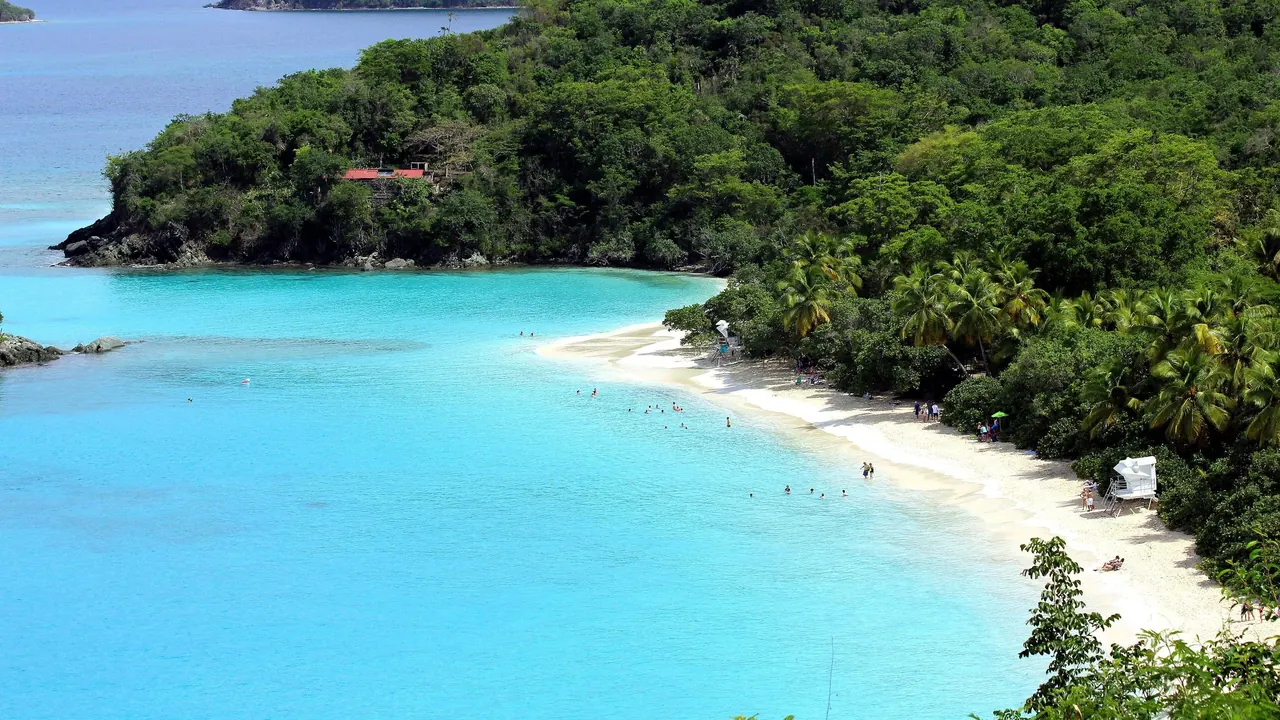
Photos: St John by Artix Kreiger 2, CC BY 2.0, cropped.
St Barts or St John?
Our verdict in twelve categories, each scored against the same fixed benchmark cities, and the climate month by month, so you can choose for your trip.
Choose St Barts for
- shopping
- nightlife
- food and drink
St Barts suits travellers who want the island to feel French and polished: long rosé lunches on the sand, serious cooking on hillside terraces, luxury boutiques around the Gustavia harbour and a fashionable party scene from Christmas into spring. It is the choice when the beach is the setting for a stylish, social trip and the cost is not the deciding question.
Choose St John for
- nature and the outdoors
- day trips
- prices
Travellers who would rather spend their days in the water and on the trails should lean towards St John. With most of the island inside a national park, it offers reefs full of turtles and rays, forest walks past plantation ruins and boat days to the British Virgin Islands, all in a quieter, more casual setting where evenings end early and dinner is grilled fish rather than fine dining.
Scoreboard
Twelve categories on one fixed scale from 0 to 100. The shaded stretch is the gap between the two.
Your match
Pick a travel style or drag the sliders, and both match scores follow your weighting.
Wins on shopping and nightlife with your weighting.
Wins on nature and the outdoors and day trips with your weighting.
What matters to you?
Category by category
What the scores mean for a trip.
Beaches & swimming
Both islands are built around their beaches, and the swimming is equally good on each, in warm, clear water all year. The difference is in character. St Barts offers variety in small coves: wild, shadeless Saline and Gouverneur with occasional surf, the calm reef lagoons at Grand Cul-de-Sac, the walk-in quiet of Colombier and the social beach at St Jean under the landing planes.
St John's beaches are mostly protected parkland along the north shore, longer, greener and more natural, with Trunk Bay's snorkel trail and turtles in the shallows at Maho. The trade-off is that the best known fill by late morning in winter, while St Barts' beaches are rarely crowded.
Food & drink
St Barts eats far better. It is French at heart, with proper boulangeries, cheese and wine in the supermarkets, long lunches on the sand at St Jean and Flamands, and polished cooking along the Gustavia harbour, even if nearly everything aims at the same expensive register.
St John is more casual and more limited: open-air grill restaurants, beach bars and food trucks in Cruz Bay, with West Indian dishes such as johnnycakes and stewed goat as the most local flavour. Its fine-dining tier is thin, and most produce is shipped in.
Culture & sights
Neither island is a place for sightseeing, though St John has a little more to seek out. Its history sits in the forest: the Annaberg sugar mill, the estate ruins and Taíno petroglyphs on the Reef Bay Trail, and the fort site at Coral Bay where the 1733 slave revolt began.
St Barts has its Swedish legacy in Gustavia, with the clock tower, the Wall House museum and the old forts, plus the church at Lorient and the village of Corossol. It is pleasant, but an hour or two covers it.
Nightlife
St Barts is the island for going out, at least in season. From Christmas into spring, beach lunches at St Jean turn into dancing on the tables, and evenings move on to Gustavia's harbour bars, late clubs and yacht decks, peaking in the loud week around New Year.
St John has no clubs at all, just a few friendly open-air bars on the Cruz Bay waterfront and in Coral Bay, where most nights finish soon after dinner. The catch on St Barts is that much of the scene closes in late summer and autumn.
Nature & outdoors
St John is the stronger choice for nature by a wide margin, because most of it is national park. Steep dry forest runs down to undeveloped bays, a trail network crosses the island to Ram Head and Lameshur, and the reefs at Waterlemon Cay and the seagrass at Maho are full of turtles, rays and coral.
St Barts has lovely views from its hill roads and a marine reserve where turtles are common, plus good kitesurfing in the Grand Cul-de-Sac lagoon. On land, though, the walking amounts to the cliff path to Colombier and a few viewpoints.
Day trips
St John is better placed for outings. St Thomas, with the Danish streets and fort of Charlotte Amalie, is a short ferry ride away, and day charters cross to Jost Van Dyke, Tortola and the boulders of The Baths on Virgin Gorda, stopping to snorkel at empty cays. Bring a passport for the British side.
From St Barts there is really only the hour-long ferry to St Martin for Marigot, Grand Case and Philipsburg. Anguilla, Saba and St Eustatius are near but need a charter or small plane.
Good for families
For families the two islands are much alike: very safe, slow-paced and good for children who love the water, but with no attractions built for them. St Barts relies on the calm lagoons at Grand Cul-de-Sac and Petit Cul-de-Sac, Shell Beach and a villa pool, though the open beaches such as Saline can have strong waves.
St John's draw is turtles at Maho Bay in water a child can stand in and the gentle snorkel trail at Trunk Bay. Few of its beaches have lifeguards, and the journey there, by flight, taxi and ferry, is longer.
Getting around
Both islands mean renting a car and tackling steep, narrow, hairpin roads, but St Barts is a little easier. Its small plane lands on the island itself, and Gustavia and St Jean are walkable.
St John has no airport, so arrival is a flight to St Thomas, a taxi to Red Hook and a ferry, and you drive on the left once there. In its favour, open-air safari taxis run from Cruz Bay to the north shore beaches, which St Barts, with no buses and few taxis, cannot match.
Shopping & style
Shopping is one of St Barts' surprises. Because it is duty-free, the streets around the Gustavia harbour hold a dense run of luxury fashion, watch and jewellery boutiques, with resortwear in St Jean and straw work from Corossol.
St John offers a couple of courtyards in Cruz Bay with galleries, local jewellery and hand-painted pottery, which fill an hour. For more, people take the ferry to Charlotte Amalie's duty-free streets.
Affordability
Neither is a cheap trip, but St Barts sits at the extreme, among the costliest vacation islands anywhere, with no budget side at all beyond cooking in your villa.
St John is expensive too, with high villa rates, shipped-in food and jeep hire, yet it leaves more room to save. The national park beaches and trails are mostly free, and the Cinnamon Bay campground gives a simpler way to stay.
Live music & performing arts
Neither island has a theatre or a concert hall, so performance comes in short seasons rather than as a programme. St Barts has the more refined moment. Each January a long-standing festival brings classical music, opera and dance into the churches and outdoor venues of Gustavia, which gives a winter stay an evening or two of real culture. Its carnival comes just before Lent, with steel bands in the streets.
St John's big event falls in early summer instead. The St John Festival is a carnival of parades, calypso, the islands' own quelbe music and food fairs, and gives a trip outside the winter season something to plan around. For the rest of the year both islands rely on bar music, though the kind differs: DJs and bands in Gustavia's harbour bars in high season, against acoustic sets and the occasional steel pan or reggae group in Cruz Bay.
Wellness & relaxation
For a pampering stay, St Barts has the edge. Its luxury hotels run polished spas, and therapists and yoga teachers will come out to a villa. Beyond that, its appeal is an unhurried rhythm on an island without tower blocks or casinos, at its stillest in spring.
St John offers less in the way of treatments, just a few yoga studios, resort therapies and visiting masseurs, but its quiet runs deeper. Because the national park covers most of the land, the hillsides stay dark and nearly empty, and after nightfall you hear frogs rather than cars. It rewards a stay spent reading on a villa terrace and swimming before breakfast, more than one spent booking sessions.
When should you go?
Pick your month. The climate figures are measured averages, not a forecast.
St Barts in July
St John in July
Daytime high, °C
Rainfall in the month, mm
Temperature and rainfall are climate normals, averaged over the years shown. St Barts: 1991-2020 (sunshine 1961-1990) normals, Gustavia, Saint Barthelemy (0.5 km from centre). St John: 1991-2020 normals, C. Amalie / St. Thomas Airport (20 km from centre).
The two islands are warm all year, with daytime highs between 28°C and 32°C and a sea that stays at about 26°C or above, so the beach works in every month. The driest and most comfortable stretch for walking runs from January to April. December is a transition month, still drying out after the autumn rains. St Barts is a little drier than St John through late winter and spring, and its sunshine stays steady all year, dipping only slightly in autumn and early winter.
The wet season sets the two apart. Rain builds from late summer on both, but St Barts is wettest in October, at about 146mm, and eases from November. St John stays wet for longer and is wettest in November, at about 159mm. St John also reaches its full summer heat from June, a month or two before St Barts, so its long trails are best walked in the cooler months.
Which traveller are you?
On an outdoors trip, St John is clearly the better island. Two-thirds of it is national park, with the Reef Bay Trail, the cliffs at Ram Head and reefs off the north shore, while St Barts has only short cliff walks and a few days of water sports.
For a food and nightlife trip, St Barts wins easily. Its French bakeries, long beach lunches and harbour dining are a step above St John's casual restaurants, and its seasonal party scene runs far later than Cruz Bay's few waterfront bars.
On a shopping trip, St Barts is the obvious pick. Duty-free status brings luxury fashion, watch and jewellery boutiques to the streets around Gustavia, whereas St John offers an hour of galleries and craft in Cruz Bay and sends serious shoppers to St Thomas.
Before you go
| Measure | St Barts | St John |
|---|---|---|
| Official language | French | English |
| Currency | Euro (EUR) | US Dollar (USD) |
| Driving side | Right | Left |
| Time zone | UTC-4 | UTC-4 |
| Emergency number | - | 911 |
| Main airport | Princess Juliana International Airport (SXM)44 non-stop destinations | Cyril E. King Airport (STT)26 non-stop destinations |
| Public holidays this year | 12 days | 18 days |
By the numbers
| Measure | St Barts | St John |
|---|---|---|
| Population | 10,124 | 3,881 |
| People per km² | 405 | 76 |
| Swim season, months above 21 °C | 12 months | 12 months |
Where else could you go?
Every comparison below shares a destination with this one, so you can follow St Barts or St John somewhere new.
- St Thomasvs St John
- British Virgin Islandsvs St John
- Sint Maartenvs St Barts
- Saint-Martinvs St Barts
- Anguillavs St Barts
- Culebravs St John