Photos: St. Moritz by JoachimKohler-HB, CC BY-SA 4.0, cropped; Wengen by Charles J. Sharp, CC BY-SA 4.0, cropped.
St. Moritz or Wengen?
Our verdict in twelve categories, each scored against the same fixed benchmark cities, and the climate month by month, so you can choose for your trip.
Choose St. Moritz for
- shopping
- food and drink
- nightlife
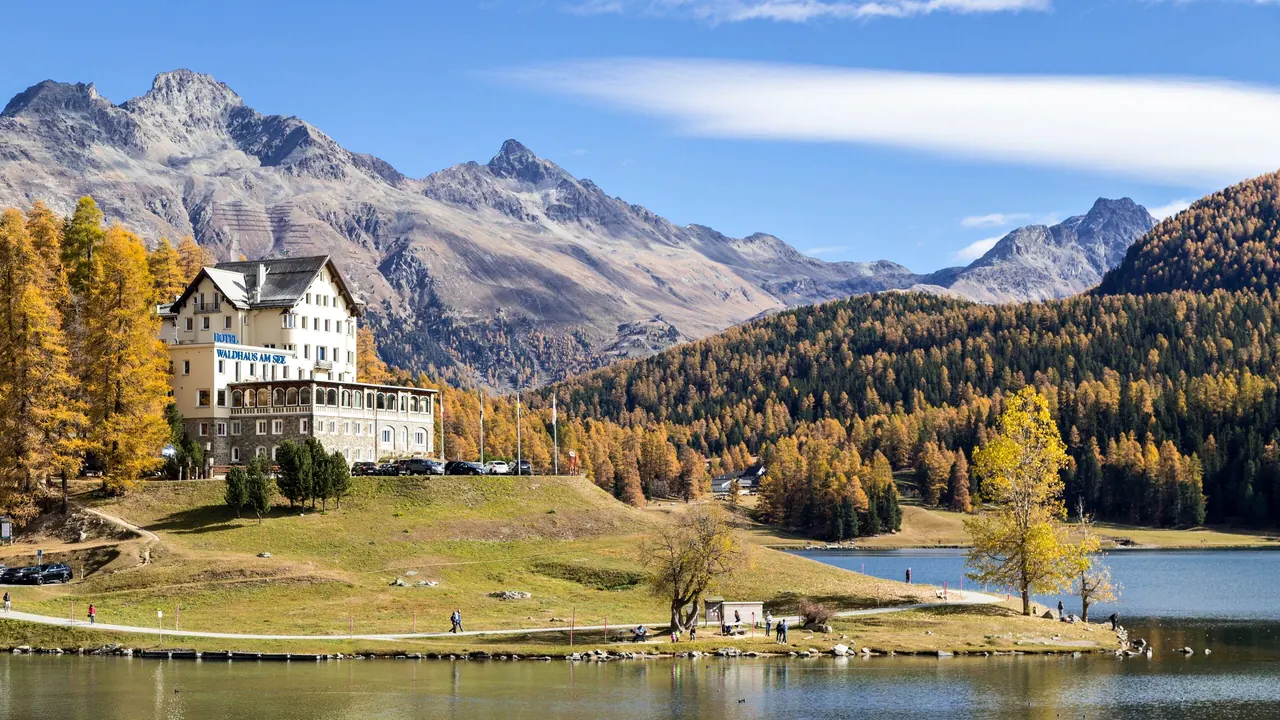
St. Moritz suits travellers who want their Alpine stay with polish: serious restaurants in the evening, elaborate hotel spas, a museum or two and a winter season of hotel bars and late nights. Its wide, sunny lake valley is as good as anywhere for downhill and cross-country skiing and summer hiking. It also has the luxury shopping and festival music that Wengen doesn't offer.
Choose Wengen for
- day trips
- families
- beaches
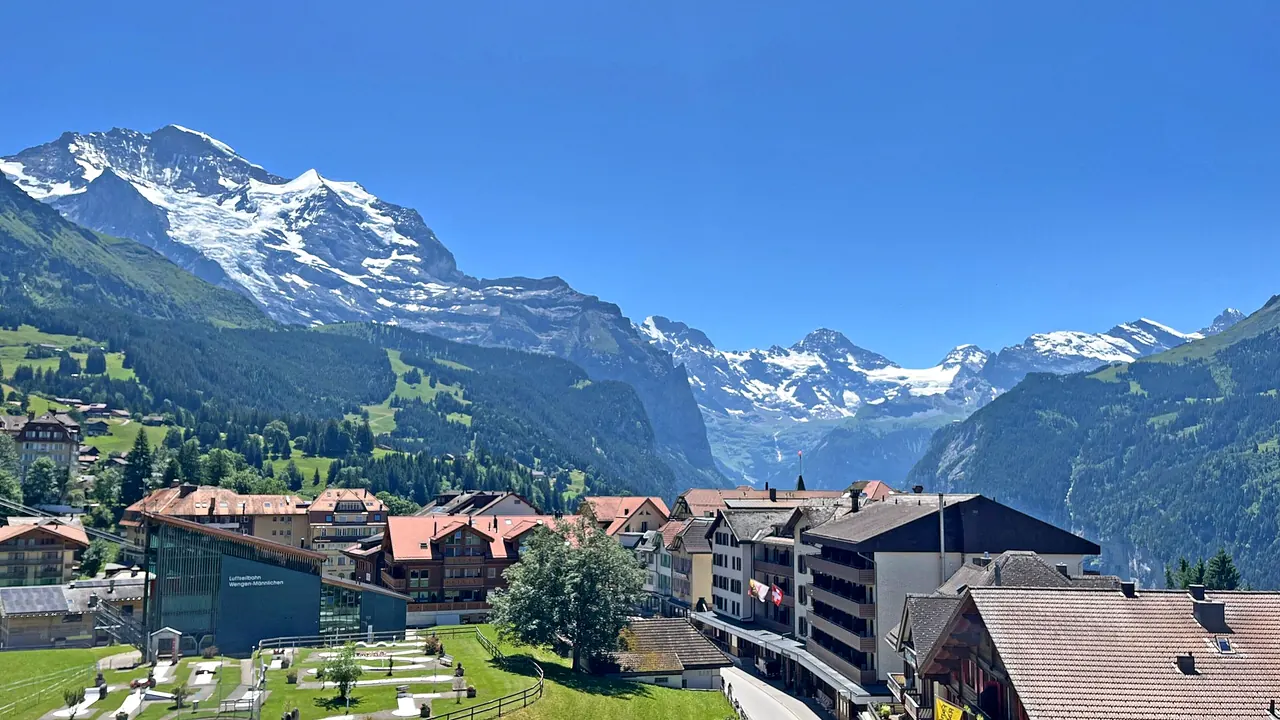
Wengen is for people who want the mountains and very little between them and the view. The car-free village faces the Jungfrau across the Lauterbrunnen valley, and children can walk around it safely. Interlaken, the lakes and Bern also make better outings than the Engadine villages. Expect quiet evenings, half-board dinners and early nights in exchange.
Scoreboard
Twelve categories on one fixed scale from 0 to 100. The shaded stretch is the gap between the two.
Your match
Pick a travel style or drag the sliders, and both match scores follow your weighting.
Wins on shopping and food and drink with your weighting.
Wins on day trips and families with your weighting.
What matters to you?
Category by category
What the scores mean for a trip.
Beaches & swimming
Neither is a swimming destination, and the only difference is how far the cold water is. St. Moritz has Lej da Staz, a forest lake within walking distance with a lawn and a short bathing season, as well as an indoor pool in town. From Wengen you take the train down for about an hour to the lidos on Lake Thun, which makes a hot-day outing rather than something on the doorstep.
Food & drink
St. Moritz eats far better. Its grand hotels and mountain restaurants hold an unusual number of ambitious kitchens, and terraces at Corviglia and Muottas Muragl make lunch an occasion. The Engadine table adds capuns, pizzoccheri and nut tart from the old confectioners.
Wengen serves plain Alpine cooking such as rösti, fondue and raclette, mostly in hotel dining rooms on half-board, and the Jungfrau view outshines the plate. Neither has street food or much casual eating. In St. Moritz, though, the restaurants are a reason to come, while in Wengen they are fuel for the trails.
Culture & sights
Neither is a sightseeing destination, but St. Moritz at least fills an afternoon. The Segantini Museum with the painter's great Alpine triptych, the Engadin Museum's painted farmhouse rooms and the leaning tower are all in the village, and the 1928 and 1948 Winter Olympics and the Cresta Run give the resort a story of its own.
Wengen has its wooden chalets, Belle Époque hotels, small church and ski-racing past, but nothing to visit as such. For museums, you take the train down the valley.
Nightlife
St. Moritz has a winter social scene that Wengen lacks. Between Christmas and early March, grand hotel bars, après-ski terraces and a couple of exclusive clubs keep going late, glamorous and costly rather than rowdy. Wengen's evenings mean après-ski in a handful of bars and a hotel bar or two, and the Lauberhorn race weekend in January is the one real party.
In summer the gap closes: both are quiet villages where the evening ends with dinner.
Nature & outdoors
Both are outstanding mountain bases, and the difference is the shape of the land. St. Moritz spreads across a broad, sunny high valley of lakes and larch forest. It has three big ski areas, some of the Alps' best cross-country trails, kitesurfing on Lake Silvaplana and the Swiss National Park within an hour.
Wengen is more dramatic close up. It sits on a shelf above the sheer, waterfall-lined Lauterbrunnen trough, face to face with the Eiger, Mönch and Jungfrau, with the walk to Kleine Scheidegg and the railway up to the Jungfraujoch glacier. Choose St. Moritz for open space and a range of sports, and Wengen for sheer scale, knowing that cloud can hide its peaks for days.
Day trips
Wengen has the better spread of outings, even though every one starts with the slow rack railway down. Within about an hour are Interlaken, Lake Thun with its castles and steamers, and Brienz with the Ballenberg open-air museum. Bern's arcaded old town makes a full but worthwhile day.
From St. Moritz, the journeys are often lovelier than the places they reach. The UNESCO-listed Bernina line runs over the pass to Tirano in Italy, Sils Maria has Nietzsche's summer house, the Lower Engadine has its sgraffito villages and Soglio lies over the Maloja. They are charming, but they are villages, with no city like Bern within reach.
Good for families
Wengen is the more natural fit for children. It is car-free, so they can walk around the village safely, the nursery slopes start close to the hotels, and in summer short train and cable-car rides reach big views without long hikes. Rainy days are its weak spot.
St. Moritz is safe and well equipped, with ski schools on Corviglia, sledging and skating on natural ice. Its tone is adult luxury, though, which is why many families stay in the calmer villages along the valley instead.
Getting around
St. Moritz links outward across a whole valley, while Wengen links upward to the peaks. The Rhaetian Railway and regional buses tie St. Moritz to everywhere from Maloja to Zuoz. The village itself is steep, climbing from Bad up to Dorf, with escalators and a lift to help.
Wengen is car-free and small enough to cross in minutes, and electric carts take luggage from the station. Its railway runs on to Kleine Scheidegg and the Jungfraujoch. The catch is going down: anywhere lower starts with the slow descent to Lauterbrunnen and often a change in Interlaken.
Shopping & style
St. Moritz is a shopping destination of a narrow kind: Via Serlas and the streets around it hold top fashion, watch and jewellery boutiques, furriers and high-end ski wear, plus Engadine linen and woodwork.
Wengen has a short main street with ski hire, gear, souvenirs, chocolate and a grocery, enough for the stay and nothing more. For proper shopping you go to Interlaken or Bern.
Affordability
Budget travellers should look elsewhere, because a stay in either costs about the same, and it is a lot. In St. Moritz the money goes on grand hotels, mountain lunches and lift passes. Summer is easier, and rooms often include local lifts and transport. Visitors on a tight budget sleep in simpler guesthouses elsewhere in the valley and come in for the day.
In Wengen the mountain railways and cable cars are the heaviest cost, and the Jungfraujoch train is the biggest single expense. Self-catering chalets, rail passes and the free trails are the ways to save.
Live music & performing arts
St. Moritz has no hall of its own, but its seasonal festivals bring real music: a summer jazz festival in intimate rooms, the Engadin Festival's chamber concerts in churches across the valley, and a classical series in winter. Plan around those dates, or the only music will be a hotel pianist.
Wengen offers an occasional summer concert, yodelling or alphorn in a hotel and a brass band on village days. For theatre or a proper concert you go to Interlaken or Bern.
Wellness & relaxation
St. Moritz is the stronger choice for a spa stay. It began as a spa town, its mineral spring still supplies a medical bath in Bad, and its hotel spas, with indoor-outdoor pools facing the peaks, are among the most elaborate in the Alps. The thermal baths at Scuol are a rail ride away.
Wengen's kind of rest is simpler: no cars, cowbells and waterfalls, and a balcony facing the Jungfrau. It has hotel saunas but no public baths, so it suits people who unwind by sitting still in fresh air. St. Moritz in high winter, by contrast, is more social than calm.
When should you go?
Pick your month. The climate figures are measured averages, not a forecast.
St. Moritz in July
Wengen in July
Daytime high, °C
Rainfall in the month, mm
Where the figures come from
St. Moritz has no rain gauge within 25 km of the centre, so its rainfall comes from a gridded climate dataset read at the destination rather than from a gauge further away.
Wengen has no weather station within reach, so its figures come from a gridded climate model rather than a measured record, and read a broad area rather than one spot.
Temperature and rainfall are climate normals, averaged over the years shown. St. Moritz: 2015-2025 (rainfall 1991-2020) normals, Samedan (5.5 km from centre). Wengen: 1991-2020 normals, TerraClimate 4 km grid at the town, no weather station within 90 km.
Neither is a beach place, and neither has water warm enough to make swimming a reason to go. St. Moritz is the warmer of the two in summer, with daytime highs around 20°C in July against about 16°C in Wengen. June to September is the walking season in both, and Wengen stays fresher on long climbs. From November to March both sit around freezing and the trip is about snow.
The bigger difference is rain. St. Moritz is notably dry in winter, at about 42mm in February, then gets wetter from May through autumn. Wengen is wet all year, with even its driest month near 76mm and summer months above 110mm, so expect cloud and showers there in any season. In both, April and May are cool in-between months, when the snow is going and summer has not arrived.
Which traveller are you?
For a food and nightlife trip, St. Moritz is the one to book. Plan long tasting dinners in winter, then a hotel bar until late. In Wengen, evenings run to a half-board meal and an early night before the next day's walk.
For a relaxing and wellness trip, go to St. Moritz in summer or autumn, when the resort is quiet and you can spend whole afternoons between treatments and warm pools. Wengen suits people who unwind with a book on a balcony rather than a massage.
On a family trip with young children, St. Moritz works if the plan is mainly skiing and you don't mind grown-up hotels. Wengen is easier day to day: children roam freely, ski school is a short walk away and a train ride makes an outing.
Before you go
| Measure | St. Moritz | Wengen |
|---|---|---|
| Official language | French, German, Italian, Romansh | French, German, Italian, Romansh |
| Currency | Swiss Franc (CHF) | Swiss Franc (CHF) |
| Sockets | CJ230 V, 50 Hz | CJ230 V, 50 Hz |
| Driving side | Right | Right |
| Time zone | UTC+1, UTC+2 in summer | UTC+1, UTC+2 in summer |
| Emergency number | 112 | 112 |
| Elevation | 1,822 m | 1,274 m |
| Main airport | Zürich Airport (ZRH)145 km from centre226 non-stop destinations | Zürich Airport (ZRH)106 km from centre226 non-stop destinations |
| Public holidays this year | 9 days | 10 days |
By the numbers
| Measure | St. Moritz | Wengen |
|---|---|---|
| Population | 5,027 | 1,116 |
| People per km² | 175 | 31 |
| Museums within 10 km | 7 | 2 |
| UNESCO World Heritage sites within 50 km | 2 | 1 |
Where else could you go?
Every comparison below shares a destination with this one, so you can follow St. Moritz or Wengen somewhere new.
- Mürrenvs Wengen
- Grindelwaldvs Wengen
- Adelbodenvs Wengen
- Lenzerheidevs St. Moritz
- Arosavs St. Moritz
- Davosvs St. Moritz