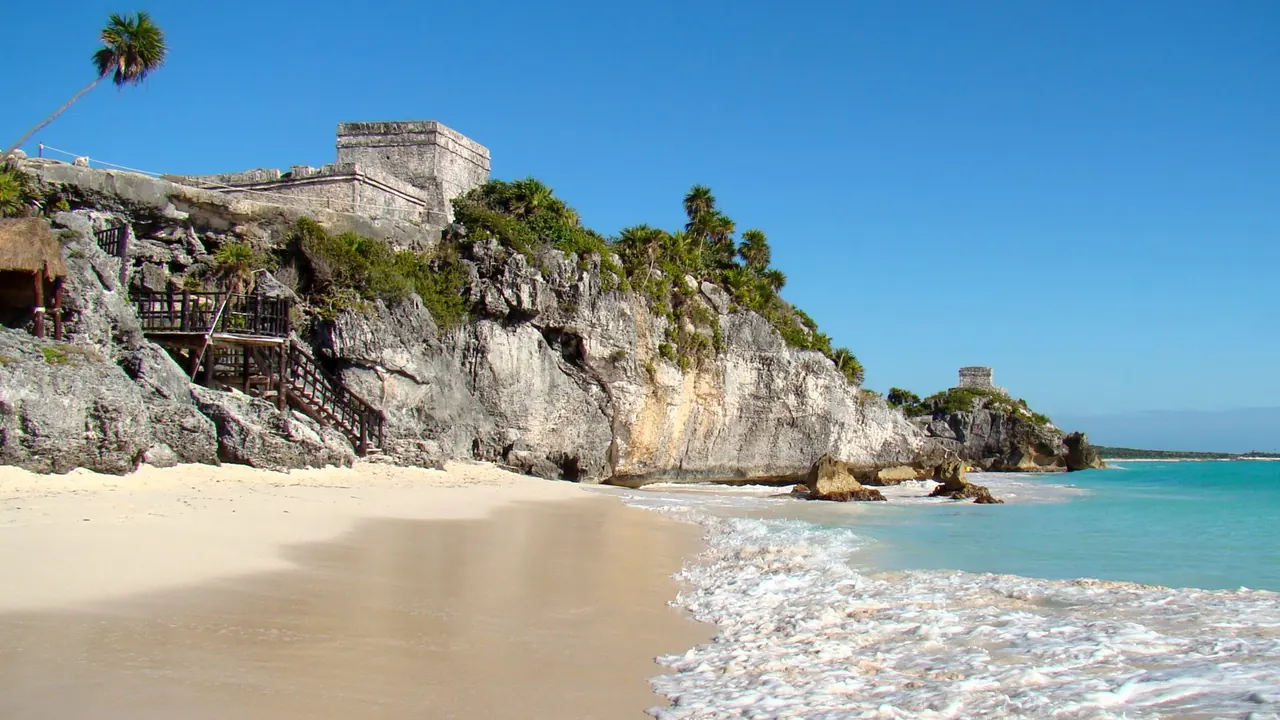
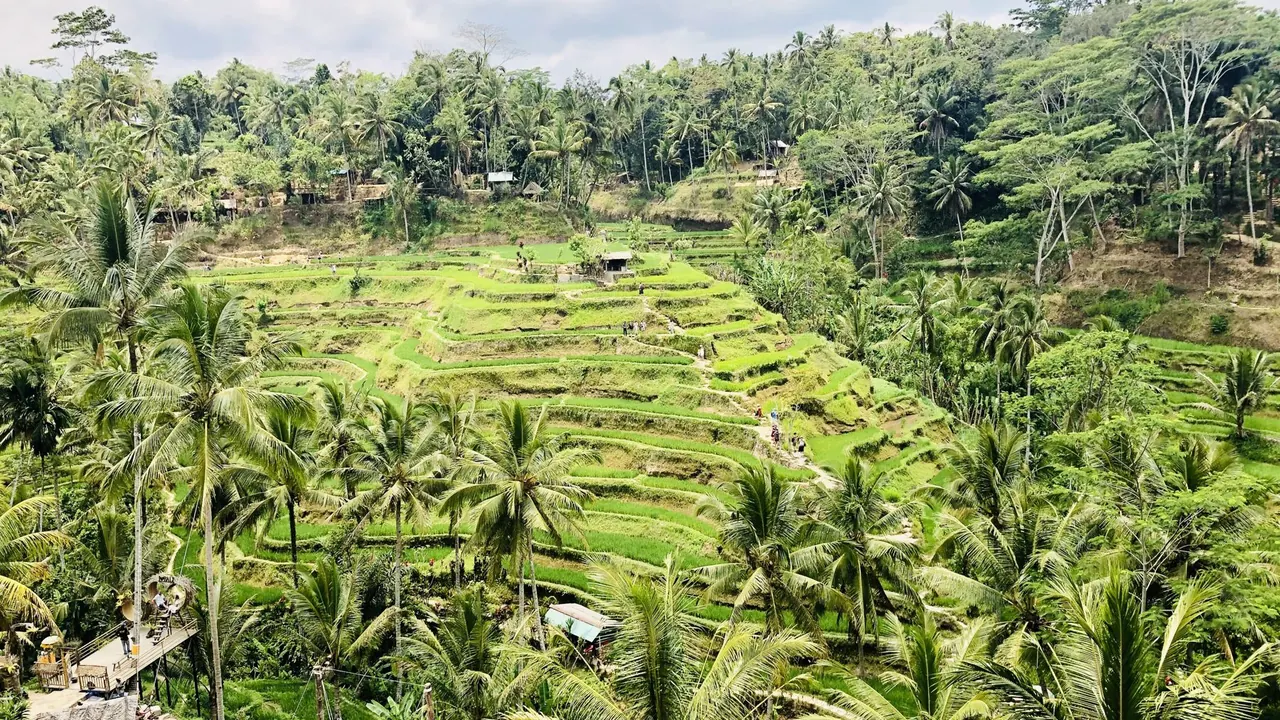
Photos: Tulum by Bjørn Christian Tørrissen, CC BY-SA 3.0, cropped; Ubud by Pinterpandai, CC BY-SA 3.0, cropped.
Tulum or Ubud?
Our verdict in twelve categories, each scored against the same fixed benchmark cities, and the climate month by month, so you can choose for your trip.
Choose Tulum for
- beaches
- nightlife
- getting around
Tulum is the pick for a trip built around water and evenings out. Warm Caribbean sea, cenotes clear enough for cavern diving, the lagoons of Sian Ka'an and a name for jungle DJ nights suit couples and friends who want beach days followed by big nights. It also works for families whose children spend all day in the water. Expect to pay for all of it.
Choose Ubud for
- prices
- live music and the arts
- culture and sights
Choose Ubud for a slower trip: yoga at dawn, walks on the rice terraces, temples that are still in daily use and dance to gamelan after dinner. It costs far less and offers much more culture. It has no beach and goes to bed early, though, so it suits wellness travellers, walkers and anyone curious about Bali more than people after sand and late nights.
Scoreboard
Twelve categories on one fixed scale from 0 to 100. The shaded stretch is the gap between the two.
Your match
Pick a travel style or drag the sliders, and both match scores follow your weighting.
Wins on beaches and nightlife with your weighting.
Wins on prices and live music and the arts with your weighting.
What matters to you?
Category by category
What the scores mean for a trip.
Beaches & swimming
Tulum is by far the better beach destination. A long sweep of pale sand runs from the cliff-top ruins south towards Sian Ka'an, and the Caribbean is warm enough to swim in every month. The two things to plan around are sargassum, which arrives in some warmer seasons, and the few kilometres between the town and the shore.
Ubud has no coast at all. The nearest easy swim is at Sanur, the best part of an hour away by car, and the closer black-sand beaches of Gianyar are better for watching surfers. Most swimming happens in a villa pool above the rice fields, so anyone who wants sand most days should split the stay.
Food & drink
Ubud has the better food. Its Balinese cooking has real depth, from babi guling at lunchtime counters to duck slow-cooked in spice paste and nasi campur in family warungs. Plant-based cafés and a few ambitious tasting menus add a range you would not expect in a town this size.
Tulum's strength is the setting: candlelit dinners cooked over fire in the jungle strip, with Caribbean fish and mezcal. The food often falls short of the surroundings and the menus tend to repeat each other. Some of the best meals come from the al pastor and cochinita pibil stands in the town centre, along with Yucatecan dishes such as sopa de lima.
Culture & sights
Ubud is the clear choice for culture. Ritual is part of everyday life, with offerings on doorsteps and processions on feast days. The town also has the old royal palace, the lotus-pond temple of Saraswati and three serious collections of Balinese painting at Puri Lukisan, Neka and ARMA, and the eleventh-century Elephant Cave sits on its edge.
Tulum has one sight of real weight: the walled Maya port on the cliff, with El Castillo above the sea, which takes a morning to see. The town itself is a modern strip along the highway with no museums, so anyone curious about the Maya ends up heading inland.
Nightlife
Tulum is the place for going out. Its electronic music nights draw a dressed-up international crowd, with DJ sets in jungle clearings, beach clubs that run into the night and full-moon parties. The busiest time is winter and around New Year. Away from those big events, the town's mezcal bars are a modest scene.
Ubud keeps early hours. A night out means dinner in a garden, perhaps a band in one of the few music bars, and quiet streets well before midnight. Anyone who wants clubs faces the long drive to Seminyak or Canggu.
Nature & outdoors
Both have fine natural surroundings, but they could hardly be more different. Tulum is flat, and its best nature is in the water: cenotes and flooded caves for cavern snorkelling and cave diving, the lagoons and mangroves of Sian Ka'an and the reef off Akumal. There is nothing to climb, and the midday heat cuts outings short.
Ubud is all hills and valleys. There are rice terraces along the Campuhan Ridge and at Tegallalang, rafting in the Ayung gorge, jungle waterfalls and a pre-dawn climb of Mount Batur for sunrise over the crater lake. Walkers will prefer Ubud, while swimmers and divers will prefer Tulum.
Day trips
From both places, most day trips lead to sacred sites. From Tulum they are Maya cities: Coba and its forest pyramid less than an hour away, and Chichen Itza about two hours off, combined with colonial Valladolid. Playa del Carmen and the ferry to Cozumel are along the coast.
From Ubud the trips go to Balinese temples that are still in use. Pilgrims bathe at Tirta Empul, Besakih stands on the slopes of Mount Agung, and Tanah Lot and the lake temple at Bratan lie to the west, as do the Jatiluwih terraces. Nearly every outing needs a hired driver on slow roads. Tulum's longer trips are easier to manage with a car, a tour or the Tren Maya.
Good for families
Tulum works better with children, mainly because of the water. There is warm sea, turtles in the shallows at Akumal, cenotes with wooden steps down into calm pools, and the large eco-parks of Xel-Ha and Xcaret up the coast. Heat, mosquitoes and a beach strip aimed at couples and parties still need planning, and a pool and a hire car make things easier.
Ubud gives children a warm welcome, with dance shows, gentle rafting and walks through the rice fields. Narrow pavements, scooter traffic and macaques that grab bags make it hard going with toddlers, so it suits families with older children who like the outdoors.
Getting around
Neither place is easy without your own transport, but Tulum is the simpler of the two. The land is flat, so you can cycle between the town, the ruins and the beach, and colectivo vans run along the highway to the cenotes and Playa del Carmen.
Ubud has no public transport worth relying on. Pavements are broken, scooter traffic is heavy and the roads climb steeply in and out of the river valleys. Days are planned around a hired driver or ride-hailing, and staying near the centre is the only way to walk to dinner.
Shopping & style
Ubud gives shoppers much more to do. Haggling is expected at the Art Market opposite the palace. Each craft village on the road in has its own trade: woodcarving at Mas, silver and gold at Celuk and painting at Batuan, with furniture workshops along the road to Tegallalang.
Tulum's shopping is narrower and more expensive, mostly linen, macramé and woven bags in the boutiques along the beach road. Huipiles, hammocks and silver cost less on the town's main avenue. Neither place has department stores or luxury streets.
Affordability
Ubud costs far less. Homestays with breakfast, meals at warungs, massages and a driver for the day are all cheap. The luxury resorts above the river valleys and imported drinks can still push a bill up quickly.
Tulum is one of the most expensive places to stay in Mexico. Boutique hotels, beach clubs, taxis and party tickets are all priced high, and each cenote charges its own entry. A tighter budget there means a guesthouse in town, food from taco stands and a bicycle to the beach.
Live music & performing arts
Ubud offers real performances, though of one kind only. Every night, village troupes dance Legong, Barong and Kecak to live gamelan in the palace courtyard, at the Saraswati lotus pond and in temple grounds. If you come across a temple festival, you can see the same dances in their original setting. The town has no theatre or concert hall.
Tulum has nothing comparable. Live performance there means bands in bars on the main avenue, a saxophone or drums playing alongside a DJ, and staged ceremonial dance at the eco-parks.
Wellness & relaxation
Both are serious wellness destinations, but Ubud goes deeper. Yoga runs from dawn in open pavilions and retreats can last for weeks. Massage, flower baths and traditional healers are part of ordinary Balinese life, the purification ritual at Tirta Empul is close by, and the rice fields keep the place quiet.
Tulum has yoga shalas, open-air spas and sound baths along the beach road, plus the Maya temazcal sweat lodge, and it has the sea, which Ubud lacks. Party nights and highway traffic can disturb the calm, so choose somewhere well away from the clubs.
When should you go?
Pick your month. The climate figures are measured averages, not a forecast.
Tulum in July
Ubud in July
Daytime high, °C
Rainfall in the month, mm
Where the figures come from
Tulum has no weather station within reach, so its figures come from a gridded climate model rather than a measured record, and read a broad area rather than the city itself.
Ubud's temperatures are measured 29 km from the centre, at Denpasar / Ngurah-Rai.
Ubud's station stands 209 m below the city centre, so the centre is likely a little cooler than the figures say.
Ubud has no rain gauge within 25 km of the centre, so its rainfall comes from a gridded climate dataset read at the city rather than from a gauge further away.
Temperature and rainfall are climate normals, averaged over the years shown. Tulum: 2001-2020 normals, NASA POWER reanalysis grid, no weather station within 90 km. Ubud: 1991-2020 normals, Denpasar / Ngurah-Rai (29 km from centre).
Tulum is at its best from December to April, the dry season, when rain stays at 60mm or less a month. It is not cool, though. Highs start near 27°C in December and January, which are the easiest months for the ruins and for cycling to the beach, and they climb through spring until April is as hot as midsummer at 30°C. The sea is warm enough to swim in every month. From May the rain picks up sharply, and it is heaviest from June to October, peaking in October.
Ubud's year runs the other way. Its driest and sunniest months are May to September, and August is the clearest of all. December to February is properly wet, with close to 300mm of rain in January. The heat barely changes through the year, so rice-field walks are best done early in any month. The two fit together well: Tulum for the northern winter and early spring, Ubud for the northern summer.
Which traveller are you?
On a beach and sun trip, Tulum wins easily. It has pale sand, warm Caribbean water in every month and turtles to snorkel with at Akumal. From Ubud, a swim in the sea means close to an hour each way by car to Sanur.
For a culture and arts trip, Ubud is the better base. Three museums cover Balinese painting, dance with live gamelan is on every evening, temple processions pass through the streets and Tirta Empul is close by. Tulum has one cliff-top ruin.
On a tight budget, Ubud makes money go much further. Homestays with breakfast, meals at warungs and cheap massages make a long stay easy. Tulum is among Mexico's most expensive places, and saving there means sleeping inland and cycling to the sea.
Before you go
| Measure | Tulum | Ubud |
|---|---|---|
| Official language | Spanish, Nahuatl, Yucatec Maya | Indonesian |
| Currency | Mexican Peso (MXN) | Rupiah (IDR) |
| Sockets | AB127 V, 60 Hz | CF50 Hz |
| Driving side | Right | Left |
| Time zone | UTC-5 | UTC+8 |
| Emergency number | 911 | 112 |
| Elevation | 5 m | 210 m |
| Main airport | Felipe Carrillo Puerto International Airport Tulum (TQO)21 km from centre11 non-stop destinations | Denpasar I Gusti Ngurah Rai International Airport (DPS)29 km from centre63 non-stop destinations |
| Public holidays this year | 9 days | - |
By the numbers
| Measure | Tulum | Ubud |
|---|---|---|
| City population | 33,374 | - |
| Museums within 10 km | 0 | 14 |
| UNESCO World Heritage sites within 50 km | 0 | 1 |
| Swim season, months above 21 °C | 12 months | 12 months |
Where else could you go?
Every comparison below shares a destination with this one, so you can follow Tulum or Ubud somewhere new.