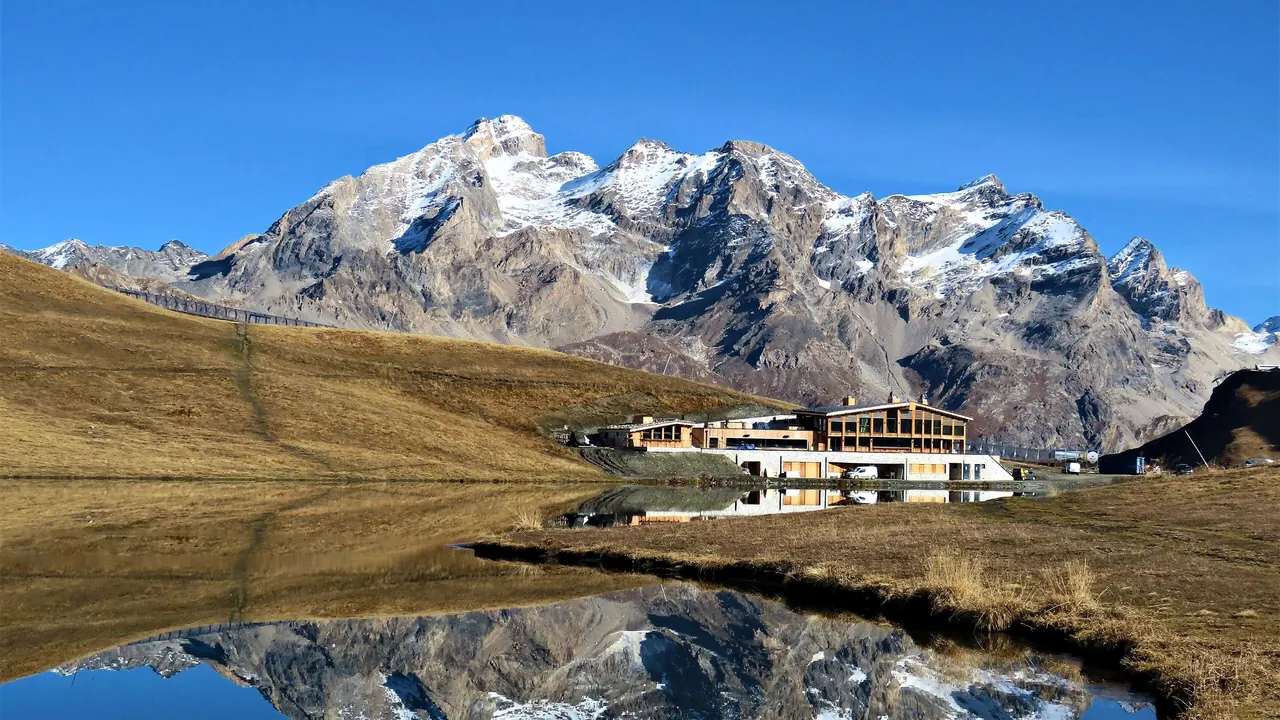
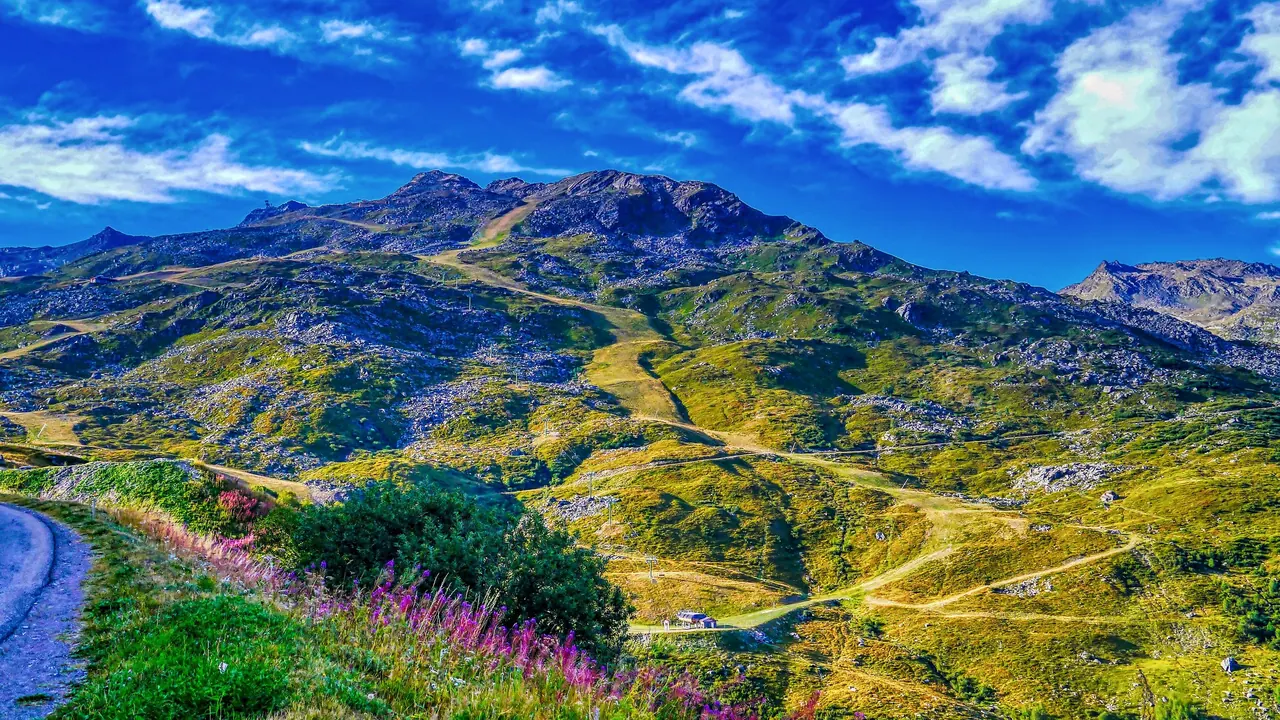
Photos: Val d'Isère by Rémih, CC BY-SA 4.0, cropped; Val Thorens by Zairon, CC BY-SA 4.0, cropped.
Val d'Isère or Val Thorens?
Our verdict in twelve categories, each scored against the same fixed benchmark cities, and the climate month by month, so you can choose for your trip.
Choose Val d'Isère for
- wellness
- shopping
- culture and sights
Val d'Isère suits skiers who want a real village around their ski week. The old stone church, the larch-wood hamlets up the valley and a mixed crowd of chalet guests and groups give it more character than a purpose-built resort. Families with small children and couples who like a hotel spa after a long day will find it a little gentler. In summer it opens onto the Vanoise and the Col de l'Iseran, which makes it the stronger choice outside the ski season too.
Choose Val Thorens for
- prices
- nightlife
- getting around
Val Thorens is the choice for groups of friends who want to ski hard all day and go out at night on a smaller budget. Its height keeps the snow reliable, and from the front door the lifts link into the whole Three Valleys, as far as Méribel and Courchevel. Shared apartments bring the cost down further than in Val d'Isère. You give up charm and comfort for that: the village is a 1970s ski station on bare, windswept ground, and the crowd is young and loud.
Scoreboard
Twelve categories on one fixed scale from 0 to 100. The shaded stretch is the gap between the two.
Your match
Pick a travel style or drag the sliders, and both match scores follow your weighting.
Too close to call, 1 point apart
Wins on wellness and shopping with your weighting.
Wins on prices and nightlife with your weighting.
What matters to you?
Category by category
What the scores mean for a trip.
Beaches & swimming
Neither resort has any beach or sea swimming. Val d'Isère at least has Lac de Tignes over the ridge, where some people take a cold dip in midsummer. Val Thorens's glacier-fed lakes are too cold even for that, so in both places swimming means an indoor pool.
Food & drink
The two eat much the same way: fondue, raclette, tartiflette and Beaufort cheese, with long lunches on terraces up on the slopes. Val d'Isère's best tables are among the most celebrated in the French Alps, and it has wine bars pouring Savoie whites.
Val Thorens's top end is in its upmarket hotels. Below that, its menus lean more towards pizza and burgers, and many guests cook in their apartments. Both villages largely close between seasons.
Culture & sights
Neither is worth visiting for sightseeing, but Val d'Isère does have a past you can see. There is the Baroque altarpiece in Saint-Bernard-de-Menthon, a few old lanes, and the stone hamlets of Le Fornet and Le Joseray. Val Thorens was built in the 1970s on an empty slope and has no old buildings at all, so for Savoyard heritage you have to drive down to the valley towns.
Nightlife
Both are among the Alps' best-known party resorts, with dancing on tables in ski boots as the lifts close and late-night basement clubs afterwards. The difference is the crowd. Val Thorens draws students and young groups of friends, and its underground club is famous among skiers. Val d'Isère mixes seasonal workers, British and Scandinavian groups and wealthy chalet guests. In both, the nightlife ends with the winter season.
Nature & outdoors
Both are world-class for skiing, but they feel different. Val Thorens is the highest resort in Europe, on bare ground of rock and glacier, and it links straight into the huge Three Valleys area. You can ski across to Méribel and Courchevel without taking your skis off.
Val d'Isère shares its area with Tignes and is known for steep terrain such as the Olympic Face de Bellevarde and for serious off-piste. It sits lower, in a valley with green meadows, and in summer it has more to offer: walks into the Vanoise and the ride up the Col de l'Iseran.
Day trips
Neither is a good base for day trips, especially in winter. From Val d'Isère the only way out is back down to Bourg-Saint-Maurice, though summer opens the Iseran road to Bonneval-sur-Arc and the Little St Bernard Pass to Aosta in Italy.
From Val Thorens, the most common outing is skiing across to Méribel and Courchevel. By road, it is Moûtiers or the medieval quarter of Conflans above Albertville, and Annecy and Chambéry make a long day from either resort.
Good for families
Both work for families who ski, with ski schools, gentle beginner slopes in the middle of the village and a sports centre pool. Val d'Isère is slightly easier with small children, thanks to fenced snow gardens, childcare in many chalets, an ice rink and less harsh weather.
Val Thorens does have a long toboggan run. Against that, the cold, the wind and the altitude can disturb young children's sleep, and its young, party-going crowd makes it feel less like a family village.
Getting around
Getting around is easy in both once you arrive, with free shuttle buses and slopes on the doorstep. Val Thorens is a tight, car-free cluster where many places are ski-in, ski-out. Val d'Isère runs a few kilometres along the valley from La Daille to Le Fornet, so you rely more on the buses.
The journey up is similar, about an hour by bus or taxi from the train at Bourg-Saint-Maurice or Moûtiers. At Val Thorens, cars have to stay in paid car parks at the edge of the resort.
Shopping & style
In both resorts shopping mostly means ski gear. Val d'Isère offers a little more: a main street of rental and boot-fitting shops, a few upmarket mountain-wear boutiques and delicatessens with Beaufort and Savoie wine. Val Thorens has the same gear and cheese shops, plus small supermarkets for self-caterers, and almost nothing else to browse.
Affordability
Val Thorens is the more affordable of the two, although neither is a budget trip. It is less exclusive than its neighbours, and a group sharing an apartment and cooking for themselves can save a lot.
Val d'Isère is among the most expensive places in the Alps for a winter week, with chalets, meals on the mountain and drinks priced for a wealthy crowd. Quiet weeks in January or late in the season help, and summer costs noticeably less there.
Live music & performing arts
Neither has a theatre, a concert hall or a regular programme. In both, live music means cover bands and DJs at après-ski, with the odd open-air concert in Val d'Isère's village or an event on the slopes at Val Thorens.
Wellness & relaxation
Val d'Isère is the better place to relax. Its upmarket hotels and catered chalets often have their own pool, hammam and massage rooms. Early summer and September there are calm, with empty trails and fresh mountain air.
Val Thorens has hotel spas and a public spa at its sports centre, but the resort revolves around hard skiing and late nights. What it offers instead is Brides-les-Bains, a traditional thermal spa town about an hour down the valley.
When should you go?
Pick your month. The climate figures are measured averages, not a forecast.
Val d'Isère in July
Val Thorens in July
Daytime high, °C
Rainfall in the month, mm
Where the figures come from
Val d'Isère has no weather station within reach, so its figures come from a gridded climate model rather than a measured record, and read a broad area rather than one spot.
Val Thorens has no weather station within reach, so its figures come from a gridded climate model rather than a measured record, and read a broad area rather than one spot.
Temperature and rainfall are climate normals, averaged over the years shown. Val d'Isère: 2001-2020 normals, NASA POWER reanalysis grid, no weather station within 90 km. Val Thorens: 1991-2020 normals, TerraClimate 4 km grid at the town, no weather station within 90 km.
Both resorts are at their best for skiing from late November into early May. Midwinter days stay below freezing in both, around -4°C at midday in January in Val d'Isère and barely warmer in Val Thorens. April is the late ski season, with milder days and softer snow on Val d'Isère's lower runs, while Val Thorens sits higher and stays wintry for longer. The bigger difference is how much falls from the sky. Val d'Isère is the drier of the two all year. Val Thorens gets far more, peaking at about 180mm in November, mostly as snow at that height.
Summer favours Val d'Isère. In July and August its afternoons reach about 18°C, which is pleasant for long walks and rides over the passes. Val Thorens stays cooler at about 15°C and can turn cold on any day. May is Val d'Isère's wettest month, so it is better to wait for summer. In both resorts October to mid-November is the poor time: too cold for comfortable walking, and the snow is not yet deep enough to ski.
Which traveller are you?
On a family trip with children, Val d'Isère is the better pick. It is lower and less windy, with snow gardens, an ice rink and sleigh rides, and its calmer village is easier on small children than Val Thorens with its party crowd and high-altitude nights.
On a tight budget, Val Thorens is easier to manage. Neither is cheap, but it is less exclusive than Val d'Isère, and groups sharing a self-catering apartment and cooking for themselves can cut the cost of a ski week a good deal.
For a food and nightlife trip with friends, Val Thorens has the edge. Its après-ski is aimed at a young crowd of students and groups, with dancing on mountain terraces and an underground club. Val d'Isère's nights are just as lively but more mixed and pricier.
Before you go
| Measure | Val d'Isère | Val Thorens |
|---|---|---|
| Official language | French | French |
| Currency | Euro (EUR) | Euro (EUR) |
| Sockets | CE230 V, 50 Hz | CE230 V, 50 Hz |
| Driving side | Right | Right |
| Time zone | UTC+1, UTC+2 in summer | UTC+1, UTC+2 in summer |
| Emergency number | 112 | 112 |
| Elevation | 1,785 m | 1,710 m |
| Main airport | Geneva International Airport (GVA)111 km from centre150 non-stop destinations | Geneva International Airport (GVA)111 km from centre150 non-stop destinations |
| Public holidays this year | 11 days | 11 days |
By the numbers
| Measure | Val d'Isère | Val Thorens |
|---|---|---|
| Population | 1,567 | - |
| People per km² | 17 | - |
| Museums within 10 km | 0 | 0 |
| UNESCO World Heritage sites within 50 km | 0 | 1 |
Where else could you go?
Every comparison below shares a destination with this one, so you can follow Val d'Isère or Val Thorens somewhere new.
- Les Menuiresvs Val Thorens
- Tignesvs Val d'Isère
- Méribelvs Val Thorens
- Courchevelvs Val Thorens
- Les Arcsvs Val d'Isère
- Val Cenisvs Val d'Isère