
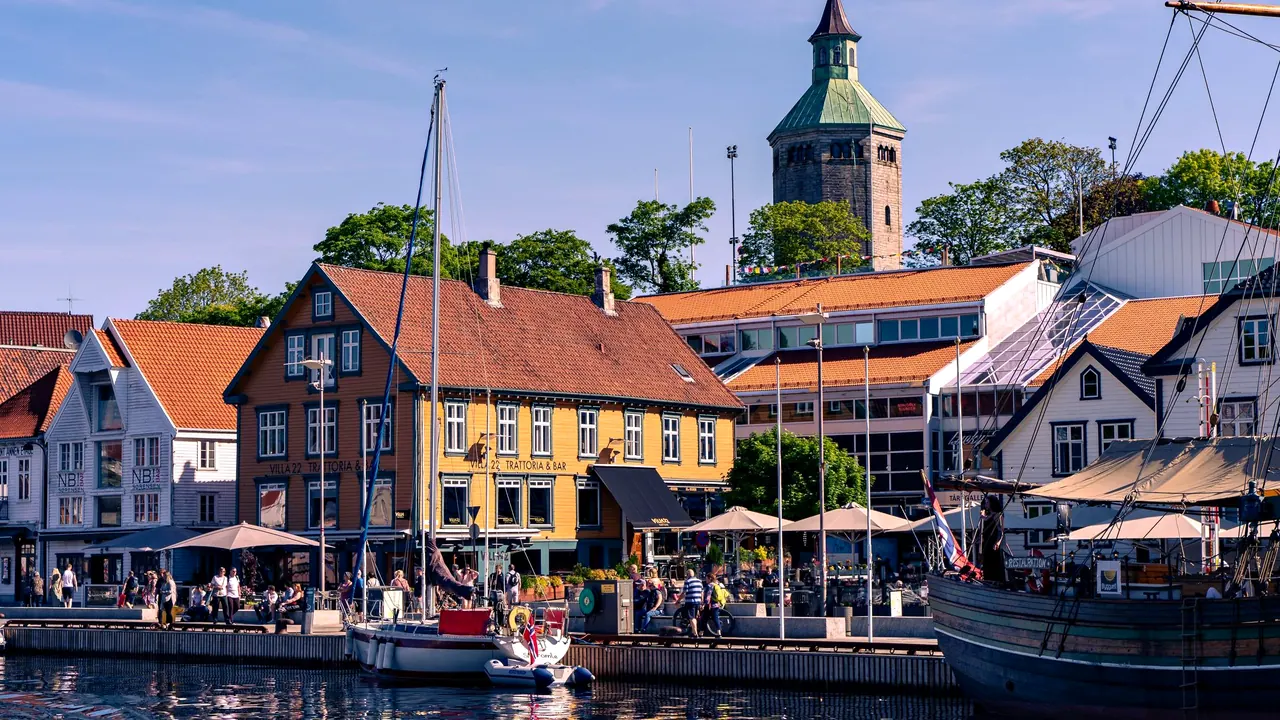
Photos: Aarhus by Mozzihh, CC BY-SA 4.0, cropped; Stavanger by Adam Cole, Pexels License.
Aarhus or Stavanger?
Our verdict in twelve categories, each scored against the same fixed benchmark cities, and the climate month by month, so you can choose for your trip.
Choose Aarhus for
- day trips
- culture and sights
- shopping
Aarhus suits a rounded city trip. It has three museums of real weight, a flat centre you can cross by bike, a student crowd that fills the bars at weekends, and a ring of Jutland towns, Viking sites and Lego attractions within easy reach. Families, art lovers and anyone who wants plenty to do without a car will get more from it, and it costs a little less.
Choose Stavanger for
- nature and the outdoors
Stavanger is the choice when the landscape is the point. The Lysefjord, Preikestolen and Kjerag are on its doorstep, and the timber houses of the old town make a handsome base to come back to in the evening. Expect more rain, higher prices and a thinner list of city sights, and plan your days around hikes and boat trips rather than museums.
Scoreboard
Twelve categories on one fixed scale from 0 to 100. The shaded stretch is the gap between the two.
Your match
Pick a travel style or drag the sliders, and both match scores follow your weighting.
Wins on day trips and culture and sights with your weighting.
Wins on nature and the outdoors with your weighting.
What matters to you?
Category by category
What the scores mean for a trip.
Beaches & swimming
Neither city is a beach destination, as both look onto cool northern water that is only swimmable for a few summer weeks. Aarhus has a slight edge because its beaches are part of town life. Den Permanente's bathing pier and the sand at Bellevue are a short bike ride through the Risskov woods, and the calm, shallow bay makes for an easy dip.
Stavanger's beaches are of a different kind: long, open dune beaches along the Jæren coast, twenty minutes to an hour out of town. They are more striking than Aarhus's, but they face the North Sea, so wind and surf often turn a swim into a walk.
Food & drink
Aarhus eats better and more widely. Its New Nordic tasting menus are its strongest suit, but it also has good bakeries, open rye sandwiches and street-food halls, which give you cheaper meals between the special dinners.
Stavanger's cooking is more rooted in place, with fish soup and shrimp by the harbour, Ryfylke lamb and Jæren strawberries in season, and the Gladmat festival on the quays in summer. Below its ambitious top tier, though, the choice narrows quickly and the harbourfront restaurants are rather predictable.
Culture & sights
Aarhus is the stronger cultural stop, mainly because of three museums: ARoS with its rainbow walkway, the walk-in history of Den Gamle By, and Moesgaard's Grauballe bog body and Viking collections. Its old core is small, but the museums alone can fill several days.
Stavanger's strength is atmosphere rather than collections. The white wooden houses of Gamle Stavanger and the medieval cathedral are more evocative than anything in Aarhus's Latin Quarter. Beyond those, the Petroleum Museum and the Hafrsfjord swords make up a shorter list that takes a couple of days.
Nightlife
Both cities come alive mainly on Friday and Saturday, but Aarhus has more going on. Its large student population keeps the riverside bars on Åboulevarden and the Latin Quarter cellars busy past midnight, with a few clubs for those who want to dance.
Stavanger's evenings are shorter on choice and suit drinking more than dancing. Øvre Holmegate's painted lane and the quays around Vågen are best on light summer nights when people drink outside, and Norwegian alcohol prices keep most nights short.
Nature & outdoors
This is Stavanger's category by a long way. The Lysefjord, with cliffs rising almost a kilometre from the water, starts just east of the city, and the Preikestolen and Kjerag hikes and the fjord boats beneath its waterfalls are the main reason most people come.
Aarhus's countryside is gentle by comparison: beech woods running down to the bay, tame deer at Marselisborg, the heath-covered hills of Mols Bjerge and canoeing on the Gudenå around Silkeborg. It makes for pleasant walks and bike rides, but there are no mountains or dramatic views.
Day trips
Aarhus is much better placed for day trips to towns and history. Within an hour or two by train or road are the Jelling runestones, the Tollund Man at Silkeborg, Hans Christian Andersen's Odense, Ribe and Lego House in Billund, so you could fill several days with outings.
Away from the fjord, Stavanger has fewer places to visit. Utstein Abbey and the pottery town of Egersund are worth a half day each, and Avaldsnes's Viking farm needs a long day with a ferry.
Good for families
Aarhus gives children more to do, and much of it is hands-on. They can walk into the old kitchens and workshops of Den Gamle By, try the old-fashioned rides at Tivoli Friheden in the southern woods, and older ones will enjoy Moesgaard's dramatic displays. Bike paths kept apart from traffic and the calm, shallow bay beaches make everyday outings easy, and Legoland and Djurs Sommerland are within reach for a big day out.
Stavanger is just as safe and welcoming, with the Petroleum Museum's playground built from salvaged oil equipment, a children's museum and Kongeparken a short drive south. Older children who are used to walking can climb Preikestolen, but frequent rain and the cost of everything make a longer stay harder work.
Getting around
Aarhus is the easier city to get about without a car. In its flat centre the station, ARoS, Den Gamle By and the harbour are a short walk apart, and separated bike lanes make cycling the natural choice. Buses and the light rail reach Moesgaard, the beaches and the Djursland coast, so you rarely need to drive.
Stavanger's centre is just as walkable, a quarter of an hour from end to end around the harbour, and the fast boats to the islands are a pleasure. The best sights lie across the fjord, though. Apart from the seasonal bus to Preikestolen, getting to Kjerag or the outer beaches usually means hiring a car and paying tolls through the tunnels.
Shopping & style
Aarhus is the better place to shop, mainly because of the small Latin Quarter shops selling Danish ceramics, lighting, textiles and clean-lined clothes, which make a satisfying morning for anyone who likes Nordic design.
Stavanger has little beyond chain stores around the cathedral and the harbour. The things worth carrying home are a good wool sweater or outdoor gear for the hikes.
Affordability
Neither city is cheap, but Aarhus is easier on the wallet. Restaurant meals, beer and coffee still cost Danish prices, and the big museums charge full admission. The street-food halls and bakeries give you a decent lunch without a restaurant bill, though, and because the sights sit close together in a flat centre, walking and cycling cover most of your days for nothing.
In Stavanger the gap is widest once you leave town. A fjord cruise, a hired car for Kjerag and an evening meal out cost more than anything on an Aarhus itinerary, where the main outlay is museum tickets. On the other hand, Stavanger's best days are spent on trails that cost nothing, so a packed lunch and the climb up Preikestolen or Dalsnuten can make a cheaper day than a round of museums in Aarhus.
Live music & performing arts
Aarhus has the fuller programme. Musikhuset houses both a symphony orchestra and the Danish National Opera, students keep the rock, jazz and indie venues busy, and the summer jazz festival and Festuge make late summer its liveliest time.
Stavanger's Konserthus at Bjergsted is a fine hall with its own orchestra, but the season is that of a regional city. It is at its busiest during the MaiJazz festival in spring and the chamber-music festival in late summer.
Wellness & relaxation
Both cities practise the same Nordic ritual of a wood-fired sauna followed by a plunge into cold sea, and neither has spa culture beyond that. Aarhus has a little more to offer, with saunas at Den Permanente and the harbour, active winter swimming clubs and quiet parks to wind down in.
Stavanger's own institution is Gamlingen, a heated outdoor pool used in all weathers, and long summer evenings by the water add to the slow pace.
When should you go?
Pick your month. The climate figures are measured averages, not a forecast.
Aarhus in July
Stavanger in July
Daytime high, °C
Rainfall in the month, mm
Where the figures come from
Aarhus's temperatures are measured 30 km from the centre, at Tirstrup.
Aarhus has no rain gauge within 25 km of the centre, so its rainfall comes from a gridded climate dataset read at the city rather than from a gauge further away.
Stavanger has no rain gauge within 25 km of the centre, so its rainfall comes from a gridded climate dataset read at the city rather than from a gauge further away.
Temperature and rainfall are climate normals, averaged over the years shown. Aarhus: 1991-2020 normals, Tirstrup (29.8 km from centre). Stavanger: 2008-2020 (rainfall 1991-2020) normals, Stavanger Vaaland / Ullandhaug (1.5 km from centre).
Both cities are cold and dark from November to March, with daytime highs only a few degrees above freezing, so winter is for indoor sights and saunas rather than walking around. Summer is the season for both. Aarhus warms a little more, to about 22°C in July, and its bay reaches about 18°C in August, cool but swimmable for a few weeks. Rain in Aarhus is moderate all year and is lightest in spring.
Stavanger's summers are cooler, nearer 19°C, and the place is far wetter. Late spring, April to June, is its driest stretch, and the high trails are at their best from June to September. From August the rain builds steeply, peaking around 164mm in October, so an autumn fjord hike there means proper waterproofs. If you want dry weather for walking the streets, Aarhus is the safer bet in every month.
Which traveller are you?
On an outdoors trip, Stavanger wins clearly. The Lysefjord's granite walls, the Preikestolen climb, the harder day to Kjerag and kayaking among the Ryfylke islands are all close by, while Aarhus offers gentle beech woods and low heathland hills.
For a culture and arts trip, Aarhus has more to fill the days. ARoS, Den Gamle By and Moesgaard are museums of real weight, and Musikhuset puts on opera, symphony concerts and ballet. Stavanger's charming old town and museums can be seen in two days.
On a family trip with children, Aarhus is easier. Children can walk through old shops at Den Gamle By and feed the deer at Marselisborg, and Legoland and Djurs Sommerland are both within reach. Stavanger is welcoming too, but wetter and dearer.
Before you go
| Measure | Aarhus | Stavanger |
|---|---|---|
| Official language | Danish | Norwegian, Nynorsk, Bokmål, Sámi |
| Currency | Danish Krone (DKK) | Norwegian Krone (NOK) |
| Sockets | CEFK230 V, 50 Hz | CF230 V, 50 Hz |
| Driving side | Right | Right |
| Time zone | UTC+1, UTC+2 in summer | UTC+1, UTC+2 in summer |
| Emergency number | 112 | Police 112, ambulance 113, fire 110 |
| Elevation | 6 m | 15 m |
| Main airport | Aarhus Airport (AAR)30 km from centre15 non-stop destinations | Stavanger Airport, Sola (SVG)12 km from centre32 non-stop destinations |
| Public holidays this year | 14 days | 13 days |
By the numbers
| Measure | Aarhus | Stavanger |
|---|---|---|
| City population | 290,598 | 129,300 |
| People per km² | 3,193 | 3,131 |
| Museums within 10 km | 17 | 13 |
| UNESCO World Heritage sites within 50 km | 0 | 0 |
| Swim season, months above 21 °C | None | None |
Where else could you go?
Every comparison below shares a destination with this one, so you can follow Aarhus or Stavanger somewhere new.
- Copenhagenvs Aarhus
- Bergenvs Stavanger
- Malmovs Aarhus
- Gothenburgvs Aarhus
- Hamburgvs Aarhus
- Oslovs Stavanger