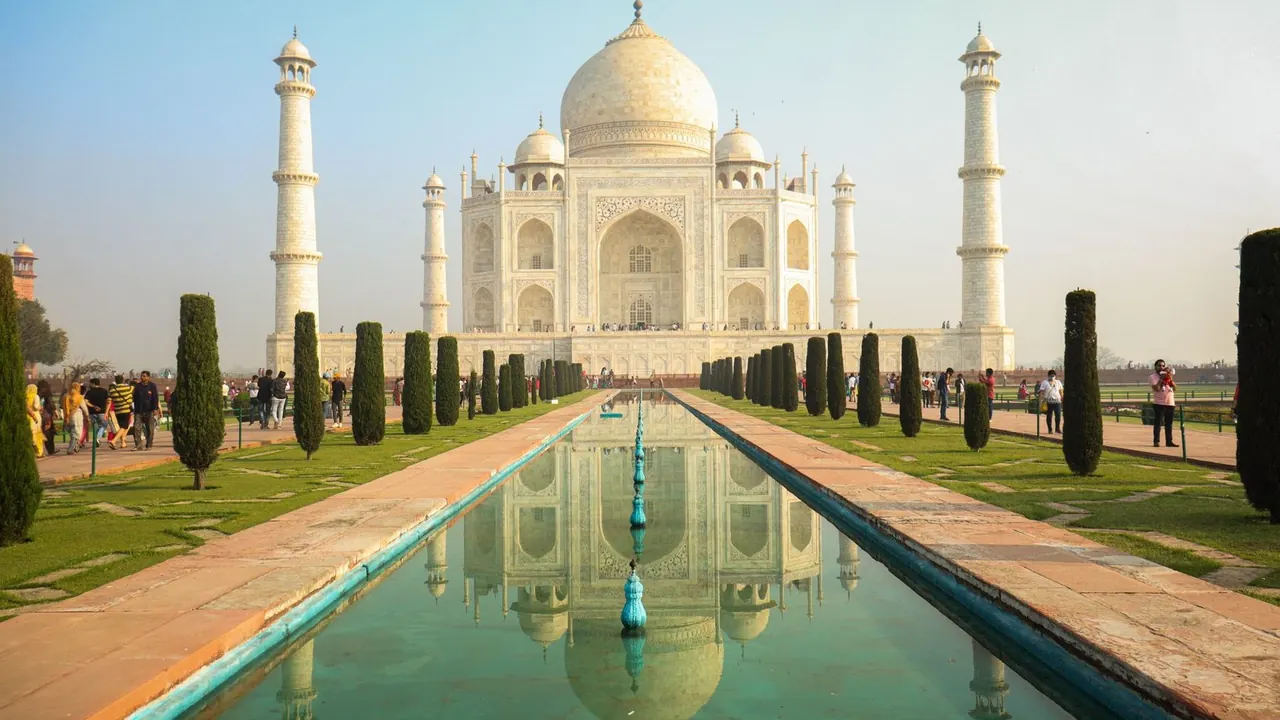
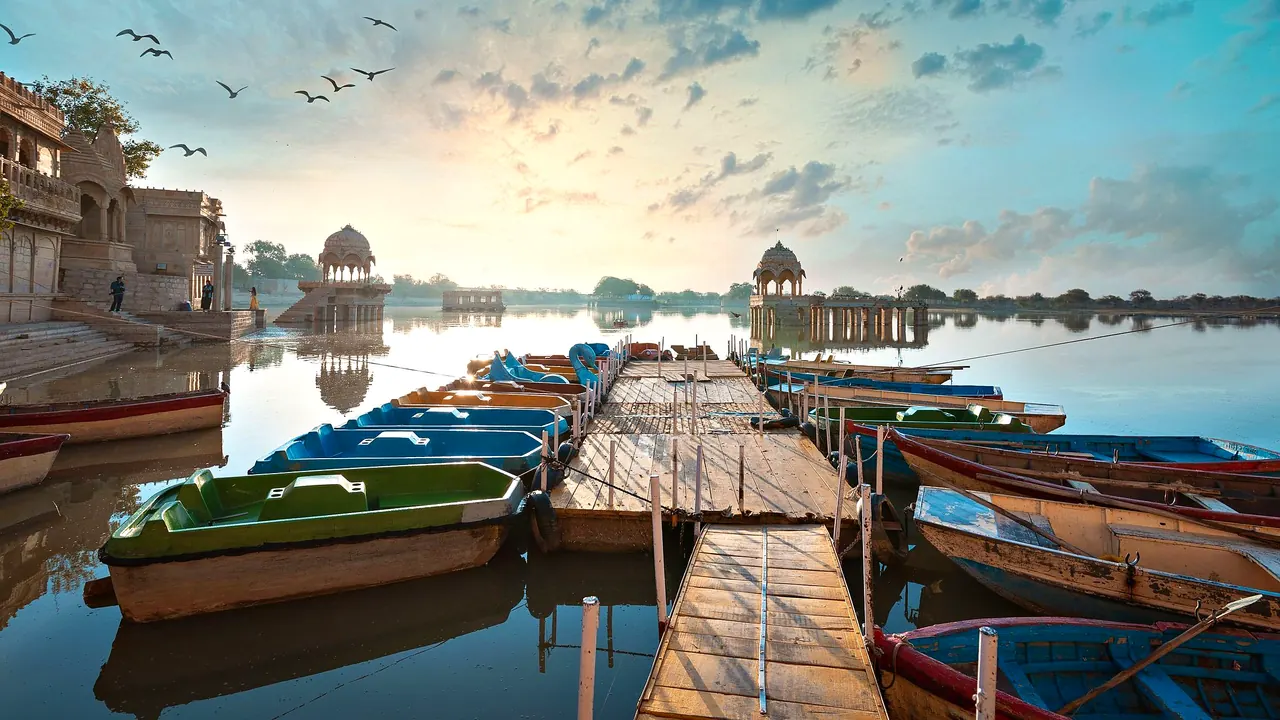
Photos: Agra by Sanket Sawale, Pexels License; Jaisalmer by Prakash Yadav, Pexels License.
Agra or Jaisalmer?
Our verdict in twelve categories, each scored against the same fixed benchmark cities, and the climate month by month, so you can choose for your trip.
Choose Agra for
- day trips
- culture and sights
- food and drink
Agra is for travellers who put great architecture first. The Taj Mahal, Agra Fort and the inlaid tomb of Itimad-ud-Daulah form one of the finest groups of Mughal buildings anywhere, and Fatehpur Sikri, the Bharatpur wetlands and Mathura are all within easy reach. The fast trains from Delhi make it simple to fit in, and two or three focused days of monuments, bazaar breakfasts and an early night will suit you well.
Choose Jaisalmer for
- live music and the arts
- getting around
- families
Jaisalmer is the better choice if you want a place to sink into, not just a list of sights. Its golden fort is still lived in, the old town is small enough to walk, and the Thar Desert begins just outside. Camel treks, nights in a dune camp and Manganiyar musicians most evenings make it the more rewarding stop for school-age families and anyone after atmosphere more than landmarks, provided you accept the long journey to get there.
Scoreboard
Twelve categories on one fixed scale from 0 to 100. The shaded stretch is the gap between the two.
Your match
Pick a travel style or drag the sliders, and both match scores follow your weighting.
Too close to call, 1 point apart
Wins on day trips and culture and sights with your weighting.
Wins on live music and the arts and getting around with your weighting.
What matters to you?
Category by category
What the scores mean for a trip.
Beaches & swimming
Neither city has anywhere to swim in open water: the Yamuna past the Taj is for looking at, and Gadisar Lake in Jaisalmer is for boating. In both, a hotel pool is the only option, and it earns its place in the hot months, whether at one of Agra's better hotels or at a heritage resort on the edge of Jaisalmer.
Food & drink
Agra gives a curious eater a little more to work with. Its Mughlai cooking is rich and varied, from kormas, biryani and tandoor kebabs to the bazaar breakfast of bedai and hot jalebi near Kinari Bazaar, evening chaat in Sadar Bazaar and the candied petha sold on every corner.
Jaisalmer's desert cooking is plainer and more regional: ker sangri, dal baati churma and a vegetarian thali are the dishes to try, with kachori and mirchi bada at breakfast. Many rooftop restaurants facing the fort fill out the menu with pasta and pizza, so the truly local food takes more seeking out.
Culture & sights
Agra has the greater monuments by some distance. The Taj Mahal, seen at dawn and again at sunset from Mehtab Bagh, the red sandstone palaces of Agra Fort, the fine inlay of Itimad-ud-Daulah and Akbar's deer-filled park at Sikandra make a group of Mughal buildings few places can match.
Jaisalmer offers something smaller and more intimate. Its twelfth-century fort is still home to thousands of people, with Jain temples carved inside and lace-like haveli façades in the lanes below. It is one coherent golden town, not a set of world landmarks, and both places take two or three days.
Nightlife
Both towns are quiet after dark, with no clubs or bar districts. In Agra the evening is short because the Taj means a pre-dawn start, and a drink in a hotel bar or on a rooftop facing the dome is about as far as it goes. In Jaisalmer it is a rooftop dinner opposite the lit fort, or a campfire and music at a dune camp that winds down soon after dinner.
Nature & outdoors
The outdoors is roughly as limited in both, but the landscapes could hardly differ more. Agra's flat river plain has little green beyond its Mughal gardens, and its strength is wildlife: the Keoladeo wetlands at Bharatpur, explored by bicycle or rickshaw in winter, and boat trips for gharials and river dolphins on the Chambal.
Jaisalmer's whole offer is the Thar Desert. That means sunset at the busy Sam dunes or the quieter Khuri dunes, an overnight camel trek with a night under very dark skies, and great Indian bustards in the Desert National Park. Neither has hills or trails for walking.
Day trips
Agra makes a far better base. Fatehpur Sikri, Akbar's abandoned capital about 40km west, pairs with the Bharatpur wetlands or the water palaces of Deeg. The Krishna towns of Mathura and Vrindavan are about an hour away, and Gwalior's hilltop fort is a train ride south.
Jaisalmer is remote, and its outings are short and modest: the old Jain temples of Lodurva and the roofless abandoned villages of Kuldhara and Khaba, usually combined with the dunes. Pokaran and Tanot are long drives for little reward, so most people treat the town as one stop on a Rajasthan route.
Good for families
Jaisalmer is the easier sell to children. The sandcastle fort, camel rides, jeep runs over the dunes and a night in a tent camp with music and a fire are memorable for school-age children, and Indian families visiting in numbers make it a welcoming place.
Agra asks more of a family: fierce heat for much of the year, chaotic traffic, few pavements and touts at the monument gates. The scale of the Taj and the bear rescue centre towards Mathura do appeal to older children, but most families keep the visit short. Neither town has anything built for children, and Jaisalmer only works between October and March.
Getting around
Once you are there, Jaisalmer is easier. The fort, the havelis and Gadisar Lake sit close together and can be walked, if slowly in the heat and on uneven lanes shared with cattle and motorbikes. You only need a hired car or jeep for the dunes and the villages beyond.
Agra's sights are spread along and away from the river, the roads are congested and walking between them is impractical, so it is auto-rickshaws, app taxis or a car and driver for the day. Its advantage is the journey in: Agra Cantt station puts it a short train ride from Delhi, while reaching Jaisalmer is a long trip.
Shopping & style
Both are craft towns with no fashion or design shopping, but the crafts differ. Agra's speciality is pietra dura, marble inlaid with semi-precious stone as on the Taj, along with leather, carpets and petha. The risk there is the commission trade, where drivers steer you to showrooms with inflated prices.
Jaisalmer's fort lanes are packed with mirror-work and appliqué textiles, quilts, camel leather, silver jewellery, puppets and carved yellow sandstone. Much of it repeats from stall to stall, and you are expected to bargain hard.
Affordability
Both are very cheap, with guesthouses, street food and rickshaws costing little. Where the money goes is different. In Agra the biggest outlay is the foreigners' entry fees at the Taj and the other Mughal monuments, plus the few luxury hotels with a view of the dome. In Jaisalmer it is the restored palace hotels and luxury tented camps, though camel treks and desert camps come at every level and haggling helps.
Live music & performing arts
Jaisalmer offers real music. The Manganiyar and Langa, hereditary musicians of the Thar, play most evenings at desert camps, on rooftops and at small shows near the fort, often with Kalbelia dancers or puppets. The settings are staged, but the musicians are the real thing, and the winter Desert Festival brings more.
Agra's performances are mostly made for tourists: productions retelling the story of Shah Jahan and Mumtaz Mahal, and dance evenings in the larger hotels. The spring Taj Mahotsav at Shilpgram is its one real highlight.
Wellness & relaxation
Neither has a bathing tradition, and in both the spas are mostly in the larger hotels. Jaisalmer has slightly more calm to offer outside them: an unhurried afternoon in a haveli courtyard, simple ayurvedic massage in the old town, and above all a still night at a remote dune camp.
In Agra, traffic, horns and winter haze push rest indoors to hotel lawns and pools after the dawn start at the Taj. The walled gardens of Itimad-ud-Daulah and Sikandra are its quiet corners in the late afternoon.
When should you go?
Pick your month. The climate figures are measured averages, not a forecast.
Agra in July
Jaisalmer in July
Daytime high, °C
Rainfall in the month, mm
Where the figures come from
Jaisalmer has no rain gauge within 25 km of the centre, so its rainfall comes from a gridded climate dataset read at the city rather than from a gauge further away.
Temperature and rainfall are climate normals, averaged over the years shown. Agra: 1942-2025, 10 years observed (rainfall 1971-2000) normals, Agra (6.2 km from centre). Jaisalmer: 1993-2020 (rainfall 1991-2020) normals, Jaisalmer (1.9 km from centre).
Both cities are at their best from late October to March, but the winters feel different. Agra's January days reach about 20°C and the plains can sit under haze. Jaisalmer is sunnier and warmer by day, around 24°C, with cold desert nights. From April both turn fierce, and Jaisalmer is the harsher of the two, reaching about 43°C in May, when sightseeing shrinks to early mornings in either place.
The monsoon is where the two part ways. Agra gets heavy rain in July and August, about 230mm a month, and stays humid into September. Jaisalmer's wet season is short and much lighter, peaking at about 121mm in August, but October there is still hot, so the comfortable desert season really begins in November.
Which traveller are you?
On a culture and arts trip, Agra is the clear choice. The Taj Mahal, Agra Fort and Fatehpur Sikri nearby are a Mughal legacy of world rank. Jaisalmer's golden fort and carved havelis are lovely but much smaller in scope.
On a family trip with children, Agra wears everyone out with fierce heat, chaotic traffic and little for children beyond the monuments. Jaisalmer works better for school-age children from October to March, when camel rides and a dune camp win them over.
For a relaxing and wellness trip, neither is a true retreat. In Agra, rest means a hotel spa or pool. Jaisalmer has a slight edge, with unhurried haveli courtyards and still nights at a remote dune camp, well away from the touts in town.
Before you go
| Measure | Agra | Jaisalmer |
|---|---|---|
| Official language | Hindi, English | Hindi, English |
| Currency | Indian Rupee (INR) | Indian Rupee (INR) |
| Sockets | CM230 V, 50 Hz | CM230 V, 50 Hz |
| Driving side | Left | Left |
| Time zone | UTC+5:30 | UTC+5:30 |
| Emergency number | 108 or 112 | 108 or 112 |
| Elevation | 171 m | 225 m |
| Main airport | Agra Airport / Agra Air Force Station (AGR)6 km from centre2 non-stop destinations | Jaisalmer Airport (JSA)6 km from centre5 non-stop destinations |
By the numbers
| Measure | Agra | Jaisalmer |
|---|---|---|
| City population | 1,585,705 | 65,471 |
| People per km² | 8,417 | 12,837 |
| Museums within 10 km | 0 | 2 |
| UNESCO World Heritage sites within 50 km | 4 | 1 |
Where else could you go?
Every comparison below shares a destination with this one, so you can follow Agra or Jaisalmer somewhere new.