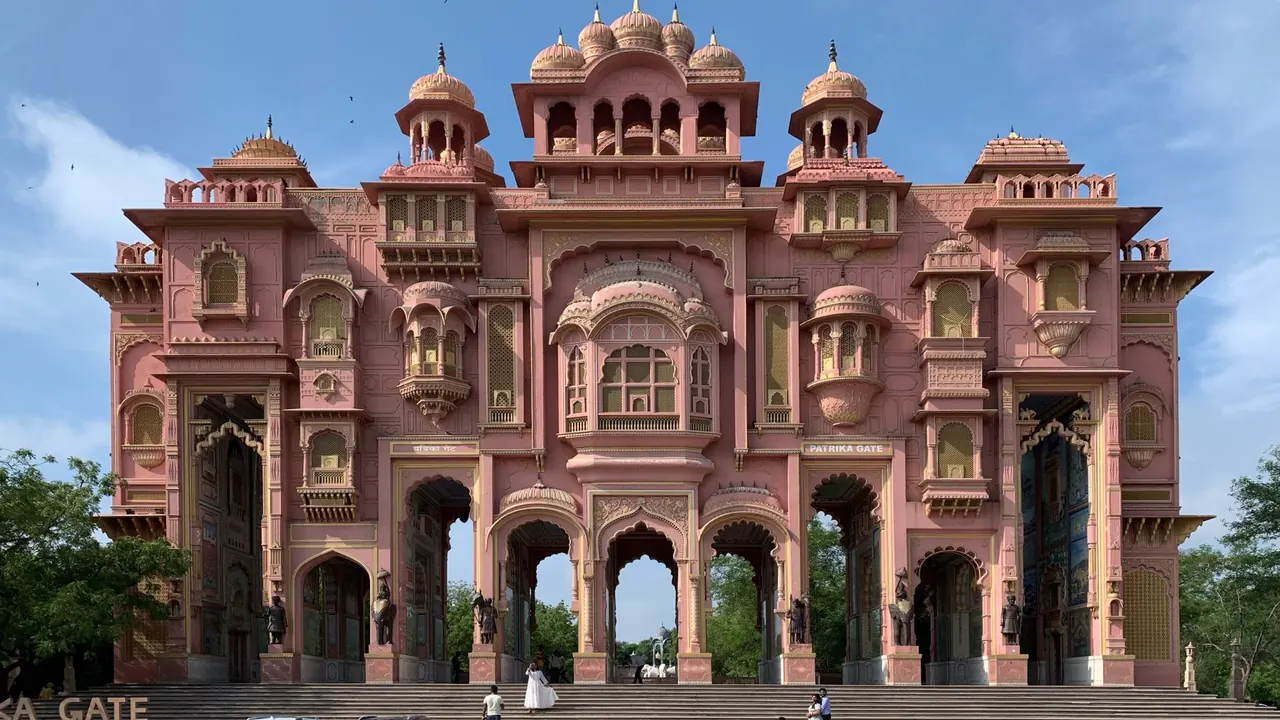
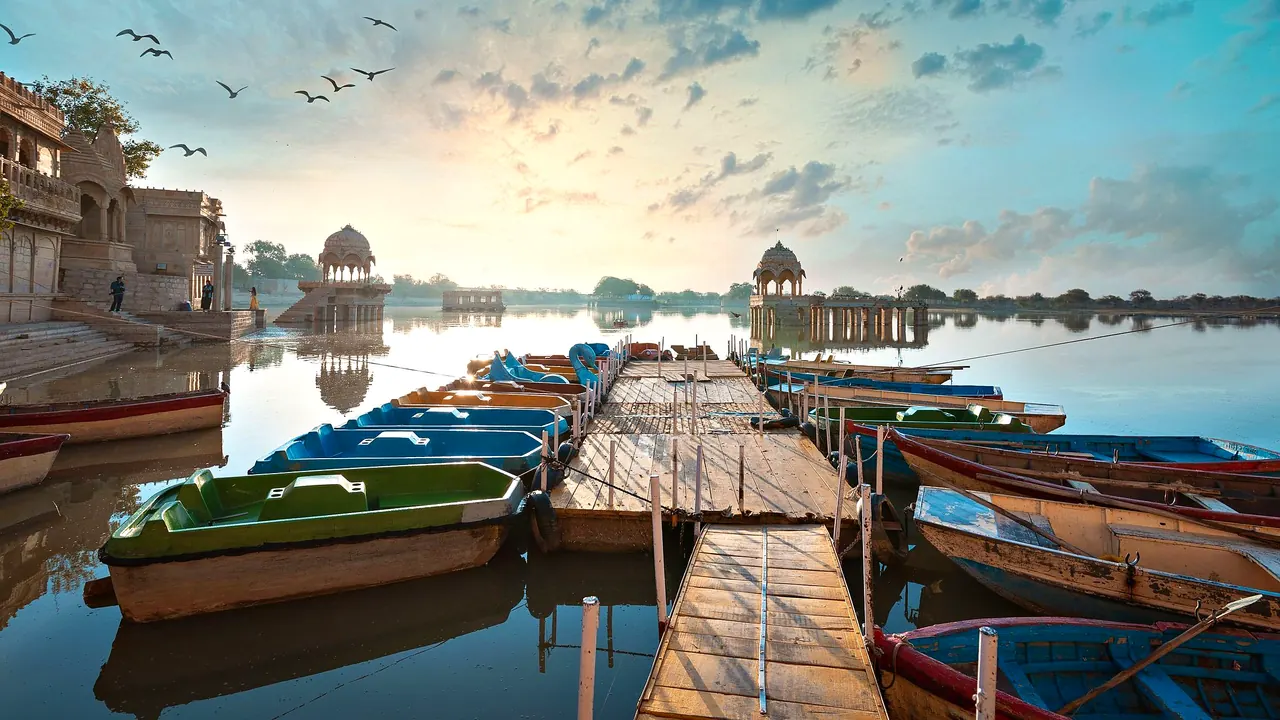
Photos: Jaipur by Chainwit., CC BY-SA 4.0, cropped; Jaisalmer by Prakash Yadav, Pexels License.
Jaipur or Jaisalmer?
Our verdict in twelve categories, each scored against the same fixed benchmark cities, and the climate month by month, so you can choose for your trip.
Choose Jaipur for
- shopping
- day trips
- food and drink
Jaipur suits the traveller who wants a full city to work through over several days. It has the palace, the observatory and the Amber Fort, bazaars where each street has its own craft, the best Rajasthani cooking of the two, and enough nearby, from stepwells to Pushkar and even Agra, to fill extra days. It is also the easier place to reach and to start a first trip to India from.
Choose Jaisalmer for
- getting around
- families
- prices
Choose Jaisalmer if you want one extraordinary place and a night in the desert. The lived-in golden fort, the lace-carved havelis and the Thar dunes at sunset make a short, concentrated stay with a strong sense of place. It is smaller, quieter after dark and more remote, so it rewards travellers who are happy with two or three days, simple food and a camel trek rather than a long list of sights.
Scoreboard
Twelve categories on one fixed scale from 0 to 100. The shaded stretch is the gap between the two.
Your match
Pick a travel style or drag the sliders, and both match scores follow your weighting.
Wins on shopping and day trips with your weighting.
Wins on getting around and families with your weighting.
What matters to you?
Category by category
What the scores mean for a trip.
Beaches & swimming
Neither city is anywhere near the sea, and neither has open water you can bathe in. In both, swimming means choosing a hotel with a pool, which matters a lot from April onwards.
The water you do see is for looking at. In Jaipur, Maota Lake is the backdrop below the Amber Fort. In Jaisalmer, Gadisar Lake is a place for a boat ride and the sunset.
Food & drink
Jaipur is the better place to eat. Laal maas from the royal kitchens, kachori breakfasts on MI Road, the vegetarian canteens and sweet counters around Johari Bazaar and thali feasts in palace courtyards give you plenty of depth even without international cooking.
Jaisalmer serves the same desert dishes, ker sangri and dal baati churma among them, and a local thali there is worth having. Beyond that the choice is narrow. Most visitor restaurants are fort-view rooftops serving uneven pizza and pancakes, so you come for the view more than the food.
Culture & sights
Jaipur has more to see. A whole planned eighteenth-century city survives inside its walls, with the City Palace, Hawa Mahal and the Jantar Mantar observatory at its centre and the Amber, Jaigarh and Nahargarh forts on the ridges above. Add Galta and the Gaitore cenotaphs and you have a solid three days.
Jaisalmer gives you less, but it all hangs together. Its golden fort is still home to thousands of people, its Jain temples are carved in remarkable detail and its havelis rank with the finest in Rajasthan. You can see the whole town in two or three unhurried days.
Nightlife
Neither is a place for nights out, but Jaipur at least has some options. Hotel bars, a few rooftop lounges in the old city and a handful of clubs in C-Scheme fill up at weekends and during the wedding season.
Jaisalmer has almost nothing after dinner. You eat on a rooftop facing the floodlit fort, perhaps have a beer, and the lanes are empty well before midnight. Out at the dune camps, the fire and the show end early too.
Nature & outdoors
There is little to choose between them on the outdoors, but the landscapes are very different. Jaipur sits among the rocky Aravalli hills. Its highlights are the views from Nahargarh, the leopard safaris in Jhalana on the city's edge and balloon flights over fort country.
Jaisalmer has only one landscape, the Thar Desert, but it is the real thing: dunes, overnight camel treks and the birds of the Desert National Park. Both are cool-season places, and in summer you are limited to dawn and dusk.
Day trips
Jaipur makes the better base for excursions. The Abhaneri stepwell, Samode's painted palace, Bhangarh and the printing villages of Sanganer and Bagru are all easy, and Pushkar, Ajmer and Agra's Taj Mahal can be done in a long day.
Jaisalmer is too remote for much more than short local trips. The Lodurva temples and the abandoned villages of Kuldhara and Khaba pair well with a dune outing. Beyond them, Pokaran and Tanot mean long drives for a modest reward.
Good for families
Neither is an easy choice with young children. Both work best for school-age children in the cool season, and both welcome families warmly.
What appeals to children differs. In Jaipur, older children get forts with secret passages, puppet shows and a leopard safari, but the city's traffic and crowds wear them out. Jaisalmer offers a sandcastle of a fort, camel rides and a night in a tent camp, but getting there is a long journey.
Getting around
Jaisalmer is easier to get around because it is small. The fort, the havelis and Gadisar Lake are all within walking distance, and you only need a car or jeep for the dunes and the villages beyond.
Jaipur is spread out, and the short metro line misses most of the sights. You will spend much of your time in auto-rickshaws or with a hired driver, especially for Amber, and walking inside the Pink City is slowed by traffic, cows and missing pavements.
Shopping & style
Jaipur is one of India's great craft markets, and many people come for the shopping alone. Each bazaar has its speciality, from Johari Bazaar's jewellery to the lac bangles of Maniharon ka Rasta. Blue pottery, rugs and block prints are made around the city, and C-Scheme boutiques give traditional crafts a modern design. Watch out for gem scams and for drivers who steer you to shops that pay them commission.
Jaisalmer has plenty of stalls, with mirror-work, appliqué, camel leather and carved sandstone, but quality is mixed and much of the stock is the same everywhere. You also get no design shopping to balance it out.
Affordability
Both are very cheap, and day-to-day spending feels much the same. Thalis, street snacks, rickshaw rides and simple guesthouses cost little in either, and in both foreigners pay more than Indian visitors at the main monuments.
Where they differ is in what drives the bill up. In Jaipur even a car with driver for the whole day is modest, so the real costs are the heritage havelis and palace hotels, plus alcohol, the one thing that feels expensive. In Jaisalmer the restored palace hotels and luxury tented camps charge international rates, but camel treks run at every level and haggling keeps a budget desert trip cheap.
Live music & performing arts
In both, live performance mostly means folk evenings staged for visitors, and neither has a season worth planning a trip around. The traditions are different, though.
Jaipur has its own school of Kathak dance and has proper venues in Jawahar Kala Kendra and Ravindra Manch for theatre and classical music. Jaisalmer is home to the Manganiyar and Langa musicians, heard at camps and on rooftops. Its winter Desert Festival brings music and dance out onto the dunes.
Wellness & relaxation
Neither is a restful town, and in both your calm comes from the hotel. Jaipur has a slightly better offer, because its havelis and palace hotels with shaded gardens, pools, yoga and Ayurvedic massage give you somewhere to recover after long days of sightseeing.
Jaisalmer's lanes are full of touts and heat, and its spas are limited to the larger hotels. Its best moment of peace is a different kind: a night at a remote camp in the dunes, far from any noise.
When should you go?
Pick your month. The climate figures are measured averages, not a forecast.
Jaipur in July
Jaisalmer in July
Daytime high, °C
Rainfall in the month, mm
Where the figures come from
Jaipur has no rain gauge within 25 km of the centre, so its rainfall comes from a gridded climate dataset read at the city rather than from a gauge further away.
Jaisalmer has no rain gauge within 25 km of the centre, so its rainfall comes from a gridded climate dataset read at the city rather than from a gauge further away.
Temperature and rainfall are climate normals, averaged over the years shown. Jaipur: 1993-2020 (rainfall 1991-2020) normals, Jaipur / Sanganer (11.1 km from centre). Jaisalmer: 1993-2020 (rainfall 1991-2020) normals, Jaisalmer (1.9 km from centre).
The two share the same rhythm: both are at their best from November to February, when days are around 23°C to 30°C and almost no rain falls. Walking the old towns and sleeping out in the desert are easy then, though Jaisalmer's desert nights get properly cold. March is still manageable in both. From April to June both bake, with Jaipur reaching 42°C in May and Jaisalmer slightly hotter at 43°C, and sightseeing shrinks to the early morning and evening.
The monsoon is where they part. Jaipur gets real rain in July and August, peaking at 226mm, and September is still wet. Jaisalmer stays far drier, with its wettest month at 121mm and the rain over by September, but the summer heat lasts just as long. October is dry in both and still hot by day, so it is a reasonable shoulder month rather than the ideal one.
Which traveller are you?
On a culture and arts trip, Jaipur gives you more to see. The City Palace, Jantar Mantar, Hawa Mahal, Amber Fort and the Albert Hall Museum fill three full days, while Jaisalmer's fort, Jain temples and havelis are beautiful but done in two.
For a shopping trip, Jaipur is clearly the better choice. Specialist bazaars for gems, bangles and textiles, block-printing villages on the edge of town and C-Scheme design boutiques go well beyond Jaisalmer's lanes of crafts, which are lively but repeat from shop to shop.
For travellers who come to India for a desert trek, Jaisalmer is the place. Overnight camel rides across the Thar, sunset on the Khuri or Sam dunes and a night under a dark, starry sky are what it offers, and Jaipur has nothing like them.
Before you go
| Measure | Jaipur | Jaisalmer |
|---|---|---|
| Official language | Hindi, English | Hindi, English |
| Currency | Indian Rupee (INR) | Indian Rupee (INR) |
| Sockets | CM230 V, 50 Hz | CM230 V, 50 Hz |
| Driving side | Left | Left |
| Time zone | UTC+5:30 | UTC+5:30 |
| Emergency number | 108 or 112 | 108 or 112 |
| Elevation | 431 m | 225 m |
| Main airport | Jaipur International Airport (JAI)10 km from centre27 non-stop destinations | Jaisalmer Airport (JSA)6 km from centre5 non-stop destinations |
By the numbers
| Measure | Jaipur | Jaisalmer |
|---|---|---|
| City population | 3,073,350 | 65,471 |
| People per km² | - | 12,837 |
| Museums within 10 km | 6 | 2 |
| UNESCO World Heritage sites within 50 km | 3 | 1 |
Where else could you go?
Every comparison below shares a destination with this one, so you can follow Jaipur or Jaisalmer somewhere new.