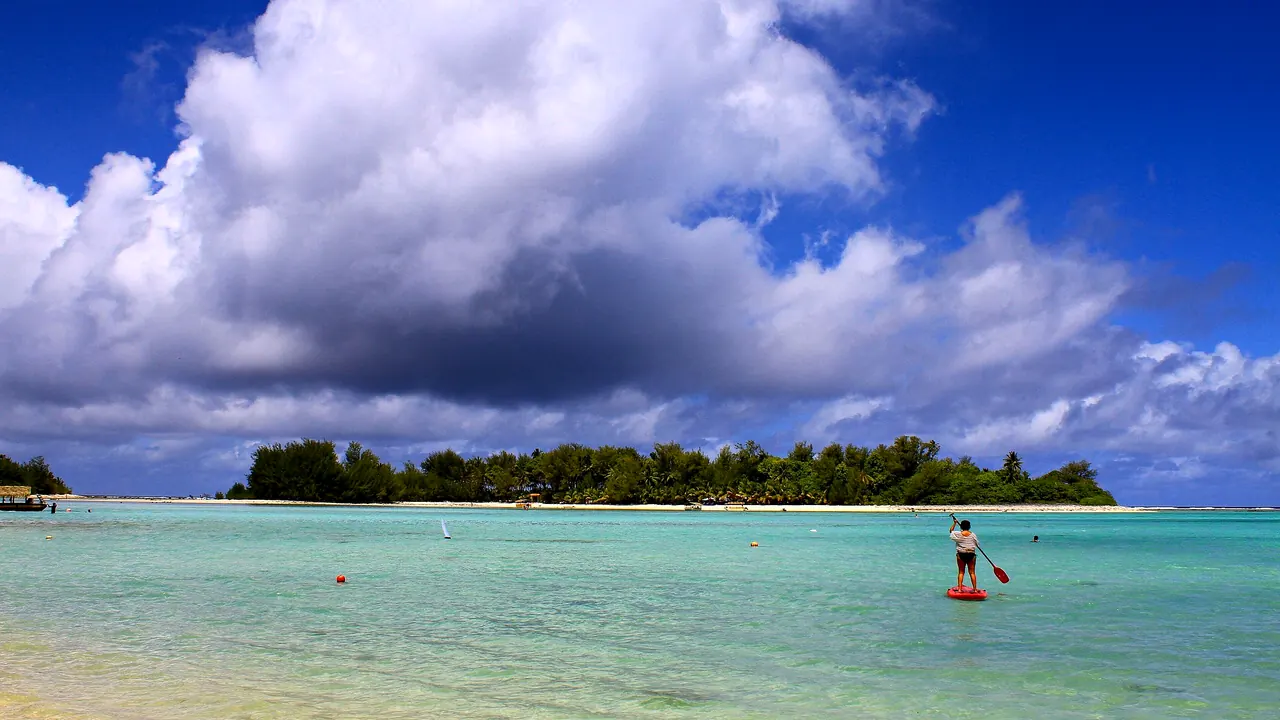
Photos: Rarotonga by Christopher Johnson from Tokyo, Japan, CC BY-SA 2.0, cropped.
Aitutaki or Rarotonga?
Our verdict in twelve categories, each scored against the same fixed benchmark cities, and the climate month by month, so you can choose for your trip.
Choose Aitutaki for
- beaches
- wellness
Aitutaki is for travellers who want the lagoon and very little else. The water is wider, clearer and emptier than on the main island, the best sand lies out on uninhabited motu, and evenings end soon after dinner. It suits couples and anyone after a deeply quiet week of swimming, snorkelling and paddling. You give up variety, food choice and family-friendly lodging, and you pay more for the privilege.
Choose Rarotonga for
- shopping
- families
- live music and the arts
Rarotonga suits a more rounded island trip. It has beaches almost all the way round, a forested volcanic interior to hike, markets to eat at, a lively Friday night in Avarua and resorts set up for children. Families, walkers and first-time visitors to the Cook Islands will find it easier and a little cheaper. It also makes a good base for a day flight to Aitutaki if you want a taste of the finer lagoon.
Scoreboard
Twelve categories on one fixed scale from 0 to 100. The shaded stretch is the gap between the two.
Your match
Pick a travel style or drag the sliders, and both match scores follow your weighting.
Wins on beaches and wellness with your weighting.
Wins on shopping and families with your weighting.
What matters to you?
Category by category
What the scores mean for a trip.
Beaches & swimming
Aitutaki has the finer lagoon. It is a wide triangle of turquoise water ringed by motu, and its best sand is out at Tapuaetai and around Honeymoon Island, reached by cruise or kayak and usually empty. Closer in, Ootu and Amuri are pleasant, though low tide can leave very shallow water over coral rubble.
Rarotonga's strength is that its beaches go almost all the way round the island. Muri has calm water and its own small motu, and the south coast around Titikaveka and the Aroa reserve gives the best snorkelling straight from the sand. The north and west coasts are rockier, and the reef passages have dangerous currents.
Food & drink
Both islands offer ika mata, umu-baked food and good fresh fish, but Rarotonga gives you more ways to eat them. The Saturday Punanga Nui market in Avarua and the Muri night market have stalls cooking local dishes, and there are beach cafés, decent coffee and a beer brewed on the island.
On Aitutaki you mostly eat in resort dining rooms, at a few cafés and at takeaways in Arutanga. The island night buffet is the main chance to try traditional food, and over a week the menus start to repeat.
Culture & sights
Neither island is a sightseeing destination, and on both the living village culture matters more than any monument. Rarotonga has a little more to visit: a small national museum and a library-museum in Avarua, the coral-lime Cook Islands Christian Church and the marae of Arai-te-Tonga, easy to find off the inland road.
Aitutaki's church in Arutanga is older, dating from the 1820s, with carved interiors from the missionary era. Its marae lie unmarked in the bush and are best found with a local guide.
Nightlife
Rarotonga has the only real night out of the two. On Fridays Avarua's waterfront bars fill up and a couple of places with dancing stay open late, though on other nights it is a beach bar or resort lounge at most. Aitutaki is quieter still, with sunset drinks, the weekly island nights and very little after dinner.
Nature & outdoors
The outdoors is just as good on both islands, but in different settings. Aitutaki's is almost entirely on the water. You can snorkel over giant clams, swim with turtles and trevally, and kitesurf the southern lagoon in the trade-wind months. Its shallow flats draw fly fishers after bonefish. On land there is only the short climb up Maungapu, at about 124m, for the view.
Rarotonga adds a steep, forested volcanic interior. The cross-island track passes beneath the Needle and a waterfall, and harder ridge walks such as Ikurangi need a guide. From July to October humpback whales can often be seen from the shore.
Day trips
Aitutaki offers no day out beyond its own lagoon. The cruise to the motu is its great excursion, but it shows you more water and sand rather than somewhere new, and Rarotonga is too far to see properly in a day.
Rarotonga has the one outing that really counts: a flight of under an hour to Aitutaki for a lagoon cruise and lunch on a sandbar, back the same evening. Apart from that, a day out means going round the island itself, because the other southern islands need overnight stays.
Good for families
Rarotonga is the easier island with children. Many resorts have kids' clubs and family units, the sheltered water at Muri and on the south coast suits small swimmers, and glass-bottom boats and the markets help fill the days.
Aitutaki's lagoon is just as gentle, with fish visible from the shore. However, several resorts take adults only, there is nothing to do beyond the water, children need reef shoes for the coral, and the connecting flight makes a long journey longer.
Getting around
Rarotonga has a working bus. It runs clockwise and anticlockwise round the 32km coast road and stops wherever you flag it down, though it thins out in the evenings and on Sundays. Avarua and Muri are each walkable on foot.
Aitutaki is smaller but has no bus to speak of, and the gaps between guesthouses and Arutanga are too far to walk in the heat. You will need a scooter or bicycle, and a boat or kayak to reach the motu.
Shopping & style
For souvenirs, Rarotonga is the better stop. Avarua has specialist black pearl shops, a short street of boutiques and gift shops, and the Punanga Nui market for tivaevae quilts, carvings and pandanus hats. Aitutaki has only general stores and a few craft stalls in Arutanga, so anyone who wants pearls or crafts should shop on Rarotonga.
Affordability
Both islands are expensive because so much is imported, but Aitutaki costs more. Its overwater and beachfront bungalows are at the top of the market, meals and groceries cost more again, and the connecting flight, cruises and fishing guides add up. Guesthouses with kitchens are the main way to save.
Rarotonga gives budget travellers more options. It has backpacker lodges, self-catering units, market food and the island bus, and its hiking trails and lagoon are free.
Live music & performing arts
Cook Islands drumming and dance is worth seeing on either island, and Aitutaki's dancers are especially well known. On Aitutaki, though, it comes mainly as resort dinner shows. Rarotonga has island nights several evenings a week at both resorts and cultural venues, and around early August it hosts Te Maeva Nui, when teams from every island compete in dance and chant. Both have Sunday hymn singing that is well worth hearing.
Wellness & relaxation
On both islands relaxation comes mostly from the slow pace rather than from spa treatments, and neither has a bathing tradition. Aitutaki is the stiller of the two. Hammocks hang over the water, Sundays come to almost a complete halt, and the larger resorts have treatment rooms facing the lagoon.
Rarotonga has a bit more on offer outside the resorts, with day spas and beach yoga, and its south and east coasts around Muri and Titikaveka are the calmest places to stay.
When should you go?
Pick your month. The climate figures are measured averages, not a forecast.
Aitutaki in July
Rarotonga in July
Daytime high, °C
Rainfall in the month, mm
Where the figures come from
Aitutaki has no weather station within reach, so its figures come from a gridded climate model rather than a measured record, and read a broad area rather than one spot.
Temperature and rainfall are climate normals, averaged over the years shown. Aitutaki: 2001-2020 normals, NASA POWER reanalysis grid, no weather station within 90 km. Rarotonga: 1991-2020 normals, Rarotonga (10.8 km from centre).
The two islands share a pattern: a hot, wet season from December to April and a drier, slightly cooler stretch from June to October. Both stay warm enough for the beach all year. The difference is in the details. Around Aitutaki's lagoon, mid-year is noticeably drier, with June down to about 57mm of rain, and the sea barely cools, holding near 26°C through the winter months. Its summer days are a touch milder than Rarotonga's.
Rarotonga runs hotter from February to April, with highs near 30°C, which makes the cross-island track a sticky, muddy walk then. Its winter lagoon drops to about 24°C, still swimmable but fresher. The dry months are its best for hiking, and October is both its sunniest month and one of its driest, a good time to visit either island.
Which traveller are you?
On a beach and sun trip, Aitutaki wins. Its lagoon is broader and clearer, and the white sand of One Foot Island and the Honeymoon Island sandbars is emptier than anything on Rarotonga. Snorkelling often starts a few steps from the guesthouse.
On a family trip with children, Rarotonga is the easier choice. Many resorts have kids' clubs and family units, the bus and markets give days some variety, and there is no extra flight. On Aitutaki several resorts take adults only.
For a food and nightlife trip, neither island excels, but Rarotonga gives you far more. It has the Saturday Punanga Nui market, the Muri night market, a local beer and a lively Friday in Avarua. Aitutaki is mostly resort dining rooms and early nights.
Before you go
| Measure | Aitutaki | Rarotonga |
|---|---|---|
| Official language | English, Cook Islands Maori | English, Cook Islands Maori |
| Currency | New Zealand Dollar (NZD) | New Zealand Dollar (NZD) |
| Sockets | I240 V, 50 Hz | I240 V, 50 Hz |
| Driving side | Left | Left |
| Time zone | UTC-10 | UTC-10 |
| Emergency number | Police 999, ambulance 998, fire 996 | Police 999, ambulance 998, fire 996 |
| Main airport | Aitutaki Airport (AIT) | Rarotonga International Airport (RAR)7 non-stop destinations |
| Public holidays this year | 11 days | 11 days |
By the numbers
| Measure | Aitutaki | Rarotonga |
|---|---|---|
| Population | - | 10,572 |
| People per km² | - | 158 |
| Swim season, months above 21 °C | 12 months | 12 months |
Where else could you go?
Every comparison below shares a destination with this one, so you can follow Aitutaki or Rarotonga somewhere new.