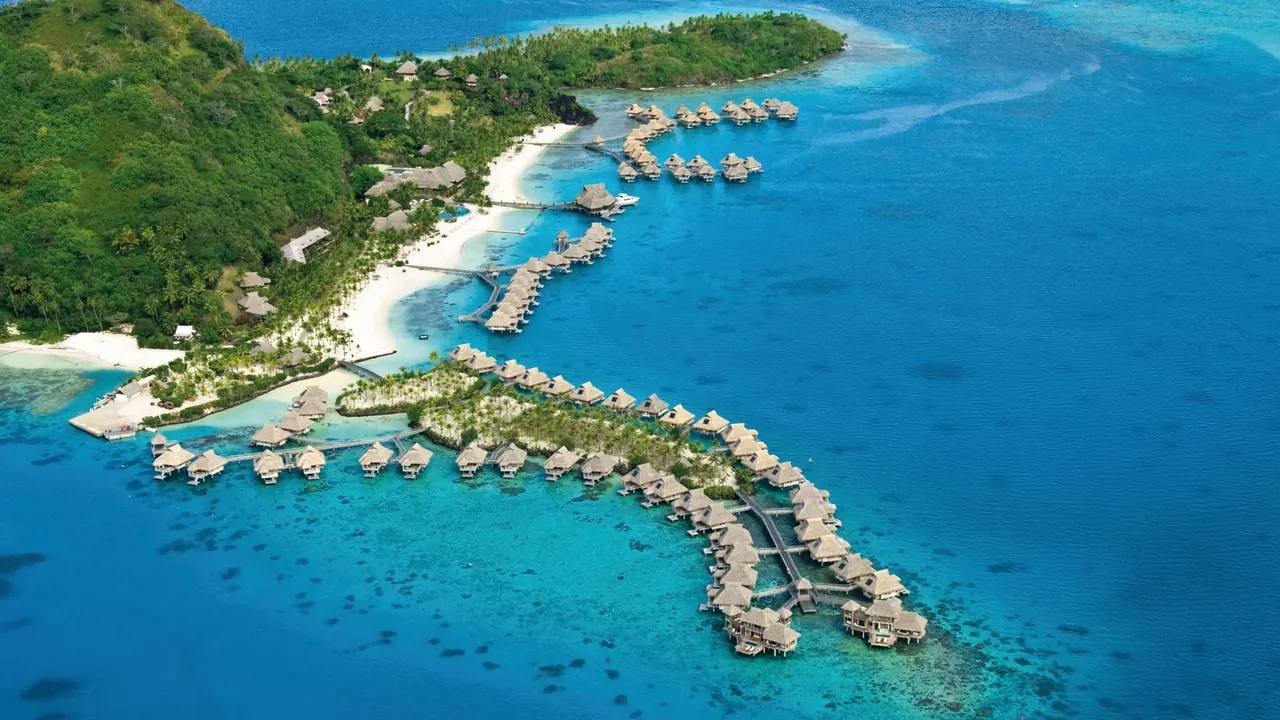
Photos: Bora Bora by Mauro Soares, CC BY-SA 3.0, cropped.
Aitutaki or Bora Bora?
Our verdict in twelve categories, each scored against the same fixed benchmark cities, and the climate month by month, so you can choose for your trip.
Choose Aitutaki for
- prices
- getting around
- families
Aitutaki suits travellers who want a world-class lagoon without Bora Bora's bill. The water and the motu sand are every bit as fine, family-run guesthouses with kitchens make a longer stay realistic, and the island is easy to roam by scooter on its single loop road. It is also a little milder in temperature and closer to village life, with Sundays given over to church and rest.
Choose Bora Bora for
- day trips
- shopping
- nature and the outdoors
For the grand, once-in-a-lifetime trip, Bora Bora is the one. The jagged peak of Otemanu above the lagoon gives it scenery Aitutaki cannot match, and the reef passes bring dives with manta rays and lemon sharks. It also offers a little more to fill the days, from French-Polynesian resort cooking and pearl showrooms in Vaitape to boat trips to Tahaa and Raiatea, in return for a far higher cost.
Scoreboard
Twelve categories on one fixed scale from 0 to 100. The shaded stretch is the gap between the two.
Your match
Pick a travel style or drag the sliders, and both match scores follow your weighting.
Too close to call, level with your weighting
Wins on prices and getting around with your weighting.
Wins on day trips and shopping with your weighting.
What matters to you?
Category by category
What the scores mean for a trip.
Beaches & swimming
These are two of the finest lagoons in the South Pacific, and there is little to choose between them for swimming. On Aitutaki the best sand lies out on the uninhabited motu, at One Foot Island and the sandbars near Honeymoon Island, reached by cruise or kayak. On the main island, Ootu and Amuri are easy shore beaches, though some spots turn very shallow over coral rubble at low tide.
Bora Bora's lagoon life is more often lived from a resort. You step off an overwater deck or a private motu beach into slightly warmer water. Its one great public beach is Matira Point at the southern tip, a long curve of white sand with shallows that suit waders.
Food & drink
Bora Bora eats better, though neither island is worth travelling to for food. Its resorts cook French food with Polynesian touches, such as tuna, mahi-mahi and vanilla sauces, and the snack counters and food trucks around Vaitape serve poisson cru where locals eat too.
Aitutaki's version of the same raw-fish dish, ika mata, is worth finding, along with grilled wahoo, taro and breadfruit from village gardens. Meals come from a narrower set of resort dining rooms, small cafés and Arutanga takeaways, however, and menus repeat quickly.
Culture & sights
Neither island is a place for sightseeing, and both fill only a few hours. Aitutaki's landmark is the coral-lime church in Arutanga from the 1820s, with marae hidden in the inland bush that are best found with a guide, and the culture you meet is mostly everyday village life. Bora Bora offers restored marae and rusting Second World War American guns on the hills above the lagoon, all covered in a morning's island tour.
Nightlife
Both islands go quiet after dinner, so neither suits anyone looking for a night out. Aitutaki's weekly island nights draw the biggest crowd it has, and Sunday shuts down almost completely. On Bora Bora the evening is a sunset cocktail in a resort bar or at one of the few bar-restaurants on the main island that draw guests from several hotels.
Nature & outdoors
Bora Bora has the more dramatic setting and more to do on the water. The jagged peak of Mount Otemanu rising out of the lagoon gives it a backdrop Aitutaki cannot match. The reef passes bring manta rays and lemon sharks for divers, and stingrays and blacktip reef sharks swim in the shallows. On land there are 4x4 tracks and a guided climb of Mount Pahia.
Aitutaki is low and green, and its outdoor life is almost all in the lagoon, among coral gardens, giant clams and turtles. Its particular draw is fly fishing for bonefish and giant trevally on the flats. The short walk up Maungapu gives its one big view.
Day trips
Bora Bora at least has neighbours to visit. Tahaa's vanilla plantations and pearl farms, Raiatea's sacred marae of Taputapuatea and quiet Maupiti are all within reach by boat or a short flight, though each needs an organised trip or careful timing. From Aitutaki there is nowhere to go for a day. The motu cruise is its great excursion, and Rarotonga is a separate stay rather than a day out.
Good for families
Both lagoons are warm, sheltered and shallow, and both islands are safe, yet neither has anything built for children. Aitutaki's slight edge lies in fish visible straight from the shore and the warm welcome children get in village life. Several resorts there are adults only, however, and coral underfoot means reef shoes.
On Bora Bora, Matira lets toddlers paddle a long way out, but overwater bungalows are a risk for children who cannot swim, and most resorts are made for couples. Older children who snorkel do best there, ideally at a resort with a kids' club and a pool. On either island the journey is long for young children.
Getting around
Aitutaki is the simpler island to get around. A single road loops most of it, you can cross it in a quarter of an hour by scooter or bicycle, and the guesthouses are on the main island. Only the lagoon trips need a boat.
Bora Bora's coast road is longer, at about 32km, and easy enough on two wheels, but buses and taxis are scarce. Many resorts sit on outer motu, so every trip to Vaitape or Matira depends on a hotel boat shuttle, starting with the crossing from the airport motu on arrival.
Shopping & style
Bora Bora has a little more to buy, mainly Tahitian black pearls from showrooms around Vaitape and in the resorts, plus pareos, carvings and monoi oil at the quay stalls. Aitutaki's choice is thinner still: general stores in Arutanga, craft stalls with woven hats and pareu, and the odd seller of Cook Islands pearls. For anything more, Rarotonga is the better place to shop.
Affordability
Both islands live on imported food, so meals and groceries cost far more than the setting suggests. The difference between them comes mostly from where you sleep and how you get about. Aitutaki has expensive lagoon resorts at the top, but much of its lodging is small and simple. Its extra costs are the connecting flight via Rarotonga, the motu cruises and the fly-fishing guides.
Bora Bora is built around luxury at a level few islands anywhere reach. The overwater bungalow is the stay it is known for, and because so many resorts sit out on the motu, guests tend to eat every meal at the hotel and pay for a boat to reach anything else. Dives, lagoon tours and spa treatments come on top, so even a careful week there costs well over a similar week on Aitutaki.
Live music & performing arts
Both islands offer Polynesian dance at resort dinner shows and little else. Aitutaki's dancers have a strong name across the Cook Islands, and the layered hymn singing at the Sunday service in Arutanga is the more moving experience for visitors who attend respectfully.
Bora Bora's shows add fire dancing and ori tahiti. In July the Heiva brings dance and singing contests between local groups to Vaitape, the one time when performance there becomes an event in its own right.
Wellness & relaxation
On both islands you rest by doing very little, and neither has thermal baths or a public bathing culture. Aitutaki's calm is part of island life, with a hammock over the lagoon and Sundays when almost everything stops. Bora Bora's is more polished and centred on the resorts, with motu spas using monoi oil and tiare flower and some treatment rooms built over the water, so it suits a couple who want pampering as much as quiet.
When should you go?
Pick your month. The climate figures are measured averages, not a forecast.
Aitutaki in July
Bora Bora in July
Daytime high, °C
Rainfall in the month, mm
Where the figures come from
Aitutaki has no weather station within reach, so its figures come from a gridded climate model rather than a measured record, and read a broad area rather than one spot.
Temperature and rainfall are climate normals, averaged over the years shown. Aitutaki: 2001-2020 normals, NASA POWER reanalysis grid, no weather station within 90 km. Bora Bora: 1991-2020 (sunshine 1981-2010) normals, Bora-Bora / Faanui (6.1 km from centre).
Both islands are warm enough to swim in every month and follow the same rhythm: a wet season from about November to April and a drier stretch from June to September. Aitutaki is the milder of the two, with daytime highs around 25°C in the southern winter, so cycling the loop road at midday is comfortable. Its rain falls from over 200mm a month at the height of the wet season to under 60mm in June and August, which makes those the surest months for cruises out to the motu.
Bora Bora runs a few degrees hotter, close to 31°C from November to April, and its sea stays about a degree warmer than Aitutaki's all year. December and January are wetter there than any month on Aitutaki. Sunshine changes little through the year and dips only slightly around December, so what the dry season mainly brings is fewer downpours. July to September is the best time for clear days on the lagoon and a dry climb into the hills.
Which traveller are you?
On a trip on a tight budget, Aitutaki is the realistic choice. Neither island is cheap, but Aitutaki's family-run guesthouses with kitchens and inexpensive scooter hire bring costs well down, while Bora Bora stays expensive even when you self-cater from Vaitape's grocery stores.
For an outdoors trip, Bora Bora gives more. You can dive the reef passes for mantas and lemon sharks, snorkel among stingrays and blacktip reef sharks, and take 4x4 tracks or a guided climb up Mount Pahia beneath Otemanu, which makes a fuller week than Aitutaki's lagoon alone.
On a food and nightlife trip, neither island delivers much, but Bora Bora eats better, with French-Polynesian resort kitchens and poisson cru from the snack counters around Vaitape. On both islands evenings end early, so expect sunset drinks rather than a night out.
Before you go
| Measure | Aitutaki | Bora Bora |
|---|---|---|
| Official language | English, Cook Islands Maori | French |
| Currency | New Zealand Dollar (NZD) | CFP Franc (XPF) |
| Sockets | I240 V, 50 Hz | - |
| Driving side | Left | Right |
| Time zone | UTC-10 | UTC-10 |
| Emergency number | Police 999, ambulance 998, fire 996 | 112 |
| Main airport | Aitutaki Airport (AIT) | Bora Bora Airport (BOB)9 non-stop destinations |
| Public holidays this year | 11 days | 16 days |
By the numbers
| Measure | Aitutaki | Bora Bora |
|---|---|---|
| Population | - | 10,605 |
| People per km² | - | 347 |
| Swim season, months above 21 °C | 12 months | 12 months |
Where else could you go?
Every comparison below shares a destination with this one, so you can follow Aitutaki or Bora Bora somewhere new.
- Mooreavs Bora Bora
- Tahitivs Bora Bora
- Rarotongavs Aitutaki
- Cook Islandsvs Bora Bora
- New Caledoniavs Bora Bora
- Hawaiivs Bora Bora