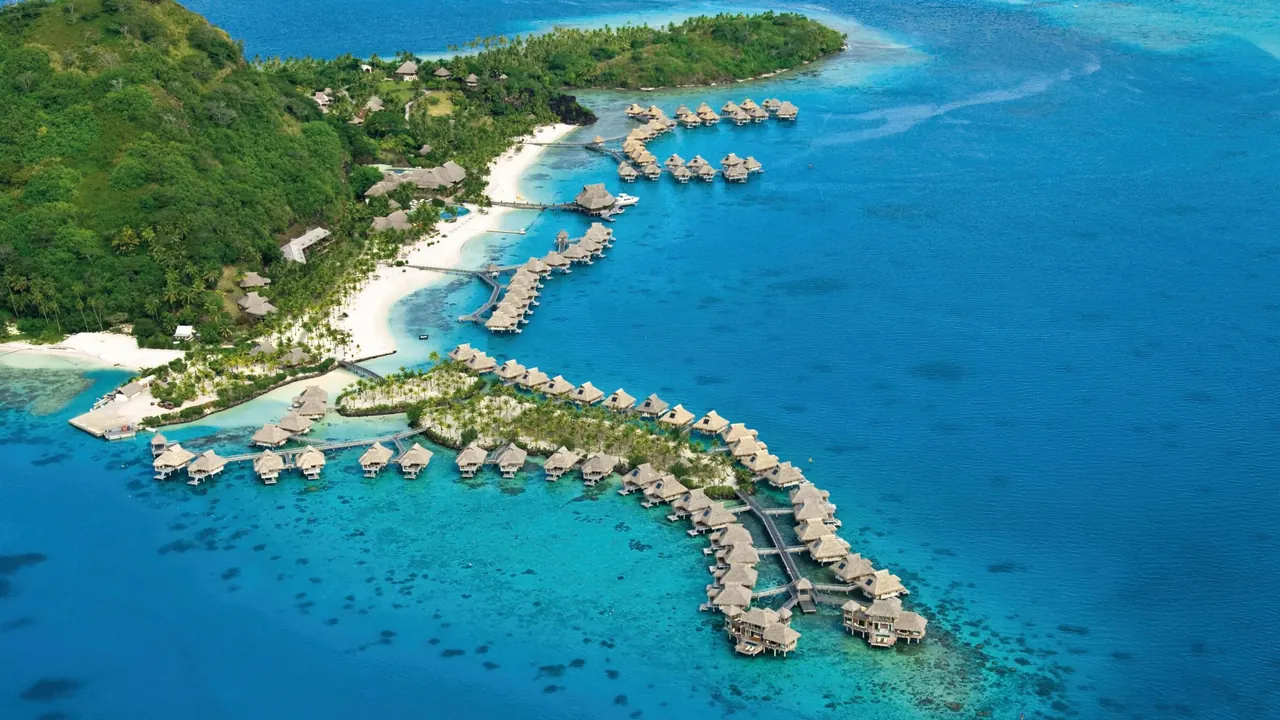
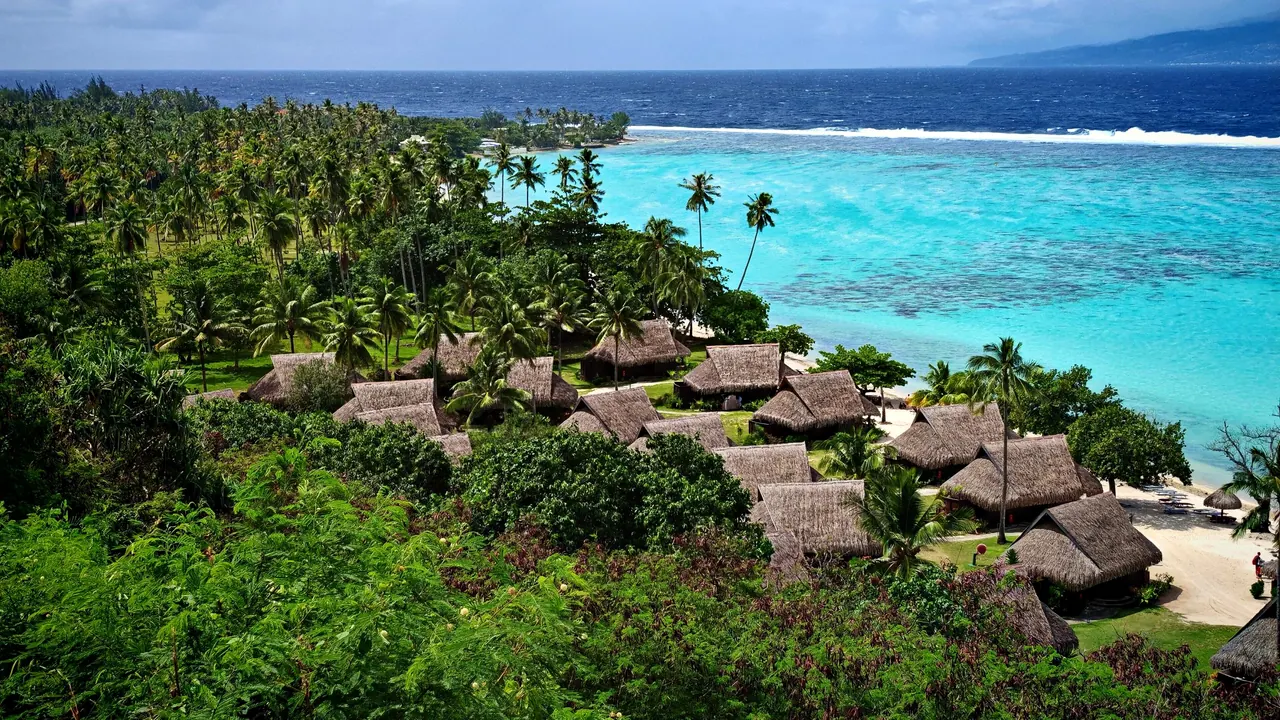
Photos: Bora Bora by Mauro Soares, CC BY-SA 3.0, cropped; Moorea by Hakilon, CC BY-SA 4.0, cropped.
Bora Bora or Moorea?
Our verdict in twelve categories, each scored against the same fixed benchmark cities, and the climate month by month, so you can choose for your trip.
Choose Bora Bora for
- beaches
Bora Bora is for a couple who want the lagoon to be the whole trip. It has the clearest and most famous water in the islands, the long, soft sand of Matira Point, and resort motu where days pass between the bungalow deck, a snorkel and the spa. In return it gives up nearly everything else, including any cheap way to stay. It suits a once-in-a-lifetime splurge more than an active week.
Choose Moorea for
- families
- nature and the outdoors
- getting around
Travellers who want to do more than float should look to Moorea. Its peaks rise straight out of the lagoon, with trails through pineapple plantations up to the ridges, and humpback whales come close to shore in the later part of the year. A coast road and a short ferry to Tahiti make it easier to get about. Pensions, roulottes and self-catering houses also make it the better choice for families and for anyone watching costs, though it is still far from cheap.
Scoreboard
Twelve categories on one fixed scale from 0 to 100. The shaded stretch is the gap between the two.
Your match
Pick a travel style or drag the sliders, and both match scores follow your weighting.
Wins on beaches with your weighting.
Wins on families and nature and the outdoors with your weighting.
What matters to you?
Category by category
What the scores mean for a trip.
Beaches & swimming
Both islands give you a warm, reef-sheltered lagoon rather than a classic beach coast, but Bora Bora's is the finer one. You swim in turquoise water off the resort motu, and at Matira Point a long curve of soft white sand runs into shallows you can wade far out into.
Moorea's swimming is still excellent, from guesthouse jetties, at Temae and around Hauru Point and Tiahura. But much of its shore is coral, rock or narrow private strips, so how much sand you get depends on where you stay.
Food & drink
Neither island is worth choosing for its food. Both rely on the same few things: poisson cru, lagoon fish and resort dining rooms with a French touch. On Bora Bora most visitors eat in their resort, and the local meals are at the snack counters and food trucks around Vaitape and along the coast road.
Moorea has a little more going on outside the hotels. There are evening roulottes, roadside stands selling the island's own pineapples, small restaurants around Cook's Bay and a Sunday ma'a Tahiti from the earth oven. Many guesthouse visitors simply cook for themselves.
Culture & sights
Moorea has a little more to see, and most of it is out in the landscape. Under the chestnut trees of the Opunohu valley there are marae, archery platforms and house foundations, at Papetoai there is the octagonal mission church, and there is a cultural village with crafts. Bora Bora has a few restored marae, rusting American guns from the Second World War above the lagoon and the church at Vaitape, all seen in a few hours on an island tour. On either island, history fills a day at most and is not a reason to choose it.
Nightlife
Bora Bora's evenings have one small advantage. A couple of bar-restaurants on the main island draw guests from several hotels, so you can at least leave your resort for a drink. On Moorea, the evening means a sunset drink on a beach terrace around Hauru Point or in one of the few hotel bars that stay open after dinner.
After that, the two islands end the night the same way, with dinner, no clubs and an early bed. Papeete is just across the water from Moorea, but the ferry times make a night out there impractical.
Nature & outdoors
Both islands are built on the same pairing of volcanic peak and lagoon, but Moorea gives you far more to do with it. You can walk its ridges and the slopes above Cook's Bay and Opunohu Bay as well as look at them, on trails through rainforest to the Three Coconuts pass and on guided rope-assisted routes higher up. From about July to November, humpback whales come close to shore to calve.
Bora Bora's Mount Otemanu is the more famous outline, and its reef passes bring manta rays as well as lemon sharks. On land, though, there are only the 4x4 tracks and a guided climb of Mount Pahia, so a week there is spent almost entirely on the water.
Day trips
On both islands most visitors stay put, and the outings on offer are quite different. Bora Bora looks out to the quiet Leeward Islands: the vanilla plantations and pearl farms of Tahaa, the sacred marae of Taputapuatea on Raiatea, or little Maupiti. All of them are small villages, reached on an organised boat trip or by planning around flights.
From Moorea there is really only Tahiti, but it is a short ferry ride away and is a proper island with a town. Papeete has its covered market and cathedral, and with a hire car you can drive the coast to Point Venus, the black-sand beaches and Tahiti Iti.
Good for families
Moorea is the easier island with children. Self-catering pensions with gardens, the sandy north coast and sandbars where rays glide around your legs make family life simple, and Polynesian fondness for children is part of the welcome. Bring reef shoes for the coral and sea urchins.
Bora Bora has the gentler paddling at Matira, where toddlers can wade a long way out. But its resorts are designed for couples, some overwater bungalows are unsafe for children who cannot swim, and the cost rises steeply with every extra person. Older children who snorkel, staying in a resort with a kids' club, get the most from it.
Getting around
Moorea is simpler to get around. You arrive by a short ferry crossing from Papeete, and a quiet coast road of about 60km puts Cook's Bay, the Belvedere and the northern beaches within half an hour of each other by hire car or scooter. Without a vehicle, though, you depend on taxis and shuttles.
Bora Bora's 32km road is easy to cycle, but arrival starts with a boat from the airport motu. Many resorts are out on the motu too, so every trip to Vaitape or Matira depends on the hotel's boat.
Shopping & style
On both islands shopping comes down to Tahitian black pearls plus a few gifts such as pareos, monoi oil, carved wood and shell jewellery. On Bora Bora it is all around the Vaitape quay and in the resorts, and a single morning is enough. Moorea's pearl shops and small galleries are spread around Cook's Bay and Hauru Point and also sell vanilla and hand-printed fabrics. Papeete's market, a ferry ride away, has a wider choice.
Affordability
Neither island is cheap, but Moorea gives you more ways to cut costs. Family-run pensions, self-catering houses, the evening roulottes and the supermarket make a careful week possible, although it still costs well above most of Europe.
Bora Bora is among the most expensive places to visit anywhere. Overwater bungalows are priced as a once-in-a-lifetime luxury, and boat transfers, lagoon tours and resort meals keep adding to the bill. Guesthouses and self-catering on the main island help, but they never make it cheap.
Live music & performing arts
The two islands differ most in July. Bora Bora holds its own Heiva in Vaitape, with dance and singing contests between local groups. Moorea's big festival takes place across the water in Papeete, and at home there are only smaller village celebrations.
For the rest of the year they are much the same. Both have Polynesian dance and drumming, with fire dancing and ori tahiti, mostly at resort dinner shows, and neither has a theatre or concert hall. Moorea also has shows at its cultural village.
Wellness & relaxation
The two islands are equally restful, and their spas are much alike. On both, the larger resorts have treatment rooms set over the lagoon or in tropical gardens, use monoi oil, coconut and the tiare flower, and offer taurumi, the traditional Polynesian massage. Neither has thermal baths or a retreat scene.
On Bora Bora, relaxing happens almost entirely inside your resort. Once you have tried its spa there is little else to find, so it suits a couple happy to spend their days between the treatment room, a hammock and the bungalow deck. Moorea gives you a little more beyond the resort gates, with a small choice of massage outside the hotels and quiet garden pensions where you can do very little away from resort life.
When should you go?
Pick your month. The climate figures are measured averages, not a forecast.
Bora Bora in July
Moorea in July
Daytime high, °C
Rainfall in the month, mm
Temperature and rainfall are climate normals, averaged over the years shown. Bora Bora: 1991-2020 (sunshine 1981-2010) normals, Bora-Bora / Faanui (6.1 km from centre). Moorea: 1991-2020 normals, Tahiti-Faaa (22.2 km from centre).
Both islands are hot all year, with daytime highs between 29°C and 32°C and a lagoon that never drops below 27°C, so the water is warm enough for swimming in every month. What changes is the rain. Each has a wet season from about December to March, heaviest in December and January, when the wettest month on each brings well over 250mm. There is also a drier, sunnier spell from June to September, and August is the sunniest month on both.
Bora Bora stays a little damper through its dry months, though still bright, and this is the best time to find a dry day for the climb up Mount Pahia. Moorea dries out more sharply, with only about 43mm in July and again in August, so the middle of the year is the best time for its hiking trails.
Which traveller are you?
On a beach and sun trip, Bora Bora is the island to choose. Its lagoon is the clearer and more famous of the two, Matira Point has a long, soft beach for wading, and the resort motu put white sand and turquoise water right outside your door.
For an outdoors trip, Moorea is the clear choice. You can hike through rainforest to ridges like the Three Coconuts pass, kayak out to the motu and, later in the year, watch humpback whales near the shore. Away from the water, Bora Bora has far less to do.
On a family trip with children, Moorea is the more practical island. Self-catering pensions near the northern beaches, sandbars full of rays and a somewhat lower cost all suit families. Bora Bora's resorts are built for couples, and its overwater bungalows are less suited to small children.
Before you go
| Measure | Bora Bora | Moorea |
|---|---|---|
| Official language | French | French |
| Currency | CFP Franc (XPF) | CFP Franc (XPF) |
| Driving side | Right | Right |
| Time zone | UTC-10 | UTC-10 |
| Emergency number | 112 | 112 |
| Main airport | Bora Bora Airport (BOB)9 non-stop destinations | Fa'a'ā International Airport (PPT)30 non-stop destinations |
| Public holidays this year | 16 days | 16 days |
By the numbers
| Measure | Bora Bora | Moorea |
|---|---|---|
| Population | 10,605 | 16,191 |
| People per km² | 347 | 121 |
| Swim season, months above 21 °C | 12 months | 12 months |
Where else could you go?
Every comparison below shares a destination with this one, so you can follow Bora Bora or Moorea somewhere new.
- Tahitivs Moorea
- Tahitivs Bora Bora
- Aitutakivs Bora Bora
- Cook Islandsvs Bora Bora
- Rarotongavs Moorea
- New Caledoniavs Bora Bora