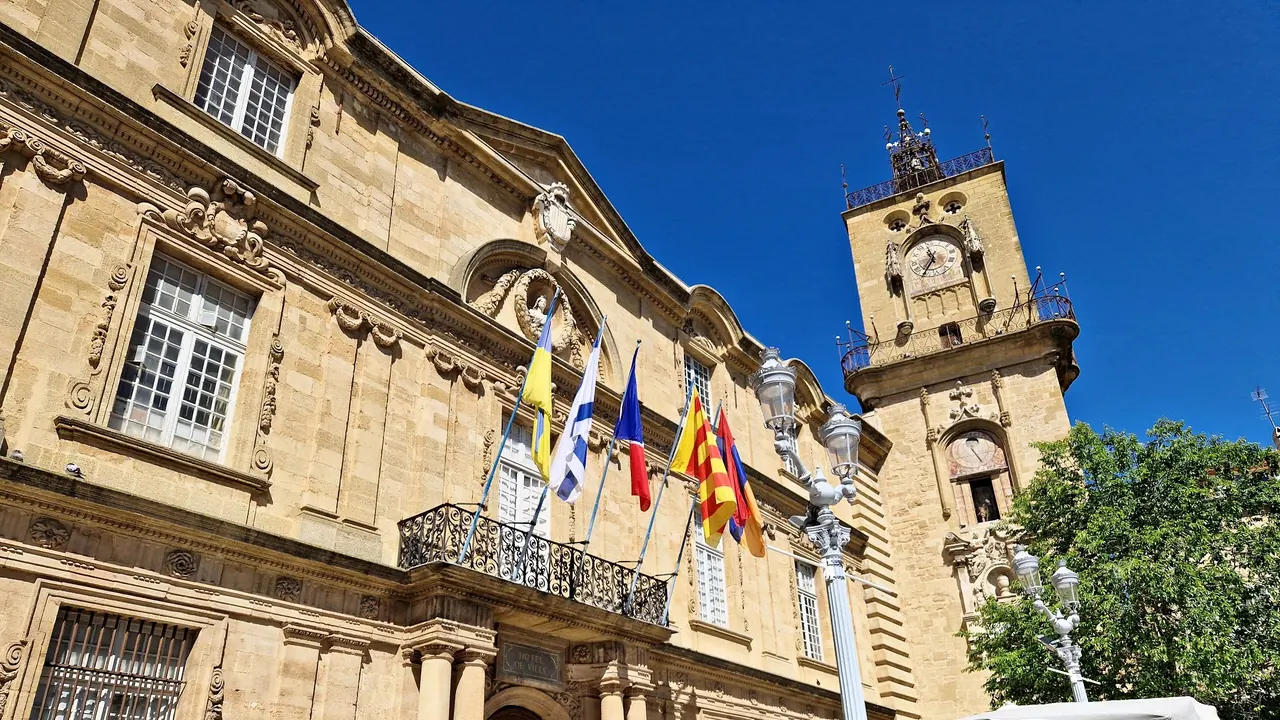
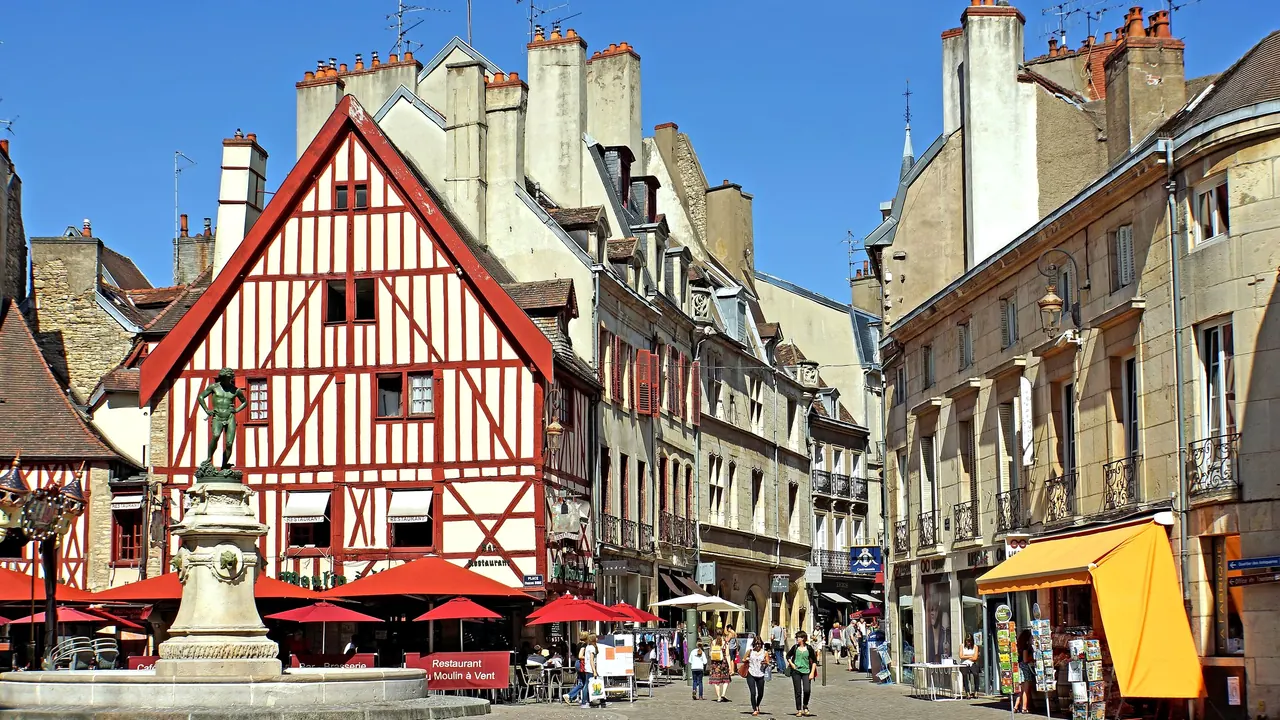
Photos: Aix-en-Provence by Hanay, CC BY-SA 4.0, cropped; Dijon by Dennis G. Jarvis, CC BY-SA 2.0, cropped.
Aix-en-Provence or Dijon?
Our verdict in twelve categories, each scored against the same fixed benchmark cities, and the climate month by month, so you can choose for your trip.
Choose Aix-en-Provence for
- beaches
- nature and the outdoors
- wellness
Aix-en-Provence suits travellers who want the south: strong sun, the sea within an hour, and a base for the Calanques, Sainte-Victoire and the Luberon villages. It is the better pick for walkers, for opera lovers in July and for anyone who likes to end the day beside a pool. It needs a budget that can stretch and, for the countryside, a hire car.
Choose Dijon for
- prices
- getting around
- food and drink
Dijon is the place for eating and drinking well at a fairer price. Burgundian cooking, Les Halles and the Grand Cru villages on the city's edge make it a trip built around the table. Trams, a compact centre and a fast train from Paris make it simple without a car. Expect a cooler, greener landscape and no beach.
Scoreboard
Twelve categories on one fixed scale from 0 to 100. The shaded stretch is the gap between the two.
Your match
Pick a travel style or drag the sliders, and both match scores follow your weighting.
Wins on beaches and nature and the outdoors with your weighting.
Wins on prices and getting around with your weighting.
What matters to you?
Category by category
What the scores mean for a trip.
Beaches & swimming
Neither city is a beach destination, but Aix at least has the sea within reach. Marseille's city beaches, the coves of the Côte Bleue and Cassis are all about an hour's drive away, though they are mostly small pebbly or rocky inlets.
Dijon is several hours from any coast. Swimming there means the supervised bathing lawn at Lac Kir on a hot afternoon, or a pool. That is pleasant enough, but it is no substitute for the Mediterranean.
Food & drink
Lunch in Aix is the long Provençal kind: produce from the morning market on Place Richelme, then tapenade, daube, grilled fish and chilled rosé on a shaded terrace, with a calisson to finish. The cooking is lighter and sunnier, though the best-known terraces lean on their setting more than their kitchens.
Dijon gives a food-minded traveller more to work with. Boeuf bourguignon, snails, mustard and cassis come from a deeper regional tradition, Les Halles is stacked with Époisses and Bresse poultry, and wine bars pour village Burgundies by the glass. A serious fine-dining tier rounds it out, though neither city offers much beyond French cooking.
Culture & sights
The two are evenly matched, each worth a good two or three days, but the pleasures are different. Aix is a town of fountains, plane trees and the honey-coloured mansions of the Mazarin quarter, and Cézanne's studio and the landscapes he painted run through a visit.
Dijon carries the weight of a medieval capital: the ducal palace with its Valois tombs, the half-timbered streets, the owl on Notre-Dame and Sluter's Well of Moses. Choose Dijon for medieval sculpture and Aix for a painter's town and its classical streets.
Nightlife
Both are student towns with more going on in the evening than their size suggests, and in both a night out means a terrace, a glass of wine and a late dinner. Aix comes out a little ahead. Warm nights fill Place des Cardeurs and the lanes behind the town hall, and Marseille's clubs are half an hour away.
Dijon's evenings centre on the small bars and pubs of Rue Berbisey and the terraces around Place Émile Zola, where beer and wine bars set the tone. Outside term time the streets are quiet by midnight.
Nature & outdoors
Aix has far more dramatic country around it. Montagne Sainte-Victoire rises just east of town, the white cliffs and turquoise inlets of the Calanques are within an hour, and the Verdon canyon makes a day out. Because of summer fire closures, spring and autumn work best.
Dijon's surroundings are gentler. There is climbing and walking in the combes west of town, flat cycling on the Burgundy Canal towpath and the signed vineyard route to Beaune. The Morvan, about an hour and a half away, is as wild as it gets.
Day trips
From Aix the choice runs from a port city to Roman ruins and hill villages. Marseille is half an hour away, the TGV reaches the papal palace at Avignon in minutes, Roman Arles, Nîmes and the Pont du Gard follow, and the Luberon villages and Cassis on the coast are within an hour.
Dijon's outings are narrower but rich in their own way: wine and abbeys. The Route des Grands Crus leads to Beaune, and Fontenay's Cistercian cloisters, Semur-en-Auxois and, on a longer day, Vézelay lie to the north-west. Beaune and Besançon are easy by train, but in both regions the villages are best reached by car.
Good for families
Neither city is built around children, though both are safe and have pedestrian centres that make wandering easy. Families in Aix tend to treat the town as a base for pool days and drives to the zoo at La Barben or the coast, and older children can walk on Sainte-Victoire.
Dijon has a little more within the city: the natural history museum and planetarium at the Jardin de l'Arquebuse, the play areas of the Parc de la Colombière and paddling at Lac Kir. It also spares children the fierce summer afternoons of Provence.
Getting around
Aix is a walking town inside its old centre and the Mazarin quarter, with small electric shuttles in the narrow lanes. Leaving it is the hard part: the TGV station is out on the plateau and needs a shuttle bus, buses serve the Provence villages poorly, and most visitors hire a car and then hunt for parking at the edge of the old town.
Dijon is just as walkable and far easier beyond the centre. The station is a few minutes from the palace and the market, two tram lines reach the outskirts and Lac Kir, and regional trains run down the wine route to Beaune.
Shopping & style
Aix makes a better afternoon of browsing. The lanes around Rue d'Italie and Rue Fabrot have French fashion and shoe boutiques, the Allées Provençales have the chains, and market days bring textile, flower and bric-a-brac stalls. Calissons, santons, olive wood and printed fabrics are the things to take home.
Dijon's shopping is mostly edible: mustard in dozens of flavours, pain d'épices, cassis and Burgundy from the wine merchants. Rue de la Liberté has a department store and chains, but there is no luxury shopping in either city.
Affordability
Dijon is the more affordable stay. Rooms are moderately priced, bistro set lunches give good food at a fair price, and Burgundy by the glass costs less than in most of France. Cellar tastings and good bottles soon add up, though.
Aix costs more. Hotels near the old town are few and expensive, especially during the July festival, the terraces on the Cours Mirabeau charge for the view, and a hire car for Provence adds to the bill. Market picnics and lunch menus in the back streets help.
Live music & performing arts
Aix has the bigger stage thanks to its July opera festival, which brings the opera world to the courtyard of the Archbishop's Palace. The rest of the year there is the Grand Théâtre de Provence, Ballet Preljocaj at the Pavillon Noir and an Easter classical festival.
Dijon's season runs the other way and is strongest in the academic year, with opera, concerts and dance at the Grand Théâtre and the Auditorium, which is known for its acoustics, plus a national drama centre. Its programme thins out in summer, just when Aix is at its peak.
Wellness & relaxation
Aix has something Dijon lacks: warm springs. The Romans founded the town for them, the Fontaine d'Eau Chaude still runs on the Cours Mirabeau, and the Thermes Sextius has thermal pools on the site of the Roman baths.
Dijon has no bathing tradition and only a few hotel spas, some in the wine villages offering grape-based treatments. Both towns share an unhurried provincial pace of long lunches and quiet squares, so for rest without treatments either one will do.
When should you go?
Pick your month. The climate figures are measured averages, not a forecast.
Aix-en-Provence in July
Dijon in July
Daytime high, °C
Rainfall in the month, mm
Temperature and rainfall are climate normals, averaged over the years shown. Aix-en-Provence: 1991-2020 normals, Marseille / Marignane (19.2 km from centre). Dijon: 1991-2020 normals, Dijon (7 km from centre).
Aix is much the sunnier and hotter of the two. The swimming season on the nearby coast runs from June to September, and the sea is warmest in August at about 22°C. July and August are fierce, with afternoons around 31°C, so sightseeing becomes a matter of mornings and evenings. May, June and late September are the best months for walking the town and the hills. July is almost dry. The rain comes in autumn, with 82mm in September and a wet spell that lasts through November.
Dijon is cooler and greyer all year, with rain spread fairly evenly across the months and far fewer hours of sunshine. Summer is its easiest season for the streets and for cycling in the vineyards: July highs are around 27°C rather than the southern heat, and May to September are all comfortable. Winters are cold, with highs of 6°C in December and January and short, dull days, while Aix stays about twice as warm by day.
Which traveller are you?
On an outdoors trip, Aix-en-Provence wins clearly. Sainte-Victoire rises at the edge of town, the Calanques offer cliff-top walking and sea kayaking within an hour, and the Verdon gorges are within reach. Dijon's combes and canal towpaths are much gentler country.
For a trip on a tight budget, Dijon makes the money go further. Rooms are moderately priced, bistro set lunches and wine by the glass are fair, and the trams mean you never need a car. Aix has few central hotels, and their rates climb in July.
For a short city break, Dijon is simpler to arrange and enjoy. The TGV from Paris takes well under two hours, the station is a short walk from the palace and the market, and two or three days cover the sights. Aix's TGV station sits far out on the plateau.
Before you go
| Measure | Aix-en-Provence | Dijon |
|---|---|---|
| Official language | French | French |
| Currency | Euro (EUR) | Euro (EUR) |
| Sockets | CE230 V, 50 Hz | CE230 V, 50 Hz |
| Driving side | Right | Right |
| Time zone | UTC+1, UTC+2 in summer | UTC+1, UTC+2 in summer |
| Emergency number | 112 | 112 |
| Elevation | 73 m | 220 m |
| Main airport | Marseille Provence Airport (MRS)21 km from centre126 non-stop destinations | Lyon Saint-Exupéry Airport (LYS)178 km from centre141 non-stop destinations |
| Public holidays this year | 11 days | 11 days |
By the numbers
| Measure | Aix-en-Provence | Dijon |
|---|---|---|
| City population | 149,695 | 161,830 |
| People per km² | 804 | 3,890 |
| Museums within 10 km | 8 | 8 |
| UNESCO World Heritage sites within 50 km | 1 | 1 |
| Swim season, months above 21 °C | 2 months | - |
Where else could you go?
Every comparison below shares a destination with this one, so you can follow Aix-en-Provence or Dijon somewhere new.
- Marseillevs Aix-en-Provence
- Avignonvs Aix-en-Provence
- Saint-Tropezvs Aix-en-Provence
- Montpelliervs Aix-en-Provence
- Cannesvs Aix-en-Provence
- Antibesvs Aix-en-Provence