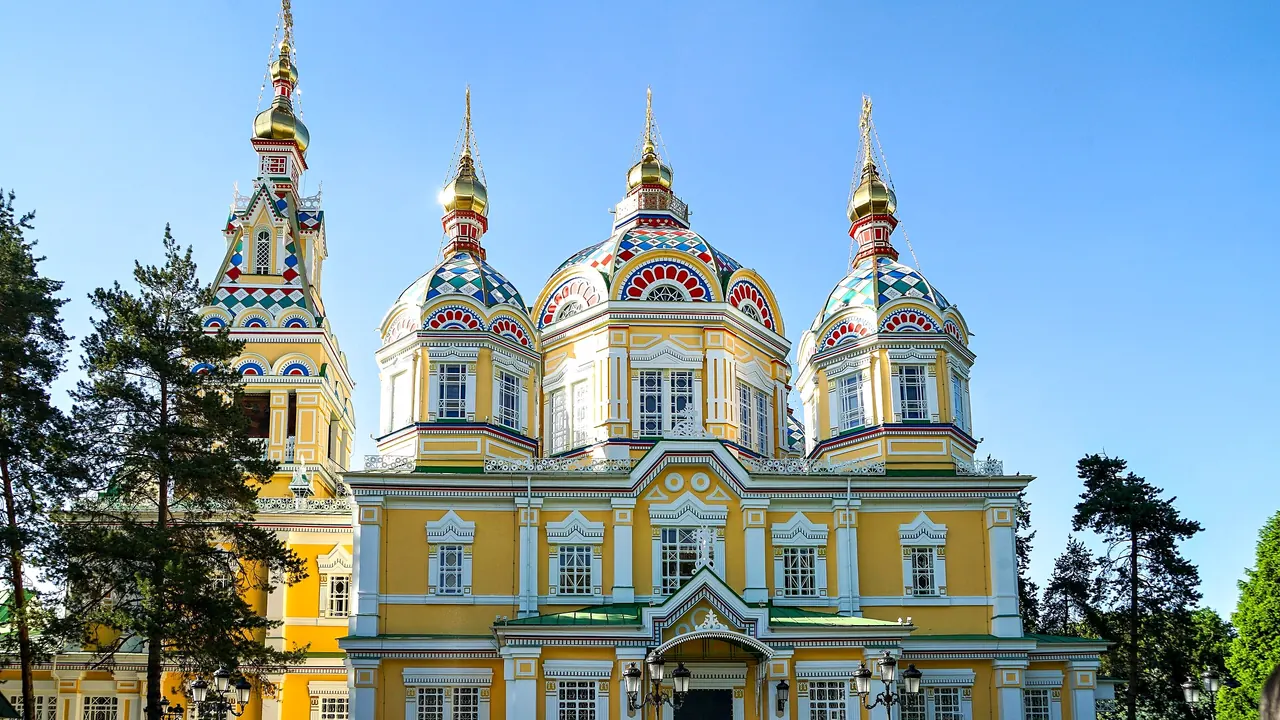
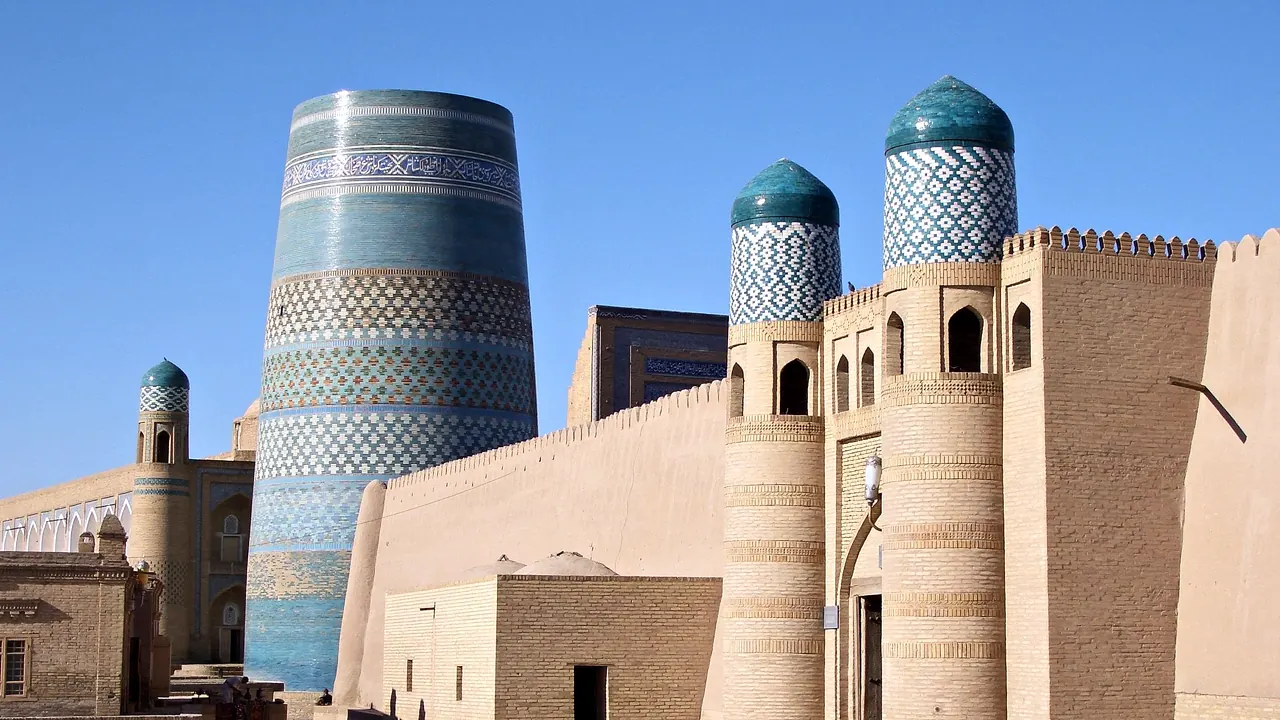
Photos: Almaty by Kalpak Travel, CC BY 2.0, cropped; Khiva by Bosinus, CC BY-SA 3.0, cropped.
Almaty or Khiva?
Our verdict in twelve categories, each scored against the same fixed benchmark cities, and the climate month by month, so you can choose for your trip.
Choose Almaty for
- nature and the outdoors
- nightlife
- live music and the arts
Almaty suits travellers who want mountains on the doorstep and a real city to come back to in the evening. The Trans-Ili Alatau rises from its southern edge, with Shymbulak for skiing in winter and high trails in summer. Back in town there are Uyghur noodle houses, late weekend bars and the opera. It is the better base for a longer stay, for families, and for anyone who wants plenty of variety without changing hotels.
Choose Khiva for
- culture and sights
- getting around
- prices
If you want Silk Road history in its most complete form, choose Khiva. Ichan Kala is a whole walled city of madrasas, minarets and palaces that you can cross on foot in minutes. It is best seen over two or three unhurried days, with the walls at sunset. Evenings are quiet, the food is simple and there is little else to do. That is exactly the appeal for travellers who come for the architecture and want to spend little while they are there.
Scoreboard
Twelve categories on one fixed scale from 0 to 100. The shaded stretch is the gap between the two.
Your match
Pick a travel style or drag the sliders, and both match scores follow your weighting.
Wins on nature and the outdoors and nightlife with your weighting.
Wins on culture and sights and getting around with your weighting.
What matters to you?
Category by category
What the scores mean for a trip.
Beaches & swimming
Neither city has a coast, but Almaty at least has somewhere to swim outdoors. The Kapchagay reservoir, about an hour and a half away across the steppe, has sandy shores and warm summer water, and locals fill it at weekends. In Khiva, swimming means a hotel pool and nothing more.
Food & drink
Almaty is the better place to eat. Its tables gather the whole region: Kazakh beshbarmak and kazy, Uyghur lagman and manty, Uzbek plov, shashlik over coals and Soviet-era Korean salads. The Green Bazaar and a leafy grid of cafés and modern restaurants give it the range of a real city.
Khiva's cooking is more distinctive than plentiful. Shivit oshi, the dill-green noodles, and tuhum barak dumplings are worth trying, but nearly every meal comes from the same guesthouse or terrace menu. There is little street food and almost no café life.
Culture & sights
Here Khiva is in another league. Ichan Kala is an intact walled Silk Road town, where the Kalta Minor minaret, the wooden-columned Juma Mosque and the harem courtyards of Tash Hauli all lie within a few minutes' walk of each other.
Almaty has a different kind of interest. Earthquakes left little older than the late nineteenth century, so the highlights are the painted wooden Zenkov Cathedral, the Scythian gold in the Central State Museum and the mosaic façades of the Soviet era. Its museum collections are larger than the small madrasa displays in Khiva, but as a historic place it does not come close.
Nightlife
Almaty is where Central Asia goes out. Cocktail bars, craft beer pubs and a few clubs around Panfilov and Abylai Khan keep weekends going until morning, though weeknights are quiet. Khiva has no bars or clubs at all. An evening there is dinner on a terrace and a stroll through the lit lanes before they empty.
Nature & outdoors
Almaty is one of the great mountain cities. Its 4,000m peaks close off the end of every street, and within half an hour you can be at Medeu, with the gondola running on to Shymbulak for skiing or high hiking. Gorges, Big Almaty Lake and, on overnight trips, Charyn Canyon and the Kolsai lakes lie beyond.
Khiva sits in a flat cotton oasis on the edge of the Karakum desert, with no hills or trails. Its outdoor moment is across the Amu Darya, riding camels among the dunes of the Kyzylkum and sleeping under a very dark sky.
Day trips
Khiva has one excursion and Almaty has two, but Khiva's makes the better day. Most outings from Almaty go up into the mountains rather than to historic sites. For history, Esik lies an hour to the east, where burial mounds gave up the gold-clad Golden Man. The Bronze Age carvings at Tamgaly, a UNESCO site, mean a long drive out across the steppe and back. These two sites lie in different directions and can't easily be seen in one day. Bishkek is within driving range, but the border makes it a trip of two days rather than one.
Khiva's day among the Elliq Qala fortresses has more to it. Ayaz Kala, Toprak Kala and their neighbours are vast ruined strongholds of ancient Khorezm standing alone in the sand, about one and a half to two hours away by car, and a hired driver can link several of them in a single loop. You leave the walls of Ichan Kala and see the same desert past on a far larger, emptier scale. It is also the only real day out, because Kunya-Urgench lies across the Turkmen border and Bukhara is too far to go and come back the same day.
Good for families
Almaty gives children much more to do. Families can take the cable car up Kok-Tobe to its rides and petting zoo, spend a day at Central Park and the zoo, skate on the open-air Medeu rink or try Shymbulak's beginner slopes. Its wide, busy avenues are the main drawback with small children.
Khiva is safe, small and calm, and older children enjoy climbing a minaret or riding a camel. Still, a stay there is a series of madrasas and palaces with nothing built for children, and the summer heat makes the middle of the day hard going.
Getting around
Khiva is the easier place to get around because it is tiny. Ichan Kala is flat and mostly closed to traffic, and its railway station is a short walk from the walls, so many visitors never need a vehicle. The exception is the desert fortresses, which you can only reach with a hired driver.
Almaty's tree-lined central grid is pleasant to walk, but distances beyond the centre are long and traffic is heavy. The single metro line does little for visitors, so most people use ride-hailing apps. The upside is that buses and gondolas reach Medeu and Shymbulak without a car.
Shopping & style
The two are close, but they offer different things. Almaty is bazaars and malls: dried fruit, honey and spices at the Green Bazaar, the sprawling Barakholka market, and malls stocked with international brands. In Khiva you buy crafts at the source, with woodcarvers at work in madrasa cells, silk carpets on the looms, suzani embroidery and Khorezmian sheepskin hats.
Affordability
Both are cheap, and Khiva is cheaper still. Its family guesthouses inside the walls come with large breakfasts, meals cost little, and a shared driver to the fortresses is affordable. In Almaty, food, transport and opera tickets are inexpensive, but good central hotels and imported wine are priced much closer to Western levels.
Live music & performing arts
Almaty has a real season of performances. Classic ballet and opera are staged at the Abai State Opera and Ballet Theatre, the Philharmonic holds orchestral and dombra concerts, and there are drama theatres and a few jazz bars, all easy to get into, though most theatre is not in English.
Khiva's offering is folk performance: the quick, shimmering lazgi dance at evening shows in madrasa courtyards and the occasional dorboz tightrope walker on a square. Beyond that there is no theatre or concert hall.
Wellness & relaxation
Almaty has a genuine bathing culture. Arasan, the Soviet-era complex beside Panfilov Park, has banya steam rooms with birch whisking, saunas and a hammam, and the Alma-Arasan gorge adds hot springs. Khiva has nothing comparable beyond a few hotel saunas. What it does have is stillness: once the day groups leave, the old town goes quiet and you can sit over tea on a rooftop at dusk.
When should you go?
Pick your month. The climate figures are measured averages, not a forecast.
Almaty in July
Khiva in July
Daytime high, °C
Rainfall in the month, mm
Where the figures come from
Khiva's temperatures are measured 27 km from the centre, at Urgench.
Khiva has no rain gauge within 25 km of the centre, so its rainfall comes from a gridded climate dataset read at the city rather than from a gauge further away.
Temperature and rainfall are climate normals, averaged over the years shown. Almaty: 1991-2020 normals, Almaty (1.7 km from centre). Khiva: 1991-2020 normals, Urgench (26.8 km from centre).
Almaty has a long, sunny summer and a wet spring. April is the wettest month at 108mm, so late spring is green but showery. June and September are the best months, with warm days and plenty of sunshine for walking the grid and hiking in the mountains. July and August reach about 31°C, which is hot in the city, but the cooler heights are close by. From December to February daytime highs stay around freezing. That is no weather for wandering the streets, but it is the ski season at Shymbulak.
Khiva is much drier and has stronger extremes. Rain hardly falls in any month, and in summer the heat reaches 36°C in July, which makes sightseeing in the middle of the day a real effort. April and May, then September and October, are the comfortable windows, and October days are a pleasant 20°C for walking the walls. Winters in Khiva are as cold as Almaty's, so the two cities share a poor season. For the rest of the year Almaty is the better summer choice and Khiva the better choice in spring and autumn.
Which traveller are you?
For a culture and arts trip, Khiva is the stronger choice. Ichan Kala keeps an entire Silk Road town inside its ramparts, from the carved columns of the Juma Mosque to the tiled courtyards of Tash Hauli. Almaty offers a few good museums and its Soviet modernist buildings.
On an outdoors trip, Almaty wins easily. Spruce gorges, Big Almaty Lake, trails towards the glaciers and the Shymbulak ski area are all close to town. Khiva's flat oasis offers little beyond a camel ride and a night in a desert yurt camp.
For a food and nightlife trip, Almaty is far more rewarding. There is Uyghur lagman and Uzbek plov, there are tastings at the Green Bazaar, and the bars and clubs run late at weekends. Khiva's terrace menus repeat from one place to the next, and its lanes are silent soon after dark.
Before you go
| Measure | Almaty | Khiva |
|---|---|---|
| Official language | Russian, Kazakh | Uzbek |
| Currency | Tenge (KZT) | Uzbekistan Sum (UZS) |
| Sockets | CF220 V, 50 Hz | CFI220 V, 50 Hz |
| Driving side | Right | Right |
| Time zone | UTC+5 | UTC+5 |
| Emergency number | 112 | 112 |
| Elevation | 893 m | 109 m |
| Main airport | Almaty International Airport (ALA)16 km from centre93 non-stop destinations | Urgench International Airport (UGC)32 km from centre21 non-stop destinations |
| Public holidays this year | 13 days | - |
By the numbers
| Measure | Almaty | Khiva |
|---|---|---|
| City population | 2,228,675 | 105,300 |
| People per km² | 3,268 | - |
| Museums within 10 km | 20 | 0 |
| UNESCO World Heritage sites within 50 km | 1 | 1 |
Where else could you go?
Every comparison below shares a destination with this one, so you can follow Almaty or Khiva somewhere new.