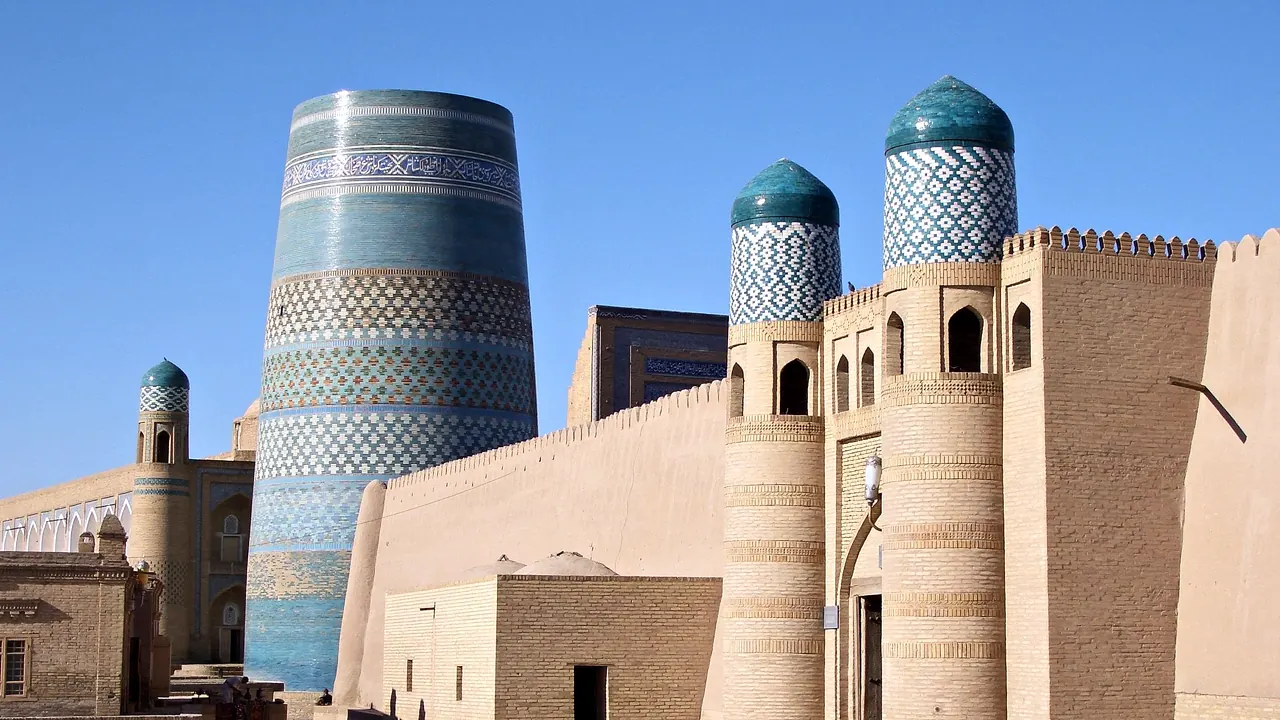
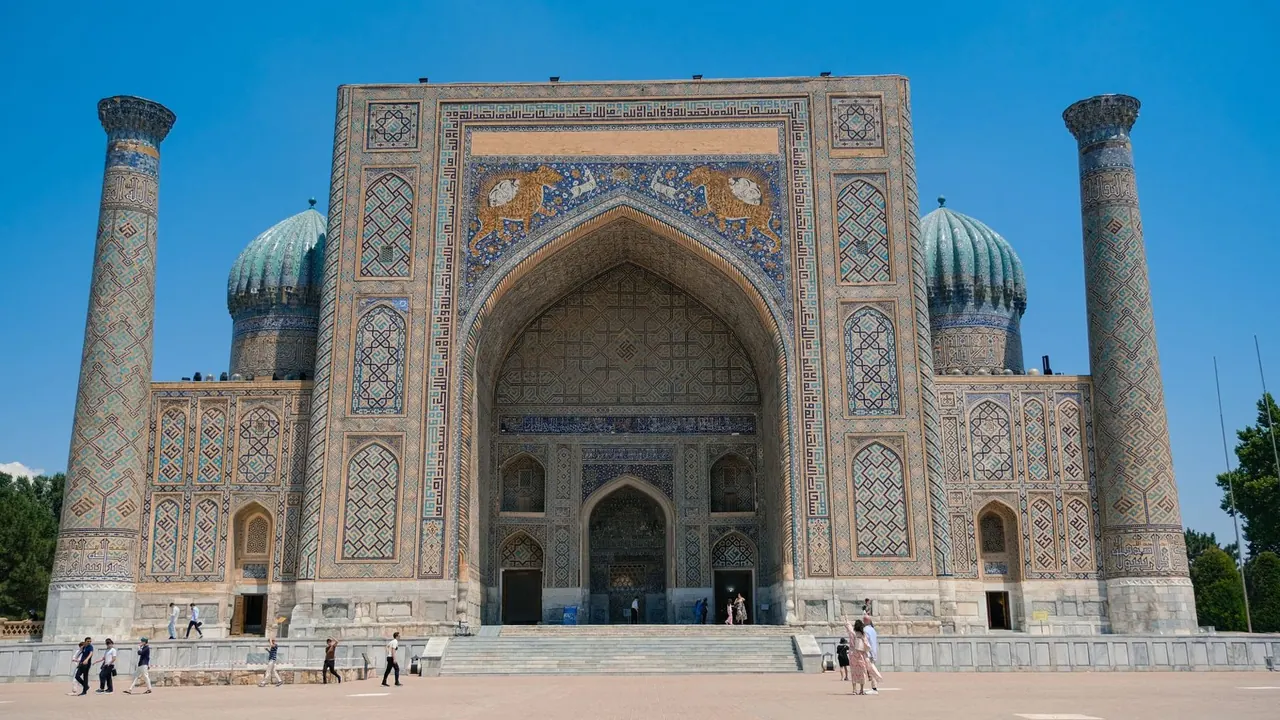
Photos: Khiva by Bosinus, CC BY-SA 3.0, cropped; Samarkand by Yaşar Başkurt, Pexels License.
Khiva or Samarkand?
Our verdict in twelve categories, each scored against the same fixed benchmark cities, and the climate month by month, so you can choose for your trip.
Choose Khiva for
- prices
- getting around
Khiva suits a traveller who wants one Silk Road town complete and whole, seen slowly over two or three days. Ichan Kala is small enough to cross on foot in minutes, the train stops a short walk from the walls, and once the day groups leave the lanes go quiet. It is the better pick for a short, focused stop with a night in a desert yurt camp added on.
Choose Samarkand for
- day trips
- nature and the outdoors
- food and drink
Samarkand rewards a longer stay and a wider appetite. Its monuments are grander, its food and crafts reach further, and it makes a far better base for excursions, with Bukhara and Shakhrisabz both within a day and walking country in the hills to the south. Choose it if Uzbekistan is the whole trip rather than one stop on it.
Scoreboard
Twelve categories on one fixed scale from 0 to 100. The shaded stretch is the gap between the two.
Your match
Pick a travel style or drag the sliders, and both match scores follow your weighting.
Wins on prices and getting around with your weighting.
Wins on day trips and nature and the outdoors with your weighting.
What matters to you?
Category by category
What the scores mean for a trip.
Beaches & swimming
Both cities are about as far from open water as travel gets, and neither offers any swimming worth planning a trip around. In Khiva the only option is a hotel pool on a hot afternoon. Samarkand at least has the shallow Zarafshan and irrigation channels where locals cool off, though visitors are better served by a hotel with a pool there too.
Food & drink
Khiva's cooking is the more unusual of the two, with Khorezmian dishes found nowhere else in the country, such as green dill noodles under stew and yoghurt, and egg-filled dumplings. But meals happen mostly on guesthouse terraces inside the walls, menus repeat, and variety runs out within a few days.
Samarkand gives a food-minded visitor far more to do. Lunchtime plov from the cauldron, the famous glazed bread, shashlik over charcoal and the stalls of Siab Bazaar with dried apricots, nuts and halva fill a day well, and a tasting at the old winery adds a little more. The range is still narrow beyond Uzbek and Russian cooking.
Culture & sights
Khiva's strength is completeness: Ichan Kala is a whole walled city of madrasas, palaces and minarets kept almost intact, from the carved columns of the Juma Mosque to the blue harem courtyards of Tash Hauli. It is compact, though, and a couple of days covers it.
Samarkand's monuments are on another scale. The Registan is one of the great squares of the Islamic world, Shah-i-Zinda holds the finest tilework, and Gur-e-Amir and Bibi-Khanym show Timur's ambition, with Ulugh Beg's observatory and the Afrasiyab murals adding depth. Soviet avenues separate the sights, but there is more of real weight to see.
Nightlife
Evenings are quiet in both, but Samarkand has a little more life. Its large restaurants often host wedding parties dancing to loud live bands, and a few hotel bars and lounges in the Russian-era quarter stay open after dinner. In Khiva the night is a terrace meal facing the minarets and a stroll through lanes that empty soon after dark, with beer found only in hotel restaurants.
Nature & outdoors
Khiva sits in a flat oasis of cotton fields and mulberry-lined canals, with no hills or trails. Its one outdoor draw is distinctive, though: camel rides and nights in yurt camps among the dunes of the Kyzylkum, under a very dark sky.
Samarkand has proper walking country close by. The Aman-Kutan valley and the hills above Urgut, about an hour out, have juniper woods, walnut groves, streams and trails through Tajik-speaking villages, and the Nuratau mountains suit longer homestay treks. It is gentle rather than dramatic, but far more than Khiva's surroundings offer.
Day trips
From Khiva there is essentially one excursion: the ruined desert fortresses of ancient Khorezm, such as Ayaz Kala and Toprak Kala, reached with a hired driver. Kunya-Urgench needs a Turkmen visa, and Bukhara and Nukus are too far for a day.
Samarkand is the far better base. Bukhara is about an hour and a half by high-speed train, Shakhrisabz lies over a mountain pass, and closer in there is the big Sunday bazaar at Urgut and the paper-making village of Konigil. Even Tashkent is within reach by train.
Good for families
Neither city has much made for children, and both are best with families in spring or autumn, when the heat allows sightseeing. Khiva's advantage is its small size, with a shady courtyard or the hotel never far away, plus minarets and walls to climb and camels in the desert. Samarkand has wide pedestrian streets and parks with simple rides, but longer walks between its mausoleums.
Getting around
Both cities are mainly explored on foot, but the shape differs. Khiva's old town is tiny, flat and largely traffic-free, and the railway station sits a short walk from the walls; the catch is that the airport is in Urgench, about 30km away, and the fortresses need a hired driver.
Samarkand's main sights line up along one pedestrian street from the Registan towards Shah-i-Zinda, with outlying places like the observatory and Afrasiyab a quick app-booked taxi ride at fixed fares.
Shopping & style
Khiva's crafts are worth watching being made, above all the woodcarving it is known for, done in madrasa cells, and silk carpets knotted on looms in the old town. Sheepskin hats and suzani fill the stalls, but much else is repeated souvenirs.
Samarkand has a broader spread: ikat silk, miniature paintings, knives and ceramics in the Registan and Shah-i-Zinda workshops, mulberry paper from Konigil, and spices and dried fruit from Siab Bazaar to take home. Quality varies in both, and neither has fashion shopping.
Affordability
Both are inexpensive, and a modest budget goes a long way in either. In Khiva the guesthouses often include a large breakfast, and the main fixed cost is the combined monument ticket, with the desert driver cheap when shared. Samarkand's costs climb mainly at upmarket hotels around the Registan and on imported alcohol, while taxis, bazaar food and entry fees stay low.
Live music & performing arts
Samarkand offers a bit more to watch. Folk and costume shows run in the evenings, the Registan hosts sound-and-light performances, and in some years the Sharq Taronalari festival fills the square with musicians from across the East. There is also a musical drama theatre, though not aimed at visitors.
Khiva's offer is narrower but distinctly local: the quick, shimmering lazgi dance of Khorezm at madrasa or hotel dinner shows, and sometimes dorboz tightrope walkers on the squares.
Wellness & relaxation
Samarkand has the one real place to bathe: the old domed bathhouse near Bibi-Khanym still offers steam and massage, alongside spas in upscale hotels. Khiva's historic bathhouse is only to look at, leaving a sauna or hammam in a few larger hotels. In both, rest comes from the pace instead, over rooftop tea at dusk in Khiva or on a shaded chaikhana topchan in Samarkand.
When should you go?
Pick your month. The climate figures are measured averages, not a forecast.
Khiva in July
Samarkand in July
Daytime high, °C
Rainfall in the month, mm
Where the figures come from
Khiva's temperatures are measured 27 km from the centre, at Urgench.
Khiva has no rain gauge within 25 km of the centre, so its rainfall comes from a gridded climate dataset read at the city rather than from a gauge further away.
Temperature and rainfall are climate normals, averaged over the years shown. Khiva: 1991-2020 normals, Urgench (26.8 km from centre). Samarkand: 1991-2020 normals, Samarkand (10 km from centre).
Neither city has a beach season, so timing is about walking the streets in comfort. Both are at their best in April and May and again in late September and October, when days are warm without being punishing. High summer is fierce in both, with Khiva reaching about 36°C in July and Samarkand barely cooler, so midday sightseeing becomes hard work. Summer is also almost completely dry in both.
The two part ways in winter and spring. Khiva sits deeper in the desert and gets much colder, with January highs near 2°C against about 7°C in Samarkand, but it stays dry all year. Samarkand catches far more rain, peaking around 69mm in March, so spring there brings some wet days along with green hills, while its summer sunshine runs to around 358 hours in July.
Which traveller are you?
For a short city break, Khiva puts an entire Silk Road town inside one set of ramparts. Sleep in a guesthouse within Ichan Kala, let one combined ticket open the monuments, and end each day walking the walls as the brick turns gold.
A food and nightlife trip is where Khiva runs out fastest, with terrace menus that repeat and lanes that empty after dark. Samarkand offers lunchtime plov from the cauldron, glazed non and halva at Siab Bazaar, and long dinners where wedding parties dance to live bands.
On an outdoors trip, Khiva's time in the open comes down to camels and a yurt night in the Kyzylkum dunes. Samarkand has proper walking about an hour away, through the juniper woods and walnut groves of Aman-Kutan, and longer village homestay treks in the Nuratau mountains.
Before you go
| Measure | Khiva | Samarkand |
|---|---|---|
| Official language | Uzbek | Uzbek |
| Currency | Uzbekistan Sum (UZS) | Uzbekistan Sum (UZS) |
| Sockets | CFI220 V, 50 Hz | CFI220 V, 50 Hz |
| Driving side | Right | Right |
| Time zone | UTC+5 | UTC+5 |
| Emergency number | 112 | 112 |
| Elevation | 109 m | 702 m |
| Main airport | Urgench International Airport (UGC)32 km from centre21 non-stop destinations | Samarkand International Airport (SKD)5 km from centre29 non-stop destinations |
By the numbers
| Measure | Khiva | Samarkand |
|---|---|---|
| City population | 105,300 | 546,303 |
| People per km² | - | 5,058 |
| Museums within 10 km | 0 | 11 |
| UNESCO World Heritage sites within 50 km | 1 | 1 |
Where else could you go?
Every comparison below shares a destination with this one, so you can follow Khiva or Samarkand somewhere new.
- Bukharavs Samarkand
- Tashkentvs Samarkand
- Bukharavs Khiva
- Tashkentvs Khiva
- Almatyvs Samarkand
- Almatyvs Khiva