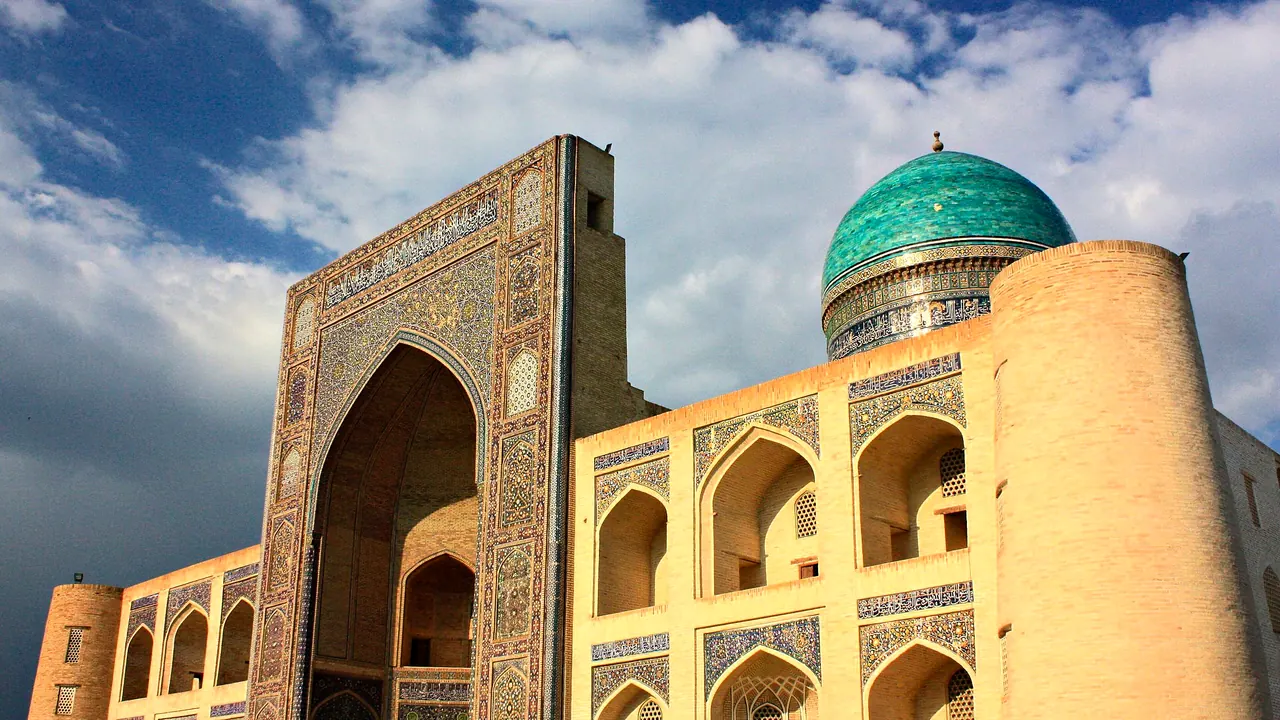
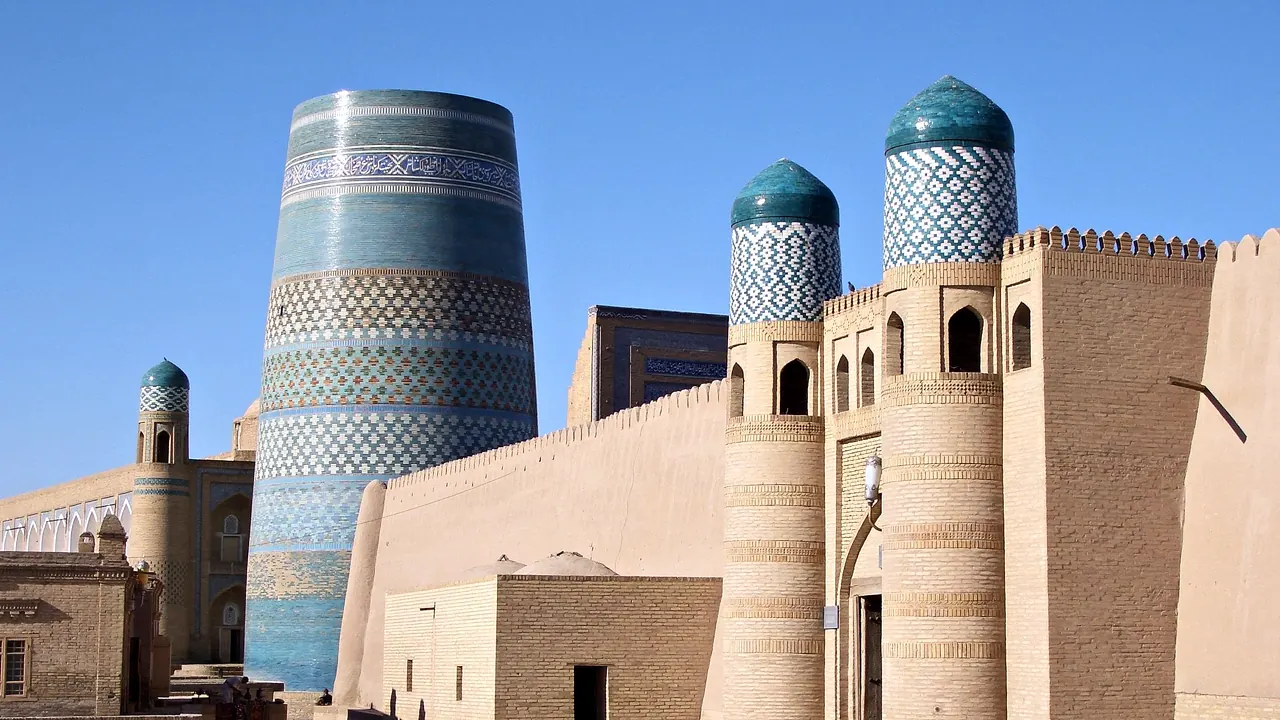
Photos: Bukhara by RK, CC BY-SA 4.0, cropped; Khiva by Bosinus, CC BY-SA 3.0, cropped.
Bukhara or Khiva?
Our verdict in twelve categories, each scored against the same fixed benchmark cities, and the climate month by month, so you can choose for your trip.
Choose Bukhara for
- day trips
- wellness
- shopping
Bukhara is the richer stop for most travellers. Its old town is larger and more varied, running from the Poi Kalon ensemble to the Samanid Mausoleum and the Ark. The trading domes make it the better place to buy textiles and crafts, and its working bathhouses under brick domes give tired legs a proper steam and scrub. Samarkand is close enough by fast train for a day out, so Bukhara also works as a base for several nights.
Choose Khiva for
- nature and the outdoors
- prices
If you want a whole walled Silk Road town in one small package and are happy with a shorter stay, pick Khiva. You can cross Ichan Kala on foot in minutes, and the station is just outside the walls. The ruined fortresses of ancient Khorezm out in the desert make a day trip quite unlike the town itself. Khiva also suits travellers curious about a regional cuisine, with dill noodles and egg dumplings that are particular to Khorezm.
Scoreboard
Twelve categories on one fixed scale from 0 to 100. The shaded stretch is the gap between the two.
Your match
Pick a travel style or drag the sliders, and both match scores follow your weighting.
Wins on day trips and wellness with your weighting.
Wins on nature and the outdoors and prices with your weighting.
What matters to you?
Category by category
What the scores mean for a trip.
Beaches & swimming
You can't swim in either town. Both lie deep in the Central Asian desert, about as far from open water as travel gets, so in summer a hotel pool is the only option. The small difference is that Bukhara's old town has historic pools such as Lyabi-Hauz to sit beside in the shade, though not to swim in. In both towns, book a hotel with a pool if you travel in the hot months.
Food & drink
Bukhara eats better over a longer stay. Plov from the big iron pots at lunchtime, samsa, charcoal-grilled shashlik and the dried fruit and spices of the central bazaar give a bit more choice. So do the places you eat them: teahouse platforms, or tables under the mulberry trees around the old pools. The old-town menus still repeat, and vegetarians will find little.
Khiva's cooking is the more unusual of the two, because it is Khorezmian rather than mainstream Uzbek. Look for the green dill noodles under stew and yoghurt, and the egg-filled tuhum barak. Most meals are eaten on guesthouse or rooftop terraces inside the walls, though. Street food, cafés and wine are scarce, and the range runs out after two or three days.
Culture & sights
Bukhara has more to see, and its buildings vary more in age and type. Around the Kalon Minaret and the Poi Kalon ensemble are the tenth-century Samanid Mausoleum, the Ark, Bolo Hauz, Chor Minor and the trading domes, all linked by residential lanes that are still lived in. On the edge of town are the emirs' summer palace and the Naqshband shrine.
Khiva's strength is that it hangs together. Ichan Kala is a complete city inside mud-brick ramparts, with the tiled stump of Kalta Minor, the wooden columns of the Juma Mosque and the blue harem courtyards of Tash Hauli, and you can see the core in a day. In both towns the museums are modest, and the architecture is the reason to come.
Nightlife
Neither town is a place for a night out, and you will find no clubs in either. What differs is the evening atmosphere. In Bukhara, families and visitors gather at Lyabi-Hauz over tea and dinner beneath the floodlit madrasas, and a few hotel bars serve a drink. Khiva's lanes empty soon after dark, and the evening comes down to a late meal on a terrace looking out at the minarets.
Nature & outdoors
Both towns stand in flat, irrigated oases of cotton fields and mulberry-lined canals at the edge of the desert, with no hills or walking trails, and both are pleasant outdoors only in spring and autumn. What differs is how easily you reach the desert. From Khiva, the dunes, ruined fortresses, camel rides and yurt camps of the Kyzylkum are just across the Amu Darya. From Bukhara, the yurt camps near the Nurata lakes are a long drive and really an overnight trip.
Day trips
Bukhara has the better spread of day trips. Samarkand, with the Registan and Shah-i-Zinda, is a little under two hours away by fast train. Closer in are the family potteries of Gijduvon, the slender minaret at Vabkent and the walled city of tombs at Chor Bakr.
Khiva has really only one excursion, though it is memorable: the mud-brick fortresses of Elliq Qala, such as Ayaz Kala and Toprak Kala, about one and a half to two hours away with a hired driver. Urgench has little to see, Kunya-Urgench needs a Turkmen visa, and Bukhara is too far to go and come back in a day.
Good for families
Both towns are safe, calm and warm towards children, and neither has anything built for them. Bukhara is a little easier with small children. Its flat, mostly pedestrian old town is good for pushchairs, the evening crowd at Lyabi-Hauz is full of Uzbek families, and a puppet show or a camel at the summer palace breaks up the monuments.
Khiva works better for older children than for toddlers. They will enjoy climbing a minaret, walking the ramparts or riding a camel in the desert, and the town's small size suits a short stay. In both towns, the summer heat makes spring or autumn the only sensible seasons with young ones.
Getting around
Scale is the real difference here. Bukhara's walkable core is a flat, largely car-free old town about 20 minutes across, linking Lyabi-Hauz, the Kalon Minaret, the Ark and Bolo Hauz through the trading domes. The railway station is well out of town, as are the summer palace, the Naqshband shrine and Chor Bakr, so for those you will use cheap taxis or ride-hailing apps.
Khiva fits almost everything into Ichan Kala, where the major sights are only minutes apart and most visitors never need a vehicle. Trains from Bukhara and Tashkent stop a short walk from the walls. The harder parts are the airport at Urgench, about 30km away, and the desert fortresses, which need a hired driver or a tour.
Shopping & style
Bukhara is the better place to shop, thanks to its sixteenth-century trading domes. They sell suzani, ikat, carpets, gold-embroidered caps, miniatures, hammered copper and the stork-shaped scissors of the local blacksmiths, often made in the next room. The quality varies, so take your time and bargain gently.
Khiva's range is narrower but has its own speciality in woodcarving, with carvers at work in the madrasa cells. You will also find silk carpets knotted on looms inside the walls and the shaggy sheepskin hats of Khorezm. Beyond those, the stalls repeat one another, and neither town has fashion shops or boutiques.
Affordability
What separates them is where the money goes, since a stay in either costs far less than in most of Europe. In Bukhara the extra costs are taxis out to the summer palace, the shrine and the station, and dinner beside the old pools, which costs more than eating in the backstreets. Monument entry is modest, and if you want more comfort, the step up is a boutique hotel in a restored merchant's mansion.
In Khiva, nights in a family guesthouse inside or near the walls and meals of noodles, plov and tea cost little. The one notable fixed cost is the combined ticket for the old town's monuments. A driver for a day at the desert fortresses is affordable, more so if you share the car. For more comfort, there are boutique hotels in restored madrasas, which are still reasonably priced. In both towns, a family-run guesthouse with a large breakfast is the best value for the night.
Live music & performing arts
Neither town has a regular theatre or concert life, and in both most of what you see is staged in madrasa courtyards for visitors. What differs is the style. Khiva's shows centre on the lazgi, Khorezm's quick, shimmering folk dance, and dorboz tightrope walkers sometimes perform on the squares. Bukhara offers folk dance and costume shows near Lyabi-Hauz, small puppet shows of local tales, and a music and drama theatre that performs in Uzbek.
Wellness & relaxation
If you want actual treatments as well as a slow pace, Bukhara is the clear winner. A handful of brick-domed bathhouses near the trading halls have been in use for centuries. A session means heat, a hard scrub and a massage with herbs, and some keep separate hours or rooms for men and women. Mornings in a guesthouse courtyard and a long rest through the hottest hours make the town easy to unwind in.
Khiva can't match that. Its old bathhouse is a sight to visit, not a working bath, and the only treatments are in the saunas or hammams of a few larger hotels. What it has is stillness. Once the tour groups have gone, Ichan Kala turns very quiet, and an unhurried evening on a terrace, watching the minarets darken, is the town's idea of rest.
When should you go?
Pick your month. The climate figures are measured averages, not a forecast.
Bukhara in July
Khiva in July
Daytime high, °C
Rainfall in the month, mm
Where the figures come from
Khiva's temperatures are measured 27 km from the centre, at Urgench.
Khiva has no rain gauge within 25 km of the centre, so its rainfall comes from a gridded climate dataset read at the city rather than from a gauge further away.
Temperature and rainfall are climate normals, averaged over the years shown. Bukhara: 2004-2020 (rainfall 1991-2020) normals, Bukhara / Tsyplan (3.4 km from centre). Khiva: 1991-2020 normals, Urgench (26.8 km from centre).
Both towns have a dry desert climate with almost no summer rain, and their good seasons are the same: April to May and September to October, when days are warm and dry enough for long walks between monuments. From June to August both are too hot for sightseeing in the middle of the day, with July highs of 38°C in Bukhara and 36°C in Khiva, so early mornings and evenings become the time to be out.
The difference shows in winter. Khiva lies further north and is clearly colder, with January highs near 2°C against 7°C in Bukhara, so trips in late autumn or early spring are more comfortable in Bukhara. March is Bukhara's wettest month at 29mm, and Khiva's rain barely registers all year. Spring also warms more slowly in Khiva, which makes May there a little gentler than in Bukhara.
Which traveller are you?
For a shopping trip, Bukhara wins easily. Its sixteenth-century trading domes are full of suzani, silk ikat, carpets, copper and hand-forged knives, often made in the next room. In Khiva, apart from the carved woodwork and carpets, the stalls mostly sell the same souvenirs.
On a relaxing and wellness trip, choose Bukhara. You can take a traditional steam, scrub and herbal massage in a domed bathhouse that is centuries old, then spend the afternoon over tea beside the old pools. Khiva is calm too, but it has no bathing culture to use.
For a short city break, Khiva fits more neatly. Its station is a short walk from the walls, and the madrasas, palaces and minarets of Ichan Kala are minutes apart, so a day or two covers them. Bukhara's larger old town, with its station well outside it, rewards a longer stay.
Before you go
| Measure | Bukhara | Khiva |
|---|---|---|
| Official language | Uzbek | Uzbek |
| Currency | Uzbekistan Sum (UZS) | Uzbekistan Sum (UZS) |
| Sockets | CFI220 V, 50 Hz | CFI220 V, 50 Hz |
| Driving side | Right | Right |
| Time zone | UTC+5 | UTC+5 |
| Emergency number | 112 | 112 |
| Elevation | 225 m | 109 m |
| Main airport | Bukhara International Airport (BHK)5 km from centre11 non-stop destinations | Urgench International Airport (UGC)32 km from centre21 non-stop destinations |
By the numbers
| Measure | Bukhara | Khiva |
|---|---|---|
| City population | 280,187 | 105,300 |
| People per km² | 7,111 | - |
| Museums within 10 km | 2 | 0 |
| UNESCO World Heritage sites within 50 km | 1 | 1 |
Where else could you go?
Every comparison below shares a destination with this one, so you can follow Bukhara or Khiva somewhere new.
- Samarkandvs Bukhara
- Tashkentvs Bukhara
- Samarkandvs Khiva
- Tashkentvs Khiva
- Almatyvs Bukhara
- Almatyvs Khiva