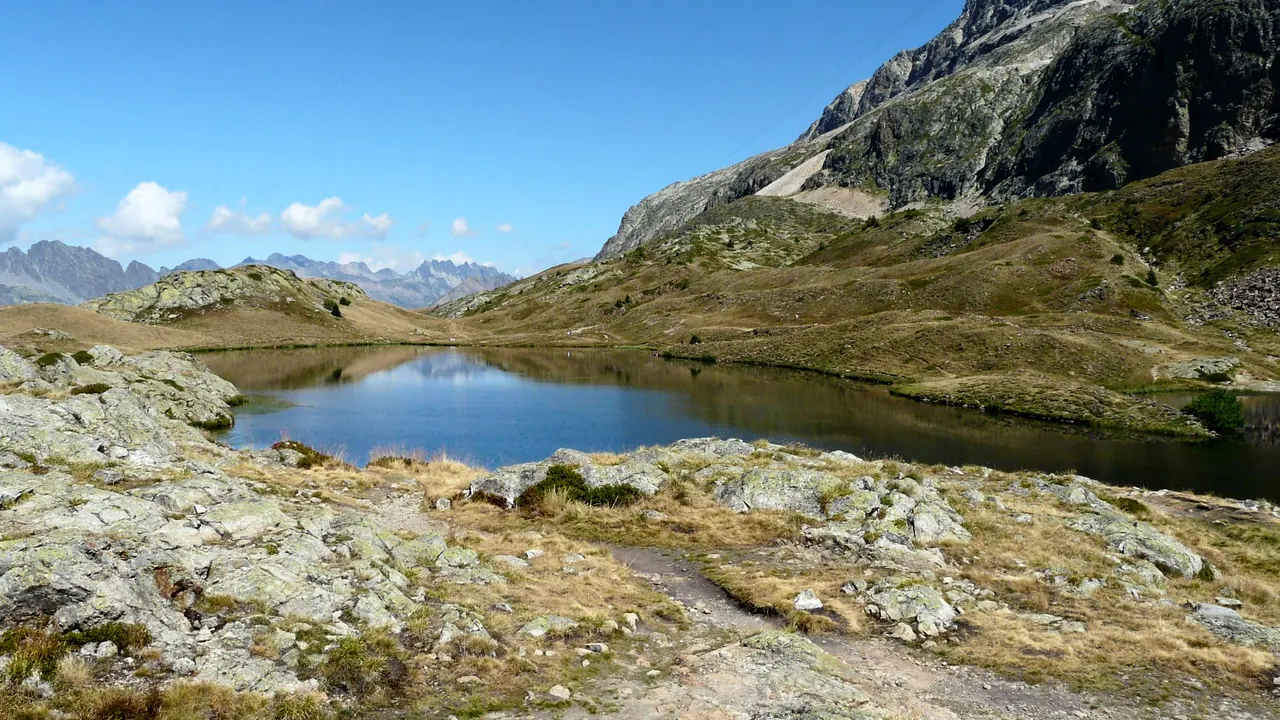
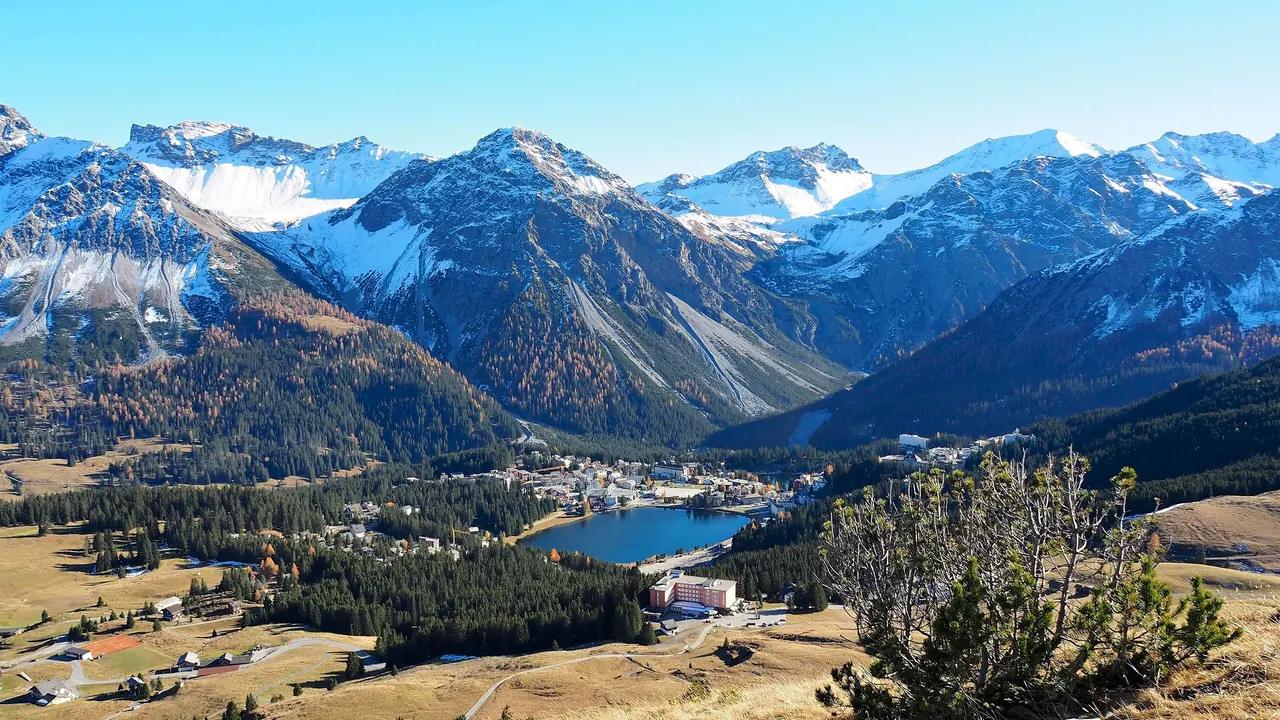
Photos: Alpe d'Huez by Beany, CC BY-SA 3.0, cropped; Arosa by Andres Passwirth, CC BY-SA 4.0, cropped.
Alpe d'Huez or Arosa?
Our verdict in twelve categories, each scored against the same fixed benchmark cities, and the climate month by month, so you can choose for your trip.
Choose Alpe d'Huez for
- prices
- nightlife
- nature and the outdoors
Alpe d'Huez suits the skier who wants a big, sunny, high mountain and a bit of noise once the lifts close. Its south-facing slopes, the long run down from the Pic Blanc and the après-ski crowd in the village make for an energetic week. It is also the less punishing of the two on the wallet, especially in an apartment you cook in. In summer it draws cyclists to the famous hairpins and mountain bikers to the lift-served trails.
Choose Arosa for
- getting around
- wellness
- beaches
Arosa is for the traveller who would rather arrive by train, leave the car at home and spend the evenings in a hotel spa than in a bar. The village grew up as a place for recovering in clean mountain air, and it is still quiet, smart and slow. You get a linked ski area with Lenzerheide, a bear sanctuary and lake walks for summer, and a small cultural calendar of comedy and chamber music. All of it comes at a high Swiss price.
Scoreboard
Twelve categories on one fixed scale from 0 to 100. The shaded stretch is the gap between the two.
Your match
Pick a travel style or drag the sliders, and both match scores follow your weighting.
Too close to call, 2 points apart
Wins on prices and nightlife with your weighting.
Wins on getting around and wellness with your weighting.
What matters to you?
Category by category
What the scores mean for a trip.
Beaches & swimming
Neither is a swimming destination, but Arosa gives you a little more to do in the water. The Untersee has a proper lido with a lawn and a jetty, and on the best summer days its lakes get close to 20°C.
At Alpe d'Huez the lakes on the Lac Besson plateau stay cold even in July. Most people swim in the sports centre pool or a hotel pool instead.
Food & drink
Both resorts eat mountain food, and lunch on a slope-side terrace is the best meal in either. Both also get repetitive over a week, and many kitchens close between seasons. The real difference is the region on the plate. Alpe d'Huez cooks Savoyard: tartiflette, raclette, diots with polenta, Beaufort and Reblochon, and a génépi at the end. The village adds pizzerias, brasseries and a handful of more ambitious French kitchens.
Arosa cooks the dishes of Graubünden: rösti, capuns, barley soup and air-dried meat. For a special evening, the best food is found in its luxury hotel dining rooms. There is no street food or market to explore.
Culture & sights
Each has about an afternoon of sights, and the character differs. Alpe d'Huez is plainly a twentieth-century ski resort, and its landmark is the tent-shaped Notre-Dame des Neiges church, with the medieval silver-mining ruins of Brandes on the plateau in summer. Arosa has an older story as a sanatorium village for tuberculosis patients. It is told in its local museum and in its grand old hotels, along with the shingled Bergkirchli chapel from the late 15th century.
Nightlife
Alpe d'Huez has the livelier evenings. The music starts at the après-ski bars by the lower runs as the lifts close, and then a young British, Dutch and French crowd moves on to the village pubs and a few late bars and small clubs.
Arosa is smarter and much calmer, with hotel bars and a couple of small clubs open late mainly at weekends. Its one big exception is the long-running gay ski week in January. Out of season, both go quiet.
Nature & outdoors
Both have superb mountain settings, and they feel different. Alpe d'Huez is bigger and higher, with lifts up to the Pic Blanc at 3,330m, the long Sarenne black run and unusually sunny south-facing slopes. In summer it adds the Écrins massif and the 21 hairpins up from Bourg d'Oisans that cyclists come for.
Arosa is gentler and more enclosed: a larch-wooded basin of lakes under the Weisshorn, linked over the ridge to Lenzerheide. It has more cross-country and winter walking, marmots on the meadows and the bear sanctuary on the hillside.
Day trips
In both, every outing begins with a long descent, so neither is a great base for exploring. From Alpe d'Huez you go by road: Grenoble with its Bastille cable car and fine-arts museum, the Revolution museum at Vizille, or over the Col du Lautaret to La Grave and Vauban's Briançon.
Arosa does it by rail, and the train down the Schanfigg viaducts to Chur is half the pleasure. From Chur you can carry on to the Maienfeld vineyards, Vaduz or the Albula line, though those take a full day.
Good for families
Both work well for a family ski week, and both lack zoos or children's museums. Alpe d'Huez has wide beginner areas right by the village and enough sun to make cold days easier, but its steep, spread-out layout is hard work with pushchairs. Arosa offers a calm, low-traffic village with free buses, long sledging runs and the bear sanctuary for summer. Rainy days are hard to fill there, and the cost of feeding a family adds up faster.
Getting around
Arosa is much easier to reach and get around without a car. The Rhaetian Railway climbs from Chur in about an hour, and free buses link the station, the lake and the lift stations.
Alpe d'Huez has no railway, so you arrive by coach, transfer or a drive up the hairpins, sometimes with chains in snowy weather. Once there, shuttles, a small gondola and ski-to-the-door lodgings do the job, though walking between its quarters with gear is tiring.
Shopping & style
Both offer little more than ski hire, outdoor gear and souvenirs. Alpe d'Huez has delicatessens with regional cheese and charcuterie to take home. Arosa has a few fashion boutiques for its hotel guests and Swiss chocolate along the main street. For real shopping, Grenoble is a large city with far more range than Chur's compact old town.
Affordability
Neither is cheap, but Alpe d'Huez is clearly easier on the budget. It has more modest places to stay than the most exclusive resorts, plenty of self-catering apartments, and summer costs far less than a winter week.
Arosa is very expensive at every turn, from upscale hotels to lift passes and meals out. The free buses and summer guest card help only a little, and even its cheaper summer is no bargain.
Live music & performing arts
Alpe d'Huez has no stage of its own. Performance comes down to organ concerts at Notre-Dame des Neiges during the seasons and the occasional outdoor gig, so anyone after a proper programme drives down to Grenoble.
Arosa has more, because its events come round at the same time each year. December brings a long-running festival of stand-up and cabaret, some of it performed in the open air in midwinter. Summer brings chamber music to the village churches, the Bergkirchli included. If you time your stay for those weeks, there is something to see. Outside them, the Swiss resort is as quiet as the French one.
Wellness & relaxation
Arosa is the more restful place. Rest is the reason it exists, and its larger hotels have extensive spas with pools and treatment rooms facing the peaks, plus a public indoor pool. The village keeps a slow pace outside the busiest weeks.
Alpe d'Huez relies on hotel and residence spas with saunas and hot tubs after skiing, and peak weeks there are noisy. Its quiet early summer is pleasant, and the historic spa at Uriage-les-Bains is about an hour's drive away.
When should you go?
Pick your month. The climate figures are measured averages, not a forecast.
Alpe d'Huez in July
Arosa in July
Daytime high, °C
Rainfall in the month, mm
Where the figures come from
Alpe d'Huez has no weather station within reach, so its figures come from a gridded climate model rather than a measured record, and read a broad area rather than one spot.
Arosa's temperatures are measured 31 km from the centre, at Samedan.
Arosa has no rain gauge within 25 km of the centre, so its rainfall comes from a gridded climate dataset read at the destination rather than from a gauge further away.
Temperature and rainfall are climate normals, averaged over the years shown. Alpe d'Huez: 2001-2020 normals, NASA POWER reanalysis grid, no weather station within 90 km. Arosa: 2015-2025 (rainfall 1991-2020) normals, Samedan (31.2 km from centre).
Both resorts are winter places first. Alpe d'Huez is the colder of the two in deep winter, with daytime highs around -3°C in January and below freezing from December to February. Arosa stays a couple of degrees milder through the season. For a ski trip, both are reliably cold from December into March, and April brings softer spring days on the snow.
Summer is where they differ most. Alpe d'Huez peaks at about 18°C in July and August, and its rain stays fairly even through the year, wettest in May and November at around 90mm. Arosa is a touch warmer at about 20°C in July, but summer is its wet season, with roughly 150mm a month from June to August. That means more afternoons cut short by showers. Neither is warm enough for anything beyond a brisk lake dip, but for hiking and cycling the French resort's drier summer is the safer bet.
Which traveller are you?
On a trip on a tight budget, Alpe d'Huez is the one that can be made to work. You give up Arosa's polish and its easy arrival by train, but a full week stays within reach. In Arosa, almost nothing comes cheap.
For a food and nightlife trip, choose Alpe d'Huez for the nights rather than the meals. The mountain cooking is much the same in both. After dark, though, the French resort has a younger, louder crowd that keeps going past midnight, while Arosa mostly goes to bed early.
On a relaxing and wellness trip, Arosa is worth what it costs. You come up by rail, never need a car, and spend unhurried days between lake walks and long spa afternoons. Alpe d'Huez only really slows down once the ski crowds have left.
Before you go
| Measure | Alpe d'Huez | Arosa |
|---|---|---|
| Official language | French | French, German, Italian, Romansh |
| Currency | Euro (EUR) | Swiss Franc (CHF) |
| Sockets | CE230 V, 50 Hz | CJ230 V, 50 Hz |
| Driving side | Right | Right |
| Time zone | UTC+1, UTC+2 in summer | UTC+1, UTC+2 in summer |
| Emergency number | 112 | 112 |
| Elevation | 1,860 m | 1,775 m |
| Main airport | Grenoble Alpes Isère Airport (GNB)65 km from centre16 non-stop destinations | Zürich Airport (ZRH)114 km from centre226 non-stop destinations |
| Public holidays this year | 11 days | 9 days |
By the numbers
| Measure | Alpe d'Huez | Arosa |
|---|---|---|
| Population | - | 3,185 |
| People per km² | - | 21 |
| Museums within 10 km | 1 | 1 |
| UNESCO World Heritage sites within 50 km | 0 | 2 |
Where else could you go?
Every comparison below shares a destination with this one, so you can follow Alpe d'Huez or Arosa somewhere new.
- Les Deux Alpesvs Alpe d'Huez
- Lenzerheidevs Arosa
- Davosvs Arosa
- Klostersvs Arosa
- Laaxvs Arosa
- St. Moritzvs Arosa