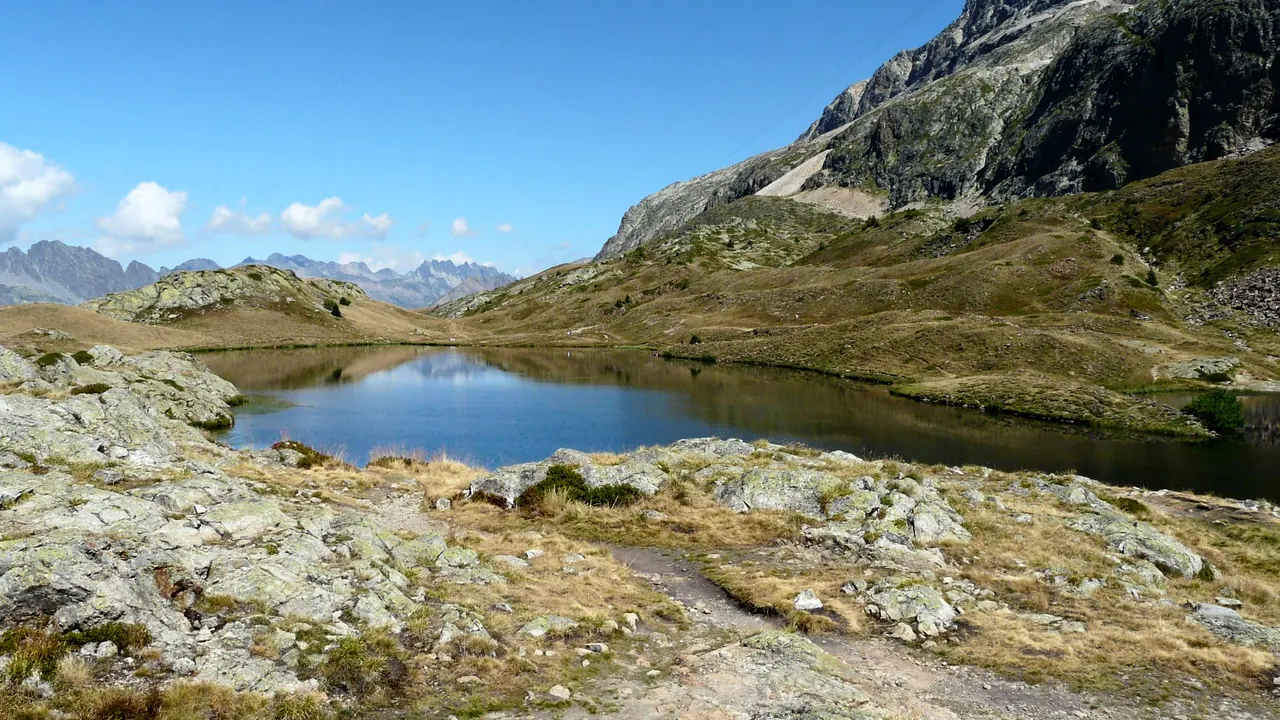
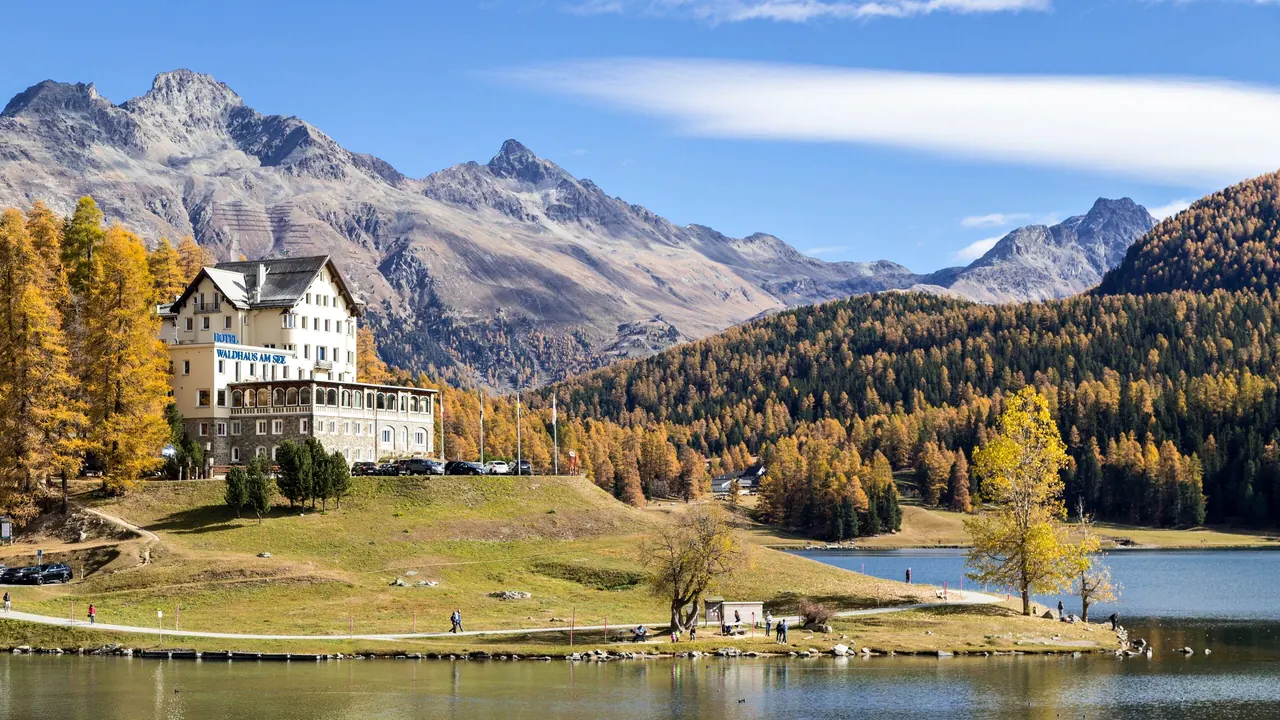
Photos: Alpe d'Huez by Beany, CC BY-SA 3.0, cropped; St. Moritz by JoachimKohler-HB, CC BY-SA 4.0, cropped.
Alpe d'Huez or St. Moritz?
Our verdict in twelve categories, each scored against the same fixed benchmark cities, and the climate month by month, so you can choose for your trip.
Choose Alpe d'Huez for
- prices
- families
- nightlife
Alpe d'Huez is the better pick for a family ski week or a group of friends who want sunny slopes, lively après-ski and a bill that is high but still manageable. Kids' clubs and beginner areas sit next to the village and the bars fill when the lifts close. In summer, the famous hairpin climb and the lift-served bike trails keep the place active and informal.
Choose St. Moritz for
- getting around
- shopping
- wellness
Choose St. Moritz if the stay itself is the point: grand hotels with elaborate spas, serious restaurants, luxury boutiques and a railway that takes you round the Engadine without a car. It costs far more and is quieter after dark. In return it has a little more to see, from the Segantini Museum to the Bernina line, and its lakes and glacier walks in summer are as fine as its winter skiing.
Scoreboard
Twelve categories on one fixed scale from 0 to 100. The shaded stretch is the gap between the two.
Your match
Pick a travel style or drag the sliders, and both match scores follow your weighting.
Wins on prices and families with your weighting.
Wins on getting around and shopping with your weighting.
What matters to you?
Category by category
What the scores mean for a trip.
Beaches & swimming
Neither has a beach, and anyone who wants a proper swim ends up in a pool in both places. The outdoor dips differ. At Alpe d'Huez you get small, cold lakes on the Lac Besson plateau. St. Moritz has Lej da Staz, a forest lake with a lawn that warms enough for a short swim for a few weeks in July, while Lake St. Moritz belongs to windsurfers in wetsuits.
Food & drink
Alpe d'Huez feeds skiers well enough on mountain staples such as raclette, tartiflette and diots with polenta. Its best moments are long lunches on sunny slope-side terraces, but a week of it gets repetitive.
St. Moritz goes further, mainly because its grand hotels and mountain restaurants have far more serious kitchens than a town of its size would suggest. Its local dishes, such as capuns, pizzoccheri and Engadine nut tart, also have a stronger identity. Below the luxury tier both resorts are thin, and both close many kitchens between seasons.
Culture & sights
Sightseeing takes a short afternoon in either place, but St. Moritz fills that afternoon better. The Segantini Museum and its great Alpine triptych are a real reason to go inside. The Engadin Museum and the town's two Winter Olympics and the Cresta Run add some depth.
Alpe d'Huez has the tent-shaped church of Notre-Dame des Neiges, a small local museum and, in summer, the ruins of the medieval silver-mining village of Brandes. For anything more, it sends you down to Grenoble.
Nightlife
Alpe d'Huez is the livelier of the two after dark. The après-ski bars by the lower runs fill as the lifts close, then the young British, Dutch and French crowd moves on to the village pubs, and a few small clubs stay open past midnight.
St. Moritz is more about glamour than partying: champagne in grand hotel bars and a couple of exclusive clubs, mostly between Christmas and early March, and expensive. Outside winter both go quiet, and St. Moritz goes quieter.
Nature & outdoors
Both are outstanding mountain bases, so the real difference is the kind of terrain. Alpe d'Huez is a sunny shelf with a large linked ski area and long runs down from the Pic Blanc at 3,330m, the Sarenne among them. In summer it centres on mountain biking and the 21 hairpins that road cyclists come to climb.
St. Moritz gives you a wider valley to explore: a chain of lakes, larch forest, three ski mountains and some of the Alps' best cross-country trails. In summer there are walks to the Morteratsch glacier, kitesurfing on Lake Silvaplana and the Swiss National Park within an hour. Riders and downhill skiers lean towards Alpe d'Huez, while walkers and cross-country skiers lean towards St. Moritz.
Day trips
Every outing from Alpe d'Huez starts with the long drive down the hairpins, which makes a day out tiring. Grenoble, with its Bastille cable car and museums, is the main prize, and Vizille and the Vauban upper town of Briançon are the alternatives.
St. Moritz has a little more choice and an easier way to reach it. The UNESCO-listed Bernina line runs down to Tirano in Italy, Sils Maria has Nietzsche's summer house, and there are the decorated villages of the Lower Engadine and Soglio over the Maloja Pass. In exchange, Alpe d'Huez has a real city within reach, while St. Moritz's outings all lead to villages.
Good for families
Alpe d'Huez is set up for families in a way St. Moritz is not. Kids' clubs, gentle beginner areas near the village, an ice rink, a pool and sledging fill a whole week, and summer adds lake walks and activity programmes. Its altitude and steep, spread-out layout are the drawback with toddlers and pushchairs.
St. Moritz is safe and easy with children, with nursery slopes on Corviglia and skating on natural ice. Its tone is adult, though, and many families with young children stay in the calmer villages nearby instead.
Getting around
St. Moritz is far simpler. The Rhaetian Railway arrives at the lakeside station, and trains and buses link the whole Upper Engadine and its lifts, so you never need a car. The only effort is the climb from Bad up to Dorf, made easier by escalators and a lift.
Alpe d'Huez has no railway, so you arrive by coach, transfer or car up the hairpins, sometimes with snow chains. Once you are there, free shuttles and a small gondola link the quarters, but walking between them with ski gear is hard work.
Shopping & style
St. Moritz has a real shopping street in Via Serlas, lined with fashion, watch and jewellery boutiques from the top of the market, along with furriers and shops for Engadine woodwork and linen. The range is narrow, but for luxury shoppers it is a genuine draw.
Alpe d'Huez sells what a ski week needs: rental, technical clothing, regional cheese and souvenirs. Anyone wanting more drives down to Grenoble.
Affordability
Neither is cheap, but they are expensive on different scales. Alpe d'Huez costs a lot in the peak school-break weeks, yet self-catering apartments and its more modest lodgings let you keep the bill under control, and summer is much gentler.
St. Moritz is among the most expensive places to stay anywhere, right down to a coffee. Hotels that include lifts and local transport help a little, but the usual way to save is to sleep elsewhere in the valley.
Live music & performing arts
St. Moritz has more worth planning a trip around, though only on its festival dates. There is a long-running summer jazz festival in intimate rooms, the Engadin Festival's chamber concerts in churches across the valley, and a winter classical series.
Alpe d'Huez offers organ concerts at Notre-Dame des Neiges and the odd outdoor gig. Neither has a theatre or concert hall, and from Alpe d'Huez the answer for a full programme is Grenoble.
Wellness & relaxation
St. Moritz has the deeper tradition and the better facilities. Its iron-rich spring still feeds a medical bath in Bad, its hotel spas with indoor-outdoor pools facing the peaks are among the most elaborate in the Alps, and the thermal baths at Scuol are a train ride away.
Alpe d'Huez offers saunas, hot tubs and massages in hotels and residences, which are welcome after skiing, and its nearest historic spa, Uriage-les-Bains, is an hour's drive away. In both resorts the calmest stays come outside the peak winter weeks.
When should you go?
Pick your month. The climate figures are measured averages, not a forecast.
Alpe d'Huez in July
St. Moritz in July
Daytime high, °C
Rainfall in the month, mm
Where the figures come from
Alpe d'Huez has no weather station within reach, so its figures come from a gridded climate model rather than a measured record, and read a broad area rather than one spot.
St. Moritz has no rain gauge within 25 km of the centre, so its rainfall comes from a gridded climate dataset read at the destination rather than from a gauge further away.
Temperature and rainfall are climate normals, averaged over the years shown. Alpe d'Huez: 2001-2020 normals, NASA POWER reanalysis grid, no weather station within 90 km. St. Moritz: 2015-2025 (rainfall 1991-2020) normals, Samedan (5.5 km from centre).
Neither resort ever gets warm enough for a beach trip, so the year splits into snow season and walking season. Alpe d'Huez is the colder of the two in midwinter, with January highs around -3°C, which keeps the snow in good shape. St. Moritz is a couple of degrees milder but still hovers around freezing. From June to September both are comfortable for hiking and sitting on terraces, at about 18°C in Alpe d'Huez in July and 20°C in St. Moritz.
Rain falls differently in the two. At Alpe d'Huez it is spread fairly evenly through the year, with May and November the wettest months. St. Moritz is driest in winter and much wetter in summer, with August reaching about 111mm, so summer walkers there should expect a few wet days and pack for them.
Which traveller are you?
On a family trip with children, Alpe d'Huez is the easier choice. Ski schools and kids' clubs sit beside wide beginner slopes near the village, and the ice rink, pool and sledging fill the hours off the snow. St. Moritz is built around adult luxury.
On a tight budget, Alpe d'Huez wins clearly. A ski week there is still expensive, but self-catering apartments and simpler lodgings bring it within reach. St. Moritz has no cheap way in, and budget visitors usually sleep elsewhere in the valley and come in for the day.
For a relaxing and wellness trip, St. Moritz is the stronger pick. It was a spa town before it was a ski resort and still has a medical bath fed by its mineral spring. Its hotel spas, with pools facing the peaks, outclass the saunas and hot tubs of Alpe d'Huez.
Before you go
| Measure | Alpe d'Huez | St. Moritz |
|---|---|---|
| Official language | French | French, German, Italian, Romansh |
| Currency | Euro (EUR) | Swiss Franc (CHF) |
| Sockets | CE230 V, 50 Hz | CJ230 V, 50 Hz |
| Driving side | Right | Right |
| Time zone | UTC+1, UTC+2 in summer | UTC+1, UTC+2 in summer |
| Emergency number | 112 | 112 |
| Elevation | 1,860 m | 1,822 m |
| Main airport | Grenoble Alpes Isère Airport (GNB)65 km from centre16 non-stop destinations | Zürich Airport (ZRH)145 km from centre226 non-stop destinations |
| Public holidays this year | 11 days | 9 days |
By the numbers
| Measure | Alpe d'Huez | St. Moritz |
|---|---|---|
| Population | - | 5,027 |
| People per km² | - | 175 |
| Museums within 10 km | 1 | 7 |
| UNESCO World Heritage sites within 50 km | 0 | 2 |
Where else could you go?
Every comparison below shares a destination with this one, so you can follow Alpe d'Huez or St. Moritz somewhere new.
- Les Deux Alpesvs Alpe d'Huez
- Lenzerheidevs St. Moritz
- Arosavs St. Moritz
- Davosvs St. Moritz
- Klostersvs St. Moritz
- Serre Chevaliervs Alpe d'Huez