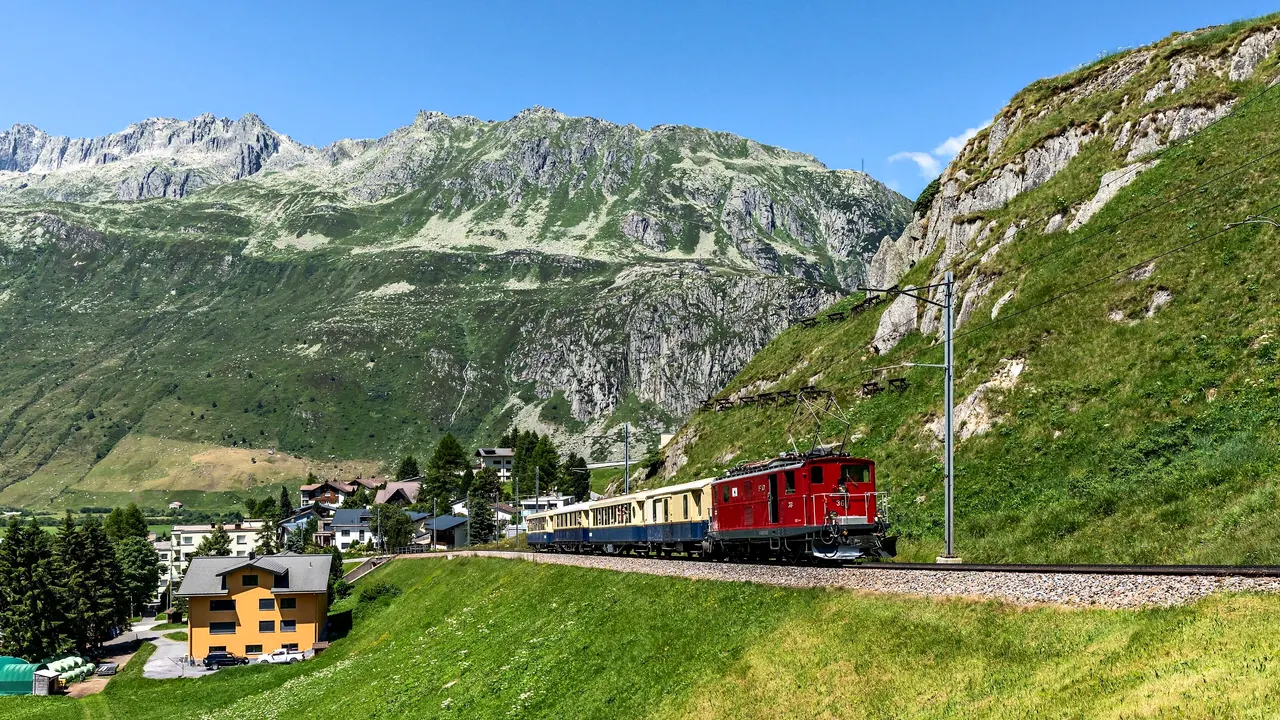
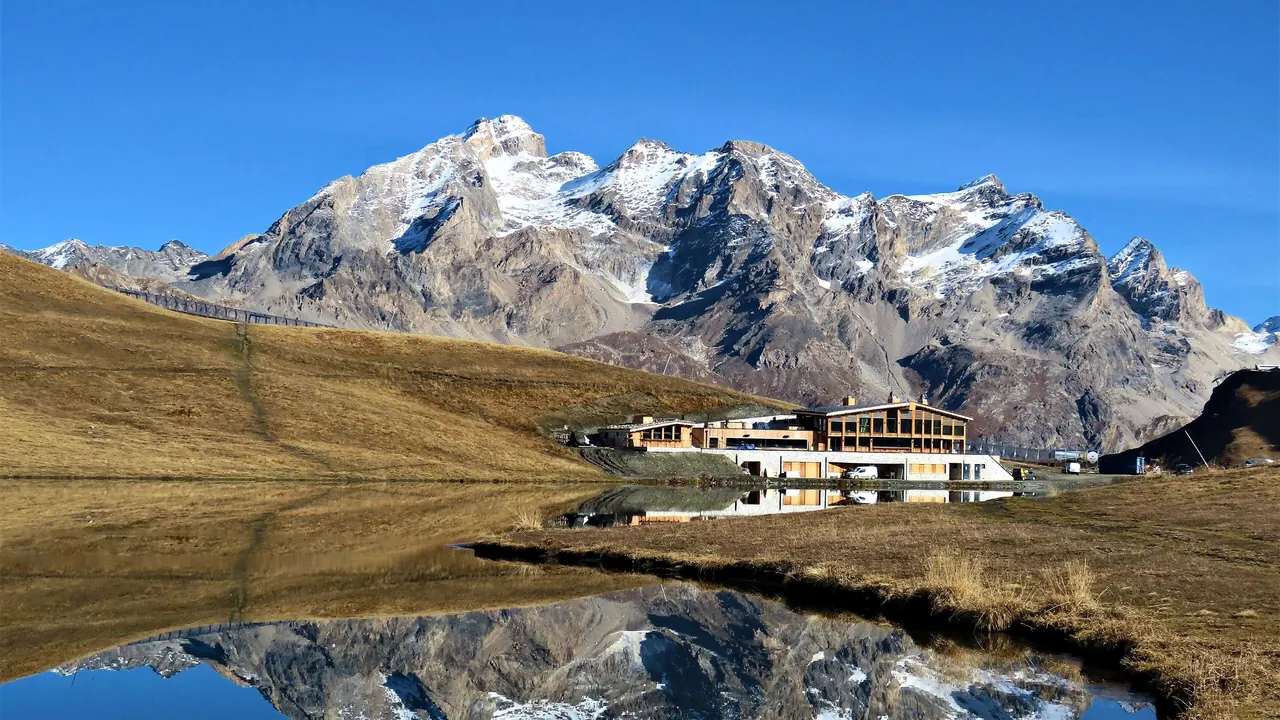
Photos: Andermatt by Kabelleger, CC BY-SA 4.0, cropped; Val d'Isère by Rémih, CC BY-SA 4.0, cropped.
Andermatt or Val d'Isère?
Our verdict in twelve categories, each scored against the same fixed benchmark cities, and the climate month by month, so you can choose for your trip.
Choose Andermatt for
- day trips
- live music and the arts
- getting around
Andermatt suits travellers who want serious mountains with a quieter, more rounded stay around them. The Gemsstock freeride slopes and the summer passes are as good as anywhere in the Alps, and the village adds things Val d'Isère can't. Trains leave from the middle of the village, Lake Lucerne and Bellinzona are close enough for a day out, the Devil's Bridge is just down the gorge, and there's a concert hall for the evenings. Pick it if you'd rather end the day over dinner or chamber music than in a crowded bar.
Choose Val d'Isère for
- nightlife
- food and drink
- shopping
For a ski week with a strong social side, Val d'Isère is the better choice. Its terrain links with Tignes into one huge area, and the glaciers keep the top runs wintry well into spring. After skiing there's lively après-ski and a few late clubs, and the dining runs from Savoyard cheese dishes to some much-praised kitchens. The cost is isolation at the end of a long valley, so it works best for people who arrive, ski hard and stay put.
Scoreboard
Twelve categories on one fixed scale from 0 to 100. The shaded stretch is the gap between the two.
Your match
Pick a travel style or drag the sliders, and both match scores follow your weighting.
Too close to call, 1 point apart
Wins on day trips and live music and the arts with your weighting.
Wins on nightlife and food and drink with your weighting.
What matters to you?
Category by category
What the scores mean for a trip.
Beaches & swimming
Neither place offers any real swimming outdoors. Andermatt's lakes, like the Oberalpsee, are cold mountain water that is better enjoyed as scenery. In Val d'Isère, a few hardy people do swim in Lac de Tignes in midsummer.
The practical difference is indoors. In Andermatt you rely on your hotel's pool, while Val d'Isère's sports centre has a pool open to everyone.
Food & drink
Val d'Isère gives you more reasons to look forward to dinner. Savoyard cooking, built around Beaufort cheese, fills the menus. Lunch at a slope-side terrace restaurant can take up half the ski day, and a few kitchens rank among the most celebrated in the French Alps, with wine bars pouring local Savoie whites alongside.
Andermatt's wood-panelled inns serve rösti, Älplermagronen and game in autumn, and the resort hotels add a Japanese dining room and some modern European cooking. Still, the choice runs out after a few nights. Both places have narrow menus outside their mountain staples.
Culture & sights
Andermatt has more to see, though neither is a sightseeing destination. You can walk its old timber-and-stone street along the Reuss up to the hilltop chapel of St Kolumban, then head down the Schöllenen gorge to the Devil's Bridge and the memorial to the Russian army's crossing in 1799. In summer, the hospice museum and the fortress inside the mountain on the Gotthard stretch this to a day or two.
Val d'Isère has the Baroque altarpiece in Saint-Bernard-de-Menthon, the old larch-wood hamlets of Le Fornet and Le Joseray, and the Bellevarde face where the 1992 Olympic downhill was raced. That's an hour's looking around.
Nightlife
This is where the two villages differ most in winter. Val d'Isère is one of the liveliest resorts in the Alps: people dance on tables in ski boots on the mountain, then pack the village bars, and a couple of basement clubs stay open into the small hours. The crowd is a mix of seasonal workers and groups on chalet weeks.
Andermatt has some après-ski and a few hotel bars that stay busy on good weekends, but there are no clubs. Outside the ski season the village is asleep early. In summer, Val d'Isère is also reduced to a few terrace bars.
Nature & outdoors
Both are top-tier Alpine bases, and the difference is in character. Val d'Isère's area, shared with Tignes, is the bigger ski domain, with the steep Bellevarde face, huge off-piste descents and glacier skiing on the Pissaillas and Grande Motte that lasts into May. In summer it opens onto the Vanoise National Park, where you can spot ibex and chamois, and the long climb up the Col de l'Iseran.
Andermatt's strengths are respected freeride terrain off the Gemsstock and the ski link over the Oberalp. In summer you're surrounded by four passes, so cyclists, motorcyclists and hikers have a different route each day, as far as the source of the Rhine at Lake Toma.
Day trips
Andermatt is far better placed for days out. A boat trip on Lake Lucerne from Flüelen, the William Tell monument at Altdorf, Lucerne's covered bridges, Bellinzona's three castles through the Gotthard, and the abbey at Disentis are all reachable by train.
Val d'Isère sits at the end of a dead-end valley. In winter, an outing means going back down to Bourg-Saint-Maurice and the Tarentaise villages. Summer adds Bonneval-sur-Arc over the Iseran and Aosta's Roman remains across the Italian border.
Good for families
For families the two are broadly level, and both depend on the children enjoying the snow. Val d'Isère is better set up for a skiing week, with ski schools in several languages from preschool age, fenced snow gardens, childcare in many chalets and a sports centre with a pool, climbing wall and ice rink.
Andermatt is smaller and quieter. The nursery slopes and sledging runs are close to the hotels, and summer brings lakes and the train ride over the Oberalp. A rainy day is hard to fill in either village.
Getting around
Andermatt is easier to reach and easier to leave. The station sits between the old village and the resort quarter, trains run to the Gotthard line and over the Oberalp, and in summer postbuses climb every pass, so you can do the whole trip without a car.
Within Val d'Isère, free shuttles run the few kilometres from La Daille to Le Fornet, so you rarely need to drive. Getting there is another matter: the nearest station is an hour away by winding road, and anything beyond the valley really needs a car.
Shopping & style
Both villages sell mostly ski kit, but Val d'Isère has a little more. Its main street adds upmarket mountain-wear boutiques for the chalet crowd, and the delicatessens are worth a visit for Beaufort, charcuterie and Savoie wine to take home. In Andermatt, apart from the hire shops and a few resort boutiques, you'll mostly find local cheese and honey in the old village.
Affordability
Both are among the most expensive places to stay in the Alps, and neither works on a tight budget. Andermatt's resort quarter is built around luxury hotels, though older guesthouses and Swiss rail passes trim the bill a little.
Val d'Isère is hardest on the wallet at Christmas, New Year and in the February break. Self-catering, January or late-season weeks, and summer all bring it down somewhat.
Live music & performing arts
Andermatt has the clear advantage for music: a modern concert hall in the resort quarter with classical and chamber programmes and visiting Swiss orchestras through the main seasons. You can plan a mountain stay around a concert there. In Val d'Isère, live music means cover bands and DJs at après-ski plus occasional open-air events, with no hall or regular programme anywhere nearby.
Wellness & relaxation
On wellness the two are close, with spas in both and no thermal springs in either. Andermatt's resort hotels have some of the most lavish spas in the Swiss mountains, several open to non-residents, and the village's early nights make the whole stay restful.
Val d'Isère spreads its spas more widely across chalets and hotels, and the sports centre has a public sauna and steam area. A winter week there is more social than restful, so come in early summer or September for real calm.
When should you go?
Pick your month. The climate figures are measured averages, not a forecast.
Andermatt in July
Val d'Isère in July
Daytime high, °C
Rainfall in the month, mm
Where the figures come from
Andermatt has no weather station within reach, so its figures come from a gridded climate model rather than a measured record, and read a broad area rather than one spot.
Val d'Isère has no weather station within reach, so its figures come from a gridded climate model rather than a measured record, and read a broad area rather than one spot.
Temperature and rainfall are climate normals, averaged over the years shown. Andermatt: 1991-2020 normals, TerraClimate 4 km grid at the town, no weather station within 90 km. Val d'Isère: 2001-2020 normals, NASA POWER reanalysis grid, no weather station within 90 km.
Neither village is ever warm enough for a beach trip, and both are at their best in two seasons, deep winter on the snow and high summer on the trails. Andermatt stays around freezing from December to February, which is cold enough for good snow but not bitter for walking around the village. Its wettest months are in summer, with June to August each bringing around 165mm, so July and August are the hiking months, but expect plenty of showers.
Val d'Isère is noticeably colder in midwinter, with January highs of about -4°C, so time outdoors off the slopes is short. Its summer is a little warmer, reaching about 18°C in July, and much drier, with about 79mm in midsummer, so high walks and pass rides are easier to plan. Both have two awkward gaps. In late spring the valleys thaw while snow still lies up high, so the high trails aren't open yet. In late autumn it turns cold and wet once the summer routes have closed, before the winter snow has settled.
Which traveller are you?
On a culture and arts trip, Andermatt is clearly better. It has the Schöllenen gorge, the Devil's Bridge, the museums on the Gotthard and a concert hall with classical programmes. Day trips to Lucerne's old town or Bellinzona's castles give you far more to see than Val d'Isère's single afternoon of sights.
For a food and nightlife trip, Val d'Isère wins without much contest. Après-ski starts on the slope terraces in mid-afternoon, then moves to packed village bars and basement clubs. Dinner can be Savoyard fondue or one of the much-praised top kitchens, while Andermatt's evenings end early by the fire.
On a family trip with children who ski, Val d'Isère has a slight edge. It offers ski schools in several languages, snow gardens, childcare in many chalets and a sports centre with a pool and an ice rink. Andermatt is calmer and simpler, with sledging, lakes and train rides.
Before you go
| Measure | Andermatt | Val d'Isère |
|---|---|---|
| Official language | French, German, Italian, Romansh | French |
| Currency | Swiss Franc (CHF) | Euro (EUR) |
| Sockets | CJ230 V, 50 Hz | CE230 V, 50 Hz |
| Driving side | Right | Right |
| Time zone | UTC+1, UTC+2 in summer | UTC+1, UTC+2 in summer |
| Emergency number | 112 | 112 |
| Elevation | 1,447 m | 1,785 m |
| Main airport | Zürich Airport (ZRH)91 km from centre226 non-stop destinations | Geneva International Airport (GVA)111 km from centre150 non-stop destinations |
| Public holidays this year | 14 days | 11 days |
By the numbers
| Measure | Andermatt | Val d'Isère |
|---|---|---|
| Population | 1,578 | 1,567 |
| People per km² | 25 | 17 |
| Museums within 10 km | 2 | 0 |
| UNESCO World Heritage sites within 50 km | 2 | 0 |
Where else could you go?
Every comparison below shares a destination with this one, so you can follow Andermatt or Val d'Isère somewhere new.
- Tignesvs Val d'Isère
- Les Arcsvs Val d'Isère
- Val Cenisvs Val d'Isère
- La Rosièrevs Val d'Isère
- La Plagnevs Val d'Isère
- Engelbergvs Andermatt