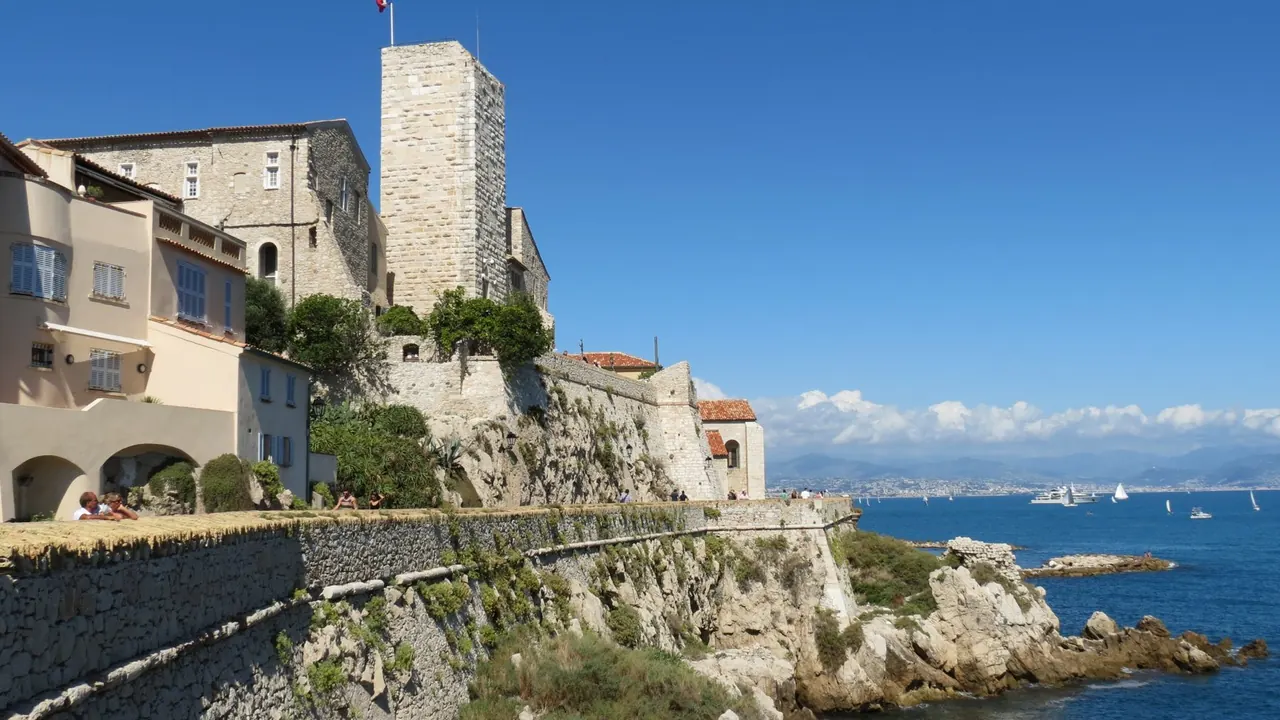
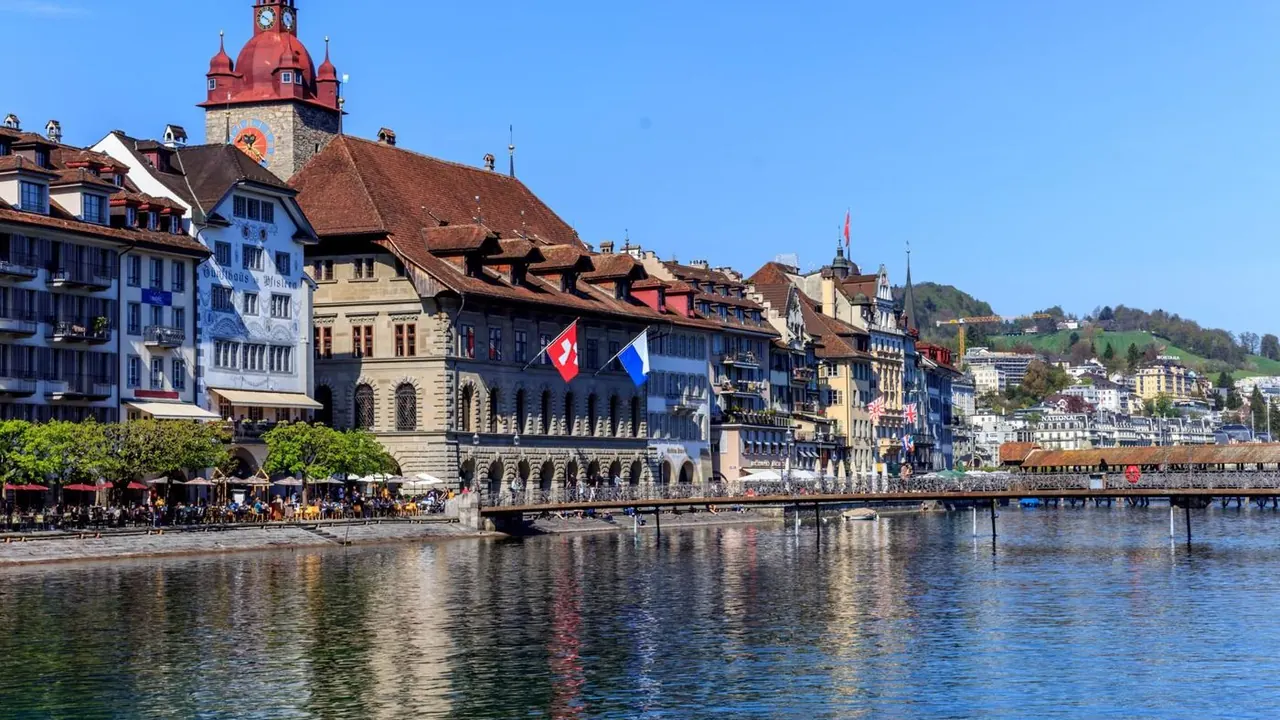
Photos: Antibes by Johan Allard, CC BY-SA 4.0, cropped; Lucerne by ILOVESwitzerland, Pexels License.
Antibes or Lucerne?
Our verdict in twelve categories, each scored against the same fixed benchmark cities, and the climate month by month, so you can choose for your trip.
Choose Antibes for
- beaches
- prices
- food and drink
Antibes is the choice for a summer by the Mediterranean. It has proper sand at Juan-les-Pins and La Salis, warm sea, livelier evenings in July and August, and the whole Riviera on one coastal railway line, from Cannes to Monaco and Menton. Pick it if your ideal day ends with a swim and a long dinner outdoors, and you would rather hop between towns than climb mountains.
Choose Lucerne for
- live music and the arts
- getting around
- nature and the outdoors
Lucerne suits travellers who want scenery and music more than the sea. Its peaks start at the edge of town, paddle steamers and cogwheel railways do the work of a car, and the lakefront concert hall gives it a classical life far beyond its size. It costs even more than Antibes and goes quiet at night, but for walking above a lake with the Alps in view it has no rival here.
Scoreboard
Twelve categories on one fixed scale from 0 to 100. The shaded stretch is the gap between the two.
Your match
Pick a travel style or drag the sliders, and both match scores follow your weighting.
Too close to call, 2 points apart
Wins on beaches and prices with your weighting.
Wins on live music and the arts and getting around with your weighting.
What matters to you?
Category by category
What the scores mean for a trip.
Beaches & swimming
This is Antibes' strongest card. It has real sand on a coast mostly given over to pebbles, with long beaches at Juan-les-Pins and La Salis and rocky coves round Cap d'Antibes for clear-water swimming. The catch is that beach clubs take much of the sand, and the free stretches fill early in high summer.
Lucerne offers lake bathing rather than a beach. Swimming from the old wooden baths or the lawns at Ufschötti, with mountains behind, is a lovely break on a hot day, but the water is cooler and the season only lasts a few weeks.
Food & drink
Antibes eats better, mainly because of what grows and swims nearby. The covered Provençal market on Cours Masséna, Niçoise dishes like socca and pissaladière, grilled fish and rosé on a terrace make meals a pleasure, as long as you avoid the tourist menus near the port.
Lucerne's cooking is hearty and well made but narrow: Chügelipastete, fondue, rösti and lake perch in wood-panelled guild houses. It costs more and offers less variety, so most people eat well enough there without remembering it.
Culture & sights
Lucerne has the fuller set of sights. Its well-kept medieval Old Town, the Chapel Bridge and Water Tower, the Musegg towers you can climb and the carved Lion Monument give it a depth of history that Antibes, for all its ramparts, does not match.
Oddly, Picasso links the two, in different ways. In Antibes you see what he painted in the Château Grimaldi in the autumn of 1946, in the very rooms where he made it, with the sea outside. Lucerne's Rosengart Collection is a collector's choice instead, setting his work beside Klee's. Beyond the museum, Antibes adds Fort Carré over the harbour and the lighthouse chapel on the cape, enough for an unhurried weekend.
Nightlife
Neither is a party town, but Antibes has more going on after dark in summer. Juan-les-Pins keeps beach bars and a few clubs open into the early hours, and the yacht crews fill the pubs and wine bars near Port Vauban. Out of season it goes quiet, and Nice is the place for a bigger night.
Lucerne's evenings mean a drink by the river and an early night, except during Fasnacht, when the town stays out in costume until dawn.
Nature & outdoors
Lucerne is in another league here. A branching lake surrounded by mountains, with Pilatus, Rigi and the Stanserhorn reached by cogwheel train and cable car, and Titlis's glacier about an hour away, makes the outdoors the reason to come. Low cloud can hide it all for days, though.
Antibes is more about the sea. The cape's coastal path, snorkelling, sailing and paddleboarding are lovely, and the red cliffs of the Esterel and gorges inland offer real hiking, but they need a trip out of a flat, built-up town.
Day trips
Both make excellent bases, and Antibes has slightly more within easy reach. Nice, Cannes, Monaco and Menton are on the same coastal line, with hill villages such as Saint-Paul-de-Vence and Eze, the Lérins Islands by boat, and Italy for a longer day.
Lucerne's trips are more varied in kind: Bern, Basel and Zurich by train within the hour, and a lake that is a day out in itself, ending at the Rütli meadow where the Swiss Confederation began.
Good for families
Lucerne has a little more for children. The Swiss Museum of Transport fills a whole day, and paddle steamers, cogwheel trains and the summer toboggan run on Pilatus make the getting there part of the fun, though costs add up and rain can spoil plans.
In Antibes, the shallow sandy beaches are the whole story, ideal for small children, with boats in the harbour and ice cream on the ramparts in between. Outside the beach, there is little made for children, and August heat needs managing.
Getting around
Lucerne is easier to get around. Station, piers and Old Town sit together on the lakefront, and one integrated ticket system takes you from steamer to cogwheel railway to cable car, so a car is never needed.
Antibes is simple on foot and by the coastal train to the other Riviera towns, but buses to the cape and hill villages are slow. Reaching Grasse or the Esterel is far easier by car, and summer traffic on the coast road is heavy.
Shopping & style
Lucerne has the edge, but only for one thing: Swiss watches, sold in the big houses on Schwanenplatz, plus chocolate and army knives. For clothes or design it is thin.
Antibes is smaller and more local, built around the Provençal market's olive oil, soaps and herbs and old-town boutiques selling linens and ceramics. For serious fashion you take the train to Cannes or Nice.
Affordability
Neither is cheap, but Antibes is the more manageable of the two. Rooms are expensive in high summer, yet spring and autumn bring big reductions, regional trains are good value and market shopping keeps meals down.
Lucerne is expensive in every season. Simple meals cost a lot, and the mountain railways that make the trip worthwhile take a large share of the budget. A Swiss travel pass and picnics by the lake help, but they do not make it a budget trip.
Live music & performing arts
For live music, Lucerne goes much deeper. The Lucerne Festival brings the world's leading orchestras to Jean Nouvel's lakefront hall, famous for its acoustics, which has a year-round programme alongside opera and drama at the city theatre.
Antibes has one great event in Jazz à Juan, held each July under the pines by the sea since 1960. The rest of the year means regional theatre at Anthéa, with Nice the nearest place for opera.
Wellness & relaxation
The two are fairly level, and neither has a bathing tradition of its own. Antibes offers seawater thalassotherapy and the spas of the grand hotels on the cape, at its most restful in May, June and September.
Lucerne's calm comes from the setting: quiet evenings, lakeside promenades and slow steamer afternoons, with Mario Botta's mineral bath high on the Rigi for a soak with a mountain view.
When should you go?
Pick your month. The climate figures are measured averages, not a forecast.
Antibes in July
Lucerne in July
Daytime high, °C
Rainfall in the month, mm
Where the figures come from
Lucerne has no rain gauge within 25 km of the centre, so its rainfall comes from a gridded climate dataset read at the city rather than from a gauge further away.
Lucerne's sunshine is measured 42 km from the centre, at Zurich Town / Ville..
Temperature and rainfall are climate normals, averaged over the years shown. Antibes: 1991-2020 normals, Nice (9.9 km from centre). Lucerne: 2005-2025 (sunshine 1991-2020, rainfall 1991-2020) normals, Emmen (4.2 km from centre).
Antibes has the longer and more reliable warm season. June to August is hot, dry and very sunny, reaching 28°C in July and August, and the sea warms to about 25°C by August. It is good for swimming from June into early October. The rain arrives in September and is heaviest in October and November, when Antibes is wetter than Lucerne, with 138mm in November. May, June and the drier spells of late September are the most comfortable months for walking the old town. Winters are mild and fairly bright rather than cold.
Lucerne is cooler than Antibes in every month, and wetter for most of the year, from December through to September. Summer days peak around 24°C, comfortable for hiking. July and August are also its wettest months, with 141mm each, so clear mountain views are never guaranteed. Late spring and September are the better months for walks. Winter in town is cold and grey with little sunshine, better for skiing and sledging in the mountains than for walking the streets.
Which traveller are you?
On a beach and sun trip, Antibes wins easily. Sandy, gently shelving beaches, a warm sea for four months and long dry summers beat Lucerne's short lake-swimming season on lawns and jetties, however clean and lovely the water.
For an outdoors trip, Lucerne is the stronger base. Pilatus, Rigi and Titlis are reached by rail and cable car straight from town, with ridge walks and summer hiking, while Antibes offers a fine coastal path, snorkelling and the Esterel within reach.
On a culture and arts trip, Lucerne gives more. Its medieval Old Town, the Chapel Bridge, the Rosengart's Picasso and Klee and a world-class concert hall outweigh Antibes, whose Picasso Museum and July jazz festival fill two days.
Before you go
| Measure | Antibes | Lucerne |
|---|---|---|
| Official language | French | French, German, Italian, Romansh |
| Currency | Euro (EUR) | Swiss Franc (CHF) |
| Sockets | CE230 V, 50 Hz | CJ230 V, 50 Hz |
| Driving side | Right | Right |
| Time zone | UTC+1, UTC+2 in summer | UTC+1, UTC+2 in summer |
| Emergency number | 112 | 112 |
| Elevation | 0 m | 436 m |
| Main airport | Nice-Côte d'Azur Airport (NCE)11 km from centre130 non-stop destinations | Zürich Airport (ZRH)49 km from centre226 non-stop destinations |
| Public holidays this year | 11 days | 12 days |
By the numbers
| Measure | Antibes | Lucerne |
|---|---|---|
| City population | 77,637 | 86,234 |
| People per km² | 2,930 | 2,963 |
| Museums within 10 km | 14 | 14 |
| UNESCO World Heritage sites within 50 km | 2 | 1 |
| Swim season, months above 21 °C | 4 months | - |
Where else could you go?
Every comparison below shares a destination with this one, so you can follow Antibes or Lucerne somewhere new.