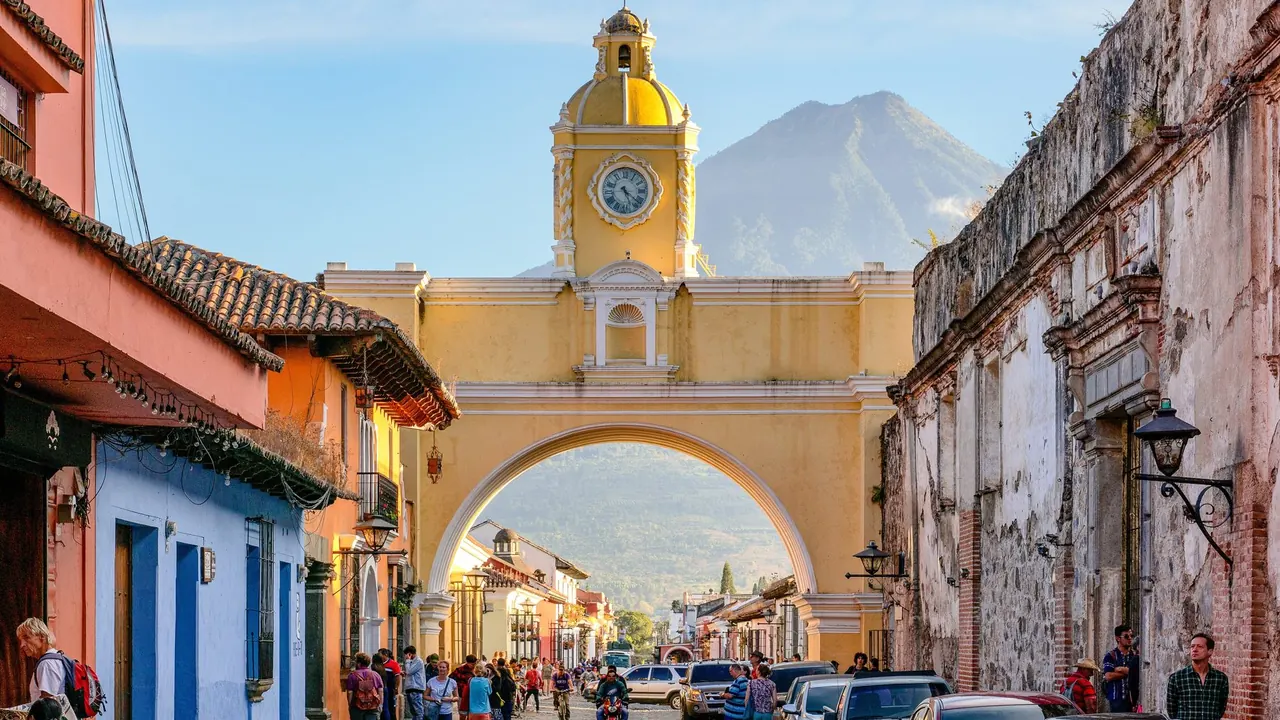
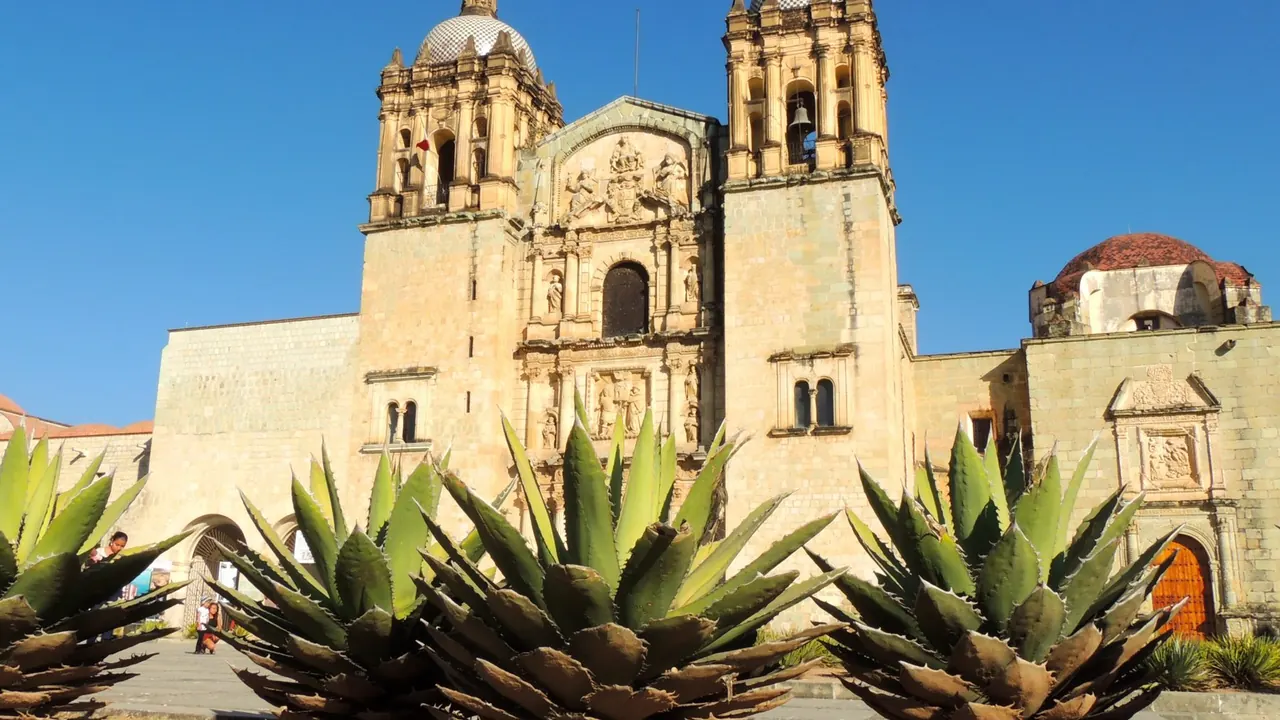
Photos: Antigua Guatemala by Chad Davis, CC BY-SA 2.0, cropped; Oaxaca by Öskr Rck, CC BY-SA 3.0, cropped.
Antigua Guatemala or Oaxaca?
Our verdict in twelve categories, each scored against the same fixed benchmark cities, and the climate month by month, so you can choose for your trip.
Choose Antigua Guatemala for
- nature and the outdoors
- getting around
- beaches
Antigua Guatemala suits travellers who want the outdoors as much as the town. Three volcanoes stand over its streets, and many people come for the overnight climb up Acatenango to watch Fuego erupt. Between hikes, the ruined convents and cobbled grid fill slow days. Its milder air also makes walking more comfortable for anyone who wilts in the heat.
Choose Oaxaca for
- food and drink
- shopping
- live music and the arts
If eating, drinking and buying are what you travel for, choose Oaxaca. Its moles, markets and village mezcal go far beyond Antigua's shorter menu, and the craft villages of the Central Valleys are within an hour. Evenings run a little later, on mezcal bars and music in the zócalo. It is also the cheaper of the two if you eat where locals do.
Scoreboard
Twelve categories on one fixed scale from 0 to 100. The shaded stretch is the gap between the two.
Your match
Pick a travel style or drag the sliders, and both match scores follow your weighting.
Wins on nature and the outdoors and getting around with your weighting.
Wins on food and drink and shopping with your weighting.
What matters to you?
Category by category
What the scores mean for a trip.
Beaches & swimming
Neither city is a beach destination. Both sit in highland valleys at around 1,500m, and in town a swim means a hotel pool. What differs is the coast beyond.
Antigua's nearest shore, around Monterrico, is about two hours away. The sand is black and volcanic and the surf is heavy, so it is better for a night away than for swimming. Oaxaca's Pacific coast at Puerto Escondido, Mazunte and Huatulco takes several hours by road or a short flight. Travellers often go there to end the trip with a few days on the sand.
Food & drink
Antigua eats well for a small town, but its strengths are narrow. They are the coffee grown on the volcano slopes, the chocolate tastings, and stews such as pepián at the market comedores. After a few days the choices start to repeat.
Oaxaca is one of the great food cities of Mexico. You could eat for a week without repeating yourself, between the many moles, the charcoal tlayudas, the smoky grill aisle of the 20 de Noviembre and the sprawling Abastos market. Mezcal from the valley distilleries and a group of serious tasting-menu chefs add a depth that Antigua cannot match.
Culture & sights
Both are low colonial grids that you see on foot over two or three days, but they offer different things. Antigua's draw is atmosphere. After the 1773 earthquakes the old capital was left in ruins, and roofless convents such as Capuchinas and Santa Clara stand on almost every other block. Its museums are small ones inside the former Santo Domingo monastery.
Oaxaca gives the walk more substance. Its Santo Domingo is intact and gilded, and the museum beside it holds the gold from Tomb 7. The city also has art and textile museums and printmaking workshops, and the Zapotec mountaintop city of Monte Albán is twenty minutes away.
Nightlife
Neither city has a real club scene, and in both an evening out means drinks with a view. In Antigua, the few blocks by the Santa Catalina arch have rooftop bars facing the volcanoes and salsa nights full of language students, but most places close early. Oaxaca runs a little later, with mezcal bars in the centre and Jalatlaco, the pedestrian Alcalá busy into the evening, and some DJ and salsa nights that go past midnight at weekends.
Nature & outdoors
Antigua's outdoors is dramatic and starts at the edge of town. Agua's cone fills the view down the streets, and Pacaya is a half-day walk over lava fields. The overnight Acatenango climb puts you within sight of Fuego erupting in the dark.
Oaxaca's landscape is gentler and takes more effort to reach. The best of it is the Sierra Norte, an hour and a half away, where trails run by Zapotec villages cross pine and cloud forest. Hierve el Agua's mineral cliffs, which look like frozen waterfalls, make a good half-day. The walking is good, but nothing here has the spectacle of Antigua's volcanoes.
Day trips
The easy outings from Antigua are the weaving and colonial villages of its own valley and the museums in Guatemala City. The bigger names, Lake Atitlán and the Chichicastenango market, are long days that many travellers turn into an overnight stay.
Oaxaca has more within an hour. The Tule cypress, Teotitlán's rugs, Yagul, the Matatlán distilleries and Mitla's fretwork palace all lie along one road east. Cuilapan and Zaachila are to the south. With colectivos or a driver, two or three stops in a day is easy.
Good for families
Both are slow towns with little made for children, and in both the cobbles defeat pushchairs. Antigua's best outings for families are hands-on: chocolate workshops, horse rides and the Pacaya walk for school-age children. Oaxaca has a warmer welcome on the street and alebrije painting in the craft villages, but its main sights are ruins with little shade.
Getting around
Both centres are easy grids to walk. Antigua's is slightly tighter, at about fifteen minutes end to end, with volcanoes as landmarks, though its large cobbles are hard on the ankles. Beyond the centre it is the simpler of the two, with tuk-tuks for short hops, chicken buses to the villages and shuttles to the lake and the airport.
Oaxaca's centre is just as easy to walk along the pedestrian Alcalá. Outside it, the city buses confuse visitors, so taxis, colectivos and hired drivers do most of the work.
Shopping & style
Both cities sell crafts rather than fashion. In Antigua, huipiles, jade and ceramics are concentrated in the craft market and the streets near the arch, and quality varies, so it pays to check and bargain.
Oaxaca has far more to choose from. Galleries and cooperatives line the Alcalá, and you can also buy in the villages where things are made: rugs in Teotitlán, barro negro in Coyotepec and carvings in Arrazola. The weekly markets at Tlacolula and Ocotlán add to the choice, and mole paste and mezcal join chocolate as things to carry home.
Affordability
Antigua is the most expensive place in Guatemala, and its boutique hotels and restaurants around the central park charge close to Western rates. Hostels, comedor lunches and chicken buses still keep a careful budget workable.
Oaxaca makes money go further day to day, since market food, fonda lunches, taxis and colectivos all cost little. Its boutique hotels and tasting menus are priced with foreign visitors in mind, and rooms cost much more during the Guelaguetza and the Day of the Dead.
Live music & performing arts
Antigua has no theatre or concert season. Marimba in the central park and the occasional concert in a ruined cloister are most of what is on offer. Its great spectacle is Holy Week, with processions over sawdust carpets, and that belongs to faith more than to the stage.
Oaxaca has more to plan a trip around. Each July the Guelaguetza brings regional dances to a hillside auditorium, and the Day of the Dead fills the streets with comparsas. The rest of the year there is the state band in the zócalo and concerts at the ornate Teatro Macedonio Alcalá.
Wellness & relaxation
Both are unhurried towns with quiet garden courtyards, and both offer temazcal sweat baths. In Antigua they turn up only here and there, so the calm comes mostly from the hotels, a few of which have spas using coffee and cacao in their treatments. In Oaxaca the temazcal is a living Zapotec and Mixtec tradition, and ceremonies led by traditional healers in the city and the valley villages give a relaxing stay more substance.
When should you go?
Pick your month. The climate figures are measured averages, not a forecast.
Antigua Guatemala in July
Oaxaca in July
Daytime high, °C
Rainfall in the month, mm
Where the figures come from
Antigua Guatemala has no rain gauge within 25 km of the centre, so its rainfall comes from a gridded climate dataset read at the city rather than from a gauge further away.
Temperature and rainfall are climate normals, averaged over the years shown. Antigua Guatemala: 1998-2020 (rainfall 1991-2020) normals, Guatemala Aeropuertola Aurora (23.5 km from centre). Oaxaca: 1961-1990 normals, Oaxaca, Oax. (1.1 km from centre).
The two cities follow the same pattern through the year. Both are dry from November to April, and rain arrives from May to October, mostly as afternoon storms. The differences are heat and how hard the rain falls. Antigua stays mild all year, with highs in the mid-20s, and it is coolest in December and January at 23°C. Its wet season is heavy, peaking near 297mm in June, and cloud then hides the volcanoes, so November to April is the time for hiking.
Oaxaca is several degrees warmer and noticeably drier. Its hottest stretch runs from March to May and peaks at 33°C in April, when walking the streets at midday is tiring. November to February is warm, very sunny and the best time for walking the city. Summer rain is roughly half what Antigua gets, and sunshine stays fairly generous, so a wet-season visit loses less here.
Which traveller are you?
For a food and nightlife trip, Oaxaca is the clear choice. Its moles, charcoal-crisped tlayudas and the grill aisle of the 20 de Noviembre market make every meal an outing. Evenings move on to mezcal tasting rooms and rooftops, while Antigua's menu runs thin after a few days.
On an outdoors trip, Antigua is the better base. Agua, Fuego and Acatenango rise from the edge of town, the overnight Acatenango climb is a highlight in itself, and Pacaya makes an easier half-day. Oaxaca's Sierra Norte has fine walking but lies further out.
For a shopping trip, Oaxaca offers more. Textiles, black pottery and alebrijes fill the galleries in the centre, and the best buys come straight from the workshops in Teotitlán, Coyotepec and Arrazola. Antigua's crafts are good, but they are mostly in one market and a few streets.
Before you go
| Measure | Antigua Guatemala | Oaxaca |
|---|---|---|
| Official language | Spanish | Spanish, Nahuatl, Yucatec Maya |
| Currency | Quetzal (GTQ) | Mexican Peso (MXN) |
| Sockets | AB120 V, 60 Hz | AB127 V, 60 Hz |
| Driving side | Right | Right |
| Time zone | UTC-6 | UTC-6 |
| Emergency number | Police 110/120, ambulance 128, fire 123 | 911 |
| Elevation | 1,582 m | 1,555 m |
| Main airport | La Aurora International Airport (GUA)22 km from centre19 non-stop destinations | Xoxocotlán International Airport (OAX)7 km from centre14 non-stop destinations |
| Public holidays this year | 13 days | 9 days |
By the numbers
| Measure | Antigua Guatemala | Oaxaca |
|---|---|---|
| City population | 59,091 | 258,913 |
| People per km² | - | 3,028 |
| Museums within 10 km | 2 | 10 |
| UNESCO World Heritage sites within 50 km | 1 | 2 |
Where else could you go?
Every comparison below shares a destination with this one, so you can follow Antigua Guatemala or Oaxaca somewhere new.