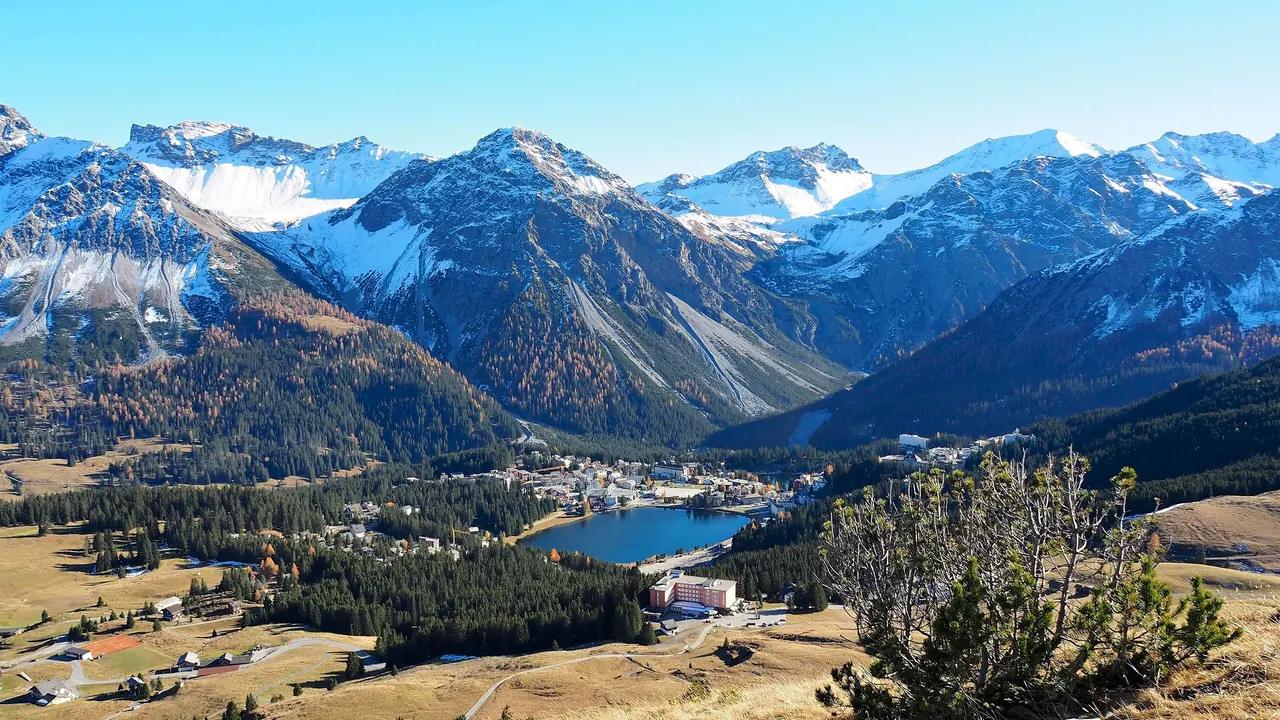
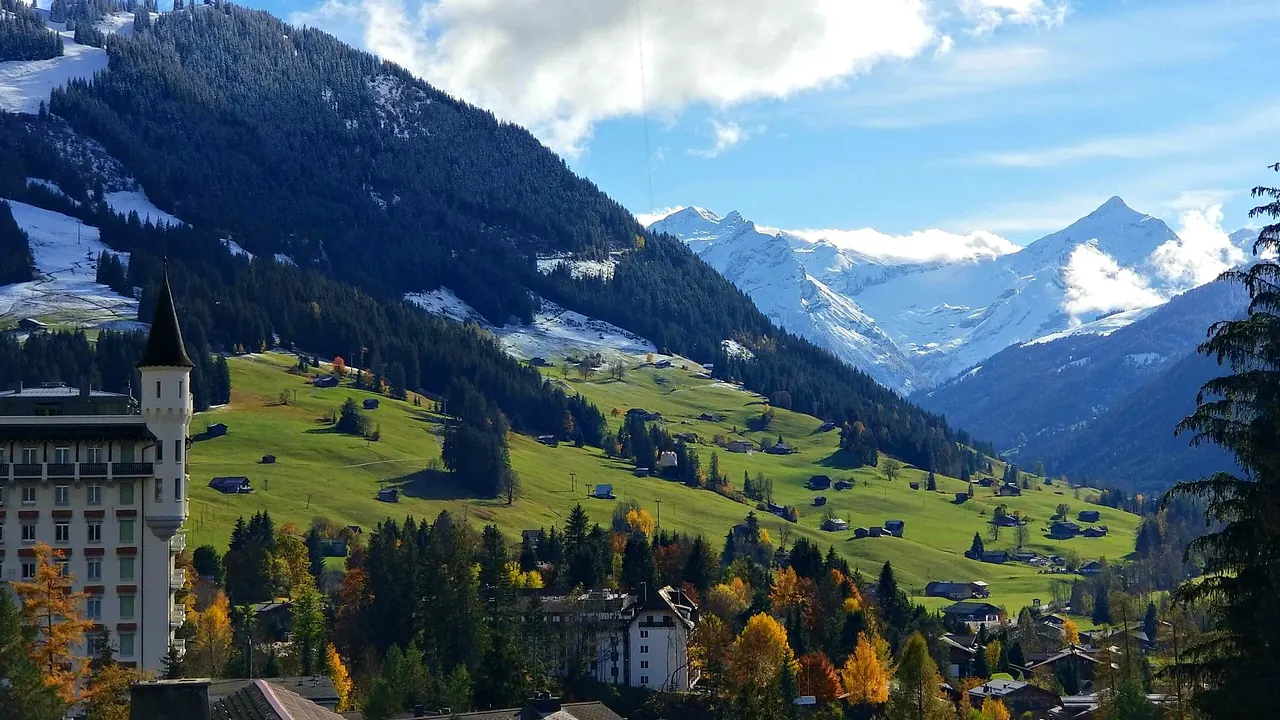
Photos: Arosa by Andres Passwirth, CC BY-SA 4.0, cropped; Gstaad by Samuel Barlow, CC BY-SA 4.0, cropped.
Arosa or Gstaad?
Our verdict in twelve categories, each scored against the same fixed benchmark cities, and the climate month by month, so you can choose for your trip.
Choose Arosa for
- families
- beaches
- prices
Arosa is the better pick for a family mountain vacation and for skiers who want snow they can rely on. It sits higher, in a self-contained basin where free buses, lifts and lakes keep everything close. The bear sanctuary and long sledging runs give children more to do. The price of that seclusion is a dead-end valley, so outings beyond Chur take real effort.
Choose Gstaad for
- shopping
- day trips
- live music and the arts
Couples and older travellers who want more than the mountains will be happier in Gstaad. The Menuhin Festival gives summer a serious music programme, the Promenade has the luxury shopping Arosa lacks, and the GoldenPass line opens up Lake Geneva, Gruyères and Bern for days out. Its home slopes are lower and gentler, so keen skiers rely on Glacier 3000 when early snow is thin.
Scoreboard
Twelve categories on one fixed scale from 0 to 100. The shaded stretch is the gap between the two.
Your match
Pick a travel style or drag the sliders, and both match scores follow your weighting.
Wins on families and beaches with your weighting.
Wins on shopping and day trips with your weighting.
What matters to you?
Category by category
What the scores mean for a trip.
Beaches & swimming
Neither is a place for a swimming vacation, but a hot afternoon is easier to spend in Arosa. The Untersee has a proper lido with a lawn and a jetty right in the village, and the Obersee and Schwellisee higher up give hardy swimmers more lakes to try without leaving the basin.
In Gstaad the lakes at Lauenen and Arnensee are up the side valleys. Their grassy shores are good for a quick, cold dip, but most locals use the heated outdoor pool in the valley instead. The nearest proper lakeside bathing is at Montreux on Lake Geneva, a long excursion over the pass.
Food & drink
Both eat in the same two kinds of place, hotel dining rooms and slope huts, but Gstaad does more with each. Several of its grand hotels run serious gourmet kitchens, and the valley has a real local product in its cheese: Saanen Hobelkäse shaved into curls, and L'Etivaz from the summer alpine dairies, both sold in small cellars you can visit.
Arosa's best meals are on the hut terraces, with Graubünden dishes such as capuns, barley soup and dried meat that Gstaad's menus do not share. Away from the slopes the choice narrows to fondue and raclette, and in both villages many kitchens close between seasons.
Culture & sights
Neither has more than an afternoon of sightseeing. Arosa's interest lies in its past as a high-altitude cure resort for tuberculosis, told in the Schanfigg museum and the grand old hotels, plus the lone shingled Bergkirchli on its meadow.
Gstaad's heritage is spread across the Saanenland in dark-timbered, carved chalets and two village churches: St Mauritius in Saanen, with its medieval wall paintings, and the old church at Rougemont. They are best seen along a walk rather than as visits in their own right.
Nightlife
Both go quiet once the ski season ends, and in winter they offer nights of a similar scale: après-ski, hotel bars and a couple of late clubs. Arosa's evenings are smart but fairly sedate, and its long-running gay ski week in January brings the liveliest nights. Gstaad's are dressier and more exclusive, with clubs in the cellars of the grand hotels and much of the social life behind closed doors at private chalet parties.
Nature & outdoors
Both are first-rate mountain bases, and the difference is in character. Arosa is high and enclosed, a basin of larches and lakes under the Weisshorn, with snow you can count on and a lift link to Lenzerheide that makes one large ski area. Marmots and high routes over the passes towards Davos give its summers a wilder feel.
Gstaad is lower and more pastoral. Its several ski areas are spread across the Saanenland, and their snow can be thin early in the season, which is when Glacier 3000 is the fallback. Summer is its stronger season, adding waterfalls in the Geltental, paragliding and rafting on the Saane to the walking.
Day trips
Gstaad has far more within reach. The GoldenPass line runs down to Montreux, the Castle of Chillon and the Lavaux terraces, Gruyères lies to the west, and Thun and Bern can be reached to the east, so one week can take in a lake, a castle and the capital.
From Arosa, every trip begins with the hour down the single line to Chur. The ride over the Schanfigg viaducts is a pleasure, and Chur's old town and cathedral make a good day out, but Maienfeld, Vaduz or the Albula line to St. Moritz take two hours or more.
Good for families
Arosa gives children more to do. Besides the ski schools and sledging it has the bear sanctuary, lakes with a lido, playgrounds and cable cars up to the viewpoints. On wet days there is an indoor pool and an ice rink, and free buses carry tired legs.
Gstaad is just as safe and calm, with gentle beginner slopes, sleigh rides and cows on the pastures, but it has nothing built for children and little to fall back on when it rains. In both villages, eating out as a family costs a lot.
Getting around
Neither needs a car on paper, but they are laid out differently. Arosa is a single village on a single hillside, with free buses linking the station, the lake and the lifts. Its slopes and stairs make walking hard work, though, and every trip out goes back down to Chur.
Gstaad's centre is a mostly car-free promenade only a few minutes from end to end, but the resort spreads across several valleys. When trains and PostBuses thin out in the quiet months, many visitors turn to hotel shuttles or a car.
Shopping & style
For a village its size, Gstaad is a real shopping stop. The chalet-lined Promenade has fine watchmakers, jewellers, international labels, cashmere and interior design, as well as local cheese, carved wood and Pays-d'Enhaut papercuts. Almost all of it is at the top end.
Arosa covers ski kit, rentals, a few boutiques and chocolate along the main street. Anyone wanting more choice takes the train down to Chur.
Affordability
Both are among the most expensive places to vacation in the Alps, and neither can be done cheaply. Arosa has a little more give, with simple guesthouses, self-catering apartments, free buses and a summer guest card with perks.
In Gstaad mid-range rooms are scarce, so the usual way to save is to sleep down the valley in Saanen or Zweisimmen. In both places summer costs noticeably less than the winter peak.
Live music & performing arts
Gstaad is the place for music. The Menuhin Festival fills several summer weeks with leading soloists and orchestras in its festival tent and in the churches of Saanen, Rougemont and Lauenen. Winter adds a chamber-music festival and New Year concerts.
Arosa's calendar is smaller but more varied in kind. There is a December comedy festival with stand-up and cabaret, partly out in the snow, and summer chamber concerts in its churches, including the Bergkirchli. Outside those weeks, neither village has much live performance.
Wellness & relaxation
Neither has thermal springs, so in both the bathing happens in hotel spas with mountain views. Gstaad has an unusual number of large, lavish spas, some selling day passes, which suits a stay built around comfort. Arosa began as a place to recover in dry, sunny air, and outside the busy ski weeks it adds a public indoor pool and a quieter rhythm of lake walks and sun terraces.
When should you go?
Pick your month. The climate figures are measured averages, not a forecast.
Arosa in July
Gstaad in July
Daytime high, °C
Rainfall in the month, mm
Where the figures come from
Arosa's temperatures are measured 31 km from the centre, at Samedan.
Arosa has no rain gauge within 25 km of the centre, so its rainfall comes from a gridded climate dataset read at the destination rather than from a gauge further away.
Gstaad's temperatures are measured 78 km from the centre, at Les Eplatures.
Gstaad has no rain gauge within 25 km of the centre, so its rainfall comes from a gridded climate dataset read at the destination rather than from a gauge further away.
Temperature and rainfall are climate normals, averaged over the years shown. Arosa: 2015-2025 (rainfall 1991-2020) normals, Samedan (31.2 km from centre). Gstaad: 2010-2020 (rainfall 1991-2020) normals, Les Eplatures (77.5 km from centre).
Arosa sits much higher, and its year shows it. Daytime highs stay around freezing from December to February, which keeps the snow dependable. February is its driest month, and late winter and early spring are generally drier than summer. From May to September the rain comes more heavily, peaking at about 159mm in August, so the short summer is also the wettest time of year. July highs of about 20°C make good walking weather, but they are only just warm enough for a dip in the lakes.
Gstaad is milder through winter, spring and autumn, often by around 4°C. That makes March, April and October walks more comfortable there, but it also makes early-winter snow on the low home slopes less certain. In high summer the gap shrinks to a degree or two, with July and August reaching about 21°C. Its rain is spread more evenly through the year, with spring the driest season and December the wettest month at about 125mm. Neither place ever gets too hot for walking, and in both only July and August are warm enough for lake swimming.
Which traveller are you?
On a family trip with young children, Arosa is the stronger choice. Free village buses, gentle ski schools, long sledging runs and the bear sanctuary give more to fill the days, and the indoor pool and ice rink help on wet afternoons.
For a culture and arts trip, Gstaad wins. Each summer the Menuhin Festival brings leading soloists and orchestras to a festival tent and old village churches, and the GoldenPass line reaches the Castle of Chillon, Gruyères and Bern's old town for days out.
On a shopping trip, Gstaad is the only real option of the two. The Promenade gathers watchmakers, jewellers, fashion labels and cashmere in one short street, plus local cheese and papercuts. Arosa offers ski gear and souvenirs, and sends you down to Chur for more.
Before you go
| Measure | Arosa | Gstaad |
|---|---|---|
| Official language | French, German, Italian, Romansh | French, German, Italian, Romansh |
| Currency | Swiss Franc (CHF) | Swiss Franc (CHF) |
| Sockets | CJ230 V, 50 Hz | CJ230 V, 50 Hz |
| Driving side | Right | Right |
| Time zone | UTC+1, UTC+2 in summer | UTC+1, UTC+2 in summer |
| Emergency number | 112 | 112 |
| Elevation | 1,775 m | 1,050 m |
| Main airport | Zürich Airport (ZRH)114 km from centre226 non-stop destinations | Geneva International Airport (GVA)94 km from centre150 non-stop destinations |
| Public holidays this year | 9 days | 10 days |
By the numbers
| Measure | Arosa | Gstaad |
|---|---|---|
| Population | 3,185 | 2,960 |
| People per km² | 21 | - |
| Museums within 10 km | 1 | 0 |
| UNESCO World Heritage sites within 50 km | 2 | 4 |
Where else could you go?
Every comparison below shares a destination with this one, so you can follow Arosa or Gstaad somewhere new.
- Lenzerheidevs Arosa
- Davosvs Arosa
- Klostersvs Arosa
- Adelbodenvs Gstaad
- Crans-Montanavs Gstaad
- Leukerbadvs Gstaad