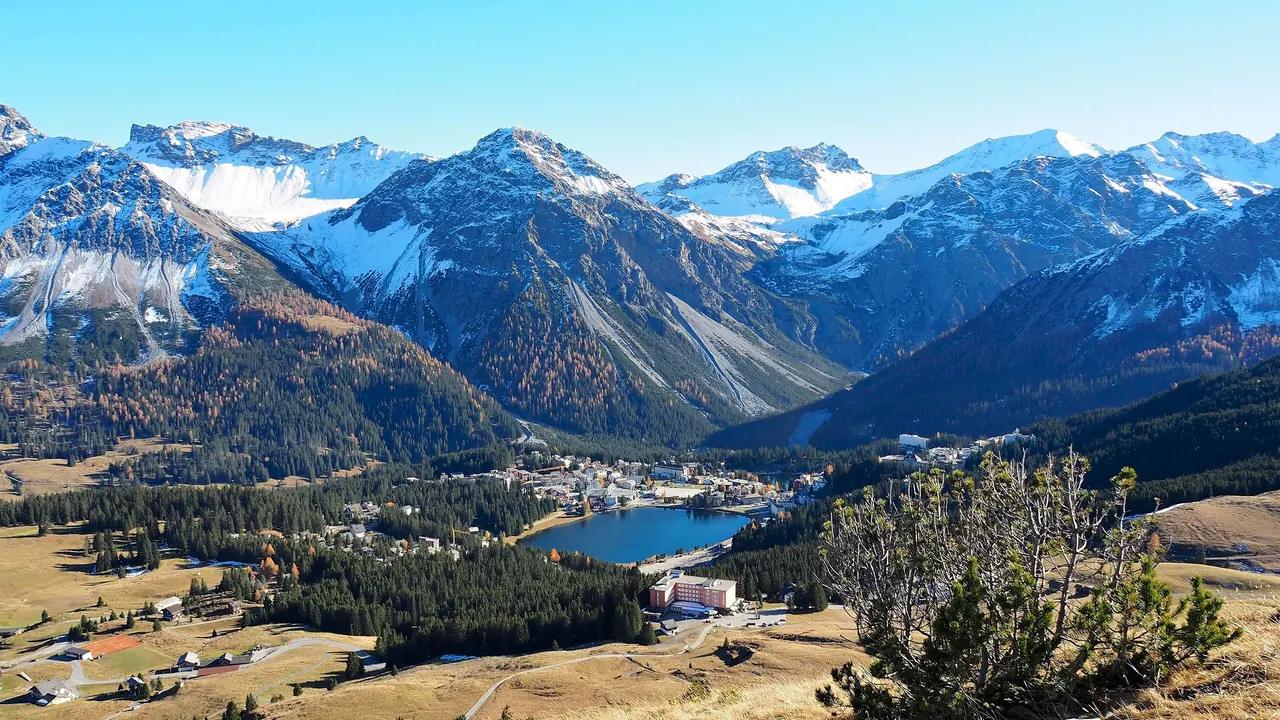
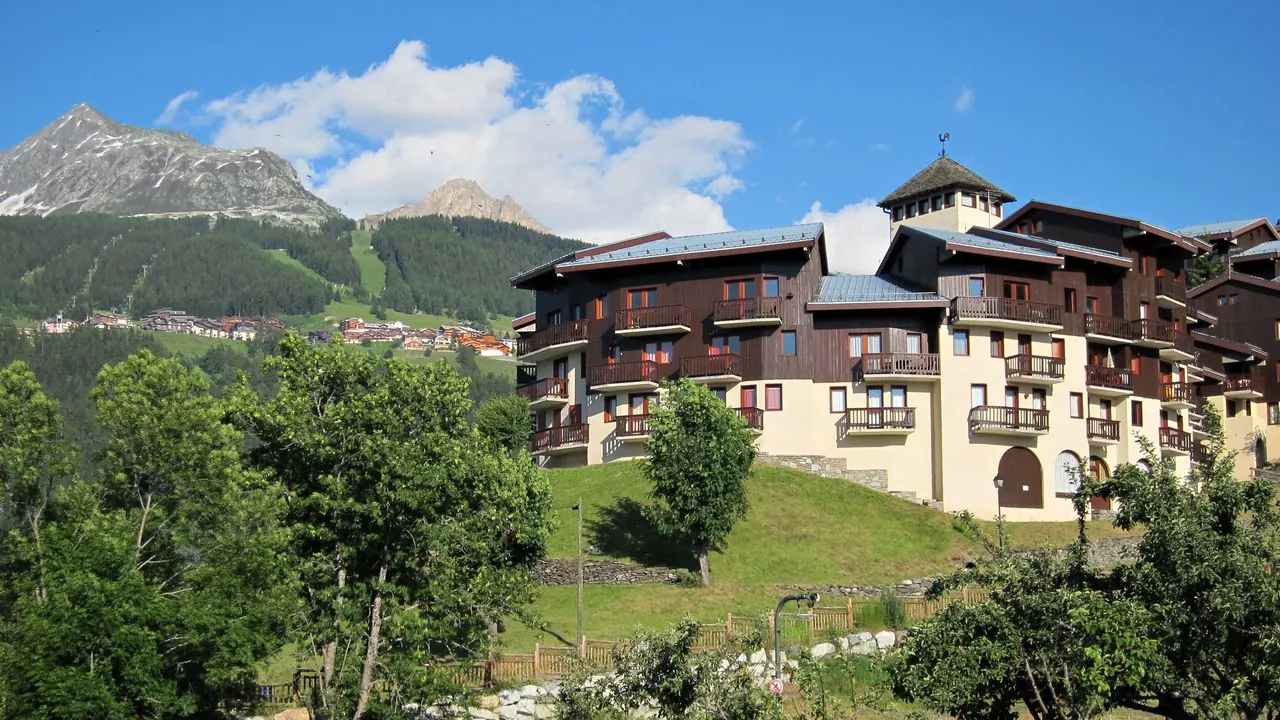
Photos: Arosa by Andres Passwirth, CC BY-SA 4.0, cropped; La Plagne by Henk Monster, CC BY 3.0, cropped.
Arosa or La Plagne?
Our verdict in twelve categories, each scored against the same fixed benchmark cities, and the climate month by month, so you can choose for your trip.
Choose Arosa for
- getting around
- live music and the arts
- wellness
Arosa suits travellers who want a mountain stay without a car and at a slower pace. The train climbs straight up from Chur, free buses do the rest, and the hotel spas and lakeside walks recall the village's past as a place people came to recover. It also has more going on in the evenings outside skiing, with a winter comedy festival and summer chamber concerts. The catch is the cost, which is steep in every season.
Choose La Plagne for
- prices
- families
- nightlife
La Plagne is the better pick for a family ski week. Its car-free villages sit right on the snow, the ski schools and kids' clubs are built for small children, and the linked Paradiski area gives keen skiers more terrain than they can cover in a week. Apartments make it easier on the wallet than Arosa, though a car makes the approach and any outings much simpler.
Scoreboard
Twelve categories on one fixed scale from 0 to 100. The shaded stretch is the gap between the two.
Your match
Pick a travel style or drag the sliders, and both match scores follow your weighting.
Too close to call, 2 points apart
Wins on getting around and live music and the arts with your weighting.
Wins on prices and families with your weighting.
What matters to you?
Category by category
What the scores mean for a trip.
Beaches & swimming
Neither has a sea, but Arosa at least offers outdoor swimming. The Untersee has a lido with a lawn and a jetty, and the higher Obersee and Schwellisee draw hardy swimmers for a few weeks in high summer.
La Plagne's lakes are too cold to be more than a picnic spot, so swimming there means the indoor and heated pools at the resort's leisure centres.
Food & drink
The two are on a par, and the difference is the regional kitchen. Arosa serves Graubünden dishes such as capuns, barley soup and air-dried meat on hut terraces, and its luxury hotels add a few fine-dining rooms for a special evening.
La Plagne is all Savoyard comfort food, tartiflette and Reblochon included, with more pizzerias and crêperies for ski-week crowds. Self-catering is a bigger part of life there, thanks to the resort supermarkets and cheese counters.
Culture & sights
Neither place is worth visiting for its sights. What little Arosa has is old: the late 15th-century Bergkirchli chapel alone on its meadow, a valley history museum, and grand hotels left over from the days when people came to cure tuberculosis.
La Plagne's interest is modern. It was built in the 1960s, and its landmarks are a ship-like concrete apartment block stepped down the mountainside and the bobsleigh track from the Albertville Winter Olympics. To see old stone churches and villages you have to go down into the valley.
Nightlife
Evenings are low-key in both and follow the ski season. Arosa leans smart and sedate, with hotel bars, a couple of small clubs and one standout week, the long-running gay ski week in January.
La Plagne is more about crowded après-ski bars at the foot of the slopes and pubs in Plagne Centre and Belle Plagne. The family crowd still means early nights, and in summer both go quiet.
Nature & outdoors
Both are first-rate mountain bases, but they differ in scale. Arosa is a compact basin of larches and lakes under the Weisshorn, with lifts linking to Lenzerheide, gentle lake circuits and the bear sanctuary, all reached on foot or by lift from the village.
La Plagne is bigger and higher. Its slopes run up to the Bellecôte glacier above 3,000m and connect across the valley to Les Arcs, while summer brings ibex in the Vanoise National Park, via ferrata and rafting on the Isère.
Day trips
Both sit at the end of the line, and outings take effort from each. From Arosa it is the scenic train to Chur's old town and cathedral, then onward to the Maienfeld vineyards, Liechtenstein or the Albula line if you have a longer day.
From La Plagne you need a car, and the reward is variety: the basilica at Aime, walled Conflans, Chambéry and Annecy. In summer the passes open up the Beaufortain cheese villages and Italy's Aosta Valley.
Good for families
La Plagne is the more natural choice for children. It was planned for families, with car-free villages on the snow, large children's ski programmes and wide, easy runs for nervous beginners.
Arosa works well too, with sledging runs, lake playgrounds, the bear sanctuary and cable cars that take small legs up to high viewpoints. It is harder to fill rainy days there, though, and eating out is costly for a family.
Getting around
Arosa is far easier to reach and get around without a car. The Rhaetian Railway runs up from Chur in about an hour, and free buses link the station, the lake and the lifts, though the hillside village means plenty of stairs.
La Plagne is simple once you arrive, with ski-in ski-out lodging and free shuttles between villages. Getting there is the hard part: a bus up a long winding road from Aime station, often with snow chains in winter, and a car for anything beyond the resort.
Shopping & style
Neither is somewhere you go to shop, and both mostly sell ski gear and essentials. Arosa adds a few fashion boutiques for hotel guests, plus Swiss chocolate, and Chur is an hour away for more choice.
La Plagne's best buys are edible: Beaufort cheese, cured sausages, génépi and mountain honey.
Affordability
Both are expensive, but Arosa is clearly the costlier of the two. Its hotels lean upscale and Swiss prices apply to everything, from lift passes to lunches. Simple guesthouses and apartments are the only real way to save.
La Plagne's winter weeks still add up, yet its huge supply of self-catering apartments makes it much more manageable. In both, summer is the cheaper time to come.
Live music & performing arts
Arosa has a modest but genuine calendar. A long-established December comedy festival puts stand-up and cabaret on stages around the village, some of them out in the snow, and in summer chamber concerts fill its churches, including the Bergkirchli.
La Plagne has nothing comparable. Torchlight descents, a few open-air concerts and après-ski bands are as far as it goes, and theatre means a trip to Chambéry.
Wellness & relaxation
Arosa is the more restful place. It was built for convalescence, and its larger hotels have extensive spas looking onto the peaks. Outside peak ski weeks the village stays genuinely calm.
In La Plagne, wellness mostly means a sauna or hot tub after a hard ski day, since a week there is a physical vacation. What it has that Arosa lacks is real thermal water, in the spa towns of Brides-les-Bains and La Léchère, about an hour down the valley.
When should you go?
Pick your month. The climate figures are measured averages, not a forecast.
Arosa in July
La Plagne in July
Daytime high, °C
Rainfall in the month, mm
Where the figures come from
Arosa's temperatures are measured 31 km from the centre, at Samedan.
Arosa has no rain gauge within 25 km of the centre, so its rainfall comes from a gridded climate dataset read at the destination rather than from a gauge further away.
La Plagne has no weather station within reach, so its figures come from a gridded climate model rather than a measured record, and read a broad area rather than one spot.
Temperature and rainfall are climate normals, averaged over the years shown. Arosa: 2015-2025 (rainfall 1991-2020) normals, Samedan (31.2 km from centre). La Plagne: 2001-2020 normals, NASA POWER reanalysis grid, no weather station within 90 km.
Both are winter destinations first, and both stay cold from December to March. La Plagne is the colder of the two, with January highs around -4°C while Arosa hovers near freezing. At those temperatures most winter precipitation falls as snow in both places. Spring comes late at either altitude, and April still feels wintry in La Plagne and only a little milder in Arosa.
Summer is the hiking season. July peaks at about 20°C in Arosa and a couple of degrees cooler in La Plagne. That is pleasant on the trails but only just warm enough for Arosa's lake lido on the best afternoons. The bigger difference is rain. Arosa's summer is wet, with around 150mm a month from June to August, and September there is still fairly wet. La Plagne gets roughly half that through the summer and is drier still in September, so its late-season days are more dependable for long hikes.
Which traveller are you?
On a family trip with young children, La Plagne has the edge. In villages like Belle Plagne you walk straight onto gentle slopes, the ski schools and snow gardens are made for small children, and the bob-raft ride thrills older ones.
For a relaxing and wellness trip, Arosa is the calmer choice. Spacious hotel spas look out onto the peaks, the village keeps the quiet rhythm of its sanatorium days, and lake walks and sun terraces fill the time between treatments.
On a tight budget, La Plagne is easier to manage. A winter week is still expensive, but its large stock of self-catering apartments and cheese counters lets families cook in. Arosa's upscale hotels and Swiss prices leave far less room to save.
Before you go
| Measure | Arosa | La Plagne |
|---|---|---|
| Official language | French, German, Italian, Romansh | French |
| Currency | Swiss Franc (CHF) | Euro (EUR) |
| Sockets | CJ230 V, 50 Hz | CE230 V, 50 Hz |
| Driving side | Right | Right |
| Time zone | UTC+1, UTC+2 in summer | UTC+1, UTC+2 in summer |
| Emergency number | 112 | 112 |
| Elevation | 1,775 m | 1,974 m |
| Main airport | Zürich Airport (ZRH)114 km from centre226 non-stop destinations | Geneva International Airport (GVA)92 km from centre150 non-stop destinations |
| Public holidays this year | 9 days | 11 days |
By the numbers
| Measure | Arosa | La Plagne |
|---|---|---|
| Population | 3,185 | - |
| People per km² | 21 | - |
| Museums within 10 km | 1 | 2 |
| UNESCO World Heritage sites within 50 km | 2 | 0 |
Where else could you go?
Every comparison below shares a destination with this one, so you can follow Arosa or La Plagne somewhere new.
- Lenzerheidevs Arosa
- Courchevelvs La Plagne
- Davosvs Arosa
- Les Arcsvs La Plagne
- Méribelvs La Plagne
- Klostersvs Arosa