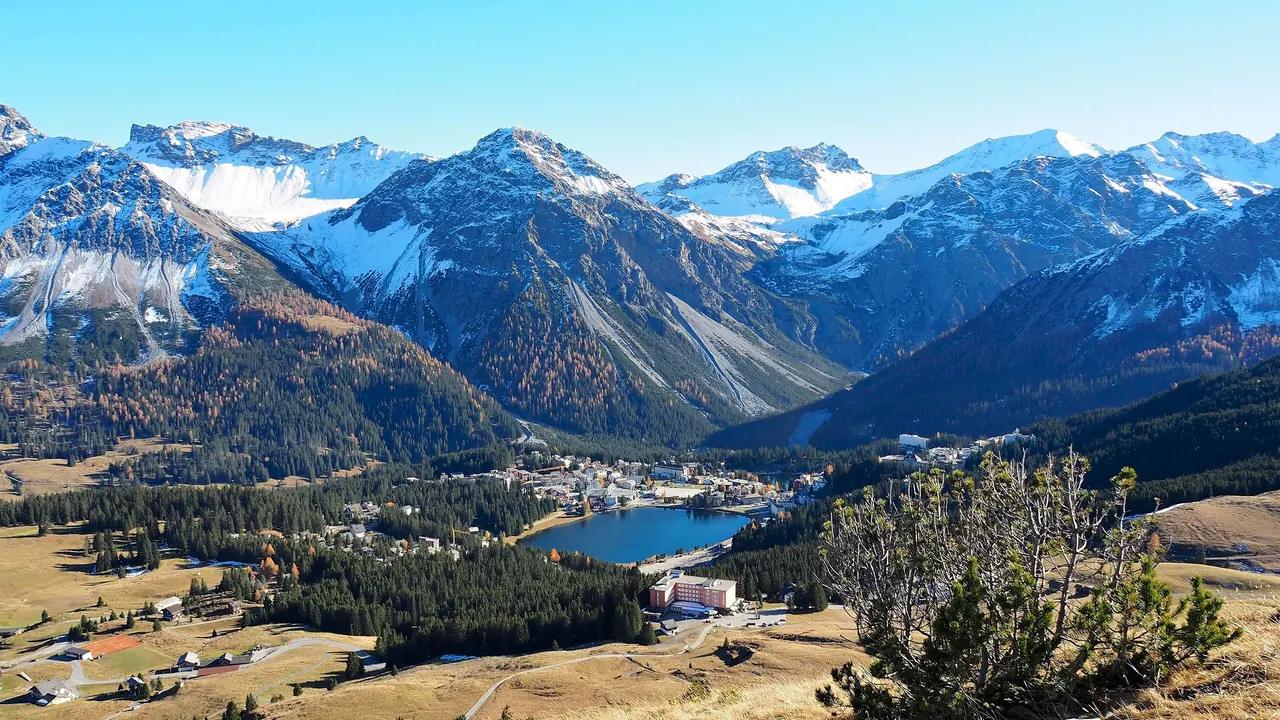
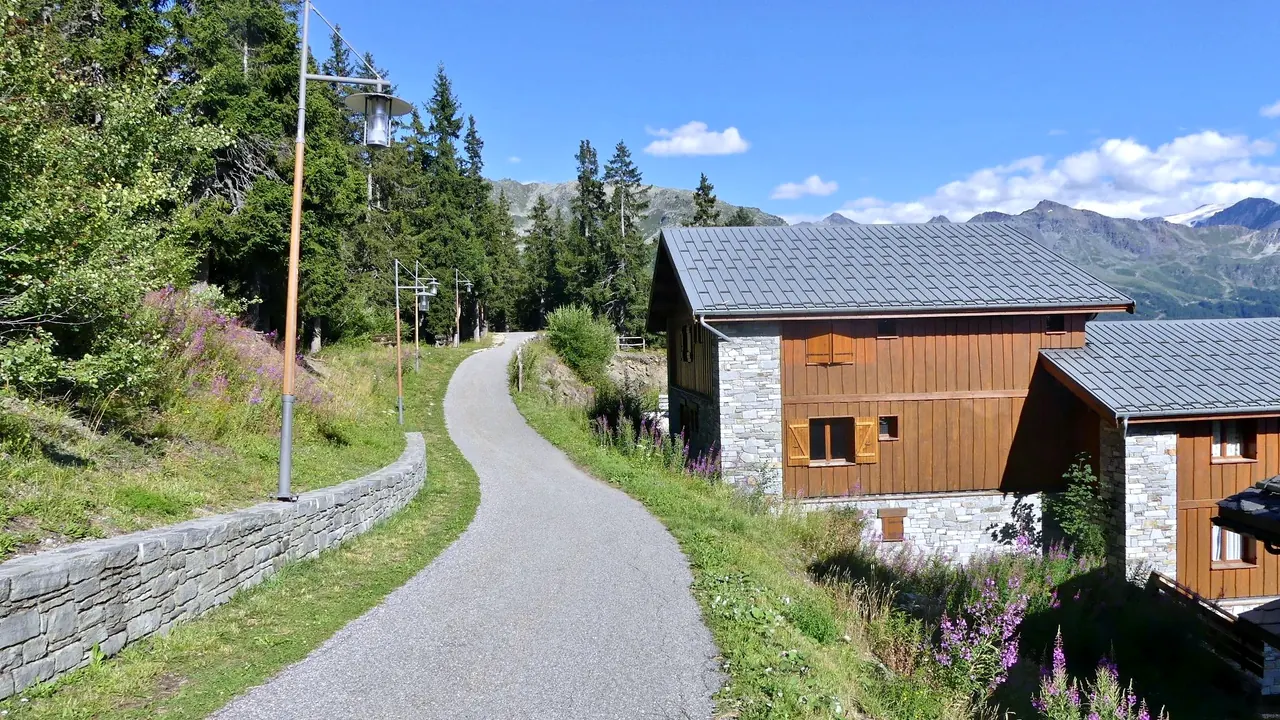
Photos: Arosa by Andres Passwirth, CC BY-SA 4.0, cropped; La Rosière by Florian Pépellin, CC BY-SA 4.0, cropped.
Arosa or La Rosière?
Our verdict in twelve categories, each scored against the same fixed benchmark cities, and the climate month by month, so you can choose for your trip.
Choose Arosa for
- getting around
- live music and the arts
- wellness
Arosa suits travellers who want a mountain stay without a car and with a little more going on around the slopes. The train runs right into the village, free buses and lifts do the rest, and the resort adds things La Rosière lacks: large hotel spas, a December comedy festival, summer chamber concerts and livelier après-ski. Families get lakes and a bear sanctuary as well as ski schools. The cost is the main drawback, because this is a resort priced at the top of the Swiss scale.
Choose La Rosière for
- prices
La Rosière is for skiers and walkers who care most about the mountain and the bill. Its sunny balcony above the Tarentaise, the link over the pass to La Thuile in Italy and its ski-in, ski-out chalets make a straightforward, quiet base, and it costs noticeably less than Arosa. Come knowing there is almost nothing to do away from the snow or the trails, and that a car makes a real difference once you want to leave the resort.
Scoreboard
Twelve categories on one fixed scale from 0 to 100. The shaded stretch is the gap between the two.
Your match
Pick a travel style or drag the sliders, and both match scores follow your weighting.
Wins on getting around and live music and the arts with your weighting.
Wins on prices with your weighting.
What matters to you?
Category by category
What the scores mean for a trip.
Beaches & swimming
Neither place is a swimming destination, but Arosa at least has water within walking distance. The Untersee has a lido with a lawn and a jetty, and the higher Obersee and Schwellisee suit a brisk dip after a hike in July and August. La Rosière offers only hotel and chalet pools, or a cold lake further down the valley, so a summer swim there means a pool or a drive.
Food & drink
Both serve Alpine comfort food, and Arosa has the slight edge in range. Its hut terraces serve Graubünden dishes such as capuns, barley soup and air-dried meat, and the luxury hotels add a fine-dining option for a special evening.
La Rosière's menus are Savoyard, with tartiflette, fondue and Beaufort cheese, and they start to repeat after a few nights. Its trick is lunch over the border, where the Italian side serves proper pasta, polenta and espresso. For more choice in the evening you have to drive down to Bourg-Saint-Maurice.
Culture & sights
Both are thin on sights, and an afternoon covers either one. Arosa's interest lies in the village itself: the late 15th-century Bergkirchli chapel alone on its meadow, the local museum and the grand hotels left over from its sanatorium years. La Rosière is a modern ski station with no past of its own. Its sights lie outside the resort, in the baroque churches of the Tarentaise villages and, in summer, the Iron Age stone circle and old hospice on the Little St Bernard Pass.
Nightlife
Arosa has more of an evening, though it is never wild. Après-ski moves on to hotel bars and a couple of small clubs open late at weekends, and the January gay ski week brings its busiest nights of the year.
La Rosière is made for families. Its bars fill when the lifts close, and most guests are back in their chalets after dinner. Anyone after real après-ski would do better in another Tarentaise resort.
Nature & outdoors
Both are first-rate mountain bases, but the landscapes differ. Arosa sits in an enclosed basin of larches and lakes below the Weisshorn. The lifts link across to Lenzerheide, the altitude keeps the snow reliable, and there are cross-country trails and sledging runs. Summer brings high routes towards Davos and a bear sanctuary, all starting from the village.
La Rosière looks out from a sunny, south-facing balcony towards the Vanoise glaciers, and its ski area crosses into Italy at La Thuile. The Italian side offers big off-piste and heli-skiing. In summer the high pastures are good for paragliding and spotting ibex, with the Mont Blanc massif just over the border.
Day trips
The choice of outings is about equal, but they work in different ways. From Arosa every trip starts with the scenic train down to Chur, whose old town and cathedral make the easy day out. The line then continues to the vineyards at Maienfeld, to Vaduz and along the Albula line, and all of this runs the same in winter and summer.
La Rosière's best outings depend on the season. In summer the pass opens to the Roman remains of Aosta and to Courmayeur. In winter the pass road closes, and even Annecy is a two-hour drive.
Good for families
Both resorts are built around family ski weeks, but Arosa gives children more to do off the slopes. Summer brings the lakes, the bear sanctuary and cable cars that make high viewpoints easy, and in bad weather there is an ice rink as well as the indoor pool.
La Rosière's strengths are on the snow. The nursery slopes are central and face the sun, and many chalets are ski-in, ski-out. The village is small enough for older children to roam alone, but on a wet day there is little to do apart from the pool.
Getting around
Arosa is much easier without a car. The Rhaetian Railway climbs straight into the village from Chur, and free buses link the station, the lake and the lifts. The only effort is the climbing on foot between Ausserarosa and Innerarosa.
At La Rosière the train stops at Bourg-Saint-Maurice, half an hour down a winding road, and a bus covers the last stretch up to the resort. A free shuttle and the pistes join its quarters in winter. For valley towns or Italy, though, a car is close to essential.
Shopping & style
Neither is worth visiting for shopping, and both send you down the valley for any real choice. Arosa has a few fashion boutiques for its hotel guests and Swiss chocolate shops, with Chur's old town an hour away by train. La Rosière's shops are more practical: supermarkets and a couple of shops selling local cheese and charcuterie, which make better things to take home.
Affordability
La Rosière is clearly the less painful bill. It is expensive in ski season like any Alpine resort, but it costs noticeably less than its glamorous neighbours. Self-catering is easy, and summer prices are set for walkers.
Arosa is very expensive. Hotels lean upmarket, and lift passes and meals carry Swiss resort prices. Summer and a self-catering apartment help, but only up to a point.
Live music & performing arts
Arosa has a few fixed dates worth planning around. A long-running comedy festival in December puts cabaret on stages around the village, some of them outdoors in the snow, and in summer chamber concerts fill the churches, including the Bergkirchli. La Rosière has nothing comparable, only occasional live music in bars.
Wellness & relaxation
Arosa was built for rest and still feels like it. Some of its hotel spas are extensive, the village has a public indoor pool, and outside the peak ski weeks its days pass slowly between the lake paths and sun terraces.
La Rosière is quiet too, but its spas are small facilities inside hotels and residences, and in summer the pass road brings steady traffic through the resort. Summer also brings its one bathing outing: the historic thermal baths at Pré-Saint-Didier, an easy drive over the pass below La Thuile. In winter the pass road closes, and that outing closes with it.
When should you go?
Pick your month. The climate figures are measured averages, not a forecast.
Arosa in July
La Rosière in July
Daytime high, °C
Rainfall in the month, mm
Where the figures come from
Arosa's temperatures are measured 31 km from the centre, at Samedan.
Arosa has no rain gauge within 25 km of the centre, so its rainfall comes from a gridded climate dataset read at the destination rather than from a gauge further away.
La Rosière has no weather station within reach, so its figures come from a gridded climate model rather than a measured record, and read a broad area rather than one spot.
Temperature and rainfall are climate normals, averaged over the years shown. Arosa: 2015-2025 (rainfall 1991-2020) normals, Samedan (31.2 km from centre). La Rosière: 2001-2020 normals, NASA POWER reanalysis grid, no weather station within 90 km.
Both are two-season resorts: snow from December to March, then hiking from June to September. Arosa is a few degrees milder all year round. Its July highs reach about 20°C, against 18°C at La Rosière, and in January La Rosière is the harder frost at around -4°C. April and May are the slack months in both places, too mild for good snow at village level and still too cool for high walks. Late autumn turns cold and grey again.
Rain is where the two differ most. Arosa's summer is its wettest season, at around 150mm a month from June to August, so plan hikes for the mornings and expect showers later in the day. La Rosière gets about half that rain in midsummer, which makes its July and August the steadier choice for walking and paragliding. For a lake swim, only Arosa's July and August are warm enough.
Which traveller are you?
On a trip on a tight budget, Arosa is hard to justify, as even a summer stay in a self-catering apartment stays costly. La Rosière is still an Alpine resort, but it charges noticeably less, and summer there is far cheaper again.
For a relaxing and wellness trip, choose Arosa. Rest has been the point of the place since its sanatorium years, and its larger hotel spas and slow village pace suit a quiet week. La Rosière is calm too, but its spas are small.
On a family trip with children, Arosa offers more beyond ski school: summer days at the Untersee lido, the bear sanctuary, cable cars to easy viewpoints and a train straight into the village. La Rosière suits a simple ski week, with sunny nursery slopes close by.
Before you go
| Measure | Arosa | La Rosière |
|---|---|---|
| Official language | French, German, Italian, Romansh | French |
| Currency | Swiss Franc (CHF) | Euro (EUR) |
| Sockets | CJ230 V, 50 Hz | CE230 V, 50 Hz |
| Driving side | Right | Right |
| Time zone | UTC+1, UTC+2 in summer | UTC+1, UTC+2 in summer |
| Emergency number | 112 | 112 |
| Elevation | 1,775 m | 1,844 m |
| Main airport | Zürich Airport (ZRH)114 km from centre226 non-stop destinations | Geneva International Airport (GVA)89 km from centre150 non-stop destinations |
| Public holidays this year | 9 days | 11 days |
By the numbers
| Measure | Arosa | La Rosière |
|---|---|---|
| Population | 3,185 | - |
| People per km² | 21 | - |
| Museums within 10 km | 1 | 0 |
| UNESCO World Heritage sites within 50 km | 2 | 0 |
Where else could you go?
Every comparison below shares a destination with this one, so you can follow Arosa or La Rosière somewhere new.
- Les Arcsvs La Rosière
- Lenzerheidevs Arosa
- Davosvs Arosa
- Tignesvs La Rosière
- Klostersvs Arosa
- La Plagnevs La Rosière