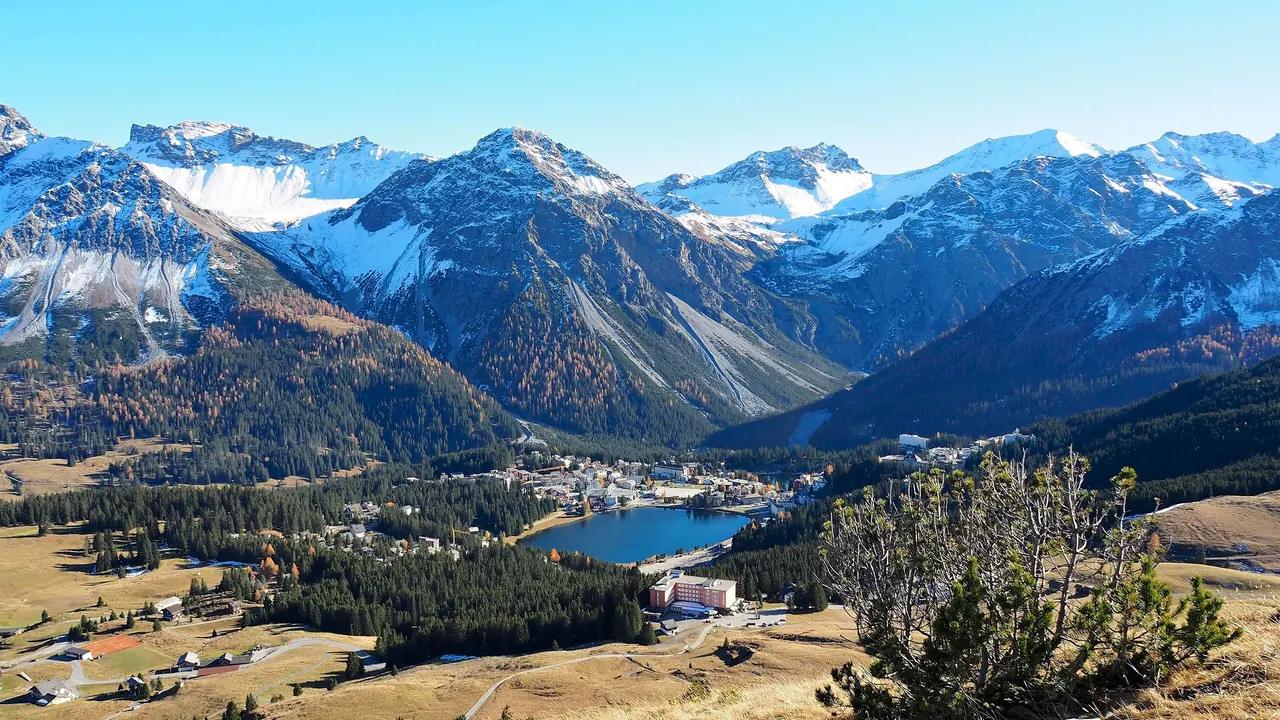
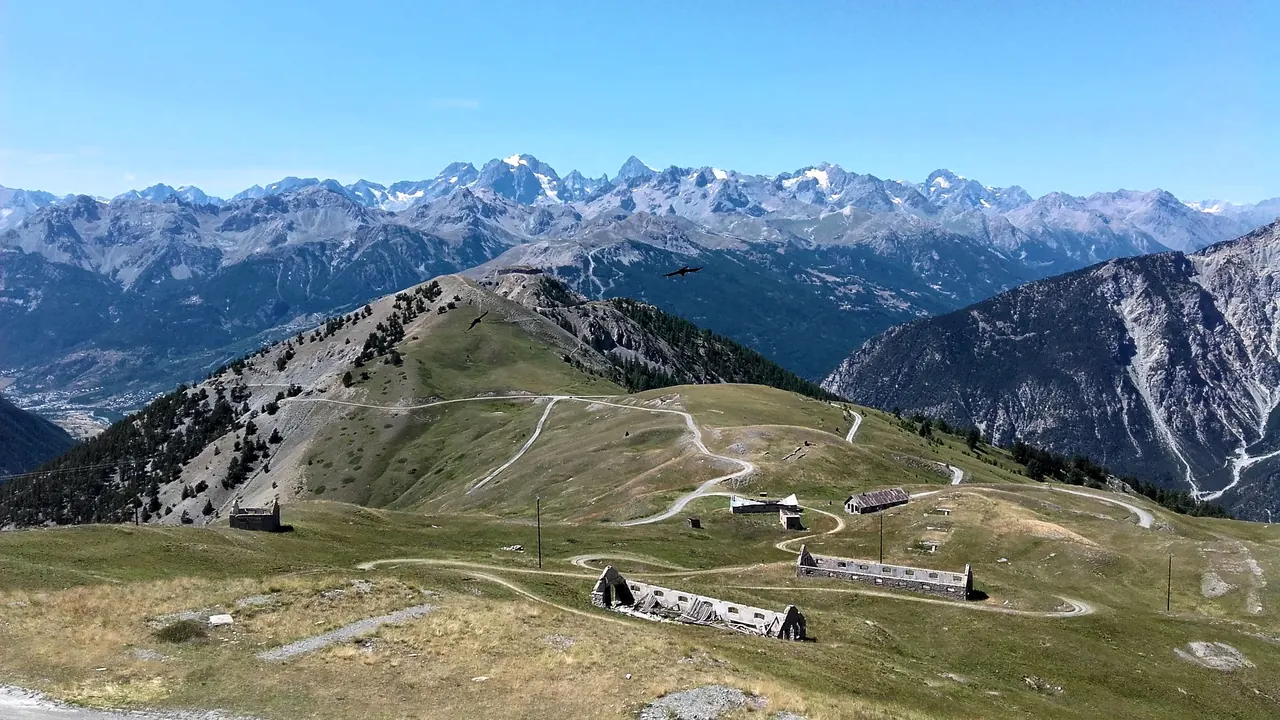
Photos: Arosa by Andres Passwirth, CC BY-SA 4.0, cropped; Montgenèvre by Jonathan Queutois, CC0.
Arosa or Montgenèvre?
Our verdict in twelve categories, each scored against the same fixed benchmark cities, and the climate month by month, so you can choose for your trip.
Choose Arosa for
- getting around
- live music and the arts
- beaches
Arosa suits travellers who want to leave the car at home and still have the whole mountain in reach. The train climbs up from Chur, free buses run through the village and the lifts carry on to Lenzerheide. Evenings, meals at the huts and the calendar of comedy and chamber music give it a little more life off the slopes. You pay heavily for that polish, so it fits a comfortable, unhurried stay better than a frugal one.
Choose Montgenèvre for
- prices
- day trips
- nature and the outdoors
Montgenèvre is the better choice if you want more mountain for your money and a car to explore with. The Milky Way ski area runs across the border to Sestriere, and Briançon's fortifications, the Susa valley and even Turin all make easy days out. It costs noticeably less, apartments make self-catering simple, and the drier summers suit long days of hiking and biking.
Scoreboard
Twelve categories on one fixed scale from 0 to 100. The shaded stretch is the gap between the two.
Your match
Pick a travel style or drag the sliders, and both match scores follow your weighting.
Too close to call, 1 point apart
Wins on getting around and live music and the arts with your weighting.
Wins on prices and day trips with your weighting.
What matters to you?
Category by category
What the scores mean for a trip.
Beaches & swimming
Neither village is a swimming destination, but Arosa has the better water close to hand. The Untersee has a lido with a lawn and a jetty, and the Obersee and Schwellisee further up make a bracing stop on a walk during the short July and August season.
Montgenèvre's own options are the heated pools at the leisure centre and alpine lakes that stay cold. Its one real beach is the sandy shore of Serre-Ponçon, with warm water, but that is more than an hour's drive away.
Food & drink
Arosa eats a little better. Its mountain huts serve Graubünden dishes such as capuns, barley soup and air-dried meat on terraces with a view down the valley, and the luxury hotels add a few fine-dining evenings.
In Montgenèvre the food is mostly quick ski-resort fare: tartiflette, crêpes and pizza. Its advantage is the border. Claviere, a few minutes away, has Italian bars with good espresso and trattorias, and Piedmontese dishes turn up on menus in the village. In both places, many kitchens close between seasons.
Culture & sights
Sightseeing is thin in both, and an afternoon is plenty either way. The two stories differ, though. Arosa's past is that of a health resort: the Schanfigg museum and the grand hotels recall its sanatoriums, and the 15th-century Bergkirchli chapel stands alone on its meadow. Montgenèvre's history is that of a border crossing, marked by the Napoleonic obelisk on the pass and old stone houses on a route used since Roman times. For real heritage it relies on Briançon below.
Nightlife
Arosa has slightly more going on after dark. Après-ski moves on to hotel bars and a couple of small clubs that stay open late at weekends, the atmosphere is smart rather than rowdy, and the January gay ski week brings the busiest nights of the year.
Montgenèvre's evenings start in boots at the bars by the bottom of the slopes. In peak weeks a few pubs and one small club stay open, but the crowd of families wants the first lift. Outside winter, both villages go quiet after dinner.
Nature & outdoors
Both are first-rate mountain bases at a similar altitude, so the difference is one of reach. Arosa is a closed basin of larches and lakes under the Weisshorn, and its lifts link to Lenzerheide. In summer, trails lead over the passes to Davos, and you can watch marmots on the meadows and visit the bear sanctuary, all reached on foot or by lift.
Montgenèvre's Milky Way ski area crosses into Italy as far as Sestriere and adds ski touring. In summer there is high-altitude golf, and with a car the Clarée valley, the Écrins and the Queyras open up for climbing, via ferrata and rafting on the Durance.
Day trips
Montgenèvre is far better placed for outings, with two countries within easy reach. Briançon's Vauban walls are just down the hill, and Mont-Dauphin and Embrun make an easy combined day. On the Italian side you can reach the Roman arch at Susa, the Sacra di San Michele and the huge Fenestrelle fortress, and Turin is about an hour and a half away.
From Arosa, everything begins with the scenic train ride down to Chur, which is a good day out in itself. After Chur come Maienfeld's vineyards and Vaduz, but most other trips take two hours or more.
Good for families
Both work equally well with children, with ski schools, gentle slopes and sledging. Arosa has the better summer: lakes, short walks to farm restaurants, the bear sanctuary and free buses for tired legs. Rainy days are harder to fill there, and eating out quickly gets expensive.
Montgenèvre is a compact village built right on its sunny beginner slopes, with husky rides for those who don't ski. Its leisure pool has a toddler lagoon for a bad-weather afternoon, and the apartments make family meals simple.
Getting around
Arosa is much easier without a car. The Rhaetian Railway climbs up from Chur in about an hour, and free buses and lifts handle the rest, though the hillside village means plenty of slopes and stairs. Its weakness is that every journey further afield goes back down the single line to Chur.
Montgenèvre is walkable, and its lifts and seasonal shuttles cover the resort. Getting there means a bus up from the stations at Briançon, which has a night train from Paris, or at Oulx. After that a car becomes essential, and in winter you need winter tyres or chains.
Shopping & style
Neither is a place to shop. Arosa's main street adds a few fashion boutiques for hotel guests and Swiss chocolate to the usual ski shops, with Chur's old town an hour away by train. Montgenèvre has a supermarket and shops selling local cheese and charcuterie. For more choice, people head to Briançon's market or cross into Italy to buy food.
Affordability
This is where the two differ most. Arosa is a Swiss luxury resort, with upscale hotels and high prices for lift passes, ski hire and meals. Cooking in an apartment, the summer guest card and travelling outside the ski season help, but only a little.
Montgenèvre is a mid-priced French resort, more modest than the big Savoie names. Most of its accommodation is in apartments and chalets, and it is cheaper still to eat across the border. A summer stay or a week outside the school vacations is genuinely affordable.
Live music & performing arts
Arosa has a small but real calendar. Its long-running December comedy festival puts stand-up and cabaret on stages around the village, some of them outdoors in the snow, and in summer chamber concerts fill the churches, including the Bergkirchli.
Montgenèvre has nothing comparable beyond occasional outdoor concerts and bands at après-ski. For an evening of theatre or music, people drive to Briançon or Turin.
Wellness & relaxation
Both are good places to unwind, but in different ways. Arosa grew up as a place to recover, and its quiet comes through the spas of the larger hotels, some of them extensive, along with a public indoor pool, lakeside walks and sun terraces. Montgenèvre's resort spa has a hammam and outdoor pools to soak in while the snow falls. It also has real thermal water at Le Monêtier-les-Bains, about 40 minutes by car, which Arosa lacks.
When should you go?
Pick your month. The climate figures are measured averages, not a forecast.
Arosa in July
Montgenèvre in July
Daytime high, °C
Rainfall in the month, mm
Where the figures come from
Arosa's temperatures are measured 31 km from the centre, at Samedan.
Arosa has no rain gauge within 25 km of the centre, so its rainfall comes from a gridded climate dataset read at the destination rather than from a gauge further away.
Montgenèvre has no weather station within reach, so its figures come from a gridded climate model rather than a measured record, and read a broad area rather than one spot.
Temperature and rainfall are climate normals, averaged over the years shown. Arosa: 2015-2025 (rainfall 1991-2020) normals, Samedan (31.2 km from centre). Montgenèvre: 2001-2020 normals, NASA POWER reanalysis grid, no weather station within 90 km.
Both villages sit high enough for snow from December into spring. Montgenèvre has the colder winter, with January highs around -3°C, while Arosa stays a couple of degrees milder. Both only warm up properly from June to August, when days reach about 20°C in Arosa and a fraction less on the pass. That is good walking weather, and July and August are the only months when Arosa's lakes are warm enough for a quick swim.
The big difference is rain. Arosa's wettest months come in summer, with up to 159mm in August, so afternoon showers are part of any hiking plan. Montgenèvre gets around 60mm in July and August, which makes it the more reliable choice for a dry summer walking trip. September is mild in both, but only the pass is dry then. Arosa is still almost as wet as in summer. Late autumn is damp in both villages, and Arosa is the wetter of the two right through October and November, even though November is one of the rainiest months of the year on the pass.
Which traveller are you?
On a trip on a tight budget, Montgenèvre is the clear pick. It is a mid-priced French resort with plenty of apartments and chalets for self-catering, and cheaper food and drink just over the border in Italy. Arosa is expensive at any time of year.
For a food and nightlife trip, Arosa offers a bit more. There are hut terraces serving capuns and Graubünden dried meat, a fine-dining option in the grand hotels, a few clubs that stay open late and a lively gay ski week in January.
On an outdoors trip, both have superb terrain on the doorstep. With a car, Montgenèvre reaches further, to the Clarée valley, the Écrins and the Queyras for climbing, via ferrata and rafting. Arosa suits walkers who want everything reachable on foot or by lift.
Before you go
| Measure | Arosa | Montgenèvre |
|---|---|---|
| Official language | French, German, Italian, Romansh | French |
| Currency | Swiss Franc (CHF) | Euro (EUR) |
| Sockets | CJ230 V, 50 Hz | CE230 V, 50 Hz |
| Driving side | Right | Right |
| Time zone | UTC+1, UTC+2 in summer | UTC+1, UTC+2 in summer |
| Emergency number | 112 | 112 |
| Elevation | 1,775 m | 1,360 m |
| Main airport | Zürich Airport (ZRH)114 km from centre226 non-stop destinations | Turin Airport (TRN)79 km from centre65 non-stop destinations |
| Public holidays this year | 9 days | 11 days |
By the numbers
| Measure | Arosa | Montgenèvre |
|---|---|---|
| Population | 3,185 | 461 |
| People per km² | 21 | 11 |
| Museums within 10 km | 1 | 3 |
| UNESCO World Heritage sites within 50 km | 2 | 1 |
Where else could you go?
Every comparison below shares a destination with this one, so you can follow Arosa or Montgenèvre somewhere new.
- Lenzerheidevs Arosa
- Davosvs Arosa
- Serre Chevaliervs Montgenèvre
- Klostersvs Arosa
- Laaxvs Arosa
- St. Moritzvs Arosa