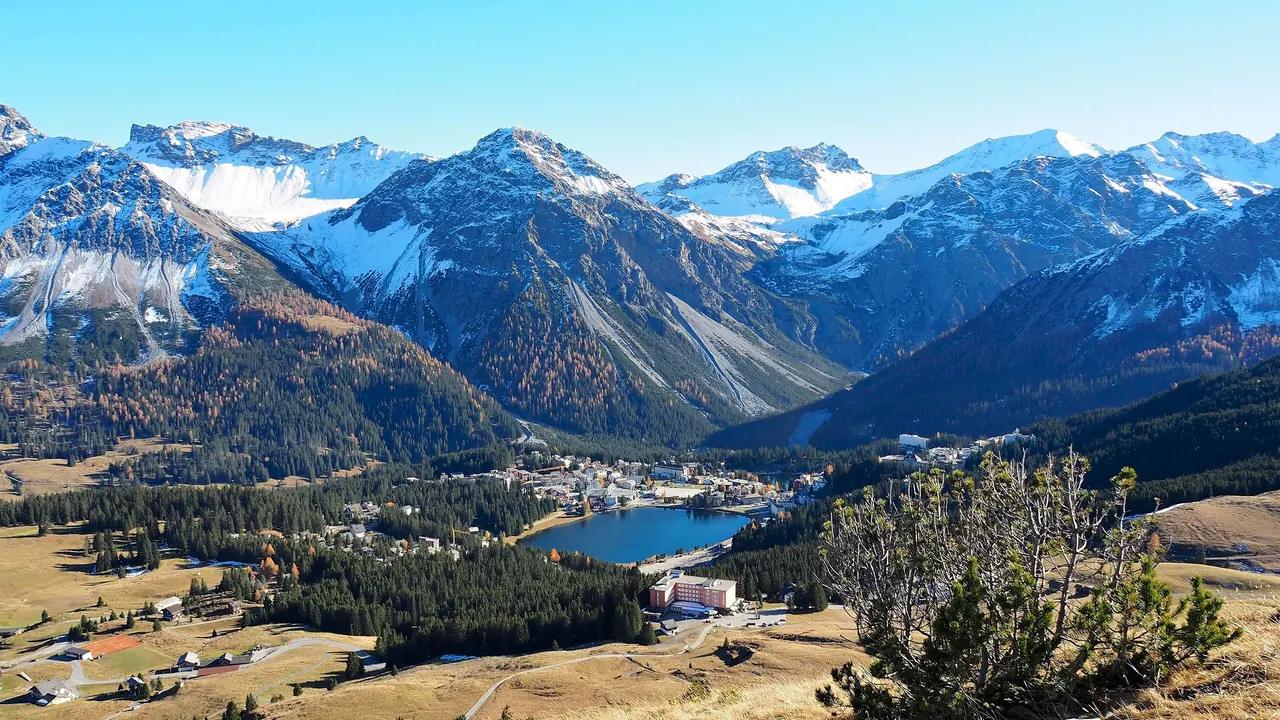
Photos: Arosa by Andres Passwirth, CC BY-SA 4.0, cropped.
Arosa or Verbier?
Our verdict in twelve categories, each scored against the same fixed benchmark cities, and the climate month by month, so you can choose for your trip.
Choose Arosa for
- families
- beaches
- getting around
Arosa suits travellers who want the mountains without the noise. It sits quietly at the end of its valley, the train runs right up to the village, and free buses and lifts take care of the rest, so a family or a couple can leave the car at home. The gentler ski area, sledging runs, lake swimming and the bear sanctuary make it the easier choice with children. Its past as a health resort still shapes evenings that are calm and end early.
Choose Verbier for
- nightlife
- day trips
- shopping
Verbier is for people who come for the mountain first and the evening second. The terrain above the village is bigger and steeper, with some of the most famous freeride slopes in the Alps, and after dark the après-ski and late bars go on far longer than anything in Arosa. It also makes a better base for exploring. Lake Geneva, the Rhône valley castles and Aosta in Italy are all within reach by car, and the summer classical festival gives music lovers a fixed date to plan around.
Scoreboard
Twelve categories on one fixed scale from 0 to 100. The shaded stretch is the gap between the two.
Your match
Pick a travel style or drag the sliders, and both match scores follow your weighting.
Wins on families and beaches with your weighting.
Wins on nightlife and day trips with your weighting.
What matters to you?
Category by category
What the scores mean for a trip.
Beaches & swimming
Neither village is a place to plan a swim, but Arosa at least gives you somewhere to get in the water. The Untersee has a proper lido with a lawn and a jetty, and on warm July and August afternoons the higher Obersee and Schwellisee are cold but swimmable.
In Verbier the alpine lakes such as Lac des Vaux are for looking at, so summer swimming means the sports centre pool or a hotel pool. Open water is on Lake Geneva, more than an hour away by car.
Food & drink
Verbier eats better, and much of that comes from its region. The Val de Bagnes makes one of Switzerland's best-known raclette cheeses, the Valais vineyards in the Rhône valley fill wine lists with Petite Arvine and Cornalin, and the village has a cluster of ambitious chef-led dining rooms.
Arosa's best meals are on the hut terraces, where you get capuns, barley soup and Graubünden dried meat with a view down the valley. Beyond those and a few hotel restaurants, the menus rarely go past fondue and raclette. In both places casual, cheap eating is scarce, and many kitchens close between seasons.
Culture & sights
Neither is a sightseeing destination, and an afternoon covers each. Arosa's interest is in its own story: the shingled Bergkirchli chapel on its meadow, and the grand hotels and local museum left from its years as a tuberculosis cure resort. Verbier is a twentieth-century ski village with almost nothing old in it, so its history lies down in Le Châble, with a stone church, granaries and a small museum of Bagnes valley life.
Nightlife
Verbier is the clear choice for going out. In winter the evening starts on terraces as the lifts close, moves into packed bars around the Place Centrale and ends in late clubs, with seasonal workers and wealthy visitors in the same rooms.
Arosa's après-ski is smart and subdued, with hotel bars and a couple of small clubs that stay open late only at weekends and in the busiest weeks. The exception is the January gay ski week, its liveliest time of year. Outside winter, both villages go quiet.
Nature & outdoors
Both are excellent mountain bases, but Verbier works on a bigger and wilder scale. Its lifts reach Mont Fort at about 3,300m, with glacier views as far as Mont Blanc and the Matterhorn, and the 4 Vallées area offers freeride and ski-touring terrain known around the world. In summer there is a bike park and paragliding, and the Haute Route runs nearby.
Arosa's basin of larches and lakes under the Weisshorn is gentler and more enclosed. The link to Lenzerheide still gives a large ski area, and in summer there are easy lake circuits, marmots on the upper meadows and high passes over to Davos.
Day trips
Verbier has far more within reach. Martigny's Roman remains, Sion's hilltop castles and the ancient abbey at Saint-Maurice are close, Chillon and the Lavaux vineyards on Lake Geneva are a little over an hour away, and the Great St Bernard pass leads to Aosta in Italy. A car makes most of these much easier.
From Arosa, every outing begins with the hour-long train ride down to Chur over the Schanfigg viaducts. Chur's old town and cathedral are a good day out, but Maienfeld, Liechtenstein and the Albula line all need two hours or more.
Good for families
Arosa is much easier with children. The village is safe, traffic is light, free buses help tired legs, and summer days are filled by the lakes, playgrounds, short walks to farm restaurants and the bear sanctuary. It struggles on rainy days, when there is little beyond the pool and the ice rink.
Verbier can work for a ski week if you base lessons at La Tzoumaz or Savoleyres, its gentler corners. The main village is steep and spread out, though, the slopes above it are famously difficult, and evenings are built around après-ski rather than children.
Getting around
Arosa is the simpler place to manage without a car. The Rhaetian Railway runs right into the village, and free buses link the station, the lake, Innerarosa and the lifts, although the hillside means plenty of stairs. The drawback is that every trip elsewhere goes back down the single line to Chur.
Getting to Verbier means a train to Le Châble and then a gondola up. Chalets are scattered across a steep slope, so walking to the centre in ski boots is hard work, and you end up relying on shuttles and taxis. For exploring the valley, a car helps a great deal.
Shopping & style
In both villages the shops are there mainly to equip you for the mountain, so rental counters and outdoor gear take up most of the street. Arosa stops roughly at that point. Add a handful of clothes boutiques and the chocolate and souvenir stores, and anything more means an afternoon in Chur's old town at the bottom of the railway.
Verbier goes further in two ways. Its sports shops are better stocked, which matters if you are buying touring or freeride kit for the terrain above the village, and its boutiques are aimed at chalet owners, so you find jewellery and things for the home as well as clothes. It also has better things to take home: Bagnes cheese, cured meats and a bottle from the Rhône valley vineyards beat anything on Arosa's main street. Neither suits a shopping trip, though, and from Verbier the nearest real choice is in Lausanne or Geneva.
Affordability
Both are very expensive, with peak winter weeks, lift passes and eating out costing what you would expect in a top Swiss resort. Where they differ is in how you can save. In Arosa the summer guest card perks and free buses help, along with self-catering apartments. In Verbier the main saving is to stay down the valley in Le Châble and ride the gondola up. Both are noticeably cheaper in summer.
Live music & performing arts
Verbier has the stronger draw for music lovers, though only for a couple of weeks each summer. Its festival, held since 1994, brings leading soloists and conductors to a large hall and the village church, with masterclasses open to the public.
Arosa's calendar is different in kind. A long-running December comedy festival puts stand-up and cabaret on stages around the village, some of them outdoors in the snow, and summer chamber concerts fill its churches, including the Bergkirchli. In both places the rest of the year is close to silent.
Wellness & relaxation
Arosa is the more restful choice, because calm is part of its character. It began as a place where people came to recover in the dry mountain air, and outside the busiest ski weeks its days are made of lake walks, sun terraces and early nights, with large hotel spas looking out on the peaks.
Verbier's hotel and chalet spas are just as well equipped, and it has something Arosa does not: thermal baths at Saillon and Lavey-les-Bains, each within about an hour. In peak winter, though, the village is busy and loud, so it feels restful only in the quieter months.
When should you go?
Pick your month. The climate figures are measured averages, not a forecast.
Arosa in July
Verbier in July
Daytime high, °C
Rainfall in the month, mm
Where the figures come from
Arosa's temperatures are measured 31 km from the centre, at Samedan.
Arosa has no rain gauge within 25 km of the centre, so its rainfall comes from a gridded climate dataset read at the destination rather than from a gauge further away.
Verbier has no weather station within reach, so its figures come from a gridded climate model rather than a measured record, and read a broad area rather than one spot.
Temperature and rainfall are climate normals, averaged over the years shown. Arosa: 2015-2025 (rainfall 1991-2020) normals, Samedan (31.2 km from centre). Verbier: 1991-2020 normals, TerraClimate 4 km grid at the town, no weather station within 90 km.
Both villages are winter places first, with daytime highs around freezing from December to February. Arosa's summer is a little warmer, reaching about 20°C in July, which is just enough for a cold dip in its lakes in July and August. June to August are also its wettest months, though, at around 150mm each, so afternoon showers are part of hiking there. Its winters are drier by comparison.
Verbier has the opposite pattern. Its summer peaks at about 18°C in August but stays drier, and September is the driest month of all, which makes late summer the best time for long high walks. The heaviest precipitation comes in November and December, at up to 145mm, so there is plenty of fresh snow as the ski season begins. In both places April is the tail end of the ski season, and Verbier's high runs towards Mont Fort usually stay open longest. May and late autumn fall between the ski and hiking seasons.
Which traveller are you?
On a family trip with children, Arosa is the better choice. It is easy to manage without a car, with free buses, gentle ski-school areas, long sledging runs, a lido on the Untersee and the bear sanctuary. Verbier's steep hillside and demanding slopes suit adults better.
For a food and nightlife trip, choose Verbier. Raclette made with Val de Bagnes cheese and wines from the Valais vineyards below make dinners more memorable, and the après-ski and late clubs around the Place Centrale keep going long after Arosa's hotel bars have closed.
On a relaxing and wellness trip, Arosa has the edge. It was built for convalescence, its rhythm is slow, and quiet hotel spas look out on the peaks. Verbier has thermal baths down the valley, but in peak winter weeks the village is loud rather than restful.
Before you go
| Measure | Arosa | Verbier |
|---|---|---|
| Official language | French, German, Italian, Romansh | French, German, Italian, Romansh |
| Currency | Swiss Franc (CHF) | Swiss Franc (CHF) |
| Sockets | CJ230 V, 50 Hz | CJ230 V, 50 Hz |
| Driving side | Right | Right |
| Time zone | UTC+1, UTC+2 in summer | UTC+1, UTC+2 in summer |
| Emergency number | 112 | 112 |
| Elevation | 1,775 m | 1,490 m |
| Main airport | Zürich Airport (ZRH)114 km from centre226 non-stop destinations | Geneva International Airport (GVA)88 km from centre150 non-stop destinations |
| Public holidays this year | 9 days | 9 days |
By the numbers
| Measure | Arosa | Verbier |
|---|---|---|
| Population | 3,185 | - |
| People per km² | 21 | - |
| Museums within 10 km | 1 | 4 |
| UNESCO World Heritage sites within 50 km | 2 | 0 |
Where else could you go?
Every comparison below shares a destination with this one, so you can follow Arosa or Verbier somewhere new.
- Lenzerheidevs Arosa
- Davosvs Arosa
- Klostersvs Arosa
- Crans-Montanavs Verbier
- Laaxvs Arosa
- St. Moritzvs Arosa