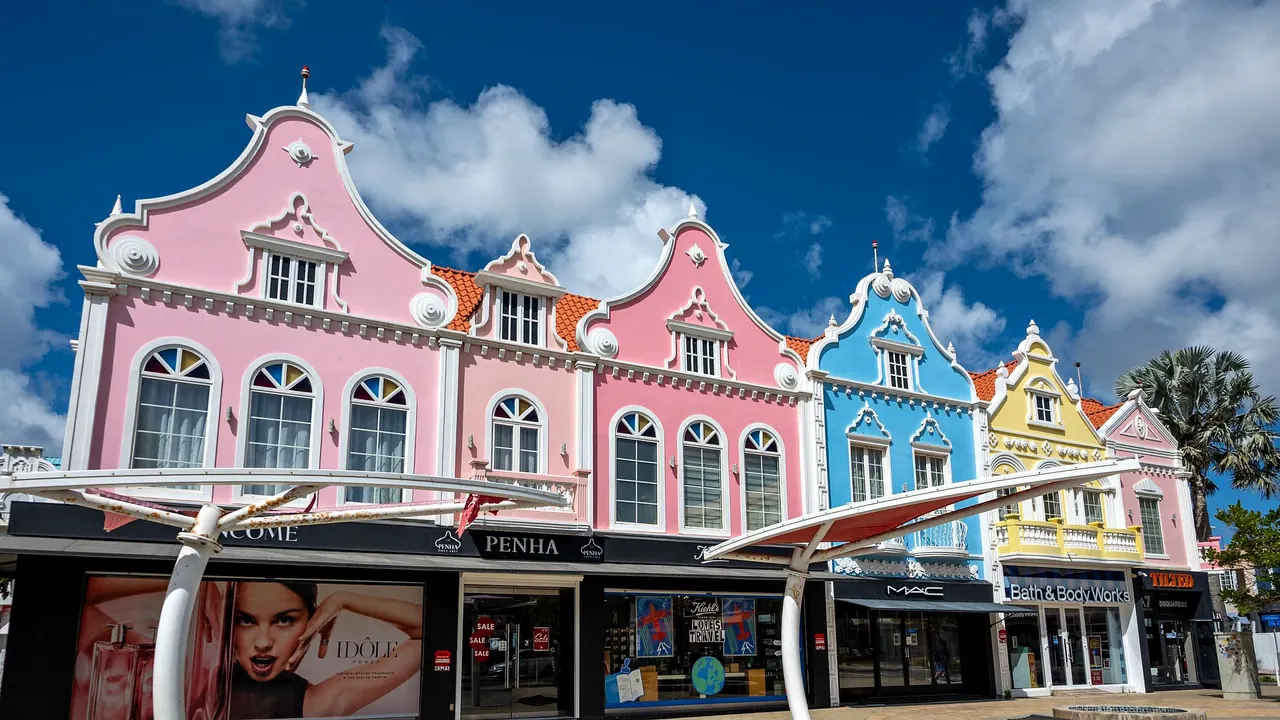
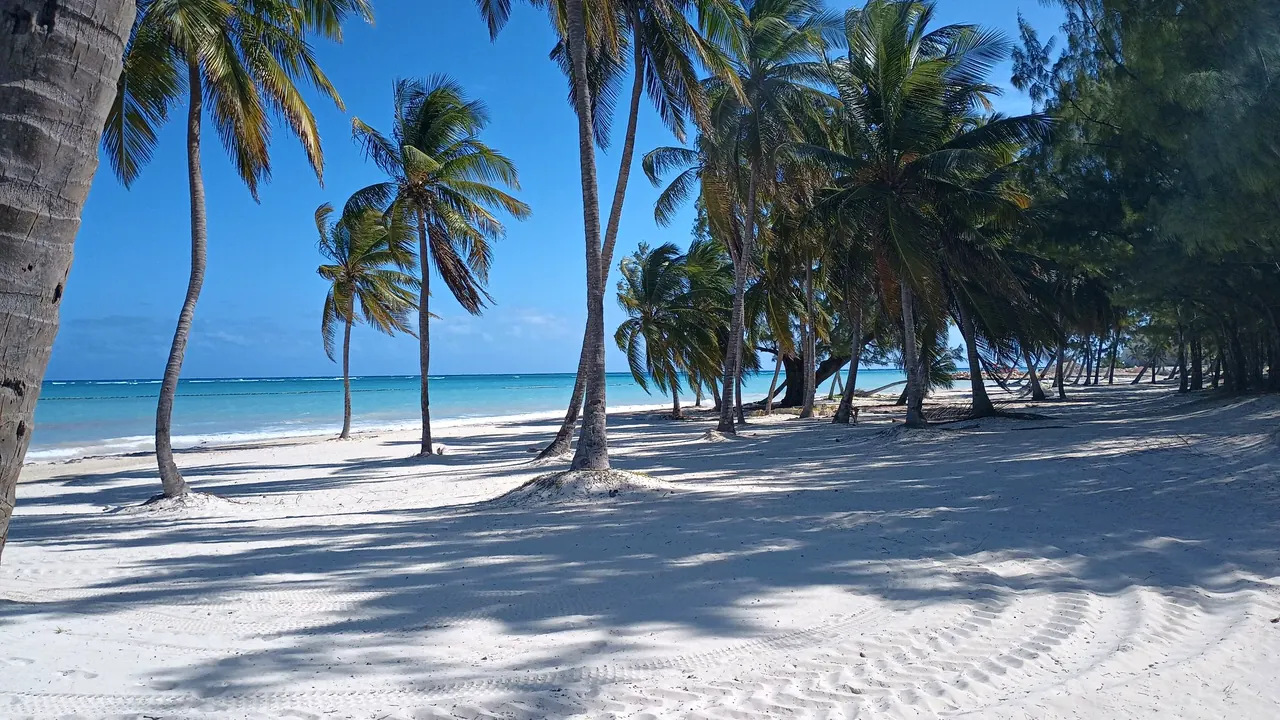
Photos: Aruba by xiquinhosilva, CC BY 4.0, cropped; Punta Cana by Mary Mark Ockerbloom, CC0.
Aruba or Punta Cana?
Our verdict in twelve categories, each scored against the same fixed benchmark cities, and the climate month by month, so you can choose for your trip.
Choose Aruba for
- getting around
- culture and sights
- food and drink
Aruba suits travellers who want an easy island they can move around themselves. The sheltered west coast stays dry for most of the year, and buses link Oranjestad with Eagle Beach and Palm Beach. A hire car covers everything else in a day. The jetty fish restaurants and Dutch Caribbean cooking in the small towns also give you reasons to leave the hotel. It is the dearer of the two, so it fits a trip where reliable weather and freedom to roam matter more than the bill.
Choose Punta Cana for
- prices
- day trips
- nature and the outdoors
Punta Cana is the better choice for a contained all-inclusive week that costs less. Its long reef-sheltered coast matches Aruba's beaches, the packages are kinder to the budget, and the Dominican mainland behind it offers proper outings: Higüey's basilica, Altos de Chavón and, on a long day, Santo Domingo's colonial quarter. In return you get a coast with no centre to walk around, a taxi or tour for every move and noticeably wetter months in the second half of the year.
Scoreboard
Twelve categories on one fixed scale from 0 to 100. The shaded stretch is the gap between the two.
Your match
Pick a travel style or drag the sliders, and both match scores follow your weighting.
Too close to call, 2 points apart
Wins on getting around and culture and sights with your weighting.
Wins on prices and day trips with your weighting.
What matters to you?
Category by category
What the scores mean for a trip.
Beaches & swimming
Both are first-rate beach destinations, but they are shaped differently. Aruba's best sand is in a few named stretches on the sheltered coast. You get the wide, roomy Eagle Beach, the resort-lined Palm Beach, snorkelling at Arashi and the enclosed lagoon of Baby Beach, which is ideal for small children. The island also lies outside the usual hurricane track. Its windward north coast is for looking at, not swimming.
Punta Cana has one almost unbroken ribbon of sand, around 50km long and protected by an offshore reef. You can walk it for miles between Bávaro, Juanillo and Cap Cana, or head to Macao for surf. Catamarans also run out to Saona Island. Expect sargassum seaweed in some summers, although the resorts rake it away each morning.
Food & drink
Aruba is the better place to eat, if not a gastronomic destination. Away from the resort grills, the fish restaurants on jetties along the south coast are a real treat. The small eateries in Oranjestad, Savaneta and San Nicolas serve keshi yena, pastechi and fresh wahoo, and the late-night food trucks are part of island life.
In Punta Cana most meals come from an all-inclusive buffet or a themed à la carte room: plentiful but forgettable. The Dominican food worth seeking out, such as la bandera, sancocho and mangú at breakfast, is in roadside comedores used by local workers, and you have to go looking for it.
Culture & sights
Neither is a cultural destination, but Aruba at least has some heritage of its own. Oranjestad's pastel Dutch facades, Fort Zoutman with its small museum, the archaeological museum on the Caquetío past, the Bushiribana gold mill ruins and the San Nicolas murals add up to a day or two of sightseeing.
Punta Cana is a resort coast built from the 1970s onwards, with no old town and no museums. Beyond craft and cigar displays there is nothing to see locally, so anyone curious about history has to leave on an excursion.
Nightlife
Evenings are much the same size in both, but they work differently. Aruba's nights gather along the Palm Beach strip, which you can walk between beach bars, lounges and hotel casinos. Party buses add a sociable group outing, and the mood stays relaxed rather than wild.
Punta Cana keeps most guests in their resort with a show and a disco that winds down around midnight. Bávaro is louder, with big acrobatic party clubs, a club inside a limestone cave and colmados playing bachata late. Each move there means a taxi.
Nature & outdoors
The outdoors is about equal, but Aruba has more to offer on land. Arikok National Park covers cactus country, caves with Indigenous drawings, dunes and the Natural Pool. Add the boulder fields at Ayo and Casibari and the climb up Hooiberg. On the water, the steady winds off Palm Beach and the SS Antilla wreck draw windsurfers and divers.
Punta Cana's country is flat, so its outdoors is mostly on the water. You can snorkel the reef, take a boat across Parque Nacional del Este to Saona and the starfish pool, or go deep-sea fishing for marlin. On land there are short lagoon trails in the Indigenous Eyes reserve and the sinkhole of Hoyo Azul.
Day trips
Punta Cana has far more to reach. Higüey's pilgrimage basilica is under an hour inland, and Altos de Chavón and the Saona departure point at Bayahibe are not much further. Santo Domingo's Zona Colonial, the oldest European city in the Americas, makes a long but worthwhile day out.
Aruba is too small for real day trips. San Nicolas and Savaneta are simply part of exploring the island, and Curaçao and Bonaire need a flight, so you will run out of outings within a few days.
Good for families
With children, Aruba makes it easy to leave the hotel, while Punta Cana is built so you hardly need to. On Aruba English is spoken everywhere, nothing is far away and the sheltered coves are shallow enough for small children to try snorkelling. Days out are gentle: a butterfly farm, a donkey sanctuary, an ostrich farm or a submarine trip.
In Punta Cana, many resorts are designed around families, with splash parks, waterslides, kids' clubs and food all day. For outings there are adventure parks with zip lines and cenotes, dolphin encounters and catamarans to Saona, but each one needs a tour or a taxi. Bring mosquito repellent and pick a family resort, not a party one.
Getting around
Aruba is much easier to get around. Buses run along the west coast between Oranjestad, Eagle Beach, Palm Beach and Arashi, a small streetcar loops through the capital, and a hire car reaches any corner in well under an hour. Only the Natural Pool and parts of Arikok need a four-wheel drive or a tour.
Punta Cana's resorts sit behind gates along a coast with few pavements, so the beach is the only pleasant place to walk. Otherwise it means hotel taxis, transfers or guaguas, and driving yourself means fast, unpredictable traffic.
Shopping & style
Aruba has the larger and more polished choice of shops. Oranjestad's pedestrian main street and harbour malls are lined with duty-free watches, jewellery and perfume, and there are a few open-air malls at Palm Beach. The local buys are few: aloe products, Dutch cheese and some painted ceramics.
Punta Cana has less retail but souvenirs with more character. Larimar, a pale blue stone found only on Hispaniola, is sold at the craft stalls on Bávaro beach alongside amber, hand-rolled cigars, cacao and painted faceless dolls, and you are expected to haggle. Apart from these stalls and a couple of open-air malls, there is little to browse.
Affordability
Punta Cana is the clearly cheaper choice. All-inclusive packages booked with flights can be good value, and the costs that add up are mainly taxis, boat trips and beachfront meals. Cap Cana and the grander resorts are another matter.
Aruba is expensive across the board, because almost everything is imported and priced for well-off visitors. Food trucks, supermarkets, kitchen apartments and the buses help, but they only soften the bill.
Live music & performing arts
Neither has theatre or concert life to speak of. The real difference is the rhythm. Aruba's moment is Carnival, weeks of parades, tumba competitions and road marches before Lent, plus folk evenings near Fort Zoutman. In Punta Cana the live merengue and bachata at beach bars are the genuine article, with glossy acrobatic shows in Bávaro for a big night.
Wellness & relaxation
For rest and pampering the two are much alike. In both, wellness means a resort spa rather than a bathing tradition, and neither has thermal springs or bathhouses. On Aruba the large hotels on Palm Beach and Eagle Beach have full-service spas, and treatments often use aloe from the island's long-established aloe industry. Add yoga sessions, beach massages and a few adults-only hotels, and with the trade wind and short distances there is little reason to hurry.
Punta Cana's resort spas run to hydrotherapy circuits and steam rooms, with cacao, coffee and coconut in the treatments and masseurs working under palm shelters along Bávaro beach. The standard is dependable, though one spa feels much like the next. What matters more there is the resort you book, because family and party resorts can be loud, so pick an adults-only or quieter one if calm is the point.
When should you go?
Pick your month. The climate figures are measured averages, not a forecast.
Aruba in July
Punta Cana in July
Daytime high, °C
Rainfall in the month, mm
Where the figures come from
Aruba has no rain gauge within 25 km of the centre, so its rainfall comes from a gridded climate dataset read at the destination rather than from a gauge further away.
Temperature and rainfall are climate normals, averaged over the years shown. Aruba: 2005-2025 (rainfall 1991-2020) normals, Queen Beatrix Airport (8.5 km from centre). Punta Cana: 1993-2020 (rainfall 1991-2020) normals, Punta Cana (0.9 km from centre).
Both are warm enough for the beach every month, with daytime highs of around 30°C or more all year and a sea that stays between 26°C and 29°C. The real difference is rain. Aruba is almost desert-dry from February to August. Even its wettest stretch, October to December, peaks at only about 76mm in November. August and September are its hottest weeks, and in those months the trade wind makes walking around Oranjestad bearable.
Punta Cana is wetter throughout. February and March are its driest months. From May the rain builds steadily to around 130mm in September, and it stays wet through to December. For the most settled weather in Punta Cana, aim for January to April. For dates in late summer or autumn, Aruba is much the safer choice.
Which traveller are you?
On a trip on a tight budget, Punta Cana is the clear pick. Package deals that bundle flights and all-inclusive rooms keep costs predictable. Local comedores, guaguas and the small apartment hotels around Los Corales help further, while Aruba is expensive across the board.
For a food and nightlife trip, Aruba gives more to work with. Its jetty fish restaurants, keshi yena in Oranjestad and late-night food trucks beat Punta Cana's resort buffets. The Palm Beach strip can be walked from bar to casino, with no taxis between scattered clubs.
For a culture and arts trip, Aruba has more on the island itself: Oranjestad's colonial waterfront, Fort Zoutman, the archaeological museum, the gold mill ruins and the San Nicolas murals. Punta Cana has nothing comparable at home, though Santo Domingo is within a long day's reach.
Before you go
| Measure | Aruba | Punta Cana |
|---|---|---|
| Official language | Dutch, Papiamento | Spanish |
| Currency | Aruban Florin (AWG) | Dominican Peso (DOP) |
| Sockets | ABF127 V, 60 Hz | AB110 V, 60 Hz |
| Driving side | Right | Right |
| Time zone | UTC-4 | UTC-4 |
| Emergency number | 911 | 911 |
| Elevation | - | 28 m |
| Main airport | Queen Beatrix International Airport (AUA)35 non-stop destinations | Punta Cana International Airport (PUJ)1 km from centre93 non-stop destinations |
| Public holidays this year | 12 days | 13 days |
By the numbers
| Measure | Aruba | Punta Cana |
|---|---|---|
| Population | 106,739 | 138,919 |
| People per km² | 553 | 292 |
| Museums within 10 km | - | 0 |
| UNESCO World Heritage sites within 50 km | - | 0 |
| Swim season, months above 21 °C | 12 months | 12 months |
Where else could you go?
Every comparison below shares a destination with this one, so you can follow Aruba or Punta Cana somewhere new.
- La Romanavs Punta Cana
- Curaçaovs Aruba
- Santo Domingovs Punta Cana
- Bonairevs Aruba
- San Juanvs Punta Cana
- Puerto Platavs Punta Cana