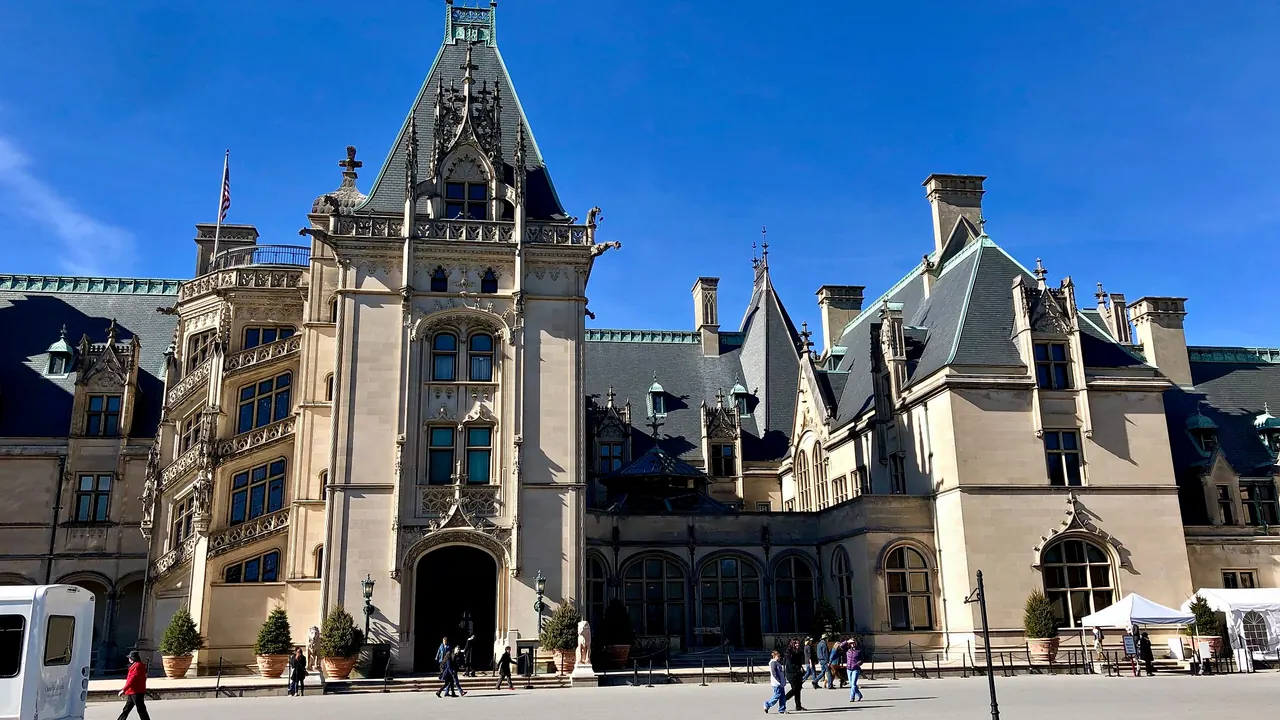
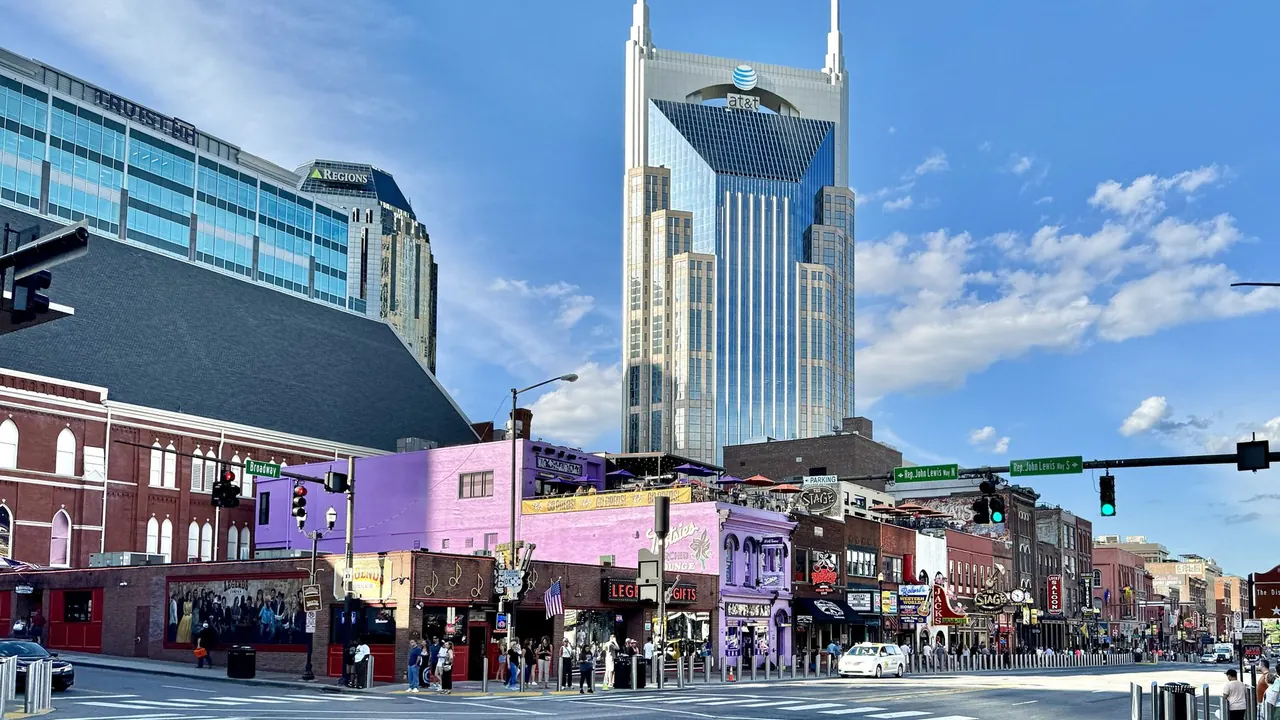
Photos: Asheville by Warren LeMay, CC0; Nashville by Warren LeMay, CC BY-SA 2.0, cropped.
Asheville or Nashville?
Our verdict in twelve categories, each scored against the same fixed benchmark cities, and the climate month by month, so you can choose for your trip.
Choose Asheville for
- nature and the outdoors
- wellness
- shopping
Asheville is for travellers who want mountains on the doorstep: ridge hikes, waterfalls, mountain biking and whitewater by day, then a taproom and a quiet inn porch in the evening. The Biltmore Estate and a downtown of handsome Art Deco buildings add a day or two of sightseeing, and it is much the calmer place to rest.
Choose Nashville for
- nightlife
- live music and the arts
- beaches
Come to Nashville for the music and the nights out. The Opry, the Ryman, the songwriter rooms and the honky-tonks of Lower Broadway make this a trip built around evenings, with hot chicken and Tennessee whiskey between shows. It suits groups and music lovers far better than anyone looking for quiet or wild country.
Scoreboard
Twelve categories on one fixed scale from 0 to 100. The shaded stretch is the gap between the two.
Your match
Pick a travel style or drag the sliders, and both match scores follow your weighting.
Wins on nature and the outdoors and wellness with your weighting.
Wins on nightlife and live music and the arts with your weighting.
What matters to you?
Category by category
What the scores mean for a trip.
Beaches & swimming
Neither city is a beach destination, so the difference lies in the kind of water. Asheville's swimming is cold and wild: pools under waterfalls in Pisgah, the natural rock slide at Sliding Rock, tubing on the French Broad and a small sandy beach at Lake Lure. Nashville's reservoirs, Percy Priest and Old Hickory, stay warm through the summer and suit a lazy afternoon on a pontoon boat better than a bracing plunge.
Food & drink
These are two Southern kitchens of similar strength, pulling in different directions. Asheville's pride is its beer, with dozens of taprooms across downtown, the South Slope and West Asheville, and cooking built on Appalachian farm produce such as trout, ramps and heirloom corn.
Nashville answers with hot chicken, meat-and-three cafeterias and Tennessee whiskey. It also has the wider international reach, thanks to the Kurdish, Mexican and Vietnamese places along Nolensville Pike. Go to Asheville for beer and farm cooking, and to Nashville for its signature dishes and a little more variety.
Culture & sights
The two have different kinds of sight. Asheville's are architectural and historic. The Biltmore Estate fills a whole day, and downtown has a rare run of Art Deco and Beaux-Arts buildings around City Hall, the Grove Arcade and the Basilica of St Lawrence.
Nashville's sights are almost all about music, led by the Country Music Hall of Fame, the National Museum of African American Music and a daytime tour of the Ryman, while the Parthenon replica and the Frist add some art. Each takes two or three days. Asheville is the better choice for old buildings, and Nashville is better if the history of a sound draws you.
Nightlife
Nashville offers by far the bigger night out. Lower Broadway's multi-storey honky-tonks have a band on every floor and a crowd that stays until the small hours, and the hen and stag groups give weekends a party feel. East Nashville and Midtown are calmer alternatives.
Asheville's evenings are gentler. Taprooms, cocktail bars and dives downtown, on the South Slope and along Haywood Road fill with a relaxed mix of locals and visitors, and most close around midnight. It is a good town for a few beers with friends but not for a night that keeps going.
Nature & outdoors
This is where Asheville pulls well ahead. The Blue Ridge Parkway, Pisgah National Forest and the Great Smoky Mountains put real mountain country within an hour, with ridge walks over grassy balds, waterfall trails, serious mountain biking and whitewater on the Nantahala and Pigeon rivers.
Nashville's outdoors are gentler and closer to home: easy trails at Radnor Lake and the Warner Parks, greenways along the Cumberland, a canoe trip on the Harpeth and cycling on the Natchez Trace Parkway. They make a pleasant morning, but few people plan a trip around them the way hikers plan one around Asheville.
Day trips
Neither city has a major destination within easy reach, and their outings have a different flavour. From Asheville most trips go into the landscape: Brevard's waterfall country, small towns such as Hendersonville and Black Mountain, and Cherokee, which gives the deepest look at the region's original people. From Nashville the themes are Civil War history and whiskey, with Franklin's preserved Main Street and battlefields, Stones River at Murfreesboro and the distilleries around Lynchburg, and Chattanooga at the far edge of a long day.
Good for families
Families do about equally well in either city, but the days look different. Asheville suits active children, with black bears and red wolves at the Nature Center, Sliding Rock, river tubing, zip lines and the farmyard at Biltmore. Nashville has the town attractions Asheville lacks: a good zoo, the Adventure Science Center with its planetarium and a summer water park, though Lower Broadway is no place for children in the evening.
Getting around
Both work the same way, with a compact downtown you can walk and a car for nearly everything else. The difference is the kind of driving. In Asheville it means slow, winding mountain roads that clog on October weekends. In Nashville it means interstates that jam at rush hour, and ride-hailing is the more practical way between neighbourhoods such as East Nashville and 12 South.
Shopping & style
Asheville is the better place to shop if you want something handmade. Pottery, glass, weaving and woodwork come straight from the River Arts District studios, the downtown galleries and the craft guild's showcase at the Folk Art Center, and there are independent shops in the Grove Arcade.
Nashville's offer is narrower: cowboy boots, rhinestone shirts, guitars and letterpress concert posters, plus boutiques and record shops in 12 South and East Nashville. Neither city has much in the way of luxury brands in the centre.
Affordability
Neither city is cheap, but Asheville costs a little less. Its inns are pricey, especially on leaf-season weekends, and the Biltmore ticket and a hire car add up. The trails, the waterfalls and the Parkway, though, cost nothing.
Nashville's downtown hotels are dearer still, especially when groups arrive at weekends, and ride-hailing across a spread-out city soon mounts up. What saves money there is the free music on Broadway and cheap meals at meat-and-three cafeterias and hot chicken counters.
Live music & performing arts
Music is the reason most people visit Nashville, and here it leads by a long way. Alongside the Grand Ole Opry and the Ryman are intimate songwriter nights and bluegrass and Americana rooms. The symphony plays in the Schermerhorn, and ballet and opera are staged at the Tennessee Performing Arts Center.
Asheville's music is rootsier and smaller in scale: bluegrass and old-time jams, buskers, a few venues for touring bands, and free evenings of fiddle music and clogging at Shindig on the Green. It makes a lovely extra on a mountain trip, but the concert halls and theatres are modest.
Wellness & relaxation
Rest comes easily in Asheville because the setting does most of the work. The evenings are cool, the town moves at an unhurried pace, and a slow day can be nothing more than a gentle drive along the Parkway or an afternoon beside a mountain creek. Calm is the ordinary mood of the place, not something you have to book.
In Nashville a restful stay takes deliberate effort. Downtown runs on noise and late nights, so anyone after quiet should stay in the leafy streets of Belmont or Hillsboro, or south of the city, where porch-front cafés and quiet parks set a gentler rhythm. A massage there means a hotel or day spa, a treat to fit between shows rather than a reason to come.
When should you go?
Pick your month. The climate figures are measured averages, not a forecast.
Asheville in July
Nashville in July
Daytime high, °C
Rainfall in the month, mm
Where the figures come from
Asheville's temperatures are measured 50 km from the centre, at Asheville Regional Airport.
Asheville has no rain gauge within 25 km of the centre, so its rainfall comes from a gridded climate dataset read at the city rather than from a gauge further away.
Temperature and rainfall are climate normals, averaged over the years shown. Asheville: 1991-2020 (sunshine 1981-2010) normals, Asheville Regional Airport (50.3 km from centre). Nashville: 1991-2020 (sunshine 1981-2010) normals, Nashville Airport (9.6 km from centre).
The two cities follow a similar calendar. Winters are cool, with January highs near 9°C in both, rain falls fairly evenly through the year, and neither has a beach season to speak of. The real difference is summer. Asheville's altitude keeps July to around 29°C, which is comfortable for hiking. Nashville reaches 32°C in July and August, and the humid heat makes walking between sights heavy going in the middle of the day.
Spring and autumn are the best seasons in both. Asheville's May and June bring the rhododendron bloom and long sunny days, and October, its driest month, brings the leaf colour. Nashville is wettest from March to May, at around 120mm a month, so October, drier and still sunny, is its most reliable month. Through the winter Asheville also gets noticeably more sunshine.
Which traveller are you?
On an outdoors trip, Asheville is the clear pick. The Blue Ridge Parkway, Pisgah National Forest and the Great Smokies put ridge hikes, waterfall trails, mountain biking and rafting within an hour, where Nashville manages pleasant lake walks and riverside greenways.
For a food and nightlife trip, Nashville wins. Hot chicken and meat-and-three cafeterias by day lead into honky-tonks with live bands until the small hours, plus songwriter rooms for a quieter night. Asheville's evenings of craft beer mostly wind down by midnight.
On a relaxing and wellness trip, choose Asheville. Its old reputation for healing mountain air survives in retreats, yoga studios and resort spas, with riverside mineral tubs at Hot Springs and quiet inn porches. Nashville's loud downtown offers little beyond hotel spas.
Before you go
| Measure | Asheville | Nashville |
|---|---|---|
| Currency | US Dollar (USD) | US Dollar (USD) |
| Sockets | AB120 V, 60 Hz | AB120 V, 60 Hz |
| Driving side | Right | Right |
| Time zone | UTC-5, UTC-4 in summer | UTC-6, UTC-5 in summer |
| Emergency number | 911 | 911 |
| Elevation | 650 m | 182 m |
| Main airport | Asheville Regional Airport (AVL)18 km from centre27 non-stop destinations | Nashville International Airport (BNA)10 km from centre122 non-stop destinations |
| Public holidays this year | 14 days | 13 days |
By the numbers
| Measure | Asheville | Nashville |
|---|---|---|
| City population | 94,589 | 689,447 |
| People per km² | 796 | 506 |
| Museums within 10 km | 4 | 12 |
| UNESCO World Heritage sites within 50 km | 0 | 0 |
Where else could you go?
Every comparison below shares a destination with this one, so you can follow Asheville or Nashville somewhere new.
- Gatlinburgvs Asheville
- Pigeon Forgevs Asheville
- Atlantavs Asheville
- Pigeon Forgevs Nashville
- Gatlinburgvs Nashville
- Memphisvs Nashville