Australia
Port Douglas
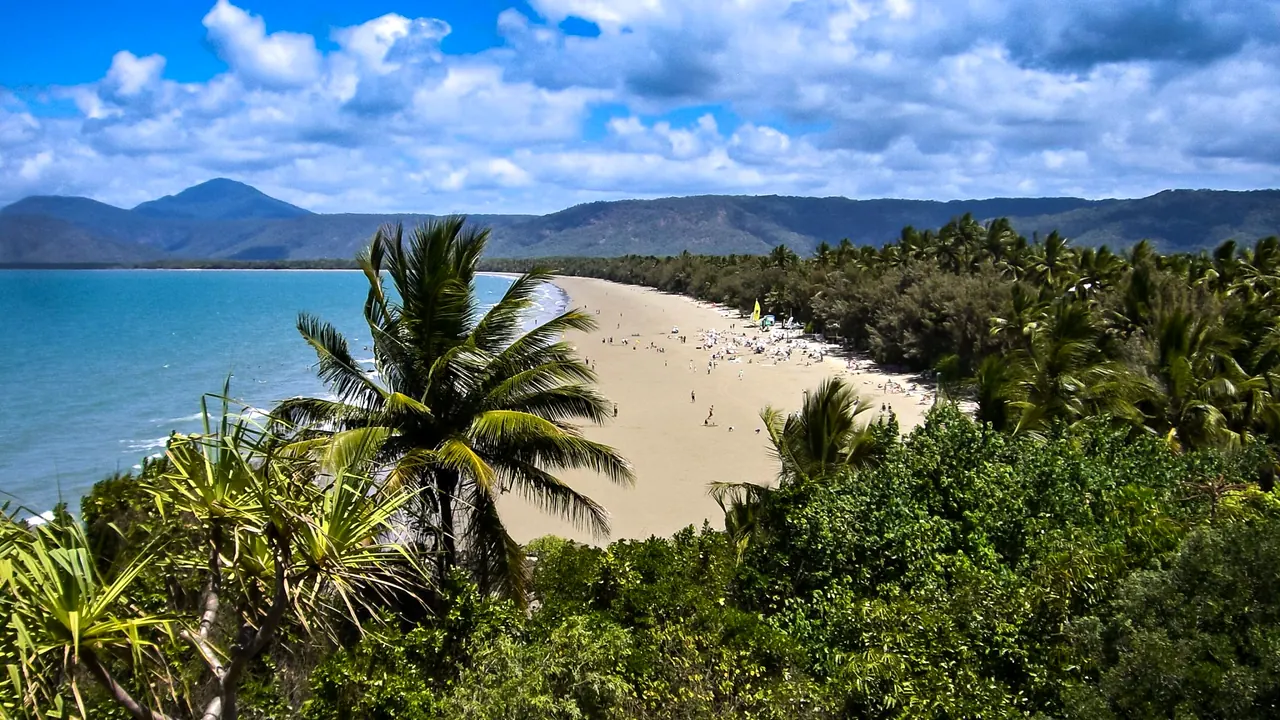
Four Mile Beach from Flagstaff Hill
- Nature & outdoors93
- Beaches68
- Families60
Match
39
Every category weighted equally
- Beach & sun46
- Culture & arts30
- Food & nightlife30
- Family trip46
- Outdoors48
- Relax & unwind47
- Shopping & style34
- On a budget37
Port Douglas in twelve categories
Our verdict on each, scored 0 to 100 against the same fixed benchmark cities, so a score means the same thing on every page.
Beaches & swimming. Scores 68 out of 100.
Food & drink. Scores 38 out of 100.
Culture & sights. Scores 10 out of 100.
Nightlife. Scores 18 out of 100.
Nature & outdoors. Scores 93 out of 100.
Day trips. Scores 30 out of 100.
Good for families. Scores 60 out of 100.
Getting around. Scores 42 out of 100.
Shopping & style. Scores 28 out of 100.
Affordability. Scores 20 out of 100.
Live music & performing arts. Scores 8 out of 100.
Wellness & relaxation. Scores 55 out of 100.
Port Douglas category by category
Beaches & swimming
68Four Mile Beach runs south from the town in a long, palm-backed curve of flat, firm sand, and walking, lying on and swimming off it is a large part of any stay. The sea is warm all year, from around 23°C in the dry winter to about 29°C in summer, but this is the tropics and it comes with rules. From roughly November to May, box jellyfish and irukandji drift inshore, so swimming means the small netted enclosure patrolled by lifeguards, or a full-length stinger suit.
The inshore water is often milky green rather than clear, stirred up by the shallow, sandy bottom and the rivers. Crocodiles live in the estuaries, so creeks and river mouths are never for swimming. The dry season, from about June to October, is the time for beach days, with calmer water and the stinger worry gone; in the wet, many visitors swim in resort pools instead.
Food & drink
38Eating out is concentrated on and around Macrossan Street and the marina, where the choice is pleasant and shaped by the resort trade: grilled reef fish, prawns and mud crab, modern Australian plates, pizza, Thai and a few polished dining rooms for a dressed-up evening. Breakfast cafés and juice bars do well with the local mangoes, papayas and pineapples, and the Sunday market in Anzac Park adds tropical fruit, coconuts and sugar cane juice. It is a good place for a long seafood dinner outdoors, but the range is limited for a stay of more than a week and there is no cuisine here that you could not find elsewhere in Australia.
Culture & sights
10Port Douglas has very little in the way of sights. The old Court House, now a small local history museum, and the white timber chapel of St Mary's by the Sea, with its window framing the sea, are the two buildings worth seeing, and both take minutes. The most meaningful cultural experience is just outside town, where Kuku Yalanji guides lead walks at Mossman Gorge explaining the rainforest as their country. Visitors come for the reef and rainforest, not for museums or architecture.
Nightlife
18Evenings revolve around dinner and a drink at one of the old pubs or bar terraces on Macrossan Street and around the marina, with a cover band some nights and a cheerful crowd in the dry season. There is no club scene to speak of, and because reef boats leave early, most people are in bed well before midnight. Anyone after a proper night out drives an hour to Cairns.
Nature & outdoors
93This is the one place where two of the world's great natural areas meet. Boats leave the marina daily for the outer ribbon reefs of the Great Barrier Reef, about ninety minutes out, where divers and snorkellers drift over coral walls, giant clams, turtles and reef sharks, and from about June to August dwarf minke whales pass through. Closer in, Low Isles makes a gentle reef day. On land, Mossman Gorge is about twenty minutes away, with boardwalks through ancient rainforest, and the Daintree River and Cape Tribulation lie beyond, with crocodile cruises, cassowaries and forest running down to the sea.
Flagstaff Hill gives a short walk with views along Four Mile Beach, and the flat roads suit cycling. The dry season, from about May to October, is the best time; the wet brings heavy rain, humid heat and rough seas that can cancel trips.
Day trips
30Most excursions from Port Douglas are into reef and rainforest rather than to other places. Cairns, about an hour south along the coast road, is the regional city with its esplanade lagoon, galleries and wider shopping. Kuranda, the hill village above the Barron Gorge, is reached by road or by the old mountain railway and cable car from the Cairns side, and is a popular day of markets and wildlife sanctuaries. The Atherton Tablelands, with small towns such as Yungaburra and crater lakes, take most of a day. Mossman and Daintree Village are close but small. Beyond these, the towns are few and far apart.
Good for families
60Families do well here. The town is small, safe and unhurried, resort pools take the place of the sea in stinger season, and the Wildlife Habitat lets children meet koalas, kangaroos, crocodiles and cassowaries up close. Low Isles is a gentle first reef trip, with snorkelling straight off the sand, and glass-bottom and semi-submersible boats show coral to children too young to swim with it. Rainforest boardwalks at Mossman Gorge suit small legs.
The limits are those of the tropics: swimming only within the nets in summer, crocodile warnings along every creek, heavy humid heat in the wet, and long, sometimes choppy boat rides to the outer reef. Beyond the wildlife park, there is little built specifically for children.
Getting around
42The town centre is compact and flat, so Macrossan Street, the marina and the north end of Four Mile Beach are an easy walk, and bicycles are a common way to get between the resorts along Port Douglas Road and the centre. Beyond that, public transport is thin: a local shuttle bus runs the main road, and reef and rainforest tours generally include hotel pick-up. Anyone who wants to explore the Daintree or the Tablelands at their own pace needs a car, and arriving means a road transfer of about an hour from Cairns airport.
Shopping & style
28Shopping is a stroll along Macrossan Street and the marina: linen and resort-wear boutiques, swimwear, homeware, jewellery made with South Sea pearls and a few galleries selling Aboriginal and tropical art. The Sunday market in Anzac Park, under the trees by the water, adds local crafts, sarongs and produce. It is pleasant browsing on a warm evening, but the selection is small and anyone needing more heads to Cairns.
Affordability
20This is an expensive place to spend a vacation. Most of the places to stay are resorts and serviced apartments at the upper end of the market, and restaurants charge Australian resort prices. The outer reef trips and guided rainforest tours that are the reason for coming are paid excursions, and they soon add up. There are a few ways to keep costs down. Self-catering apartments, the supermarket in town and casual takeaway seafood eaten by the beach all help, and so do the cheaper rates of the wet season. Walking, cycling and free days on Four Mile Beach also save money. Still, a visitor on a tight budget will feel the cost of every day here.
Live music & performing arts
8There is no theatre, concert hall or regular live-music venue. Live music means an acoustic set or cover band at a pub or on a bar terrace, and the town's yearly carnival in autumn brings outdoor music and street parades. For anything more formal, Cairns is the nearest option.
Wellness & relaxation
55Port Douglas is built for slowing down. The pace is unhurried, days follow the sun and tide, and the larger resorts run day spas with treatments using native botanicals, alongside massage studios and yoga classes in town. Lagoon pools under palms are the main place people simply lie still. There is no bathing tradition, thermal water or bathhouse culture, so the restorative side comes from the setting and the hotels rather than anything particular to the place.
When should you go?
Pick a month to see what it is like. The climate figures are measured averages, not a forecast.
Port Douglas in July
Daytime high, °C
Rainfall in the month, mm
The whole year
Shaded against this city’s own year: the deepest cell is its best month for that figure and the palest its weakest.
Temperature and rainfall are climate normals, averaged over the years shown. Port Douglas: 1991-2020 normals, Low Isles (17.1 km from centre).
Before you go
| Measure | Port Douglas |
|---|---|
| Official language | English |
| Currency | Australian Dollar (AUD) |
| Sockets | I230 V, 50 Hz |
| Driving side | Left |
| Time zone | UTC+10 |
| Emergency number | 000 |
| Elevation | 24 m |
| Main airport | Cairns International Airport (CNS)53 km from centre32 non-stop destinations |
| Public holidays this year | 11 days |
By the numbers
| Measure | Port Douglas |
|---|---|
| City population | 3,650 |
| Museums within 10 km | 2 |
| UNESCO World Heritage sites within 50 km | 1 |
| Swim season, months above 21 °C | 12 months |
Compare Port Douglas with
Every comparison with a written verdict behind it.